


A financial advisor for dentists builds the plan for your savings, investments, insurance and retirement, but the plan only works if it starts from your tax return. For a practice owner, a few lines on that return decide how much you can save, where it can go and what it costs you, so the advisor and the CPA need the same numbers.
- Financial planning for dentists is a tax question first. Your taxable income, your W-2 salary and your IRA balances set the limits of the plan before any investment is picked.
- Titles don’t tell you much. “Financial advisor” and “financial planner” are not licenses. Check registration, how the person is paid and the standard of conduct they owe you.
- Some decisions echo for years. Medicare premiums look back two years, and a spouse’s unused estate exclusion needs a return filed on time.
- Some filings belong to nobody. Form 5500-EZ for an owner-only plan and Form 8606 for a backdoor Roth fall between the advisor and the tax preparer.
- What we see in dental practices: the plan breaks where the advisor’s spreadsheet and the CPA’s projection never meet, not where the portfolio underperforms.
The advisor’s deck shows a retirement date, a savings rate and a portfolio. It looks complete. Then April comes, the tax bill is bigger than anyone planned, and the savings rate in the deck becomes a payment to the IRS.
That gap is the most common reason a dentist’s financial plan drifts. This guide covers what a financial advisor for dentists does, what the CPA does, the lines on your return that move the plan the most, and how to choose an advisor who works from your real numbers, with the 2026 figures.
What is financial planning for dentists, and what isn’t it?
Financial planning for dentists is the plan that connects what the practice earns to the life you want: savings, investments, debt, insurance, taxes and the date work becomes optional. It covers the household and the practice together, because for an owner they share one cash flow.
It isn’t the same as investment management. Wealth management for dentists usually means someone runs your portfolio for a fee. An investment adviser, the regulated term, is paid to give advice about securities, and the fee is often a percentage of the assets in your account (SEC, Investor.gov). A broker recommends and executes trades and is often paid per transaction. A CPA prepares the returns and, in a planning engagement, projects the tax before the year closes. Each one sees a different slice of the same picture.
| Financial advisor or planner | Broker | Dental CPA (planning engagement) | |
|---|---|---|---|
| Main job | Savings plan, portfolio, insurance, retirement income | Recommends and executes investment transactions | Tax projection, entity and salary, retirement plan design, the returns |
| Usually paid by | Flat fee, hourly, or a percentage of assets | Commissions or transaction fees | Monthly or project fee |
| Standard of conduct | Registered investment advisers owe a fiduciary duty | Regulation Best Interest when recommending | Professional standards for CPAs |
| Sees your tax return | Only if you send it | Rarely | Always |
| Sees your portfolio | Always | The accounts it holds | Only through the 1099s |
The standards come from the SEC: advisers must act in your best interest across the relationship, and brokers must act in your best interest when they make a recommendation (FINRA on Regulation Best Interest).
Who needs a financial advisor for dentists, and who can skip one?
A practice owner with high income, a retirement plan to design and a sale or a building somewhere in the future usually gets the most from a financial advisor for dentists, as long as the advisor works with the CPA. It tends to fit when:
- You own the practice, collections are $750K or more, and profit after your salary is larger than what your 401(k) can hold.
- You are in your 50s, a DSO offer or an associate buyout is on the horizon, and you need to know what the sale means for retirement income.
- You and your spouse are both high earners, maybe both dentists, and nobody has looked at the household, the estate and the insurance together.
- You have investments outside retirement accounts large enough that taxes on dividends and gains show up on the return each year.
You may not need an ongoing advisor yet if you are early in your career and the job is still paying down student loans. The ADEA reports average education debt of $297,800 for 2025 graduates who had debt (ADEA, Dentists of Tomorrow 2025). At that stage, a cash flow plan, the employer’s 401(k) and a one-time project with a planner can be enough. W-2 associates have fewer moving parts on the return, so the CPA side matters less until ownership.
Why does the tax return matter so much for dental financial planning?
Because for a practice owner, the tax return is where the plan’s limits are set. How much you can put in a retirement plan, whether you keep a 20% deduction, whether a Roth contribution is allowed and what Medicare will cost you later are all decided by numbers on the return, not in the portfolio.
Take the qualified business income deduction. Dentistry is a health-care service business, so for a married couple filing jointly the deduction phases out between $403,500 and $553,500 of taxable income in 2026 (Rev. Proc. 2025-32). A dentist near that range is making investment and savings decisions that change the deduction, whether or not the advisor knows it. That is why good financial advice for dentists starts by reading the last return and the current-year projection, and why your freedom number has to be built on after-tax numbers.
When should your CPA and your advisor talk?
Before the decision, not after the return is filed. These are the moments when a plan made without the tax numbers usually goes wrong:
- Before December 31, when retirement contributions, salary, equipment and tax-loss sales still change the year.
- Before a Roth conversion, because the tax is due on this year’s return and the income counts toward Medicare premiums two years later.
- Before you sign on a practice, a building or a DSO deal, because the structure decides how the money is taxed when it comes out.
- Before buying disability or life insurance through the practice, because who pays the premium decides how a claim is taxed.
- After a death or divorce in the family, because filing status, deadlines and estate elections change at once.
You can skip the joint meeting in a quiet year with no big decisions. A short written update from each side is enough then.
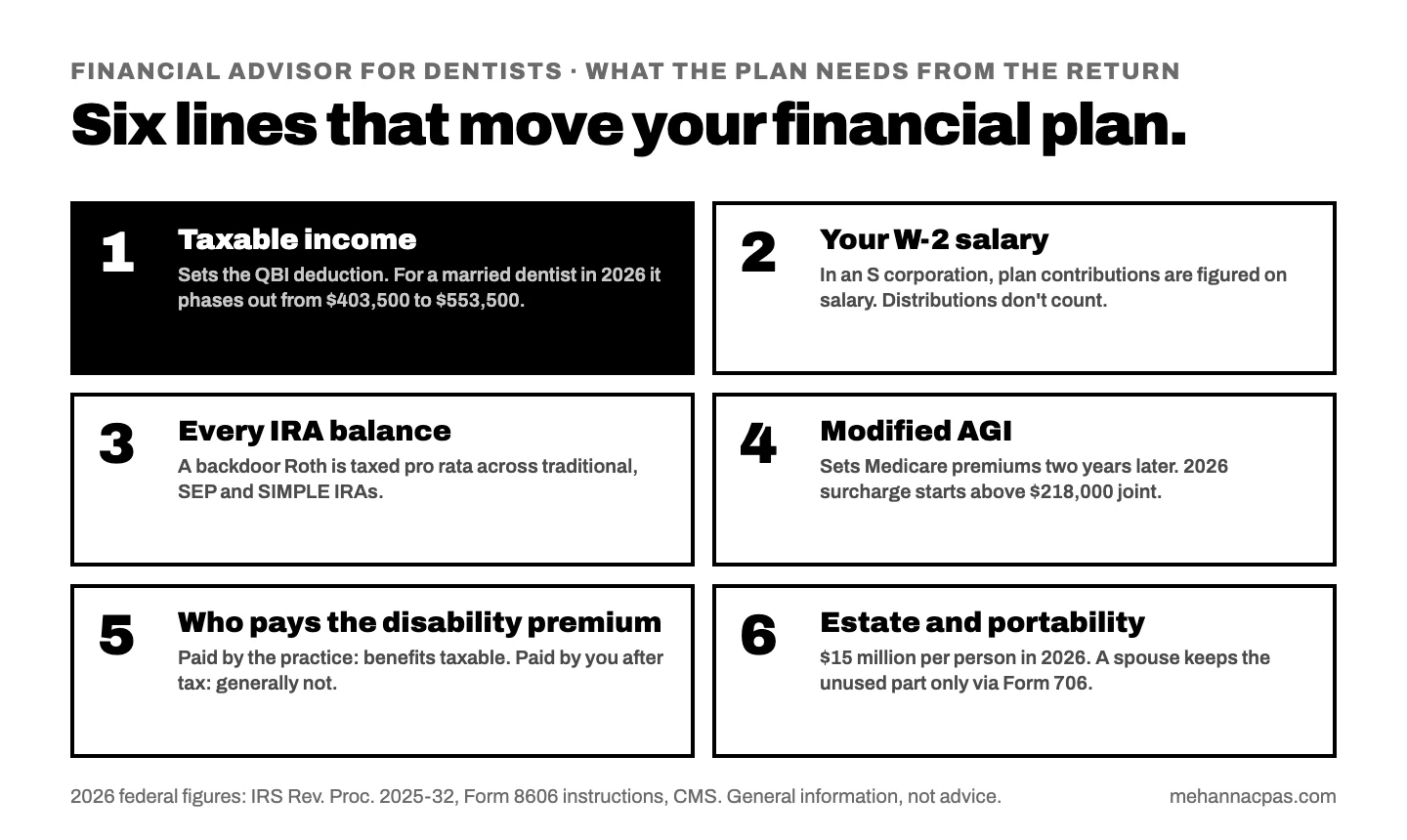
The six lines on your return that move your financial plan
Most of the plan’s limits come from six places on the return. If your advisor never asks about them, the plan is guessing.
1. Taxable income and the QBI deduction
Where your taxable income lands decides whether you keep the qualified business income deduction. Above $553,500 for a married couple in 2026, a dentist gets none of it; below $403,500, the full deduction is on the table (Rev. Proc. 2025-32). Retirement contributions that lower taxable income can move you inside that range. Run that math in the projection, before the year ends.
2. Your W-2 salary and your retirement plan room
In an S corporation, retirement plan contributions and benefits are figured on your W-2 salary. Distributions don’t count (26 U.S.C. 415). A low salary saves payroll tax and can also cap how much the plan can take for you. Our guide to the S corp reasonable salary for dentists covers how to set it, and the cash balance plan guide for dentists covers the next layer once the 401(k) is full.
3. Your IRA balances and the backdoor Roth
For 2026, a married couple filing jointly can’t contribute directly to a Roth IRA above $252,000 of modified AGI, and the IRA limit is $7,500 (IRS). That is why many dentists use a backdoor Roth. The trap: when you convert, the taxable share is figured across all your traditional IRAs, and that includes SEP IRAs and SIMPLE IRAs (Instructions for Form 8606). An old SEP IRA can turn a conversion that looked tax-free into a taxable one. Check every IRA balance on December 31 before you convert.
4. Your modified AGI, and Medicare two years later
Medicare Part B premiums are set from the return you filed two years earlier. For 2026, the surcharge starts above $218,000 of 2024 modified AGI on a joint return, or $109,000 on an individual return, and the monthly premium rises from $202.90 to as much as $689.90 (CMS). A Roth conversion or a practice sale after about age 63 belongs in the same plan as your Medicare budget.
5. Who pays the disability premium
Disability insurance matters more for a dentist than for most people, because your hands are the practice. How the premium is paid decides the tax on a claim. If you pay the whole premium with after-tax money, the benefits are generally not taxable; if the practice pays it and doesn’t include it in your income, the benefits are taxable (IRS). Decide that with your CPA when the policy is bought, not when you need it.
6. The estate exclusion and portability
For 2026, each person can pass up to $15,000,000 free of federal estate and gift tax, and the annual gift exclusion is $19,000 per recipient (IRS). A surviving spouse can keep the first spouse’s unused exclusion only if the estate elects it on Form 706, even when no tax is due. Estates under the filing threshold can make that election up to five years after the death under a simplified method (Rev. Proc. 2022-32). For a two-dentist household with a practice and a building, that return is worth filing.
How do you choose a financial advisor as a dentist?
Look past the title and check four things: registration, how the person is paid, the standard of conduct they owe you, and whether they will work from your tax return. The SEC and state regulators warn that the requirements behind financial titles range “from rigorous to nothing at all” (SEC and NASAA investor bulletin).
| Question to ask | A good answer | Where to check |
|---|---|---|
| Are you registered, and as what? | Investment adviser, broker, or both, and when each applies | SEC adviser search and FINRA BrokerCheck |
| How are you paid, in dollars? | A clear fee you can compare: flat, hourly or a percentage of assets | The firm’s Form CRS and Form ADV Part 2 |
| Do you earn anything from products you recommend? | A plain yes or no, with the conflicts listed | Form CRS, conflicts section |
| Will you read my return and talk to my CPA? | Yes, before year end, every year | The engagement agreement |
| Who files what? | A named owner for Form 5500-EZ, Form 8606 and estimated tax changes | A written list of responsibilities |
Do I need a financial advisor who only works with dentists?
Not necessarily. A dental focus helps with practice sales, DSO offers and associate buy-ins, but the bigger test is whether the advisor reads your return and works with your CPA. A generalist who does that will usually serve you better than a dental specialist who doesn’t.
Is fee-only better than commission?
Fee-only means the advisor is paid by you, not by the products. That removes one conflict, but it doesn’t remove all of them; an advisor paid on assets still earns more when more money stays in the account. Ask for the total yearly cost in dollars and compare it with what you get.
What does dentist financial independence actually depend on?
Dentist financial independence depends on three numbers: what you spend after tax, what you save each year, and what the practice is really worth after debt and tax. The advisor handles the investing; the tax return decides how much of each dollar reaches the account.
Want to see the date work becomes optional, on your own numbers? Start with the after-tax math.
How we build the plan with dental practices
We start from the return and the projection, then hand the advisor numbers they can plan with. On The Treatment Plan, the same three people who keep your books and your projection run it:
- Read the last return. Taxable income, salary, QBI position, IRA balances, estimated payments and anything filed late or not at all.
- Project this year. What the practice will earn, what you will owe and what is still open before December 31.
- Set the salary and the retirement plan together. In an S corporation, the two are one decision.
- Map net worth to the freedom number. Where you are now, the number you need and the path between them, which is what the Wealth Dream Roadmap lays out.
- Share the numbers with your advisor. The after-tax savings capacity, the Roth window, the year-end moves and the deadlines.
- Calendar the filings nobody owns. Form 5500-EZ, Form 8606, estimated tax changes after a big gain.
The advisor and the CPA are rarely both wrong. More often, each is right about their own slice and nobody owns the gap between them: a Roth conversion done in the same year as a building sale, or a savings target set before anyone knew what April would cost. Our rule of thumb: no big money decision without the current-year projection on the table.
Financial planning for dentists checklist
Run these once a year, before the fourth quarter. Every row comes from the sections above.
| Check | Fits you if | Deadline | What to bring |
|---|---|---|---|
| QBI position | Married taxable income near $403,500 to $553,500 | December 31 | Current-year projection |
| Salary and plan room | You own an S corporation and want to save more | Last payroll of the year | Payroll reports, plan documents |
| Backdoor Roth | Joint modified AGI above $242,000 | Before the conversion | December 31 balances of every IRA, incl. SEP and SIMPLE |
| Medicare look-back | You are about 63 or older and planning a sale or conversion | Two years before Medicare | Projected modified AGI by year |
| Disability premium | You are buying or changing a policy | Before the policy is bought | Policy, who pays and how |
| Estate and portability | Married, with a practice, a building or large savings | Form 706 on time; up to 5 years in some cases | Will, trust, beneficiary list |
| Owner-only plan filing | Your one-participant plans together exceed $250,000 | Due date of Form 5500-EZ | Year-end plan statements |
| Advisor fit | You pay an advisor or are choosing one | Before you sign | Form CRS, Form ADV Part 2, fee in dollars |
Mistakes we’d avoid
The expensive mistakes are coordination mistakes, not investment mistakes.
- Planning on pre-tax income. A savings rate built on collections or gross profit will meet the tax bill in April.
- Choosing an advisor by title. Check registration, the fee in dollars and the conflicts, in writing.
- Converting to Roth with an old SEP IRA open. The pro-rata rule pulls those balances into the math.
- Harvesting losses with no one watching the other accounts. Net capital losses offset only $3,000 of ordinary income a year (IRS Topic 409), and buying a substantially identical investment within 30 days can disallow the loss (IRS Publication 550).
- Leaving filings without an owner. An owner-only plan over $250,000 needs Form 5500-EZ, and the penalty is $250 a day, up to $150,000 per plan year (Instructions for Form 5500-EZ).
- Skipping the estate return after a spouse’s death. The unused exclusion is lost if the election isn’t made.
What changed for 2026
Four dated changes affect a dentist’s financial plan this year and next.
- The One Big Beautiful Bill Act, signed July 4, 2025, set the basic estate and gift exclusion at $15,000,000 for 2026, up from $13,990,000 for 2025, with inflation adjustments after (IRS, IR-2025-103).
- For 2026, the QBI phase-in range for a married couple runs from $403,500 to $553,500 of taxable income (Rev. Proc. 2025-32).
- For 2026, the IRA limit rose to $7,500, and the joint Roth IRA phase-out moved to $242,000 to $252,000 (IRS, IR-2025-111). For 2027, the IRA limit stays at $7,500 (IRS, IR-2026-136).
- For 2026, the standard Part B premium is $202.90 a month, with income surcharges based on 2024 returns (CMS).
How to tell whether your financial plan is working
Look at three numbers each year: the tax you paid against the projection, the amount you actually saved, and the distance to your freedom number. If April’s bill matched the projection, the tax side worked. If the savings landed where the advisor planned, the cash flow side worked. If the gap to your number shrank, the plan as a whole worked. When one of the three misses, the fix usually starts where the advisor’s plan and the CPA’s projection used different numbers. That year-round view is what our tax planning services for dental practices are built around.
Frequently asked questions
What does a financial advisor for dentists cost?
It depends on how the advisor is paid: a flat yearly fee, an hourly rate, a percentage of the assets they manage, or commissions on products. Ask for the total yearly cost in dollars and read the fee section of the firm’s Form CRS before you sign.
Should my CPA and my financial advisor be the same firm?
Not necessarily. What matters is that both work from the same numbers and talk before big decisions. Two firms that share the return and the projection can work better than one firm where the tax and investment teams never meet.
Can a CPA give financial advice?
A CPA can advise on taxes, entity structure, salary, retirement plan design and cash flow. Advice about buying or selling specific securities generally requires registration as an investment adviser, so most CPAs leave the portfolio to the advisor and plan the tax around it.
When should a dentist start financial planning?
Start with a simple plan as an associate: spending, student loans, an emergency fund and the employer’s retirement plan. Bring in the CPA and the advisor together once you buy or start a practice, because that is when the return starts setting the plan’s limits.
Is wealth management the same as financial planning?
Not quite. Wealth management usually means ongoing investment management, sometimes with planning included. Financial planning is the broader plan for savings, debt, insurance, taxes and retirement. Many dentists need the planning before they need the portfolio management.
Glossary
| Term | Meaning |
|---|---|
| Investment adviser | A firm or person paid to give advice about securities, registered with the SEC or a state, and owing a fiduciary duty. |
| Fiduciary duty | The duty to act in the client’s best interest and not put the adviser’s interest first. |
| Regulation Best Interest | The SEC rule that requires brokers to act in your best interest when they recommend an investment. |
| Form CRS | A short relationship summary that describes a firm’s services, fees, conflicts and disciplinary history. |
| QBI deduction | The qualified business income deduction, which phases out for dentists at higher taxable income. |
| Backdoor Roth | A nondeductible traditional IRA contribution converted to a Roth IRA, used when income is too high for a direct Roth contribution. |
| Pro-rata rule | The rule that figures the taxable share of a conversion across all your traditional, SEP and SIMPLE IRAs. |
| Modified AGI | Adjusted gross income with certain items added back; it sets Roth eligibility and Medicare surcharges. |
| Portability | A surviving spouse’s right to use the first spouse’s unused estate exclusion, elected on Form 706. |
| Form 5500-EZ | The annual return for a retirement plan that covers only the owner, or the owner and spouse. |
Sources
- IRS, Rev. Proc. 2025-32 (2025): 2026 QBI phase-in range, estate exclusion and annual gift exclusion.
- IRS, IR-2025-103 (October 2025): 2026 estate exclusion of $15,000,000, up from $13,990,000.
- IRS, IR-2025-111 (November 2025): 2026 IRA limit and Roth IRA income ranges.
- IRS, IR-2026-136 (November 2026): 2027 IRA limit.
- IRS, Instructions for Form 8606: traditional IRAs include SEP and SIMPLE IRAs for conversions.
- CMS, 2026 Medicare Parts A and B premiums and deductibles (2025): Part B premium and income-related amounts.
- IRS, Life insurance and disability insurance proceeds: tax on disability benefits by who paid the premium.
- IRS, Frequently asked questions on gift taxes: 2026 annual exclusion and basic exclusion amount.
- IRS, Rev. Proc. 2022-32 (2022): late portability election up to five years after death.
- U.S. Code, 26 U.S.C. 415: retirement plan limits tied to compensation.
- IRS, Topic 409, Capital gains and losses: $3,000 net capital loss limit.
- IRS, Publication 550: wash sale rule.
- IRS, Instructions for Form 5500-EZ: $250,000 threshold and penalty.
- SEC, Investment Advisers and Form CRS: what advisers do, how they are paid, relationship summary.
- FINRA, Regulation Best Interest and Form CRS (2024): broker standard of conduct.
- SEC and NASAA, Making Sense of Financial Professional Titles (2013): titles are not licenses.
- ADEA, Dentists of Tomorrow 2025 (2026): average education debt of 2025 graduates.