

A cash balance plan is an employer-funded pension that sits on top of your 401(k) and lets a practice owner put away far more each year than a 401(k) allows. For 2026 it can fund an annual benefit of up to $290,000. It fits dentists with high, steady profit, several working years left and a staff the plan can afford to cover.
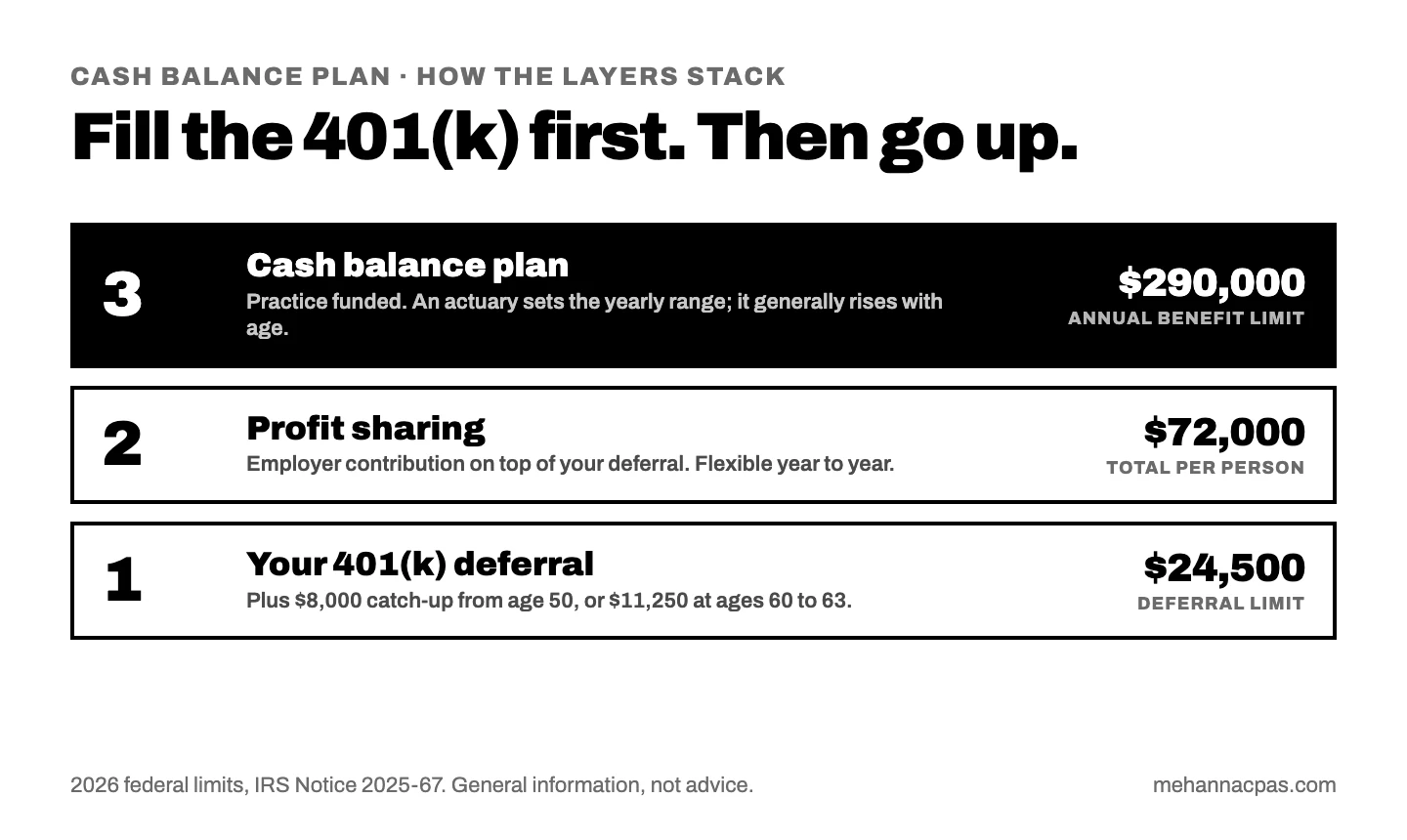
- A 401(k) with profit sharing tops out at $72,000 per person for 2026, before catch-up. A cash balance plan is the usual next layer once that is full.
- The limit is on the benefit, not the deposit. An actuary sets each year’s contribution range, and it generally rises the closer you are to retirement.
- It is a commitment. Each year has a required minimum contribution, and missing it triggers an excise tax.
- Your staff is part of the design. The plan must cover a minimum number of employees, and their benefits vest after three years.
- What we see in dental practices: the right first question isn’t “how much can I put in?” It’s “what does it cost to cover the team, and can the practice fund it in a slow year?”
Your 401(k) is maxed. The profit-sharing contribution went in. The practice still had a strong year, and April’s number is going to be big anyway.
That is the moment most dentists hear about a cash balance plan, usually from a study club friend or an advisor with an illustration ready. This guide covers what the plan is, who it fits, what it costs the practice, and the rules to check before you sign, with the 2026 numbers.
What is a cash balance plan, and what isn’t it?
A cash balance plan is a defined benefit plan that states each participant’s benefit as an account balance instead of a monthly pension. Each year the account gets a pay credit, such as a percentage of pay or a flat dollar amount, and an interest credit at a fixed or index-linked rate written into the plan (U.S. Department of Labor). The practice funds it, and the investment risk sits with the practice, not the employee.
It isn’t a bigger 401(k). Employees don’t defer into it, there is no individual investment menu, and the contribution isn’t optional year to year. Because it is a defined benefit plan, an actuary figures what has to go in to fund the promised benefits (IRS Publication 560).
| 401(k) with profit sharing | Cash balance plan | Traditional pension | |
|---|---|---|---|
| Plan type | Defined contribution | Defined benefit, shown as an account | Defined benefit, shown as a monthly payment |
| 2026 limit | $24,500 deferral; $72,000 total per person before catch-up | Annual benefit up to $290,000 | Annual benefit up to $290,000 |
| Who funds it | You, your team and the practice | The practice | The practice |
| Yearly contribution | Flexible; profit sharing can be skipped | Required minimum set by an actuary | Required minimum set by an actuary |
| Staff vesting | Schedule set by the plan, within legal limits | 100% after 3 years of service | Schedule set by the plan, within legal limits |
The limits come from IRS Notice 2025-67, and the three-year vesting rule for cash balance plans from 26 U.S.C. 411(a)(13).
Who is a cash balance plan for, and who can skip it?
It is for practice owners who already max out the 401(k), earn high and steady profit, and expect to keep contributing for at least several more years. Among retirement plans for high income earners, it is the one with the highest ceiling. It tends to fit when:
- You are in your late 40s or 50s, started saving late after school and the buildout, and want to catch up.
- Collections are stable, and the profit after your salary is large enough that the 401(k) feels small.
- Your team is small, and most of them are younger or paid much less than you.
- You are a 1099 associate or a solo owner with no staff, so every dollar of the plan goes to you.
You can usually skip it, at least for now, if profit swings a lot from year to year, if a sale or a DSO deal is likely in the next few years, if you haven’t maxed the 401(k) yet, or if you are early in ownership and the cash is still going to debt. If you are a W-2 associate, the plan isn’t yours to set up; your levers are your employer’s 401(k) and the offer itself.
Why does a cash balance plan matter for a dentist’s retirement planning?
Because the 401(k) limits are small next to what a practice owner earns, and a cash balance plan is how a defined benefit plan for a small business closes that gap. For 2026, you can defer $24,500 into a 401(k), plus $8,000 from age 50 or $11,250 at ages 60 to 63, and total defined contribution additions per person stop at $72,000 before catch-up (IRS).
A defined benefit plan is measured differently. The annual benefit at retirement can’t exceed the lesser of $290,000 for 2026 or 100% of your average pay over your three highest consecutive years (26 U.S.C. 415(b), Notice 2025-67). The plan can count pay up to $360,000. Funding a benefit that large over a short runway takes large deposits, which is why the allowed contribution generally grows with age.
The deduction also lowers taxable income, which matters twice for a dentist. Dentistry is a health-care service business, so the qualified business income deduction phases out for married couples between $403,500 and $553,500 of taxable income in 2026 (Rev. Proc. 2025-32). A large plan contribution can move you down inside or below that range. How much that is worth depends on the rest of your return, so it belongs in a projection, not a rule of thumb. It is also why this plan shows up in our guide on how dentists reduce taxable income.
When should you start one, and when should you wait?
Start one when profit is high and steady, your runway is long enough to fund it for years, and the staff cost works on your real census. Many advisors suggest modeling it from your mid-40s; the older you are, the bigger the allowed contribution tends to be.
- Do it in a year when profit is clearly above what the 401(k) can absorb and you expect the next several years to look similar.
- Wait if the practice just took on acquisition debt, a large buildout or a partner buy-in, or if next year’s profit is uncertain.
- Skip it if you plan to sell within a few years. A qualified plan is meant to be permanent, and dropping one within a few years for a reason other than business necessity can be treated as evidence it was never a real plan (26 CFR 1.401-1(b)(2)).
The deadlines are friendlier than most people think. A practice can adopt a new qualified plan, including a defined benefit plan, as late as its tax return due date with extensions and treat it as adopted on the last day of the prior year (IRS issue snapshot on IRC 401(b)(2)). But the minimum required contribution for a plan year is due 8½ months after the plan year ends, which is September 15 for a calendar-year plan (26 U.S.C. 430(j)). A plan signed late in the extension period can start life already behind on funding. Your own 401(k) deferrals are different: the 401(k) generally has to be in place before the pay is earned, so deferrals close with the last payroll of the year. Our year-end tax planning guide for dentists lists which moves close on December 31.
Which retirement plan fits your practice?
The best retirement plan for dentists depends on who works in the practice and how much profit is left after your salary. This is how the options usually line up, and why the best retirement plan for business owners is usually two plans working together, not one. A dentist retirement plan that ignores the staff census or the cash flow isn’t a plan yet.
| Your situation | Usually the first plan | When to add a cash balance plan |
|---|---|---|
| 1099 associate or solo owner, no staff | Solo 401(k) | Once the solo 401(k) is full and income is steady |
| Owner with a small team | Safe harbor 401(k) with profit sharing | When profit is well above the $72,000 per-person limit |
| Owner in your 50s, high profit | 401(k) with profit sharing already maxed | Often the main lever left; model it first |
| Two owners or partners | One 401(k) for the practice | When both can commit; each can have a different pay credit, subject to testing |
| Early owner, high debt | 401(k) only | Usually later, once cash flow is predictable |
Is a solo 401(k) enough for a dentist with no staff?
Often it is, at first. A solo 401(k) for dentists with no employees can take the full $72,000 per person for 2026, plus catch-up. When income keeps climbing past that, a cash balance plan for one participant is the next step, and every dollar of it goes to you.
What does a dental practice 401(k) look like next to a cash balance plan?
Most practices that add a cash balance plan keep the 401(k) and pair the two. A common design is a safe harbor 401(k), which avoids the annual deferral test, with profit sharing, plus the cash balance plan as a second plan. Ask the administrator for an illustration that shows, in dollars, what goes to you and to each team member under each version.
Maxed out the 401(k)? What next?
For an owner, the order is usually: max your own deferral, add profit sharing up to the $72,000 limit, then look at a cash balance plan. Taxable investing and a backdoor Roth are the other levers, but neither gives a current deduction. A cash balance plan is the one that does, which is why it is the usual answer once the 401(k) is full.
Profit above what your 401(k) can hold this year? The year-end check flags whether a retirement plan move is still open for 2026.
The rules that decide whether a cash balance plan works
Most cash balance plans that disappoint fail on one of these, not on the investment returns. Check each one before you sign.
1. Who has to be covered
A defined benefit plan must benefit, on each day of the plan year, at least the lesser of 50 employees or the greater of 40% of all employees or two employees (26 U.S.C. 401(a)(26)). It also has to pass the general coverage and nondiscrimination tests. In a practice with five or six employees, that usually means some of the team is in the plan. Part-time hygienists and assistants can count, so have the administrator run the test on your real census.
2. How fast the team vests
Benefits in a cash balance plan must be fully vested after three years of service, with no graded schedule (26 U.S.C. 411(a)(13)). In a practice with turnover among assistants, eligibility rules and entry dates are the lever to set deliberately.
3. Your salary sets the ceiling in an S corporation
The benefit limit is tied to your compensation, and in an S corporation that means W-2 salary. Distributions don’t count (26 U.S.C. 415). A low salary that saves payroll tax can also cap what the plan can fund for you, so set the two together. Our guide to the S corp reasonable salary for dentists covers the salary side.
4. The required contribution every year
Unlike profit sharing, a cash balance plan has a minimum required contribution each year. If it isn’t paid, the employer owes an excise tax of 10% of the unpaid amount, and 100% if it still isn’t corrected (26 U.S.C. 4971). Only commit money you expect to have in a slower year too.
5. The annual return nobody files for you
A plan that covers only you, or you and your spouse, files Form 5500-EZ once the assets of all your one-participant plans combined pass $250,000 at year end, and again in the plan’s final year. The penalty for not filing is $250 a day, up to $150,000 per plan year (Instructions for Form 5500-EZ). The IRS late-filer relief program charges $500 per return, up to $1,500 per plan (IRS). The form isn’t part of your tax return, so put it on someone’s calendar.
6. What it costs, and the credit that offsets some of it
Expect a setup fee and a yearly actuarial and administration fee, higher than a 401(k) alone, and compare two or three quotes. A practice with 50 or fewer employees can claim a credit for 100% of eligible startup costs, up to $5,000 a year for three years, if the plan covers at least one non-highly compensated employee (IRS). The separate credit for employer contributions applies to defined contribution plans, SEPs and SIMPLE IRAs, not to cash balance contributions.
7. How the money comes out
At retirement, a participant can take an annuity or, in many plans and with spousal consent, a lump sum equal to the account balance, which can generally be rolled over to an IRA (U.S. Department of Labor). For an owner, the exit often means terminating the plan. Plan the exit when you plan the entry, and line it up with your freedom number, the date work becomes optional.
How we look at a cash balance plan with dental practices
The plan decision gets made in the projection, months before the deadline, not in April. On The Treatment Plan, the same three people who keep your books and your projection run it:
- Max the 401(k) first. Your deferral, catch-up and profit sharing, with the safe harbor design checked.
- Set the salary. In an S corporation, the W-2 salary and the plan are modeled together.
- Test the cash flow. Can the practice fund the minimum in a slow year, with debt payments and a buildout on the calendar?
- Get the census illustration. In dollars, what goes to you and to each team member, with two or three administrator quotes.
- Run the tax both ways. With and without the plan, including the QBI position and the state return.
- Calendar the compliance. Funding date, Form 5500 filing, startup credit, and the review each year.
The illustration is rarely wrong about the owner’s number. What gets missed is the team side: hygienists are paid well and sometimes have long tenure, which raises the cost of covering them. Our rule of thumb: look at the staff cost and the slow-year funding before you look at your own contribution.
Cash balance plan checklist for dentists
Run these before you adopt a plan. Every row comes from the sections above.
| Check | Fits you if | Deadline | What to bring |
|---|---|---|---|
| 401(k) maxed | Deferral, catch-up and profit sharing are full | Last payroll of the year for deferrals | Year-to-date payroll and plan reports |
| Steady profit | Profit after salary is high in normal and slow years | Before you adopt | Three years of P&Ls and returns |
| Owner salary | In an S corporation, the W-2 salary supports the benefit | Last payroll of the year | Salary history |
| Staff census | Coverage and staff cost work on real numbers | Before you adopt | Each employee’s age, pay, hours and hire date |
| Funding | The practice can fund the minimum every year | 8½ months after plan year end | Cash flow projection and debt schedule |
| Adoption | The plan is signed in time for the year you want | Practice return due date, with extensions | Signed plan document |
| Startup credit | The plan covers at least one non-highly compensated employee | With the practice return | Setup and admin invoices |
| Form 5500-EZ | An owner-only plan with combined assets over $250,000 | Due date of the annual return | Year-end plan statements |
Mistakes we’d avoid with a cash balance plan
The expensive mistakes are about commitment and coverage, not about the plan itself.
- Buying the owner’s number without the team’s. An illustration that only shows your contribution isn’t an illustration of the plan.
- Treating it like profit sharing. The minimum is required each year, and the excise tax applies if it isn’t paid.
- Keeping the S corp salary too low. The plan can only build on your W-2 pay.
- Signing late without the money. Retroactive adoption moves the plan’s start, not the funding due date.
- Forgetting Form 5500-EZ. Owner-only plans cross $250,000 faster than people expect, and the penalty adds up by the day.
- Starting right before an exit. If a sale or DSO deal is near, the plan may be closed before it pays for its own setup.
What changed for 2026 and 2027
Three dated changes affect a cash balance plan decision this year and next.
- For 2026, the defined benefit limit rose from $280,000 to $290,000, the compensation limit from $350,000 to $360,000, and the defined contribution limit from $70,000 to $72,000 (IRS Notice 2025-67, November 2025).
- For 2026, catch-up contributions to a 401(k) must be Roth for participants whose 2025 FICA wages from the employer were more than $150,000 (IRS Notice 2025-67). For many S corporation owners, that changes the catch-up from a deduction into a Roth contribution, which leaves more weight on the cash balance plan for current deductions.
- On November 12, 2026, the IRS set the 2027 limits: a $300,000 defined benefit limit, $75,000 for defined contribution plans, $375,000 of compensation and a $25,500 401(k) deferral, with catch-ups of $8,500 and $11,750 at ages 60 to 63 (IRS, IR-2026-136; Notice 2026-66).
How to tell whether your cash balance plan is working
Look at three things each year: the contribution landed in the range you planned, the deduction lowered taxable income as projected, and the practice funded it without strain. On the actuary’s report, check that the required minimum was met on time. On the return, compare taxable income and the QBI deduction with the projection you made before adopting the plan. In the practice, check that the plan didn’t push a buildout or a debt payment off schedule. Then review the design when the team or your timeline changes. That year-round view is what our freedom number guide for dentists builds toward: the plan is one input to the date work becomes optional.
Frequently asked questions
How much can a dentist put in a cash balance plan?
There is no single number. The limit is on the benefit, $290,000 a year for 2026, and an actuary converts that into a yearly contribution range based on your age, pay and years left. Older owners with high pay generally get the largest ranges. Ask for an illustration on your own numbers.
Can I stop or change the contributions in a bad year?
Not freely. The minimum required contribution is set each year, and changing pay credits takes a plan amendment that applies going forward. That’s why steady profit matters more than one great year. Talk to your actuary before a slow year, not after.
Does my spouse count if they work in the practice?
Yes, a spouse who really works in the practice and is paid for it can be a participant, and a plan covering only you and your spouse is still a one-participant plan for the Form 5500-EZ rules. Pay has to be reasonable for the work done.
What happens to the plan if I sell the practice?
The plan is usually terminated around the sale, benefits are paid out, and the balances can generally be rolled to IRAs. A final Form 5500 is due for the last plan year. Plan the timing with the deal, because a buyer usually has its own plans.
Is a cash balance plan the same as a defined benefit plan?
It is one type of defined benefit plan. The difference is how the benefit is shown: as an account balance with pay and interest credits, instead of a monthly pension formula. The funding, limits and many of the rules are the same.
Glossary
| Term | Meaning |
|---|---|
| Cash balance plan | A defined benefit plan that shows each participant’s benefit as an account balance with pay credits and interest credits. |
| Defined benefit plan | A plan that promises a benefit at retirement; an actuary sets what must be contributed to fund it. |
| Defined contribution plan | A plan like a 401(k) or profit sharing, where the contribution is set and the benefit depends on the account. |
| Pay credit | The yearly amount credited to a participant’s account, as a percentage of pay or a flat dollar amount. |
| Interest credit | The return credited to the account each year at a fixed or index-linked rate written into the plan. |
| Minimum required contribution | The amount the practice must fund each year, due 8½ months after the plan year ends. |
| Safe harbor 401(k) | A 401(k) design with a required employer contribution that avoids the annual deferral test. |
| Census | The list of employees with age, pay, hours and hire date that the administrator uses to design and test the plan. |
| Form 5500-EZ | The annual return for a plan that covers only the owner, or the owner and spouse. |
| QBI deduction | The qualified business income deduction, which phases out for dentists at higher taxable income. |
Sources
- IRS, Notice 2025-67 (November 2025): 2026 defined benefit, defined contribution, compensation and deferral limits; Roth catch-up wage threshold.
- IRS, 401(k) limit increases to $24,500 for 2026 (2025): 2026 deferral and catch-up amounts.
- IRS, IR-2026-136 and Notice 2026-66 (November 2026): 2027 limits.
- U.S. Department of Labor, Frequently Asked Questions on Cash Balance Pension Plans: pay and interest credits, lump sum and rollover.
- IRS, Publication 560, Retirement Plans for Small Business: defined benefit plans and actuarial funding.
- U.S. Code, 26 U.S.C. 415: defined benefit limit and the high-3-years compensation test.
- U.S. Code, 26 U.S.C. 411(a)(13): three-year vesting for cash balance plans.
- U.S. Code, 26 U.S.C. 401(a)(26): minimum participation for defined benefit plans.
- U.S. Code, 26 U.S.C. 430(j): due date of the minimum required contribution.
- U.S. Code, 26 U.S.C. 4971: excise tax on unpaid minimum required contributions.
- IRS, Issue snapshot on plans established after year end: retroactive adoption under IRC 401(b)(2).
- IRS, Instructions for Form 5500-EZ (2025): $250,000 threshold, final-year filing, penalty.
- IRS, One-participant plans over $250,000: late-filer relief fees.
- IRS, Retirement plans startup costs tax credit: startup credit and the contribution credit’s plan types.
- IRS, Rev. Proc. 2025-32 (2025): 2026 QBI threshold and phase-in amounts.