

A dental practice can deduct any cost that is ordinary and necessary for the practice: team wages and benefits, equipment, rent, supplies, lab fees, insurance, CE and marketing. The owner adds a few deductions of their own, such as health insurance, retirement contributions and a qualifying home office. For each one, the entity, the timing and the records decide whether it counts this year.
- The test for every business deduction is the same: the cost must be ordinary and necessary for your practice, and you must be able to prove it (IRS Publication 334).
- In 2026, Section 179 lets a practice expense up to $2,560,000 of equipment, and 100% bonus depreciation applies to property acquired after January 19, 2025. Either way, the equipment has to be placed in service, ready to use.
- In an S corporation, your own health insurance is deductible only if the practice pays or reimburses it and it shows up on your W-2.
- W-2 associates can no longer deduct unreimbursed work costs at all, and that change is now permanent. The fix is a reimbursement from the practice.
- What we see in dental practices: missed deductions are rarely exotic. They’re usually a timing or process step that slipped, like a reimbursement that never happened or equipment that arrived in January.
Every December someone forwards you a list of “50 things dentists can write off.” You already deduct most of it. The rest either doesn’t apply to an S corporation, changed for 2026, or only works if something happens before your last payroll of the year.
This is the list we’d hand a practice owner instead: the tax deductions for dentists grouped the way a practice actually spends money, with the rule that decides each one and the 2026 numbers.
What counts as a small business tax deduction, and what doesn’t?
A small business tax deduction is a cost of running the practice that the tax code lets you subtract from income before tax is figured. To qualify, the expense has to be ordinary, meaning common and accepted in dentistry, and necessary, meaning helpful and appropriate for the practice. It doesn’t have to be indispensable. If a cost is part business and part personal, only the business part counts (IRS Publication 334).
Deductions get mixed up with things that work differently:
| What it does | Dental example | When it lowers your tax | |
|---|---|---|---|
| Deduction | Lowers taxable income | Lab fees, staff wages, rent | The year it’s paid (cash method) |
| Credit | Lowers the tax itself, dollar for dollar | Credit for starting a 401(k) plan | The year you qualify |
| Capitalized cost | Deducted over several years through depreciation | A building, or equipment you don’t expense | Spread over its recovery period |
| Reimbursement | The practice pays you back for a practice cost you covered | CE you paid on a personal card | When the practice reimburses you |
| Personal expense | Not deductible | Your commute, everyday clothes | Never |
A deduction is worth your tax rate, not its face value. A $10,000 deduction at a 32% bracket lowers federal income tax by about $3,200. That’s why the practice should still spend money only when the practice needs it.
Who is this list for, and who can skip it?
It’s written for dentists who own a practice or are about to, whether the practice is a sole proprietorship, a partnership or an S corporation. The situations where it helps most:
- You own a practice collecting $750K or more and your return is prepared once a year, in April.
- You recently elected S corporation status and aren’t sure which costs now need to run through payroll or a reimbursement.
- You’re a 1099 associate or locum, so your work costs go on your own Schedule C.
- You’re about to buy a practice and want to know what the first year’s deductions will look like.
If you’re a W-2 associate, most of this list belongs to your employer. There’s a short section for you further down. You can also skip it if a CPA already reviews your deductions with you before year-end, not only at filing time.
Why do deductions matter more for a practice owner?
Because a practice owner’s tax rate is high, and the biggest deductions depend on decisions made during the year, not at filing. Equipment has to be in service, retirement plans need the right features, and owner health insurance has to be on the W-2 before the year closes. A deduction you can’t support with records can also be disallowed, so the paperwork is part of the deduction (IRS Publication 334).
There’s one deduction on most small business lists that works differently for dentists. The 20% qualified business income (QBI) deduction treats health as a specified service, so for a dental practice it shrinks once joint taxable income passes $403,500 in 2026 and is gone above $553,500 ($201,750 to $276,750 for other filers), whatever the entity (Rev. Proc. 2025-32; IRS QBI FAQs). If your taxable income lands above that range, the practice-level deductions below carry more of the load.
When should you review your deductions, and when is it too late?
Review them before your last payroll of the year, not in April. By the time the return is prepared, most of the decisions are already made.
- Before the last payroll: owner health insurance onto your W-2, retirement deferrals, reimbursements under the practice’s accountable plan.
- Before December 31: equipment delivered and installed, prepaid expenses that qualify for the 12-month rule, practice costs charged to a personal card reimbursed.
- By the return due date: some retirement contributions and elections, such as the de minimis safe harbor statement, go with the return.
The full date-by-date view of what’s still open is in our guide to year-end tax planning for dentists.
How we build a practice owner’s deduction list
We start from the practice’s own books and the owner’s entity, then check each deduction against its rule and its deadline. The steps:
- Read the P&L by category, tied to the bank statements, and look for costs sitting in the wrong place (owner expenses in “miscellaneous,” equipment in supplies).
- Check the entity rules. An S corporation changes how owner health insurance, the home office and owner-paid expenses are deducted.
- List the year’s big decisions: equipment, build-out, a new hire, a retirement plan change.
- Date each one against the last payroll, December 31 and the return due date.
- Fix the process, so reimbursements, payroll entries and records happen through the year, not in a December rush.
On The Treatment Plan, the same three people stay on the account all year, with projections and three planning calls, so these decisions get made while there’s still time to make them.
The deductions owners miss are rarely the clever ones. They’re the owner’s health insurance that never made it onto the W-2, the CBCT that was ordered in December and installed in January, and the CE trip paid on a personal card that the practice never reimbursed. Each one is a timing or process step, and each one is easier to fix in October than to explain in April.
Which deductions fit your practice?
The same expense can be deducted in different places depending on how you’re paid. Use this table to see where each kind of cost lands:
| Cost | Sole proprietor or 1099 dentist | S corporation owner | W-2 associate |
|---|---|---|---|
| Practice expenses (supplies, lab, rent) | Schedule C | On the practice’s return | Paid by the employer |
| Your health insurance | Schedule 1, if no subsidized plan is available | Paid or reimbursed by the practice, on your W-2, then Schedule 1 | Through the employer’s plan |
| CE, licenses, loupes you pay for | Schedule C | Reimbursed by the practice | Not deductible; ask for reimbursement |
| Home office | Schedule C, if it qualifies | Reimbursed by the practice, if it qualifies | Not deductible |
| Retirement contributions | Your own plan | Practice plan, through payroll | Employer’s plan |
What can a dentist write off?
Anything ordinary and necessary for the practice, in the year it’s paid, with records to prove it. The common dental tax write off categories are team costs, equipment and build-out, rent and insurance, supplies and lab fees, CE and dues, and marketing. Personal costs, commuting and entertainment are out.
What are the associate dentist tax deductions?
For a W-2 associate, almost none. The One, Big, Beautiful Bill Act made permanent the rule that unreimbursed employee expenses can’t be deducted as miscellaneous itemized deductions (IRS Notice 2026-10). If you pay for CE, licenses or loupes yourself, ask the practice to reimburse them under an accountable plan, which keeps the payment tax-free to you when you account for it and return any excess (IRS Publication 463). A 1099 associate deducts those costs on Schedule C instead.
Does the QBI deduction help dentists?
Only below the income range. Because dentistry is a health service, the 20% QBI deduction phases out between $403,500 and $553,500 of joint taxable income in 2026, and an S corporation doesn’t change that. Below the range, it can be one of the larger small business tax deductions you get.
Not sure which of these still count for 2026? The year-end check walks through the ones that close before December 31.
The small business tax deductions a dental practice owner can take
Here are the twelve that matter most for a dental practice, grouped the way a practice spends. Each one has a rule, a deadline and a trap.
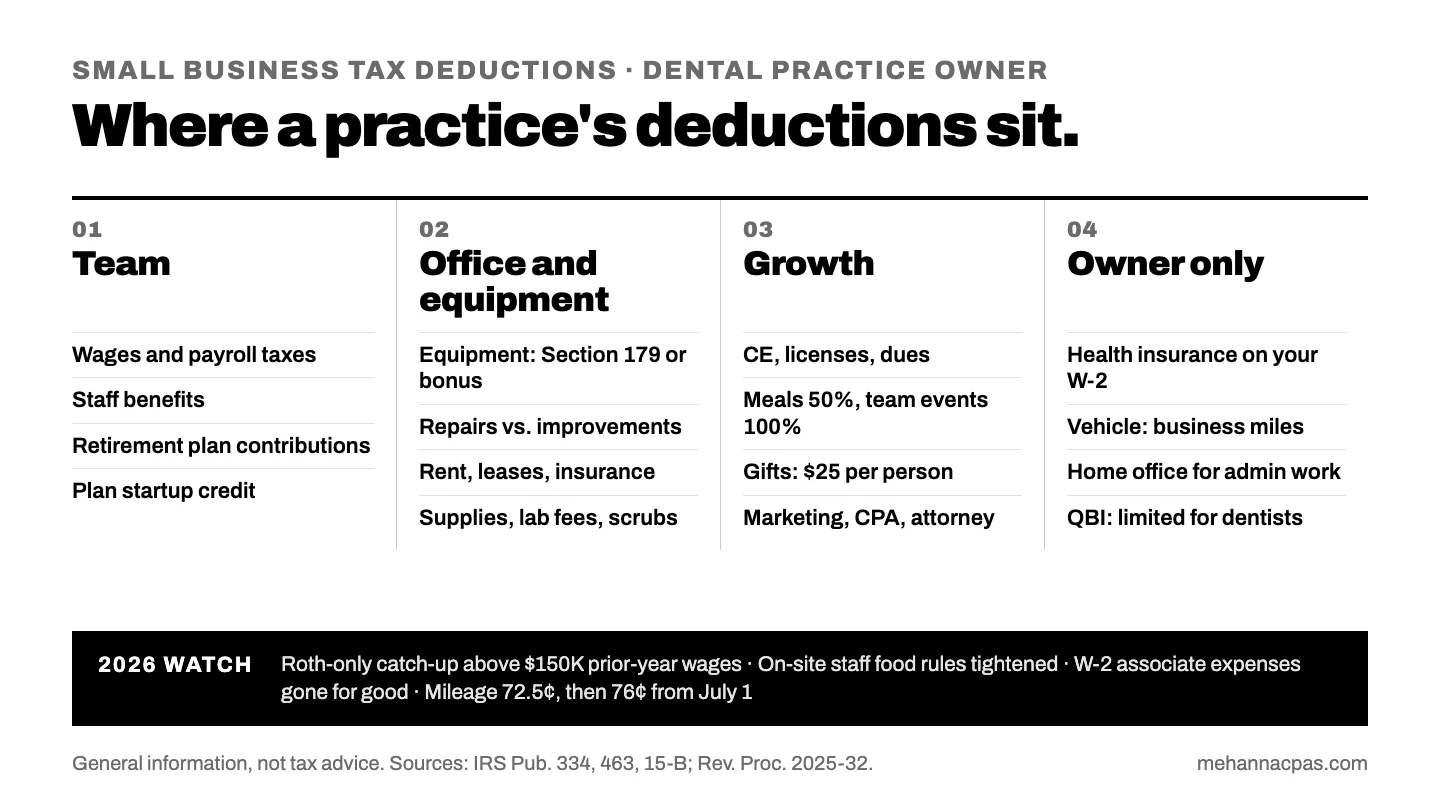
1. Team wages, payroll taxes and benefits
Wages for hygienists, assistants and front desk, the employer’s payroll taxes and the benefits the practice provides are deductible, as long as the pay is reasonable and for services actually performed (IRS Publication 334). In an S corporation, your own salary is part of this line, and setting it is its own decision, covered in how much to pay yourself as an S corp dentist. Paying your children for real work in the practice can also fit here, with conditions.
2. Retirement plan contributions
Contributions the practice makes for the team and for you are deductible. For 2026, the 401(k) deferral limit is $24,500, the total contribution limit per participant is $72,000, and catch-up contributions are $8,000 from age 50, or $11,250 at ages 60 to 63 (IRS; Notice 2025-67). The trap: starting in 2026, if your prior-year wages from the practice exceeded $150,000, any catch-up has to go in as Roth (IRS), so check that your plan offers a Roth option. A practice starting a new plan may also qualify for a credit of up to $5,000 a year for three years toward startup costs, plus $500 a year for three years for automatic enrollment (IRS).
3. Your own health insurance
If you own more than 2% of an S corporation, your health insurance premiums are deductible only if the practice pays them or reimburses you, and reports them as wages in Box 1 of your W-2. You then take the deduction on Schedule 1, line 17 (Instructions for Form 7206). Miss the W-2 step and the deduction is lost. It’s also unavailable for any month you or your spouse were eligible for a subsidized employer plan (IRS).
4. Equipment and technology
Chairs, imaging, scanners, computers and practice software can usually be written off in the first year. For 2026, Section 179 allows up to $2,560,000, reduced once total qualifying purchases pass $4,090,000 (Rev. Proc. 2025-32), and 100% bonus depreciation applies to qualified property acquired after January 19, 2025 (IRS). The deadline is the day the equipment is placed in service, installed and ready to use, not the day you sign the order. The trade-offs between the two are in our Section 179 guide for dental equipment.
5. Repairs versus improvements
Fixing what’s broken is usually a deduction now; making it better, bigger or fit for a new use is usually capitalized. The IRS rules include three simplifications: a de minimis safe harbor that lets you expense items up to $2,500 per invoice or item if your books treat them the same way, a routine maintenance safe harbor, and a small taxpayer safe harbor for owners with gross receipts of $10 million or less and a building with an unadjusted basis of $1 million or less (IRS). The de minimis election is made each year with the return.
6. Rent, leases and insurance
Office rent, equipment leases, malpractice, general liability and workers’ comp premiums are deductible. On the cash method, an expense paid in advance is generally deductible in the year it applies to, but the 12-month rule lets you deduct a prepayment that doesn’t run past 12 months from when the benefit starts or past the end of the next tax year (IRS Publication 538). If the practice hasn’t used that rule before, starting it is an accounting method change, so plan it with your CPA. It moves the deduction earlier; next year has less.
7. Clinical supplies, lab fees and uniforms
Composites, impression materials, PPE, sterilization supplies and lab fees are deductible as they’re used in the practice (IRS Publication 334). Whether a December stock-up counts this year depends on how your books treat supplies, so ask before you buy ahead. Scrubs and protective gear generally qualify when they’re required and not suitable for everyday wear; clothes you could wear anywhere don’t (IRS letter 2024-0009).
8. CE, dues, licenses and dental meetings
Education that maintains or improves your skills as a dentist, state license renewals, and professional dues are deductible (IRS Publication 334). Travel to a dental meeting counts when the meeting serves the practice, while conventions outside North America and on cruise ships face stricter tests (IRS Publication 463). If you own an S corporation and pay these yourself, submit them to the practice for reimbursement.
9. Meals and team events
A business meal with a referring specialist is generally 50% deductible, and entertainment, such as tickets to a game, is not deductible (IRS Publication 463). A holiday party or team outing held primarily for employees, other than owners of 10% or more and highly compensated employees, remains 100% deductible. Food on site changed in 2026: the practice can no longer deduct food and drinks provided through an employee eating facility or for the employer’s convenience (IRS Publication 15-B (2026)). How that applies to coffee and snacks in the break room is a question to settle with your CPA before you count on it.
10. Gifts to referring offices
Holiday gifts to referring doctors and their teams are deductible up to $25 per person per year. A $150 basket for one doctor still deducts $25. Items under $4 with your practice name permanently on them don’t count toward the limit, and you need records of the cost, date, description and business purpose (IRS).
11. Vehicle
Driving between practice locations, to the bank or to a dental meeting is deductible; your commute from home to the office isn’t. For 2026 the standard mileage rate is 72.5 cents per mile through June 30 and 76 cents from July 1 (IRS), or you can deduct the business share of actual costs. If you expense an SUV under Section 179, the 2026 cap is $32,000 (Rev. Proc. 2025-32). Keep a mileage log.
12. Home office, marketing and professional fees
A home office can qualify even though you treat patients elsewhere, if you use it regularly and exclusively for administrative or management work and don’t do substantial administrative work at another fixed location (IRS Publication 587). In an S corporation, the practice reimburses you for it. Advertising, your website and professional fees for your CPA and attorney are deductible as ordinary business expenses (IRS Publication 334).
Tax deductions for dentists checklist
Use this table to check each deduction before the year closes. Every row comes from the sections above.
| Deduction | Fits you if | Deadline | What to keep |
|---|---|---|---|
| Team wages and benefits | You have employees | Paid by December 31 | Payroll reports |
| Retirement contributions | The practice has a plan | Deferrals by the last payroll; employer amounts by the return due date | Plan statements, Roth catch-up setting |
| Owner health insurance | You own an S corporation | On your W-2 by the last payroll | Premium proof, W-2 Box 1 |
| Equipment | You bought equipment this year | Installed and ready by December 31 | Invoice, install date |
| Repairs | You fixed equipment or the office | De minimis election with the return | Invoices with a description of the work |
| Prepaid rent, leases, insurance | You’re on the cash method | Paid by December 31, covering 12 months or less | Contract, payment date |
| CE and meetings | You or your team trained | Reimbursed by December 31 if you paid | Agenda, receipts, expense report |
| Meals and events | You met referral sources or held a team event | Paid by December 31 | Receipt, who attended, business purpose |
| Gifts to referrers | You send holiday gifts | Paid by December 31 | Cost, date, recipient, purpose |
| Vehicle | You drive for the practice | Log kept through the year | Mileage log |
| Home office | You manage the practice from home | Reimbursed by December 31 (S corporation) | Floor plan, expense records |
Mistakes we’d avoid
Most lost deductions come from timing and process, not from a missing idea. The ones we’d steer you away from:
- Paying owner health insurance personally in an S corporation. Without the practice paying or reimbursing it and the W-2 entry, it isn’t deductible.
- Counting the order date for equipment. If it’s installed in January, the deduction moves to next year.
- Running practice costs through your personal card and forgetting them. In an S corporation, they need an expense report and a reimbursement.
- Buying things the practice doesn’t need for the write-off. A deduction returns a fraction of what you spend. To change the tax, you have to change the facts, and the facts should make sense for the practice first.
- Relying on an old list. 2026 changed the rules for on-site staff food, catch-up contributions and associate expenses.
What changed for 2026
Several deduction rules moved on January 1, 2026, most of them from the One, Big, Beautiful Bill Act signed July 4, 2025.
- Section 179 rose to $2,560,000, phasing out above $4,090,000, with a $32,000 cap for SUVs (Rev. Proc. 2025-32).
- The QBI deduction’s phase-in range for joint filers now runs from $403,500 to $553,500 (Rev. Proc. 2025-32).
- Catch-up contributions for participants whose prior-year wages exceeded $150,000 must be Roth (IRS).
- Food and drinks provided through an employee eating facility or for the employer’s convenience are no longer deductible (IRS Publication 15-B (2026)).
- The disallowance of unreimbursed employee expenses is now permanent (IRS Notice 2026-10).
- The business mileage rate rose from 72.5 to 76 cents per mile for driving on or after July 1, 2026 (Announcement 2026-11).
How to tell whether your deductions are working
Look at your P&L and your W-2 in January, not your refund in April. Good looks like this: no owner expenses in “miscellaneous,” equipment on a depreciation schedule with in-service dates, your health insurance in Box 1 of your W-2, and no practice costs left sitting on a personal card. If your tax bill still surprised you, the next step is a broader look at how high-income dentists reduce taxable income, beyond deductions alone. Year-round planning with the same team is how The Treatment Plan works.
Frequently asked questions
Can I deduct my dental school loan payments?
Not as a practice expense. Student loan interest may be deductible on your personal return, but the deduction phases out at incomes most practice owners exceed. Loans you take to buy or equip a practice are different: that interest is generally a business deduction when the money is used for the practice.
Are malpractice premiums deductible?
Yes. Malpractice insurance is an ordinary and necessary cost of a dental practice. On the cash method, a policy paid in advance can be deducted in the year paid if it covers 12 months or less and doesn’t extend past the end of the next tax year.
Can I deduct my scrubs and loupes?
As an owner, yes: scrubs and protective gear that aren’t suitable for everyday wear, and loupes as equipment. As a W-2 associate, no. Ask the practice to reimburse them under an accountable plan instead, which keeps the reimbursement tax-free to you.
Is buying a new car for the practice a good write-off?
Only if the practice needs the car. The deduction follows business use, a mileage log has to support it, and caps apply to most passenger vehicles and SUVs. A car bought mainly for the deduction still costs you most of its price.
Do I need receipts for every deduction?
You need records that prove the amount and the business purpose. For meals, gifts, travel and vehicles the rules are stricter: who, when, where and why. Bank and card statements help but often aren’t enough on their own.
Glossary
| Term | Meaning |
|---|---|
| Ordinary and necessary | The test every business deduction must pass: common in dentistry, and helpful and appropriate for the practice. |
| Placed in service | Installed and ready to use. It sets the year equipment can be deducted. |
| Section 179 | An election to expense equipment in the year it’s placed in service, up to $2,560,000 in 2026. |
| Bonus depreciation | A first-year deduction of 100% of qualified property acquired after January 19, 2025. |
| Accountable plan | The practice’s rules for reimbursing work costs you paid, tax-free when you account for them. |
| De minimis safe harbor | An annual election to expense items up to $2,500 per invoice or item. |
| QBI deduction | A deduction of up to 20% of pass-through business income, limited for dentists above the income range. |
| 12-month rule | Lets a cash-method practice deduct certain prepayments covering 12 months or less in the year paid. |
Sources
- IRS, Publication 334, Tax Guide for Small Business (2025): ordinary and necessary test, business and personal split, wages, education, licenses, advertising, supplies, records.
- IRS, Rev. Proc. 2025-32 (2025): 2026 Section 179 limit ($2,560,000, $4,090,000 phase-out, $32,000 SUV cap) and QBI thresholds ($403,500 to $553,500 joint; $201,750 to $276,750 other).
- IRS, Guidance on the additional first-year depreciation deduction (2026): 100% bonus depreciation for property acquired after January 19, 2025.
- IRS, Section 199A QBI deduction FAQs: health as a specified service trade or business.
- IRS, IR-2025-111 and Notice 2025-67 (2025): 2026 401(k) limits, catch-up amounts, $150,000 Roth catch-up wage threshold.
- IRS, Retirement topics: catch-up contributions: Roth catch-up rule beginning in 2026.
- IRS, Retirement plans startup costs tax credit: up to $5,000 a year for three years, $500 auto-enrollment credit.
- IRS, Instructions for Form 7206 (2025) and S corporation compensation and medical insurance issues: more-than-2% shareholder health insurance on the W-2, Schedule 1 line 17, subsidized plan rule.
- IRS, Tangible property final regulations: $2,500 de minimis safe harbor, routine maintenance and small taxpayer safe harbors.
- IRS, Publication 538, Accounting Periods and Methods: expenses paid in advance and the 12-month rule.
- IRS, Publication 463, Travel, Gift, and Car Expenses (2025): 50% meal limit, entertainment, conventions, accountable plans.
- IRS, Publication 15-B (2026), Employer’s Tax Guide to Fringe Benefits: employer meal deduction change after 2025, employee recreation events at 100%.
- IRS, Small business FAQs: income and expenses: $25 business gift limit and records.
- IRS, Information letter 2024-0009 (2024): work clothing required and not suitable for everyday wear.
- IRS, Standard mileage rates and Announcement 2026-11 (2026): 72.5 cents through June 30, 76 cents from July 1, 2026.
- IRS, Notice 2026-10 (2025): permanent disallowance of miscellaneous itemized deductions, including unreimbursed employee expenses.
- IRS, Publication 587, Business Use of Your Home (2025): principal place of business test for administrative or management activities.