

You owe so much in taxes when your total tax for the year is larger than what was withheld and paid in estimates. For a dental practice owner the usual causes are profit with no withholding, estimates copied from last year in a growth year, and last year’s deductions moving tax into this one. A fall tax projection shows the number early.
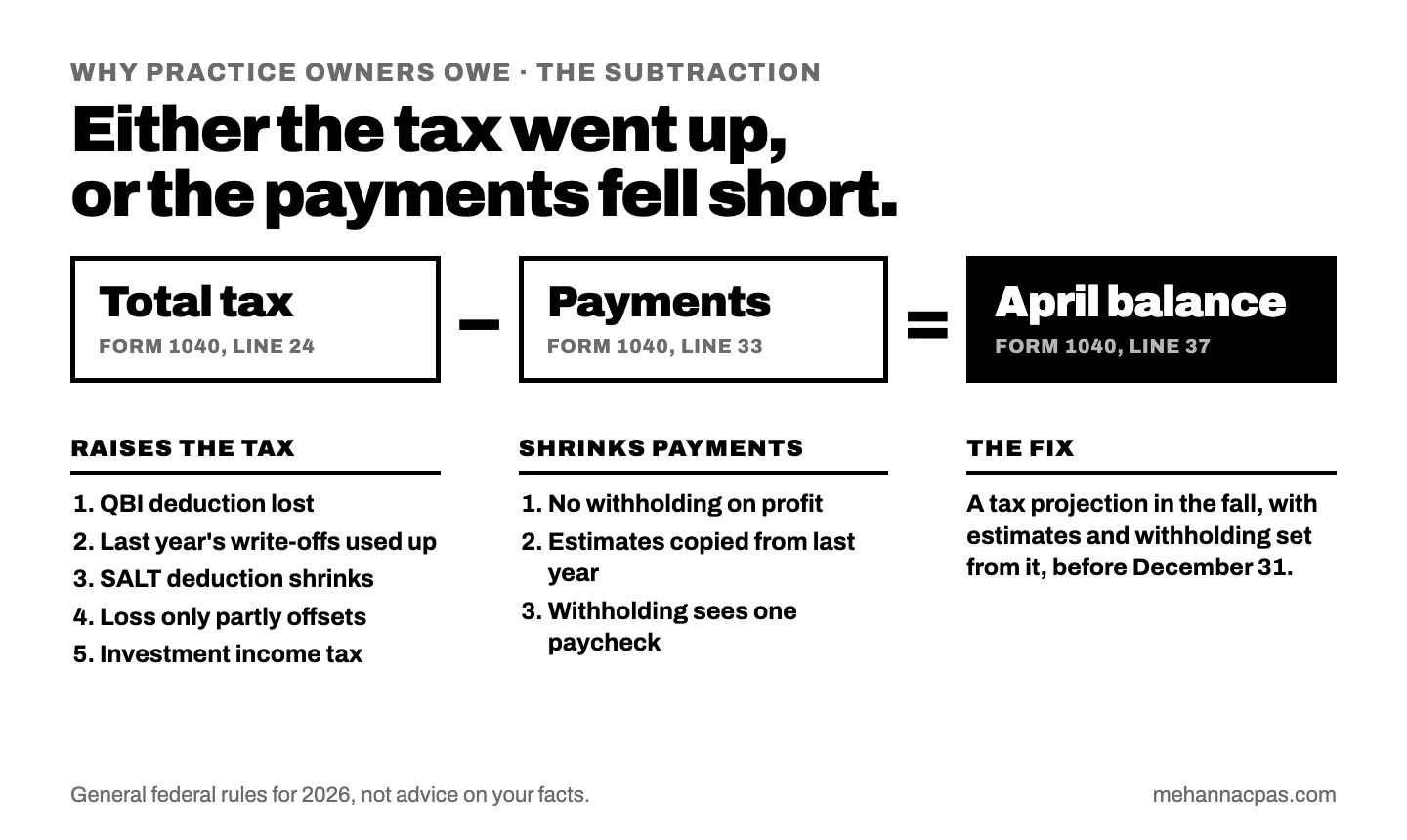
- A balance due is a subtraction: total tax minus total payments. Either the tax went up, the payments fell short, or both.
- Paying 110% of last year’s tax avoids the penalty. It does not cover the extra tax of a year when collections grew.
- Big write-offs, like 100% bonus depreciation on a CBCT, deduct the cost once. The year after has less to deduct, and the tax comes back.
- Above $403,500 of joint taxable income in 2026, a dentist’s 20% qualified business income deduction starts shrinking, and above $553,500 it is gone.
- What we see most in dental practices: the surprise lands in the first year as an owner, or the year collections jump.
The return is done, and the number at the bottom is bigger than the check you set aside. Your collections were good. You paid your estimates. You still owe a lot of taxes this year, and nobody told you until April.
This guide explains why a practice owner owes so much in taxes, the eight causes we see most often, how a tax projection catches them while there is still time, and how to avoid owing taxes like this again.
What does “owing taxes” actually mean, and what doesn’t it mean?
Owing taxes means your total tax for the year was larger than the tax you paid in during the year. On the 2025 Form 1040, line 24 is your total tax and line 33 is your total payments: withholding, estimated payments and refundable credits. Line 37, the amount you owe, is line 24 minus line 33 (IRS, Form 1040).
So every balance due has two possible stories. The tax went up, the payments fell short, or both. A big balance is not, by itself, a sign that something was filed wrong, and it is not the same as a penalty.
| Balance due | Total tax | Underpayment penalty | Refund | |
|---|---|---|---|---|
| What it is | Tax still unpaid when you file | Everything you owe for the year | Interest-like charge for paying late during the year | Payments above your total tax |
| Where it shows | Form 1040, line 37 | Form 1040, line 24 | Form 1040, line 38 (Form 2210) | Form 1040, line 34 |
| What drives it | The gap between tax and payments | Income, deductions, credits, other taxes | Short or late quarterly payments | Overpaying during the year |
| Good or bad? | Depends on whether you planned for it | Neutral: it is the bill | Avoidable cost | Money you lent the IRS at no interest |
Who ends up owing a big balance, and who usually doesn’t?
The owners who get surprised are usually the ones whose year looked different from the last one. The situations we recognize:
- Your first full year as an owner. As an associate, tax came out of every paycheck. Now most of your income arrives with nothing withheld.
- A growth year. A new associate, a second office or a strong hygiene department pushed collections up, and your estimates still followed last year.
- The year after a big purchase. You wrote off equipment or a build-out in full, and this year there is little left to deduct.
- Two high earners on one return. Each paycheck withholds as if it were the only income in the house.
Who usually doesn’t: an associate paid on a W-2 with one job and a current Form W-4. If that’s you, the IRS Tax Withholding Estimator is the right first check. An associate paid on a 1099 is in the owner group.
Why do I owe so much in taxes? The eight causes we see most
Most surprise balances for a dentist come from one of these eight causes, often two at once. The first two shrink your payments. The rest raise your tax.
1. You became an owner, and nothing is withheld anymore
Owner draws and distributions arrive with no tax taken out. In a sole proprietorship or partnership you also pay self-employment tax: 15.3% on the first $184,500 of net earnings in 2026, then 2.9% above it (IRS, Self-employment tax). Partners are not employees and generally should not get a W-2 from the partnership (IRS, Paying yourself), so there is no paycheck withholding to lean on. In an S corporation, only your salary has withholding; the profit on your K-1 does not.
2. Your estimates were set from last year’s return
If your adjusted gross income last year was over $150,000, paying 110% of last year’s tax on time avoids the underpayment penalty (26 U.S.C. § 6654(d)). It does nothing about the extra tax of a bigger year. That difference shows up in April, the same day your first 2027 estimate is due. We walk through the math in estimated tax payments for practice owners.
3. Last year’s write-offs moved tax into this year
Equipment acquired after January 19, 2025 can generally be written off 100% in the year it goes into service through bonus depreciation (IRS, IR-2026-06). That is a real deduction, but it is used once. If you expensed a CBCT or a full operatory last year, there is little or no depreciation left on it for the years after. Prepaying next year’s expenses in December works the same way. Those moves shift tax between years; they don’t erase it. More on that trade-off in when the Section 179 write-off is worth it.
4. You earned past the QBI limit for a health practice
Dentistry is in the health field, which the tax code treats as a specified service business for the 20% qualified business income deduction (IRS, QBI deduction FAQs). For 2026, the deduction starts shrinking once joint taxable income passes $403,500 and is gone at $553,500 ($201,750 to $276,750 for most other filers) (Rev. Proc. 2025-32). A good year can cost you the deduction and push more income into higher brackets at the same time.
5. Your withholding only sees one paycheck
An employer withholds the 0.9% Additional Medicare Tax only on wages it pays you above $200,000, whatever your filing status and whatever your spouse earns (IRS, Topic 560). The tax itself applies to a married couple’s combined wages and self-employment income above $250,000. Two incomes that each stay under $200,000 can owe it with nothing withheld. Regular income tax withholding has the same blind spot when both spouses earn well.
6. Your state and local tax deduction shrank
The itemized deduction for state and local taxes is capped at $40,400 for 2026, but the cap drops by 30% of modified AGI above $505,000 and can fall back to $10,000 (26 U.S.C. § 164(b)(7)). A strong year can put a practice owner above that line. If your state offers a pass-through entity tax, the practice may be able to pay the state tax itself; see tax strategies for high-income dentists.
7. A big loss didn’t offset as much as you expected
In 2026, net business losses above $256,000 ($512,000 on a joint return) can’t offset wages or investment income that year (Rev. Proc. 2025-32). The excess carries forward instead. This matters in the year you buy a practice or a building and the first-year write-offs create a large paper loss.
8. Investment income picked up an extra tax
A 3.8% net investment income tax applies to investment income once modified AGI passes $250,000 on a joint return ($200,000 single) (IRS, Topic 559). It doesn’t apply to income from a practice you actively run, but it does reach interest, dividends, gains and passive rental income. A year with a stock sale on top of strong collections can trigger it.
Why does a big balance matter for your practice?
The balance itself is the bill you would have owed anyway; the cost is the cash crunch and the penalty that come with it. Your 2026 balance is due April 15, 2027, the same day as the first 2027 estimated payment (IRS, Publication 505). If the year grew, that first estimate is often larger too.
If payments fell short during the year, the IRS also charges an underpayment penalty, figured quarter by quarter at its underpayment rate: 7% a year, compounded daily, for the fourth quarter of 2026 (IRS, IR-2026-98). For a practice, the worst version is paying both out of the operating account in a month when payroll and the lab bill are due.
When should you run a tax projection, and when can you skip it?
Run a tax projection whenever the year looks different from the last one, and every year in the fall. A projection takes this year’s numbers so far, estimates the rest, and figures the tax before the year closes. The triggers we watch:
- October and November, while year-end decisions can still change the number.
- Your first year as an owner, or the year you change entity.
- Before a big purchase: equipment, a build-out, a building or a second practice.
- When collections run well ahead of last year, so the next estimate goes up before a gap forms.
- Before you sign a sale or DSO offer, because one year can hold several years of income.
You can skip it if you are a W-2 associate with one job and steady pay. The Withholding Estimator covers you.
How we keep April from being a surprise with dental practices
We treat April’s number as something we find in November, not something we read in April. The steps:
- Project the year in January from expected collections, overhead, owner salary and planned decisions.
- Set the estimates from the projection, not from last year’s return, and schedule all four payments.
- Refresh it at each planning call. Three a year on The Treatment Plan, Standard. If collections are ahead, the next payment goes up.
- Check the big decisions before you sign. You text before you sign; we tell you what the purchase does to this year and next year.
- Close the year in November and December: catch-up withholding on the last payroll, the January 15 payment, and any year-end moves that fit.
The surprise almost always lands in one of two years: the first full year as an owner, or the year collections jump. In both, the estimates followed last year’s return. The second most common pattern is the year after a big equipment write-off, when the owner expects the same deduction again and it isn’t there.
If 2026 was a bigger year, see what can still change before December 31. Free, and about eight minutes.
How to avoid owing taxes like this again: which fix fits?
The fix depends on which side of the subtraction moved. Match your cause to the fix below.
| Cause | Fix | When |
|---|---|---|
| No withholding on profit | Quarterly estimates sized from a projection; a tax savings account for every distribution | From January |
| Estimates copied from last year | Raise the next payment, or add withholding on your S corp salary | Before the next due date; last payroll of the year |
| Last year’s write-offs used up | Plan big purchases over several years, not only in a high-income year | Before you sign |
| QBI deduction phasing out | Model retirement plan contributions and salary against the $403,500 to $553,500 range | Before December 31 |
| Two incomes, one household | Update both Forms W-4 using the two-earner step, or add estimates | Any time; earlier is cheaper |
| SALT deduction shrinking | Ask whether your state’s pass-through entity tax fits the practice | Under your state’s election rules |
Can a tax projection tell me exactly what I’ll owe?
Not to the dollar, but close enough to act on. It is only as good as the numbers behind it, so it improves each time actual collections and expenses replace estimates. The point is to see the size of April’s number while you can still send estimates, adjust withholding or make a year-end decision.
Is it bad to owe taxes when I file?
Not if you planned for it and paid enough during the year to avoid the penalty. A small balance means you kept your money until April. A big, unplanned balance is the problem, because it arrives with no cash set aside for it.
Why do I owe so much in taxes checklist for 2026
Use this to find your cause and what to bring to the conversation.
| Item | Fits you if | Deadline | What to bring |
|---|---|---|---|
| Compare line 24 and line 33 | You owed more than last year | Now, with last year’s return | Your 2024 and 2025 Form 1040 |
| Tax projection | Collections, entity or big purchases changed | Before December 31, 2026 | Year-to-date P&L, payroll report, estimates paid |
| Withholding on your salary | You own an S corporation and estimates are short | Last payroll of 2026 | Year-to-date payroll report, current W-4 |
| January estimate | Profit or K-1 income has no withholding | January 15, 2027 | Updated projection |
| QBI range check | Joint taxable income near $403,500 to $553,500 | Before December 31, 2026 | Projection, retirement plan options |
| Two-earner W-4 review | Both spouses earn wages | Any time | Both pay stubs |
Mistakes we’d avoid
Most big balances are a planning problem, not a filing problem. The ones we’d steer you away from:
- Treating “no penalty” as “no balance.” The prior-year safe harbor says nothing about a growth year.
- Buying equipment just to cut this year’s tax. Buy it because the practice needs it. The write-off moves tax; it doesn’t make it disappear.
- Using the “25% to 30%” set-aside rule. It was built for freelancers. Your last dollars of profit are taxed at your top rate.
- Waiting for the return to find out. By April, every lever except paying is gone.
- Changing preparers instead of finding the cause. A new preparer reading the same facts will usually find the same tax. Compare the two returns line by line first.
What changed for 2026
Several 2026 numbers changed how much a high-earning owner can owe, mostly under the 2025 tax law.
- QBI phase-in range widened to $403,500 to $553,500 for joint filers (Rev. Proc. 2025-32).
- SALT cap of $40,400, reduced by 30% of modified AGI above $505,000, not below $10,000 (26 U.S.C. § 164(b)(7)).
- Alternative minimum tax: the joint exemption is $140,200 and starts phasing out at $1,000,000, gone completely at $1,280,400 (Rev. Proc. 2025-32). That is a lower starting point than in 2025, so more high earners should check it.
- Excess business loss threshold of $256,000 ($512,000 joint), down from $313,000 ($626,000) for 2025 (Rev. Proc. 2025-32).
- Tax brackets: 32% above $403,550, 35% above $512,450 and 37% above $768,700 of joint taxable income (IRS, IR-2025-103).
How to tell whether your tax projection worked
When the 2026 return is done, the balance due should be close to the number you planned for, and the penalty line should be zero. If the balance is still a surprise, the projection was set once and never refreshed. If you got a large refund instead, you overpaid during the year with money the practice could have used. Projections all year, with the estimates set from them, are part of The Treatment Plan.
Frequently asked questions
Why do I owe taxes when I paid my estimates?
Because estimates are usually set to avoid the penalty, not to cover the full tax. Paying 110% of last year’s tax keeps the penalty away, but if your 2026 income grew, the extra tax is still due in April. Setting the estimates from a current-year projection closes that gap.
Why do I owe so much more than last year when my income barely changed?
Look at deductions. A large write-off last year, like equipment expensed in full, a prepaid expense or a retirement contribution you didn’t repeat, lowers last year’s tax and leaves this year without it. A lost QBI deduction or a smaller SALT deduction can do the same.
Can I fix this year’s balance after December 31?
Mostly no. Once the year closes, you can still make the January 15 estimate and, in some cases, a retirement contribution that counts for the prior year, but most decisions that change the tax have to happen by December 31.
Does a dentist owe taxes on money left in the practice?
In an S corporation, partnership or sole proprietorship, yes. You are taxed on your share of the profit whether or not you take it out. Leaving cash in the practice account doesn’t defer the tax on it.
Should I ask for an extension if I can’t pay?
An extension gives you more time to file, not more time to pay. The IRS still expects the tax you owe by the April filing date (IRS, Get an extension). Pay what you can by April 15 and look at an IRS payment plan for the rest.
Glossary
| Term | Meaning |
|---|---|
| Balance due | Total tax minus total payments, Form 1040 line 37. |
| Tax projection | An estimate of this year’s tax made during the year, from actual numbers so far plus expected numbers for the rest. |
| Safe harbor | Paying at least 90% of this year’s tax or 100% of last year’s (110% if AGI was over $150,000) on time, which avoids the underpayment penalty. |
| QBI deduction | The 20% qualified business income deduction for pass-through owners, phased out for health practices above the 2026 range. |
| Specified service business | A business in fields such as health, law or accounting, whose owners lose the QBI deduction at higher incomes. |
| SALT | The itemized deduction for state and local income and property taxes. |
| Excess business loss | The part of a net business loss above the yearly threshold that can’t offset other income that year. |
Sources
- IRS, Form 1040 (2025): line 24 total tax, line 33 total payments, line 37 amount you owe.
- IRS, Rev. Proc. 2025-32 (2025): 2026 QBI thresholds, AMT exemption and phaseout, excess business loss threshold.
- IRS, IR-2025-103 (2025): 2026 tax brackets.
- Cornell LII, 26 U.S.C. § 6654: safe harbor, 110% rule.
- Cornell LII, 26 U.S.C. § 164: 2026 SALT cap and phase-down.
- IRS, Section 199A QBI deduction FAQs: health as a specified service trade or business.
- IRS, Topic 560, Additional Medicare tax: thresholds and the $200,000 withholding rule.
- IRS, Topic 559, Net investment income tax.
- IRS, Self-employment tax: 15.3% rate, $184,500 wage base for 2026.
- IRS, Paying yourself: partners are not employees.
- IRS, IR-2026-06, Notice 2026-11 (2026): permanent 100% bonus depreciation for property acquired after January 19, 2025.
- IRS, Publication 505 (2026): estimated tax due dates, interest and penalties.
- IRS, IR-2026-98 (2026): 7% underpayment rate for the fourth quarter of 2026.
- IRS, Tax Withholding Estimator.
- IRS, Get an extension to file your tax return: an extension is for filing, not paying.