

A dental startup is a practice you build from an empty space instead of buying one. Dental lenders put the all-in cost at roughly $500,000 to $1 million, including about $100,000 of working capital. The business plan has to carry you through a ramp of 18 to 24 months, and opening day is when most of the tax clock starts.
- The construction bid is rarely what sinks a startup. The ramp is: the months of payroll, rent and loan payments before collections catch up.
- Costs you pay before opening, like rent during the build-out and training payroll, are start-up costs. Once they pass $55,000, none of them is deductible right away. They are spread over 15 years from the month you open.
- Equipment bought before the practice opens is generally written off in the year it opens, not the year you paid for it.
- A first-year loss is normal. How much of it can offset a spouse’s salary is capped, so the year-one tax plan matters as much as the build-out plan.
- In our work with dental practice owners, the startups that open with a written ramp and a separate bank account from day one have the easiest first tax return.
The lender approved the project, the landlord sent the lease, and the contractor wants a deposit to hold the schedule. Every number on the table is about getting the doors open. Almost none of them is about the 18 months after, when you are paying a team to wait for the schedule to fill.
Whether you call it opening a dental clinic or setting up a dental practice, the order of the numbers is the same. This guide covers how to start a dental practice with them in the right order: what it costs, what a dental practice business plan has to prove, and the tax rules that apply to the money you spend before your first patient.
What is a dental startup, and what isn’t it?
A dental startup, also called a scratch or de novo practice, is a new practice with no patients, no collections history and no goodwill on day one. You choose the location, design the space, buy the equipment and build the patient base yourself. Building a dental practice from scratch is different from buying one or buying into one, and the money behaves differently in each.
| Dental startup | Buying a practice | Associate buy-in | |
|---|---|---|---|
| Patients on day one | None | The seller’s | The existing practice’s |
| Where the money goes | Build-out, equipment, working capital | Mostly goodwill | A share of an existing practice |
| Cash flow in year one | Negative for months | From the first month, if patients stay | From your share of profit |
| Main risk | A slow ramp | Paying for patients who leave | Terms you can’t control |
| When the tax clock starts | When the practice opens | At closing | When you become an owner |
If you are weighing a purchase instead, our guide to buying a dental practice covers what to check before you sign.
Who is a dental startup for, and who should buy instead?
Starting your own dental practice fits dentists who want control of the location and the model, and who can live through a slow first year. It tends to fit when:
- You have years of clinical production as an associate and a clear idea of the practice you want: fee-for-service or PPO mix, specialty, number of operatories.
- The area you want has room for another practice, or no practice for sale fits what you do.
- Your household can cover personal costs for a year or more without a full owner’s income, for example because a spouse earns a salary.
It fits less well when you need full income from month one, or when a practice for sale nearby already has the patients you would spend two years building. In those cases, run the purchase numbers first.
How much does it cost to open a dental practice?
Dental lenders put the cost to start a dental practice at roughly $500,000 to $1 million, and the spread comes from space, equipment and working capital. No government agency publishes an average, so the useful figures come from lenders who fund these projects.
- A dental lender writing in ADA News puts the cost at “often $500,000 at minimum,” covering equipment, the space, design and construction, permits, marketing and working capital (ADA News, 2025).
- The same lender, in 2026, puts construction at $250,000 to $500,000 and equipment at $100,000 to $200,000, and says practices often take 18 to 24 months to reach 70% to 80% of target collections (ADA News, 2026).
- Bank of America says the dental startup costs it has seen range from $950,000 to $1,050,000, averaging $1,000,000, including working capital of typically $100,000 (Bank of America).
Dental office build out cost depends most on the condition of the space. A suite that was already a dental office has plumbing, vacuum and electrical in place. An empty shell needs all of it. Ask for a written bid from a contractor who has built dental offices before you sign the lease, not after.
Two lines get underbudgeted most often: working capital and your own living costs. They are the same problem seen from two sides. Every month the schedule isn’t full, the practice and your household both draw on cash.
When should you start, and when should you wait?
Start the numbers 12 to 18 months before you want to open, and before you sign anything. Starting a dental practice takes longer than most first plans assume, and the order matters: the budget and the ramp come first, then the lender, then the lease. A signed lease with no financing, or financing sized to a budget that left out working capital, is hard to undo.
Wait if your savings can’t cover personal expenses through the ramp, if your credit or student loan payments will limit the loan, or if you haven’t yet produced enough as an associate to know your own numbers. Lenders look for a loan coverage ratio of at least 1.25 and expect cash left over after closing (ADA News, 2026). For how lenders size the loan, see dental practice loans and how much you can afford.
What goes in a dental practice business plan?
A dental startup business plan has one job: show, month by month, that the practice can pay its bills and you before it is busy. The lender reads it to size the loan. You should read it to decide whether to sign. The SBA’s outline (executive summary, market, organization, services, marketing, funding request, financial projections) is a good skeleton (SBA). For a dental office, these are the parts that carry the weight.
1. The practice model
One page: general or specialty, payer mix, operatories built now and plumbed for later, hours, and the patients you expect to see. The model drives everything else, from square footage to the first hires.
2. The ramp
New patients per month, collections per month, and when the schedule fills. Write a slow case alongside the expected one. Insurance credentialing takes months, so in-network collections usually start later than the first appointments.
3. The budget, with working capital inside it
Build-out, equipment, technology, supplies, deposits, professional fees, launch marketing and working capital, each from a written quote. Keep a contingency on construction and don’t spend it on upgrades.
4. The loan and the payments
Ask when full payments start, whether early payments are interest-only, and what the coverage ratio looks like in the slow case, not just the expected one.
5. Your own pay
Put your household budget in the plan. If the practice can’t pay you anything for six months, the plan has to say where that money comes from.
6. The first-year tax picture
Most dental startup plans skip this line. The next section is why it belongs in yours.
Six tax rules for the year you open
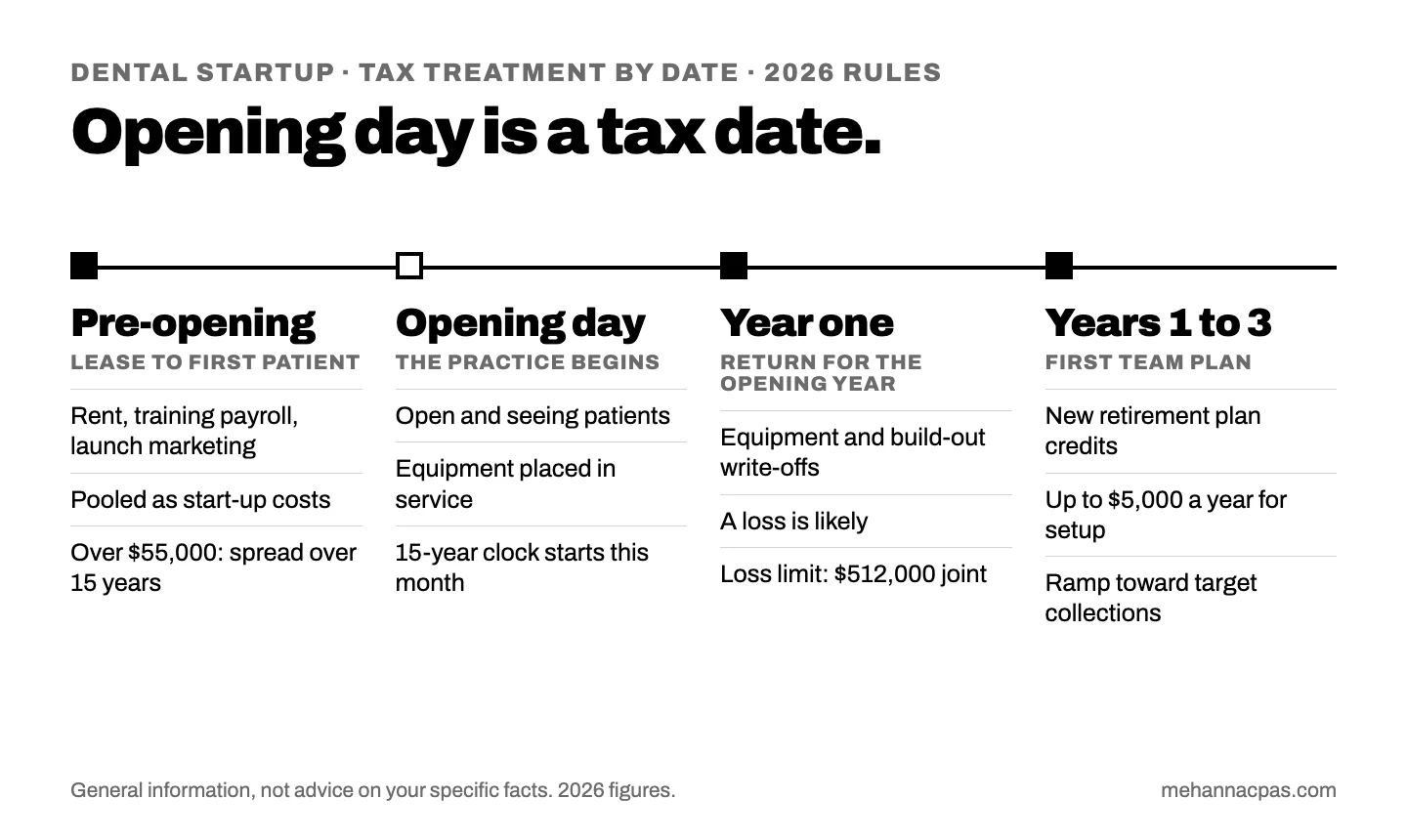
For a dental startup, the tax year turns on one date: the day the practice opens. Most of what you spend before it is treated differently from what you spend after.
1. Your opening date is a tax date
A business begins, for tax purposes, when it starts to function as a going concern and performs the activities it was organized for (Richmond Television Corp. v. United States, 4th Cir. 1965). For a dental office, that generally points to when it is open and offering care to patients, not when you formed the entity or signed the lease. Keep a record of the date: the first appointment, the day the phone and website went live.
2. Pre-opening costs are pooled and spread
Rent and utilities during the build-out, payroll while the team trains, launch marketing and similar costs paid before opening are start-up costs. You can deduct up to $5,000 in the year the practice begins, reduced dollar for dollar once the total passes $50,000, so above $55,000 there is no immediate deduction. The rest is deducted evenly over 180 months starting the month you open (26 U.S.C. § 195). The election is made simply by claiming the deduction on a timely return, and it can’t be reversed (Treas. Reg. § 1.195-1).
A hypothetical example: $80,000 of start-up costs and an April 2026 opening. Nothing is deducted up front. The $80,000 is spread at about $444 a month, so about $4,000 for 2026 and about $5,333 a year after that. Interest and taxes paid before opening are not part of this pool; they follow their own rules.
3. Equipment waits for opening day
Chairs, imaging and sterilization equipment are not start-up costs. They are depreciated, and depreciation, bonus depreciation and Section 179 begin when the asset is placed in service in your business (IRS Publication 946). Equipment delivered in December for a practice that opens in February is generally written off in the year the practice opens. That changes which year’s return the deduction lands on, so plan the projection around it.
4. Build-out in leased space and new construction are different
Interior improvements to an existing commercial building are qualified improvement property when the building was already placed in service by someone else; enlargements, elevators and the internal structural framework are excluded (IRS Publication 946). That category can qualify for bonus depreciation, which is 100% for property acquired after January 19, 2025 (IRS). A building you construct from the ground up is a different, much slower schedule. Our guide to the Section 179 deduction for dental equipment covers when taking it all in year one is worth it.
5. A first-year loss has limits
Year one usually shows a loss, especially with large equipment write-offs. For 2026, business losses can offset other income only up to $256,000, or $512,000 on a joint return; the excess carries forward as a net operating loss (Rev. Proc. 2025-32). Wages earned as an employee, including a spouse’s salary, don’t count as business income for this test (26 U.S.C. § 461(l)). Decide how much to write off in year one before you file, not after.
6. Your first retirement plan can earn credits
A practice with 50 or fewer employees that starts a new plan can take a credit for 100% of eligible setup costs, up to $5,000 a year for three years, and a credit for employer contributions of up to $1,000 per employee, phasing down after year two. Adding automatic enrollment earns another $500 a year for three years (IRS). For 2026, contributions for employees paid over $110,000 don’t count toward the contribution credit (IRS Notice 2025-67). Costs covered by the credit can’t also be deducted.
How we work with dental startups
We like the first three years, and we start before the lease. Our process for a new practice runs in five steps.
- Budget and ramp before signatures. We build the month-by-month projection with you, including your household budget, and test it against the slow case.
- Entity and books before the first dollar. A separate business account and a chart of accounts that keeps pre-opening costs apart from equipment and from interest.
- Opening day on record. We note the date the practice began and why, because amortization and depreciation both key off it.
- Year-one tax plan. How much to write off in year one, given the loss limit and what your household earns elsewhere.
- Planning calls through the ramp. Scheduled calls with decisions on the table, and you text before you sign anything big.
The startups that struggle in year one rarely missed on the construction bid. They missed on the ramp: payroll and rent for a schedule that filled more slowly than planned, plus the owner’s own living costs. A plan with a slow case written in, and the cash to survive it, is worth more than a nicer operatory.
If you set up the entity yourself, read S corp vs. LLC for dentists first. The choice affects how you pay yourself once the practice is profitable.
Opening in the next year or two? Practices in their first three years, under $750K in collections, are priced on our Starter plan. See your number before any call.
Dental startup checklist
Each row comes from a rule or a cost above. Few startups skip any of them.
| Item | Fits you if | When | What to bring |
|---|---|---|---|
| Budget with working capital | Every startup | Before the lender | Written quotes for build-out, equipment, technology |
| Ramp with a slow case | Every startup | Before the lease | Expected new patients and collections per month |
| Household budget | The practice can’t pay you for months | With the ramp | Personal expenses, spouse income, student loan payments |
| Contractor bid on the actual space | You lease or build | Before you sign the lease | Floor plan, operatory count, condition of the space |
| Separate business account and books | Every startup | Before the first payment | Entity documents, EIN |
| Start-up cost log | You pay rent, payroll or marketing before opening | From the first payment | Invoices by category: start-up, equipment, interest |
| Opening date record | Every startup | Opening week | First appointment, website and phone go-live |
| Year-one write-off plan | Large equipment or build-out costs | Before you file the first return | Asset list with placed-in-service dates, household income |
| Retirement plan design | You plan to hire staff | Year one or two | Staff list and pay, plan quotes |
Mistakes we’d avoid
- Signing the lease before the budget. The space sets the build-out cost, and the build-out cost sets the loan. Getting the order wrong leaves you negotiating with no leverage.
- Treating working capital as optional. It is the line that pays the team while the schedule fills. Cutting it to afford better finishes trades a slow month for a crisis.
- Buying every operatory’s equipment on day one. Plumb for the operatories you plan to have; equip the ones you can fill.
- Mixing personal and practice money before opening. Pre-opening costs paid from a personal card are hard to sort into start-up costs, equipment and interest later.
- Counting on a big year-one write-off to cover your household. The deduction can create a loss you can’t fully use this year. Plan the cash first, then the deduction.
What changed for 2026
- Bonus depreciation is back to 100% for property acquired after January 19, 2025, without the phase-down that applied before (IRS).
- The 2026 Section 179 limit is $2,560,000, reduced once qualifying property placed in service in the year passes $4,090,000 (Rev. Proc. 2025-32).
- The excess business loss threshold for 2026 is $256,000, or $512,000 joint (Rev. Proc. 2025-32).
- The pay cap for the retirement plan contribution credit rose to $110,000 for 2026, from $105,000 (IRS Notice 2025-67).
The start-up cost amounts ($5,000, $50,000, 180 months) are fixed in the statute and did not change.
How to tell whether your dental startup plan worked
Compare actual collections to the ramp every month, and the cash balance to the working capital line. A plan that is working shows collections tracking between the expected and slow cases, and cash that never falls below a few months of overhead. By the second year, look at overhead as a share of collections: middle-range general practices typically run 58% to 68% (ADA News, 2026). Your first full set of financial statements will show where you stand. If you want a CPA on the numbers from the first lease draft, see what the plan costs for a startup.
Frequently asked questions
Do I need a dental startup consultant?
Not always. A dental startup consultant coordinates site selection, design, vendors and the timeline, which helps if you have no time to manage the project. It doesn’t replace a CPA on the budget, the ramp and the tax plan, or an attorney on the lease. Ask what the fee covers and whether vendors pay the consultant.
What does a dental startup loan usually cover?
Dental startup loans from dental-focused lenders typically fund construction, equipment, technology and working capital in one project. Ask whether working capital is included, when full payments begin, and whether early payments are interest-only. Your own cash still matters, because lenders look for reserves left after the project.
How long does it take to break even on a new dental practice?
Plan on well over a year to a full schedule. A dental lender writing in ADA News says new practices often take 18 to 24 months to reach 70% to 80% of target collections. Location, payer mix and how early credentialing starts move that number more than the build-out does.
Is it cheaper to start a dental clinic or buy one?
Not necessarily. To start a dental clinic, you pay for build-out, equipment and the months it takes to fill the schedule. A purchase usually costs more up front, mostly for goodwill, but brings patients and collections from the first month. Compare the cash each path leaves you in years one to three, not just the price.
What should a first-year dental practice owner track each month?
Three numbers: collections against the ramp, cash against the working capital line, and new patients against the plan. A first year dental practice owner who checks those monthly can change course while there is still cash to do it.
Glossary
| Term | Meaning |
|---|---|
| Dental startup (de novo) | A new practice built from an empty space, with no patients or goodwill on day one. |
| Ramp | The months between opening and a full schedule, when collections are still growing. |
| Working capital | Cash set aside to pay expenses while collections catch up. |
| Start-up costs | Costs paid before the practice opens that would be deductible if it were already open. Up to $5,000 deducted in year one, the rest over 180 months. |
| Placed in service | Ready and available for its use in your business. Depreciation and Section 179 start here. |
| Qualified improvement property | Interior improvements to an existing commercial building, excluding enlargements, elevators and structural framework. |
| Excess business loss | The part of a business loss above the yearly threshold ($256,000, or $512,000 joint, for 2026) that carries forward instead. |
| Loan coverage ratio | Cash available for debt payments divided by those payments. Lenders look for at least 1.25. |
Sources
- U.S. Code, 26 U.S.C. § 195, Start-up expenditures: $5,000, $50,000 and 180-month rules.
- eCFR, Treas. Reg. § 1.195-1: deemed election, irrevocable.
- U.S. Court of Appeals, 4th Circuit, Richmond Television Corp. v. United States, 345 F.2d 901 (1965): when a business begins.
- IRS, Publication 946, How to Depreciate Property (2025): placed in service, qualified improvement property.
- IRS, Guidance on the additional first-year depreciation deduction (2026): 100% bonus depreciation after January 19, 2025.
- IRS, Rev. Proc. 2025-32 (2025): 2026 Section 179 limits and excess business loss threshold.
- U.S. Code, 26 U.S.C. § 461(l): employee wages excluded from the excess business loss test.
- IRS, Retirement plans startup costs tax credit (2026): startup, contribution and auto-enrollment credits.
- IRS, Notice 2025-67 (2025): $110,000 pay cap for the contribution credit in 2026.
- SBA, Write your business plan: business plan structure.
- ADA News, What are my financial paths to practice ownership? (2026): construction and equipment ranges, 18 to 24 month ramp, overhead, coverage ratio.
- ADA News, How to be financially prepared for practice ownership (2025): “often $500,000 at minimum”.
- Bank of America, Top tips on how to start a successful dental practice start-up: $950,000 to $1,050,000 range, $100,000 working capital.