

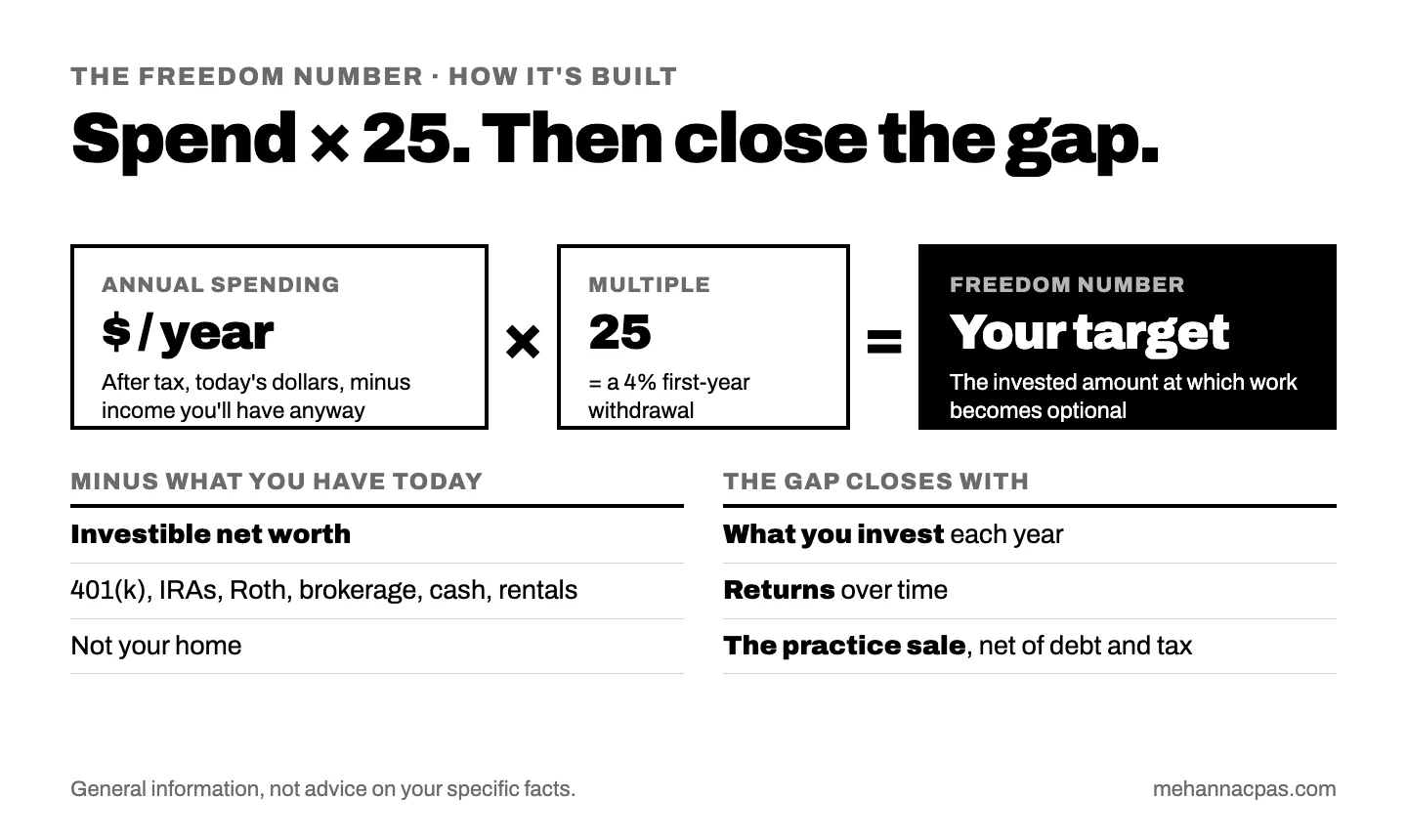
A dentist needs about 25 times the after-tax amount they want to spend each year, invested, to retire on a 4% first-year withdrawal. That is the freedom number. Wanting $200,000 a year means about $5 million. Subtract what you already own, then count the practice sale only after debt and tax.
- Your freedom number is your annual spending times 25. The 25 comes from the 4% rule: in William Bengen’s 1994 study of U.S. market history, a 4% first-year withdrawal, raised each year for inflation, never ran out in less than 33 years.
- Dentists retire later than most people. The ADA Health Policy Institute puts the average dentist retirement age at 68.7 for those who retired in 2024, up from 64.7 in 2001.
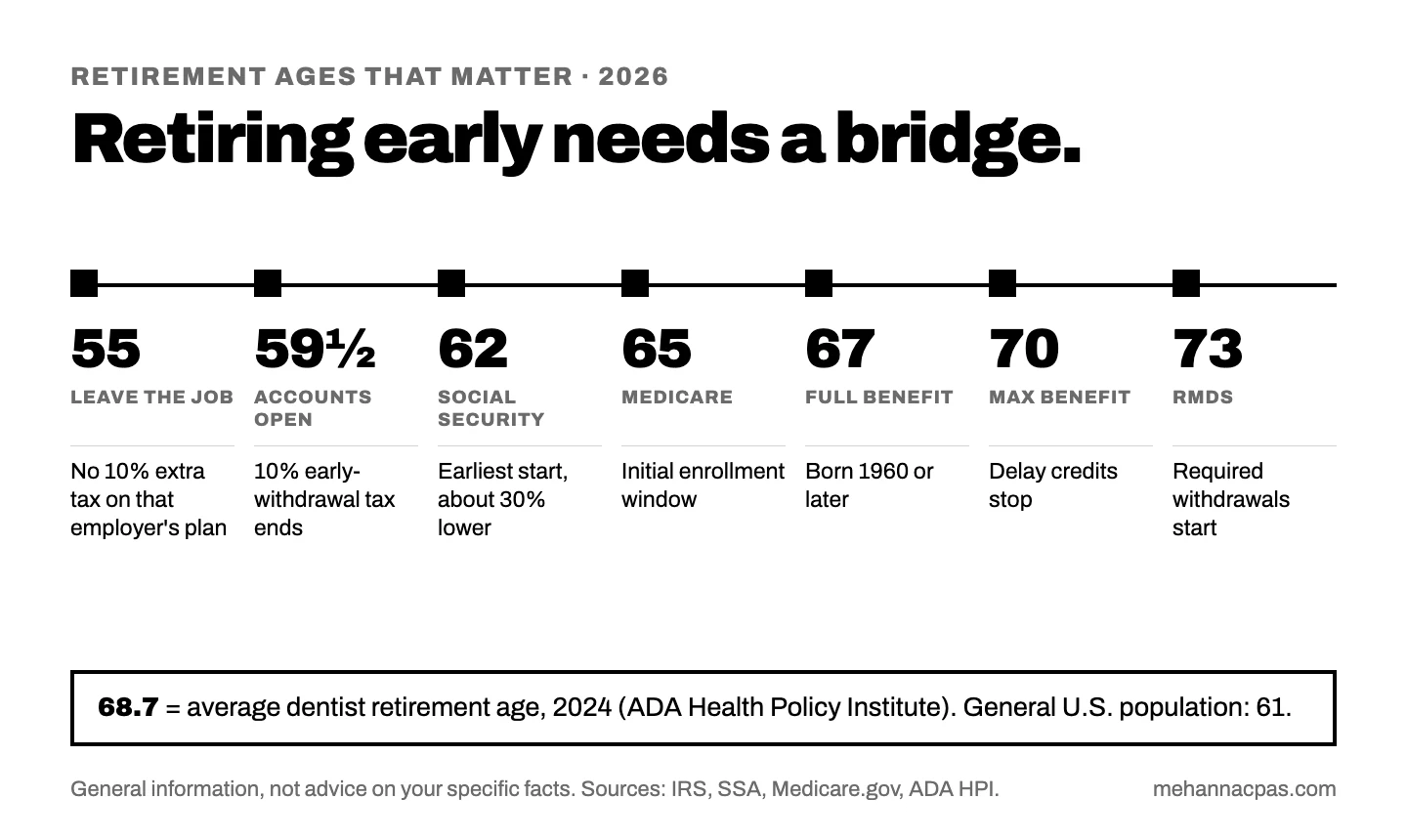
- Retiring early is a bridge problem, not only a savings problem: the 10% additional tax on early withdrawals before 59½, Medicare at 65, Social Security from 62 to 70.
- The practice is often the largest asset on the list, but it isn’t spendable until it sells, and the check arrives after practice debt and tax.
- What we see with dental practices: spending, not collections, decides the date. The owners who know their number are the ones who stop moving it.
You can tell anyone last month’s production to the dollar. Ask when you could stop working, and the answer is usually a shrug and an age that sounds about right.
That gap is what this guide closes. It answers the question every owner gets to eventually, how much does a dentist need to retire? Then it shows how to turn that amount into a date, which ages change the math if you want to retire early, and where the money actually comes from for a practice owner. No product to buy, no savings promise. Just the arithmetic and the decisions behind it.
What is a freedom number, and what isn’t it?
A freedom number is the invested amount that would cover the life you want without a paycheck. It starts from your spending, not your income: what you want to spend each year, after tax, in today’s dollars, multiplied by 25. Once your investible net worth reaches it, work becomes a choice instead of a requirement.
The same idea goes by other names. The FIRE community calls it a financial independence number or FI number. We call it the freedom number because the point isn’t to stop working. The point is that you could.
It gets mixed up with several other numbers that sound similar but answer different questions:
| Number | What it measures | Why it isn’t your freedom number |
|---|---|---|
| Freedom number | Annual after-tax spending times 25 (or another multiple you choose) | It is the target itself |
| Net worth | Everything you own minus everything you owe | Includes your home and the practice, which don’t pay your bills until sold |
| Investible net worth | Retirement accounts, brokerage, cash, rentals; not your home | It is the amount you compare against the target |
| “10x your salary” rules | A savings benchmark based on income | Built for W-2 employees; an owner’s income and spending can be very far apart |
| Practice value | What a buyer might pay for the practice | Before practice debt, before tax, and only on the day it sells |
The income-based rules are popular because they are easy. Fidelity’s guideline, for example, is to save 10 times your income by 67 (Fidelity). For a practice owner, income swings with collections, overhead and how the owner is paid, so a spending-based number is the more honest starting point.
How much do I need to retire as a dentist?
Take the after-tax amount you want to spend each year, subtract income you will have regardless, and multiply the rest by 25. That is how much you need invested. The three steps:
- Annual spending for the life you actually want. Travel, the house, kids, giving, all of it, in today’s dollars, after tax. Not your current spending if you expect it to change, and not what a rule of thumb says you should spend.
- Minus income you will have anyway. Social Security once it starts, rent from a building you plan to keep, a pension if you have one. These reduce what the portfolio has to cover.
- Times 25. That is the 4% rule turned around: if you can withdraw 4% in the first year, you need 25 times the withdrawal.
The 4% comes from William Bengen’s 1994 study in the Journal of Financial Planning. Using U.S. stock and bond returns since 1926, he found that a first-year withdrawal of 4%, raised every year for inflation, never exhausted a portfolio in less than 33 years, and that 3% to about 3.5% lasted at least 50 years in every historical case he tested (Bengen, Journal of Financial Planning). It is history, not a promise about the next 30 years, but it is the most widely used starting point.
The multiple you choose depends on how long the money has to last. A dentist stopping at 50 needs a longer horizon than one stopping at 68:
| First-year withdrawal | Multiple of spending | Needed for $200,000 a year | What history showed (Bengen) |
|---|---|---|---|
| 4.0% | 25x | $5.0 million | Lasted at least 33 years |
| 3.5% | About 28.6x | About $5.7 million | Lasted at least 50 years |
| 3.0% | About 33.3x | About $6.7 million | Lasted at least 50 years |
One thing most online answers skip: the 25x math assumes the withdrawal is spendable. If most of your money sits in pre-tax 401(k) and profit-sharing accounts, every dollar you take out is taxed as income, so the gross amount you need is higher than the after-tax spending times 25. A mix of pre-tax, Roth and taxable accounts gives you more control over the tax each year. That mix is decided while you are still working, which is why how dentists reduce taxable income today and how they retire later are the same conversation.
Who should run the number, and who can wait?
Every practice owner should know their freedom number; it matters most when a big decision is about to move it. In our experience, the number pays off fastest in these situations:
- You are in your 40s or 50s, collections are at or above $750K, and you have never put a date on stopping.
- You are deciding whether to buy the building, add a location or bring in an associate, and you want to know what each one does to your date.
- You have a DSO offer, or expect one, and need to know whether the after-tax proceeds actually get you there.
- You are married to another high earner and the household has never looked at one combined number.
- Your spending has risen with collections and you want to know whether the finish line moved with it.
It can wait a little if you are in the first two years of ownership and every spare dollar is going to practice debt. Even then, a rough number is useful: it tells you what the debt payoff is for. If you are a W-2 associate with no plans to own, the math is the same, but the levers are fewer. A 1099 associate has more of them, because they can set up their own retirement plan.
When can a dentist retire?
A dentist can retire when investible net worth reaches the freedom number, not at a set age. In practice, most dentists stop later than the rest of the country.
The ADA Health Policy Institute’s 2025 workforce report found that the average dentist retirement age was 68.7 for dentists who retired in 2024, four years later than in 2001 (64.7). For comparison, the average reported retirement age of the general U.S. population is 61, and people who haven’t retired yet expect to stop at 66 (ADA HPI, 2025). The same report notes that dentists are working more hours, for more years, and that general practitioners’ average net income, adjusted for inflation, fell from $267,168 in 2010 to $207,980 in 2024.
That average dentist retirement age is not a target. It is what happens, on average, when nobody runs the number. The date that answers “when can I retire?” comes from three inputs you control:
- How far you are from the number: the freedom number minus your investible net worth today.
- How fast you close the gap: what you invest each year, plus returns.
- What the practice adds at the end: its sale value, net of practice debt and tax.
Change any one of them and the dentist retirement age on your plan moves. Spending moves it twice: it raises the target and lowers what you invest each year.
Can I retire early? The ages that change the math
Yes, if the money is there and it is in the right accounts. Early retirement mostly fails on timing: money locked in accounts you can’t touch yet, or health insurance you didn’t price. These are the ages that matter:
| Age | What changes | Source |
|---|---|---|
| 55 | If you leave the employer in or after the year you turn 55, distributions from that employer’s qualified plan avoid the 10% additional tax. This exception doesn’t apply to IRAs. | IRS |
| 59½ | The 10% additional tax on early distributions no longer applies. Regular income tax still does on pre-tax money. | IRS Topic 558 |
| 62 | Earliest Social Security, permanently reduced. With a full retirement age of 67, a benefit started at 62 is about 30% lower. | SSA |
| 65 | Medicare’s initial enrollment period runs from 3 months before to 3 months after the month you turn 65. | Medicare.gov |
| 67 | Full Social Security retirement age for anyone born in 1960 or later. | SSA |
| 70 | Delaying Social Security past full retirement age raises the benefit up to age 70. | SSA |
| 73 or 75 | Required minimum distributions start from IRAs and retirement plan accounts: at 73 if you were born from 1951 to 1959, at 75 if you were born in 1960 or later. Roth IRAs are exempt during the owner’s life. | IRS |
A dentist who wants to stop at 52 therefore needs three things a dentist stopping at 68 doesn’t: enough money outside retirement accounts to live on until 59½ (or a plan built around the age-55 rule), health insurance for every year until 65, and a lower withdrawal rate because the money has to last longer. None of that is a reason not to do it. It is a reason to plan it ten years ahead instead of two.
Where does a dentist’s freedom number come from?
From five places, and the practice is only one of them. For most owners, the list looks like this, in roughly the order they can be controlled.
1. The retirement plan at the practice
For 2026, you can defer $24,500 into a 401(k), plus an $8,000 catch-up from age 50, or $11,250 at ages 60 to 63 if the plan allows it. Total contributions per person in a defined contribution plan can reach $72,000, and a defined benefit plan, such as a cash balance plan, can fund an annual benefit of up to $290,000 (IRS Notice 2025-67). How much of that reaches the owner depends on plan design and the staff. Some plan types can still be adopted for 2026 after year end; our year-end tax planning guide for dentists lists which deadlines close on December 31 and which run to the return due date.
2. IRAs and Roth money
The 2026 IRA limit is $7,500, plus $1,100 from age 50 (IRS Notice 2025-67). The dollar amounts are small next to the practice plan. The value is in the mix: Roth money gives you tax-free withdrawals and has no required minimum distributions during your life, which helps control the tax on the years you live off the portfolio.
3. Taxable investments
A brokerage account has no contribution limit and no age rules. That makes it the bridge for anyone who wants to retire early: it pays for the years before 59½ while the retirement accounts keep growing. It is also where many high earners under-save, because the retirement plan feels like enough.
4. The practice sale
For many owners the practice is the largest single asset, but it only counts at its net value: the sale price, minus practice debt, minus tax. For where the sale price itself comes from, see how to value a dental practice. How the price is split among equipment, goodwill and other assets is reported by buyer and seller on Form 8594 (IRS), and that split decides how much is taxed as ordinary income and how much as capital gain. Gain on equipment you already depreciated is generally recaptured as ordinary income (IRS Publication 544). A DSO offer adds another layer: rollover equity is part of the price, but it isn’t cash until a later sale.
5. The building and other income
If you own your building, you can sell it with the practice or keep it and collect rent. Rent you will keep collecting is income you subtract before multiplying by 25, which lowers the number. Social Security works the same way once it starts.
How we build a freedom number with dental practices
We start from the life you want, not from the return. The deliverable is the Wealth Dream Roadmap: net worth now, the freedom number, and the path between them. The process, as we run it:
- Spending first. What you want to spend each year, after tax, in today’s dollars. Most owners have never written it down.
- Inventory what you have. Retirement accounts, brokerage, cash and rentals, separated by tax type. Not the house.
- Value the practice honestly. Collections, overhead, practice debt and a realistic sale range, then the tax on the sale.
- Fix the tax structure. Entity, owner salary and the retirement plan, because what you keep each year is what you can invest.
- Project two dates. When you get there at today’s pace, and when you could with tax planning working for you.
- Revisit it before big decisions. Three planning calls a year, plus a text before you sign for a building, a location or an offer, because each one moves the date.
The same three people work on the account all year: a client advisor, a client controller and a senior accountant. The roadmap is built on your books, not on estimates, because advice built on someone else’s books is a guess.
The number that moves the date most is usually spending, not collections. When lifestyle rises every time collections rise, the finish line moves with it, and the owner works longer without noticing why. The second pattern is treating the practice sale as the whole plan. The practice is often the biggest asset, but it pays out once, late, and after debt and tax.
Which retire early calculator should you trust?
Trust the one that uses your spending, your accounts and your practice, and shows its assumptions. Most free tools answer a simpler question than the one a practice owner is asking.
| Tool | What it does well | What it misses for a practice owner |
|---|---|---|
| Multiple-of-salary rule | Fast check for W-2 employees | Owner income and spending can be far apart; no practice value |
| Generic retirement calculator | Savings, returns and a target age | Usually assumes a salary that stops; no sale, no practice debt, no tax on the sale |
| FI number calculator | Spending times a multiple; good on early retirement | Treats all money as one pool; ignores which accounts you can reach before 59½ |
| Freedom Number tool (ours) | Spending, investible net worth, yearly investing, collections, overhead, practice debt and sale value | A projection with straight-line returns; the roadmap replaces the estimates with your actual numbers |
What is a good FI number calculator for dentists?
One that asks for spending, not income, and separates the practice from your investments. If it doesn’t ask about practice debt and what a sale would bring after tax, it is leaving out the biggest line on most owners’ balance sheet.
How accurate is a retire early calculator?
As accurate as its assumptions. Every calculator assumes a return, an inflation rate and a withdrawal rate, and small changes in any of them move the date by years. Use it to see direction and order of magnitude, then build the real plan on your returns and books.
See your number and both dates, at today’s pace and with planning. Numbers you already know, results on the same page.
Dentist retirement planning checklist
Use this to build your number and check it once a year. Every row uses facts from this guide.
| Item | Fits you if | When | What to bring |
|---|---|---|---|
| Annual spending target | You have never written down the life you want | Now, then yearly | 12 months of personal spending |
| Freedom number | Every owner | Now, then after any big decision | Spending target, expected Social Security, rental income |
| Investible net worth by tax type | Your money is spread across many accounts | Once a year | Statements: 401(k), IRAs, Roth, brokerage, cash |
| Practice value, net | You plan to sell, or have an offer | Before any letter of intent | Collections, overhead, practice debt balance |
| Retirement plan design | The plan only covers your own deferrals | Before year end; some plans by the return due date | Plan documents, staff census |
| Early retirement bridge | You want to stop before 59½ or 65 | Ten years before the date | Brokerage balance, health insurance quotes |
| Social Security start age | You are within 10 years of 62 | Before 62 | Your Social Security statement |
| Building decision | You own the building | Before selling the practice | Lease, building entity return |
Mistakes we’d avoid
Most retirement mistakes we see in dental practices are about timing and assumptions, not investment picks.
- Using income instead of spending. Income-based rules were built for salaried employees. Your number comes from what you spend.
- Counting the practice at its sale price. Practice debt and tax come off first, and rollover equity isn’t cash yet.
- Putting everything in pre-tax accounts. The deduction feels good every year. Then every withdrawal is taxed, and required distributions start at 73.
- Planning an early exit with no bridge. Money you can’t reach without the 10% additional tax doesn’t pay for age 52.
- Letting spending follow collections. Each raise in lifestyle moves the target up and the savings down at the same time.
- Waiting for the DSO offer to start planning. By then the entity, the building and the retirement plan are already set. Come before the offer, not after.
What changed for 2026
The retirement limits went up, and the latest workforce data shows dentists working longer. The dated changes that matter for a freedom number:
- IRS Notice 2025-67 raised the 2026 limits: 401(k) deferrals from $23,500 to $24,500, the age-50 catch-up from $7,500 to $8,000, total defined contribution additions from $70,000 to $72,000, the defined benefit annual benefit limit from $280,000 to $290,000, and the IRA limit from $7,000 to $7,500 with a $1,100 catch-up. The higher catch-up for ages 60 to 63 stays at $11,250 (IRS).
- The ADA Health Policy Institute’s August 2025 report put the average dentist retirement age at 68.7 for 2024 and showed general practitioners’ inflation-adjusted net income falling between 2023 and 2024 across all career stages (ADA HPI).
Higher limits mean more room to save inside the practice plan. Lower margins mean the room is harder to fill without planning the tax first.
How to tell whether your retirement plan is working
Your plan is working when the date gets closer every year, not further. Three checks, once a year:
- The gap. Freedom number minus investible net worth. It should shrink each year, faster than your spending grows.
- The savings rate. What you invested this year, across all accounts, compared with what you planned.
- The date. Recalculated with this year’s numbers. If it moved out, find out which input moved: spending, savings, returns or the practice.
If nobody has ever shown you those three numbers, start there. Projections all year, three planning calls and the roadmap to your freedom number are the core of what we do for dental practice owners. If you are weighing who should help you build it, here is what a dental CPA does that a general CPA won’t.
Frequently asked questions
What is the average dentist net worth?
There is no reliable public figure for dentist net worth. The ADA Health Policy Institute tracks income, not net worth: general practitioners averaged $207,980 in 2024, in 2024 dollars. Net worth depends far more on age, student loans, practice debt and spending than on income, which is why your own number matters more than an average.
Is $5 million enough for a dentist to retire?
It depends on spending. At a 4% first-year withdrawal, $5 million supports about $200,000 a year, before tax on withdrawals from pre-tax accounts. If you want to spend more, retire well before 65, or hold most of it in pre-tax accounts, you likely need more.
Does the freedom number include my house?
No. Your home is part of net worth, but it doesn’t pay your bills unless you sell it or borrow against it. The freedom number is compared with investible net worth: retirement accounts, brokerage, cash and rentals.
Should I pay off practice debt before I retire?
Usually it gets paid off at the sale, because practice debt comes out of the proceeds. The question is whether the net amount, after debt and tax, still reaches your number. Run the plan on the net figure, not the headline price.
Can I cut back instead of stopping completely?
Yes, and many dentists do. Every dollar you still earn is a dollar the portfolio doesn’t have to pay out, so working two or three days a week for a few years can lower the number you need on the day you stop entirely.
Glossary
| Term | Meaning |
|---|---|
| Freedom number | Annual after-tax spending times 25 (or another multiple). The invested amount at which work becomes optional. |
| Financial independence number | Another name for the same target, common in the FIRE community. Also called an FI number. |
| 4% rule | Withdraw 4% of the portfolio in the first year of retirement, then raise the amount each year for inflation. |
| Investible net worth | Retirement accounts, brokerage, cash and rentals. Not your home. |
| Full retirement age | The age when you get your full Social Security benefit: 67 for anyone born in 1960 or later. |
| Required minimum distribution | The amount you must withdraw each year from IRAs and retirement plans, from age 73, or 75 if you were born in 1960 or later. |
| Cash balance plan | A type of defined benefit plan; for 2026 it can fund an annual benefit of up to $290,000. |
| Depreciation recapture | Gain on a sale that is taxed as ordinary income because the asset was already depreciated. |
Sources
- IRS, Notice 2025-67 (2025): 2026 limits for 401(k), catch-ups, defined contribution and defined benefit plans, and IRAs.
- IRS, 401(k) limit increases to $24,500 for 2026, IRA limit increases to $7,500 (2025).
- IRS, Topic 558, Additional tax on early distributions: the 10% additional tax before 59½.
- IRS, Exceptions to tax on early distributions: separation from service at 55.
- IRS, Required minimum distributions: age 73, Roth exemption.
- U.S. Treasury and IRS, Final regulations on required minimum distributions (2024): applicable age 75 for anyone born in 1960 or later.
- IRS, Instructions for Form 8594: allocation of a business purchase price.
- IRS, Publication 544, Sales and Other Dispositions of Assets (2025): depreciation recapture as ordinary income.
- Social Security Administration, Retirement age and benefit reduction: ages 62, 67 and 70.
- Medicare.gov, When does Medicare coverage start?: initial enrollment around 65.
- ADA Health Policy Institute, The U.S. Dentist Workforce, 2025 update (2025): average retirement age 2001 to 2024, GP net income.
- William P. Bengen, Determining Withdrawal Rates Using Historical Data, Journal of Financial Planning (1994, reprinted 2004): the 4% rule.
- Fidelity, How much do I need to retire?: the 10x-income guideline.