


Dental practice valuation estimates what a willing buyer would pay for a practice, based on what it earns after a market salary for the dentist doing the work. Collections give a quick range. Normalized earnings, debt coverage and the price allocation decide whether that price works for the buyer and what the seller keeps after tax.
- A percentage of collections is a screen, not a price. Two practices with the same collections can earn very different profits.
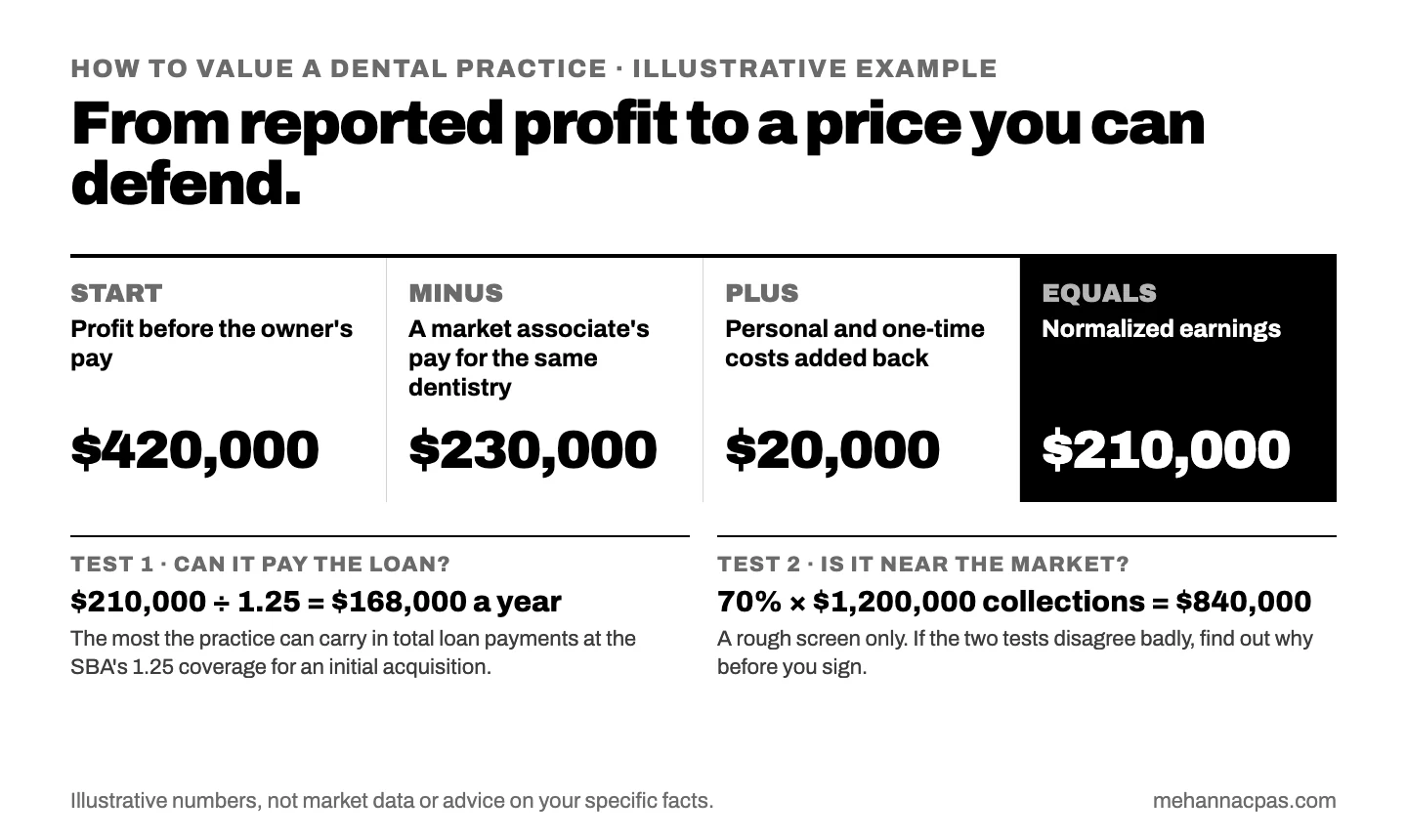
- The number that matters is normalized earnings: profit after replacing the owner’s pay with what an associate would earn for the same dentistry, and after removing personal and one-time costs.
- Since October 1, 2026, an SBA 7(a) purchase needs an independent business valuation ordered by the lender in most cases, and anything you pay above it must come from your own equity.
- The price allocation on Form 8594 changes the tax for both sides. It belongs in the negotiation, not in the closing paperwork.
- What we see most with buyers: the price gets negotiated, and the allocation and the after-loan cash flow get checked after the letter of intent is signed.
The broker’s package says the practice collected $1.2 million last year and the asking price is “in line with the market.” The bank has pre-approved you. The seller wants a letter of intent by Friday. None of that tells you whether the practice can pay your loan, pay you a real salary, and still leave something for the next CBCT.
This guide explains how to value a dental practice the way a careful buyer or seller should: what each method measures, what it misses, what changed for 2026, and what to check before anyone signs.
What is a dental practice valuation, and what isn’t it?
A dental practice valuation is an estimate of fair market value: the price a willing buyer and a willing seller would agree on, both informed and neither forced to act. That definition comes from the IRS’s long-standing guidance on valuing closely held businesses, Revenue Ruling 59-60, which the IRS’s own valuation job aid calls widely accepted as the bedrock of business valuation (IRS). The ruling is blunt: no formula fits every case, and goodwill rests on earning capacity.
A valuation covers the practice as a going concern: patient base, staff, systems, equipment and goodwill. The building is valued separately by a real estate appraiser, and the ADA notes it may carry different loan terms. People use several names for overlapping things, and they are not the same document:
| Who orders it | What it answers | Who it protects | |
|---|---|---|---|
| Broker’s opinion of value | The seller | What to list the practice for | The seller |
| Lender’s business valuation | The bank | How much debt the practice supports | The bank |
| Independent dental practice appraisal | Buyer or seller | Fair market value, with the method shown | Whoever hired it |
| Dental office appraisal (real estate) | Bank or owner | What the building and land are worth | Whoever hired it |
| Online dental practice valuation calculator | You | A rough range from a few inputs | Nobody, it can’t see your books |
Buyers sometimes call the first three “dental practice evaluations” as if they were interchangeable. Ask who each was prepared for. A number built for someone else’s decision is a starting point for yours, not an answer.
Who needs a valuation, and who can skip it?
Anyone about to put a price on a practice needs one: buyers before the letter of intent, sellers before listing, and owners planning a partner or associate buy-in. The situations we see most:
- You are an associate or a first-time buyer looking at a practice whose asking price came from the seller’s broker.
- You own one practice and are buying a second location, so the new debt sits on top of the old.
- You plan to sell in the next three to five years and assume the sale funds most of your retirement.
- An associate wants to buy in, and you need a value now that both of you will accept later.
- A DSO letter of intent arrived, and its number is built on a multiple of earnings you have never calculated yourself.
You can skip a formal valuation for now if no transaction is on the horizon and you only want to know roughly where you stand. A rough range is enough for that. If the practice sale is part of your retirement math, see how much a dentist needs to retire for how to count it: net of practice debt and tax, not at the headline price.
Why the value of a dental practice matters beyond the price
The price you agree on sets your debt, your equity check and your first five years of cash flow, and the allocation of that price sets your taxes for fifteen. Three numbers carry most of the weight.
The lender’s valuation caps your loan. Under the SBA’s current rules, total debt for a practice purchase, including seller financing that is not on full standby, is limited to the business valuation amount. If you pay more than the valuation, the difference has to come from your own equity, in addition to the 10% minimum equity injection for an initial acquisition (SBA SOP 50 10 8.1).
The cash flow has to cover the payments with room to spare. For an initial acquisition, the SBA requires debt service coverage of at least 1.25 to 1, measured as EBITDA divided by all business debt payments after the deal (SBA SOP 50 10 8.1). Conventional dental lenders set their own tests, but the logic is the same.
The allocation decides how each dollar is taxed. A practice sale is treated as a sale of each asset separately (IRS Publication 544). On Form 8594 the price is assigned in a fixed order: equipment and supplies first, then identifiable intangibles such as the patient base and a non-compete, and whatever is left goes to goodwill. Buyer and seller report the same split.
When should you get a valuation, and when is a rule of thumb enough?
Get the analysis before you sign a letter of intent, because the letter usually fixes the price and the structure that everything else is built on. After it is signed, due diligence can lower a price, but rarely restructures a deal.
- Buying: before the letter of intent, and again when the full financials arrive in due diligence.
- Selling: two to three years before you want to leave, so you have time to fix what lowers the value. The ADA notes that many dentists take years to prepare a practice for a sale.
- Buy-in or partnership: at the start, so the formula for the later buyout is agreed while everyone is friendly.
A rule of thumb is enough when you are screening listings, comparing two practices quickly, or checking whether a seller’s expectation is in the same universe as the market. It is not enough to sign anything. For the full sequence, from lender talks to the first day as owner, see what to check before buying a dental practice.
If you’re closing on a practice, come before the closing, not after. The structure decisions happen at the table.
How to value a dental practice: the methods and what each misses
Valuators typically run more than one method and weight them by the practice, according to the ADA. Here is what each one measures, in the order we look at them.
1. Percentage of collections
The shortcut most brokers start with: a year’s collections times a percentage. Industry guides commonly put general practices sold to another dentist somewhere around 60% to 85% of annual collections (Tenet; Private Practice Research, 2026). These are broker and industry ranges, not official data, and they move with the market.
The weakness is that collections are not profit. A practice collecting $1 million at 60% overhead and one at 75% overhead get the same price from this method and leave the buyer with very different paychecks. Use it to spot a price that is far off. Don’t use it to set one.
2. A multiple of normalized earnings
This is the core dental practice valuation formula: normalized earnings times a multiple. Normalizing means rebuilding profit as a new owner would see it:
- Replace the owner’s total pay with what a market associate would earn for producing the same dentistry.
- Add back personal expenses run through the practice (a car, family on payroll who don’t work there) and one-time costs (a lawsuit, a move).
- Adjust rent to market if the seller owns the building and charges the practice more or less than market.
Smaller deals often use seller’s discretionary earnings (SDE), which adds the owner’s pay back instead of replacing it. Larger deals and DSOs use EBITDA after a market dentist’s pay. The two give different multiples, so never compare a multiple without knowing which earnings it multiplies.
3. The income approach
Instead of a market multiple, the valuator capitalizes next year’s expected earnings, or discounts several years of projected cash flow, at a rate that reflects the risk. The risk factors are dental: how much production depends on the selling dentist, the hygiene department’s share, the payer mix, the fee schedule and the trend in new patients. Revenue Ruling 59-60 singles out the loss of the key person in a “one-man” business as something that lowers value, which is the solo practice question in plain terms.
4. The asset approach
Equipment, supplies, technology and leasehold improvements at fair market value. For most practices this sets a floor, not the price, because most of the value is goodwill and the patient base. It matters more for a practice with low earnings, where the buyer is mostly paying for chairs and a location.
Looking at a practice right now? Talk through the numbers before you sign the letter of intent. Bring the broker’s package, or don’t.
How we look at a practice purchase with dental owners
We start from what the practice can pay you, not from what it collects. A practice acquisition analysis is a project we scope and price on a call. The steps:
- Rebuild three to five years of earnings from the tax returns and P&Ls, and reconcile them to the practice management system’s collections and the bank deposits.
- Normalize: replace the seller’s pay with a market associate’s, strip out personal and one-time costs, set rent to market.
- Test the price both ways: against a percentage of collections and against normalized earnings times a multiple. If the two disagree badly, find out why before going further.
- Run the debt: loan payments at your real rate and term, the lender’s coverage test, and what is left for you after the payment and your own salary.
- Model the allocation: how the price splits across equipment, intangibles and goodwill, and what that does to your deductions in years one to five.
- Plan the first year: entity, owner salary, the building, and a projection so the first April has no surprise. Then the same three people stay on it all year, with a text before you sign anything big.
The price is rarely where buyers get hurt. It’s what nobody modeled: the payment on the loan plus a market salary for the new owner, measured against what the practice really earns once the seller’s personal costs come out. The second gap is the allocation, which often arrives as a schedule from the seller’s side after the price is set. Both are easier to change before the letter of intent than after it.
Which number should you trust?
Trust the number that explains its earnings and shows its method, and treat every single figure as a range. A quick way to read what you are given:
| Method | Best for | What it misses | Ask |
|---|---|---|---|
| Percentage of collections | Screening listings | Overhead, owner pay, debt | Which year’s collections, and net of refunds? |
| SDE multiple | Small, owner-run practices | That you still need a salary | What was added back, line by line? |
| EBITDA multiple | Larger practices, DSO offers | Rollover equity, earn-outs, employment terms | What dentist pay was assumed? |
| Income approach | Independent appraisals | Only as good as the projection | What growth and risk rate, and why? |
| Asset approach | Low-earning practices | Goodwill and the patient base | Fair market value or book value? |
How much is my dental practice worth?
Roughly, what its normalized earnings can support after a market salary for the dentist, cross-checked against a percentage of collections. If you are selling to a DSO, the offer is usually a multiple of EBITDA paid partly in cash and partly in rollover equity, so compare the cash at closing and the after-tax value, not the headline. Our guide to what rollover equity in a DSO offer is really worth covers that part.
Is a dental practice valuation calculator accurate?
It is accurate about the arithmetic and blind to your books. A dental practice valuation calculator multiplies the inputs you give it. It can’t see that the seller’s spouse is on payroll or that the hygiene schedule is half empty. Our freedom number calculator uses a percentage of collections for the same reason: to show a sale’s place in your retirement, not to price a deal.
Dental practice valuation checklist
Use this to see what to gather and what each item protects you from. The ADA’s own list starts with five years of tax returns and financial statements, the fee schedule, accounts receivable and the collection rate.
| Item | Why it matters | Where it comes from | Watch for |
|---|---|---|---|
| Tax returns and P&Ls, 3 to 5 years | The earnings trend behind any multiple | Seller’s CPA | Collections that don’t match deposits |
| Production and collections by provider | How much depends on the selling dentist | Practice management system | Owner producing most of the dentistry |
| Active patients, new patients, recare | Whether patients stay after the sale | Practice management system | An “active” count that includes patients not seen in years |
| Payer mix and fee schedule | What a crown actually pays | PPO contracts, fee schedule | Heavy PPO write-offs on recent contracts |
| Owner pay and add-backs | The base the multiple multiplies | Payroll, general ledger | Add-backs with no document behind them |
| Equipment list with age | What you’ll replace in year one | Seller, invoices | Imaging or sterilization near the end of its life |
| Lease or building terms | Your rent and your right to stay | Lease, appraisal | A short remaining term or above-market rent |
| Price allocation | Your deductions and the seller’s tax | Purchase agreement, Form 8594 | Most of the price in goodwill with no discussion |
If the building is part of the deal, or you are weighing whether to buy it later, run the buy vs. rent calculator separately. The practice and the real estate are two decisions.
Mistakes we’d avoid
Most expensive valuation mistakes come from trusting a number built for someone else. The ones we’d steer you away from:
- Pricing on collections alone. It tells you the size of the practice, not what it earns.
- Forgetting to pay yourself. If the earnings only cover the loan when you take no salary, the price is too high.
- Accepting add-backs on faith. Every add-back raises the price by the multiple. Ask for the receipts.
- Letting the allocation happen at closing. Equipment and goodwill are deducted on very different schedules. Negotiate the split with the price.
- Using the bank’s valuation as your diligence. It answers the bank’s question: whether the loan gets repaid. Yours is whether the practice is worth owning.
What changed for 2026
The SBA rewrote its rules for financing a practice purchase, effective October 1, 2026. The changes that matter most to a dentist buying with a 7(a) loan:
- SOP 50 10 8.1 replaced SOP 50 10 8 on October 1, 2026 (SBA Information Notice 5000-880695). The old rule that let a lender value small deals itself when the financed amount was $250,000 or less is gone. An internal valuation is now allowed only for 7(a) Small and SBA Express loans with a business purchase price of $350,000 or less.
- The independent valuation must come from an accredited appraiser (ASA, CBA, ABV, CVA or BCA), must be ordered by and prepared for the lender, and the lender may not use a valuation prepared for the buyer or the seller (SBA SOP 50 10 8.1).
- A quality of earnings report is now required on top of the valuation for initial acquisitions and expansions with a business purchase price of $3 million or more, before any equity or seller financing.
- The purchase price is measured without owner-occupied real estate, which is appraised separately, and the 10% equity injection for an initial acquisition cannot be reduced.
On the tax side, 100% bonus depreciation is permanent for property acquired after January 19, 2025 (IRS, Notice 2026-11), and the 2026 Section 179 limit is $2,560,000 (Rev. Proc. 2025-32). For a buyer, that makes the equipment line of the allocation worth more in year one, while goodwill and other section 197 intangibles are still amortized over 15 years (IRS). For a seller, gain on equipment that was already depreciated can be taxed as ordinary income under the recapture rules (IRS Publication 544).
How to tell whether the price was right
Twelve months after closing, check two numbers: debt coverage and your own pay. The practice should cover all its loan payments with room to spare, measured the way the lender measures it, while paying you at least what an associate would earn for the same dentistry. If it does both and collections held after the transition, the price worked. If one of them only works on paper, find out which assumption broke: patient retention, the fee schedule, or an add-back that wasn’t real. Year-round projections and planning calls after the purchase are part of The Treatment Plan.
Frequently asked questions
What percentage of collections is a dental practice worth?
Industry guides commonly quote general practices sold to another dentist at roughly 60% to 85% of annual collections. Where a practice lands depends on overhead, how much production depends on the owner, payer mix, equipment and location. Treat the percentage as a screen, then check it against normalized earnings.
Who should do a dental practice appraisal?
Someone who values professional practices regularly, preferably in dentistry, as the ADA recommends, and who holds a recognized credential such as ASA, ABV or CVA. If you finance with an SBA 7(a) loan, the lender orders its own valuation and can’t use one you commissioned, so yours is for your decision.
Is goodwill tax deductible when you buy a dental practice?
Yes, over time. Goodwill and other section 197 intangibles, such as the patient base and a non-compete, are generally amortized over 15 years. Equipment can often be deducted much faster through bonus depreciation or Section 179, which is why the allocation of the price matters to the buyer.
How long does a dental practice valuation take?
It depends on how quickly the seller produces documents. An independent appraisal usually needs the full financials, practice management reports and the equipment list before work starts. Ask the valuator for a timeline in writing and build it into your letter of intent and lender dates.
Should I value my practice even if I’m not selling?
If the sale is part of your retirement plan, yes, at least as a range. The ADA notes it matters most when you assume the sale will fund most of your retirement. Knowing what lowers the value gives you years to fix it.
Glossary
| Term | Meaning |
|---|---|
| Fair market value | The price a willing buyer and a willing seller would agree on, both informed and neither forced to act. |
| Collections | What the practice actually received from patients and insurers in a period, after write-offs. |
| Normalized earnings | Profit rebuilt as a new owner would see it: a market associate’s pay instead of the owner’s, without personal or one-time costs, with rent at market. |
| SDE | Seller’s discretionary earnings: profit with the owner’s pay and personal costs added back. Used for smaller practices. |
| EBITDA | Earnings before interest, taxes, depreciation and amortization. Used by lenders and DSOs. |
| Debt service coverage | EBITDA divided by all business loan payments. The SBA requires at least 1.25 for an initial acquisition. |
| Goodwill | The part of the price above the identifiable assets, tied to the practice’s earning capacity. Amortized over 15 years by the buyer. |
| Form 8594 | The IRS form where buyer and seller report how the price was allocated across asset classes. |
Sources
- U.S. Small Business Administration, SOP 50 10 8.1, Lender and Development Company Loan Programs (effective October 1, 2026): change of ownership valuation, Qualified Source, equity injection, debt service coverage, quality of earnings.
- U.S. Small Business Administration, Information Notice 5000-880695, Issuance of SOP 50 10 8.1 (2026).
- IRS, Revenue Ruling 59-60 (1959, reprinted by the American Society of Appraisers): fair market value, goodwill, key person.
- IRS, S Corporation Valuation Job Aid for IRS Valuation Professionals: Revenue Ruling 59-60 as the basis of valuation analysis.
- IRS, Instructions for Form 8594: asset classes and the residual method.
- IRS, Publication 544, Sales and Other Dispositions of Assets (2025): sale of a business asset by asset, depreciation recapture.
- IRS, Intangibles: 15-year amortization of section 197 intangibles.
- IRS, Notice 2026-11 guidance on 100% bonus depreciation (2026).
- IRS, Rev. Proc. 2025-32 (2025): 2026 Section 179 limit.
- American Dental Association, In buying or selling a dental practice, start with an accurate valuation: valuation factors, real estate valued separately.
- American Dental Association, What makes a successful sale: documents for a valuation, fair market value, multiple methods.
- Tenet, How much is a dental practice worth?: industry range for percentage of collections.
- Private Practice Research, How dental practices are valued in 2026 (2026): industry range for percentage of collections.