

CPA vs. tax preparer comes down to two things: credentials and calendar. Anyone with an IRS PTIN can prepare your return for pay, but only CPAs, enrolled agents and attorneys can represent you before the IRS in every matter. For a dental practice owner, the bigger gap is timing: a preparer records the year in April, a planning CPA changes it before December 31.
- A PTIN is a registration number, not a credential. It lets someone prepare returns for pay. It says nothing about training, and since 2016 a PTIN alone carries no right to represent you before the IRS.
- CPAs, enrolled agents and attorneys have unlimited representation rights: audits, collections and appeals. Other preparers have limited rights or none.
- Even when someone else prepares and signs it, you are accountable for every item on your return, according to the IRS.
- A CPA license doesn’t make the relationship proactive. Plenty of CPAs work like seasonal preparers. Ask what happens between May and December.
- What we see in dental practices: owners rarely leave because a return was wrong. They leave because nobody called before the decisions that shaped it.
It’s October. You just signed for a second operatory, your collections are up, and you have no idea what April will look like. You email your accountant. The reply comes in February, with an organizer and a deadline.
That accountant may be a perfectly good tax preparer. The question this guide answers is whether a practice owner needs more than that, what the CPA vs. tax preparer difference really is, how to choose a CPA, and how to switch accountants without losing a year.
What is the difference between a CPA and a tax preparer?
A tax preparer is anyone paid to prepare tax returns; a CPA is a state-licensed accountant who may also prepare returns, plan, and represent you before the IRS. Every paid preparer, CPAs included, must have a preparer tax identification number (PTIN) and enter it on your return (IRS Topic 254). Beyond that, the requirements depend on the credential.
| Credential | Who grants it | What it takes | Represent you before the IRS? |
|---|---|---|---|
| PTIN only | IRS registration | An application. No exam, no required education | No (except returns filed before 2016) |
| Annual Filing Season Program | IRS, voluntary | 18 hours of yearly education, incl. a 6-hour refresher course with a test | Limited: only returns they prepared, not appeals or collections |
| Enrolled agent (EA) | IRS license | Three-part IRS exam, 72 hours of education every 3 years | Yes, in all matters |
| CPA | State board of accountancy | Accounting degree, supervised experience, the Uniform CPA Exam, ongoing education and ethics rules | Yes, in all matters |
| Attorney | State bar | Law degree and bar exam | Yes, in all matters |
The representation column comes from the IRS: enrolled agents, CPAs and attorneys have unlimited representation rights, including audits, payment and collection issues, and appeals. Preparers in the Annual Filing Season Program can represent clients only on returns they prepared and signed, and only before revenue agents and similar IRS staff. A preparer with just a PTIN can prepare returns and nothing more (IRS).
Why so loose? In 2011 the IRS tried to require a competency exam and continuing education for all paid preparers. In 2014 a federal appeals court ruled that the IRS didn’t have the authority to do that (Loving v. IRS, D.C. Cir. 2014). The voluntary Annual Filing Season Program came after. So in most of the country, “tax preparer” is a job description, not a license.
One more distinction matters more than any of these: tax preparation vs. tax planning. Preparation reports a year that already happened. Planning changes the facts while the year is still open. A CPA can do either. Many only do the first.
Who needs a CPA, and who is fine with a tax preparer?
A good tax preparer is enough when your return is simple and your decisions are small. A W-2 associate with a mortgage, a retirement account and no side business usually doesn’t need more. Neither does a dentist whose income and life look the same every year.
A practice owner is a different case. In our experience, you have outgrown a preparer-only relationship if one of these is true:
- You own the practice, it’s taxed as an S corporation, and your W-2 salary hasn’t been revisited since it was set.
- Collections are at or above $750K and climbing, so estimates based on last year’s return keep falling short.
- You are planning equipment, a buildout, a second location, an associate, or a building purchase in the next 12 months.
- You have received an IRS or state notice and want someone who can answer it for you.
- You want to know when work could become optional, not just what you owe.
Associates looking at their first ownership move are in between. Before you sign, the structure decisions are open. After you sign, most of them are made. Our guide to what a dental CPA does that a general CPA won’t covers that choice in more depth.
Why does the choice matter for a practice owner?
Because the IRS holds you, not your preparer, responsible for the return, and because a practice owner’s tax is decided by choices made during the year. The IRS is explicit: although the preparer always signs, you’re ultimately accountable for the accuracy of every item reported (IRS Topic 254).
The second reason is income range. For 2026, the 20% qualified business income (QBI) deduction phases out for a dental practice between $403,500 and $553,500 of taxable income on a joint return (Rev. Proc. 2025-32). Many practice owners sit inside that window, where owner salary, retirement contributions and equipment timing all change the result. A preparer who sees the numbers in March can report them. Only someone who sees them in October can help you change them.
Estimates follow the same logic. If your 2025 adjusted gross income was over $150,000, paying 110% of last year’s tax avoids the underpayment penalty, but in a growth year it can still leave a large balance due in April (IRS Publication 505). Knowing that number in November is planning. Finding out in April is preparation.
When should you switch accountants, and when should you stay?
Switch when the relationship is built around the return and your practice is built around decisions. The signs you need a new accountant are usually about timing and contact, not accuracy:
- You hear from them between February and April, and almost never in the fall.
- You learn what you owe after the year has closed.
- You make big purchases first and tell them later, because there’s no one to ask.
- Questions sit unanswered for weeks, or the answer is “we’ll look at it at tax time.”
- Nobody has asked about your salary, your estimates or your retirement plan this year.
Stay if your current preparer or CPA already projects your year, calls before big decisions, and answers you within a reasonable time. A credential doesn’t make someone a proactive accountant; behavior does. An enrolled agent who plans with you all year is worth more than a CPA you only hear from in March.
Timing your switch matters too. Late in the year, some decisions close with the last payroll or on December 31. Our year-end tax planning guide for dentists lists what is still open and when each item closes.
How we work as your CPA all year
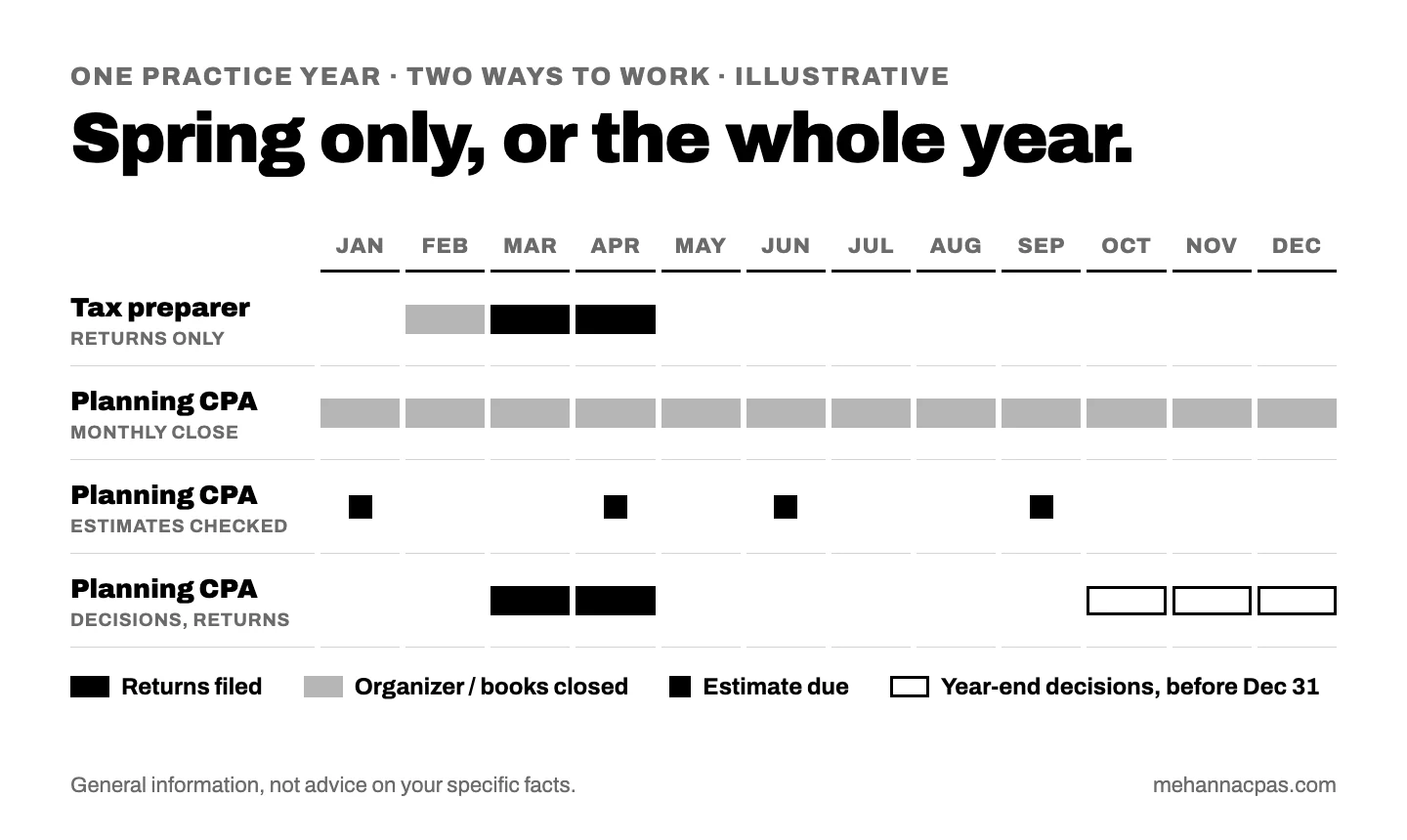
We don’t take return-only or bookkeeping-only engagements, because planning built on someone else’s books is a guess. Here is how The Treatment Plan runs for a dental practice owner:
- Same three people all year. A client advisor, a client controller and a senior accountant. You don’t re-explain your practice every April.
- Books first. Weekly bookkeeping and a monthly close on a fixed date, tied to your practice management system, so the numbers we plan with are current.
- A projection that moves with the year. We update where the year is heading as collections and expenses come in, so April’s number shows up in November.
- Planning calls with decisions. Three a year on the standard plan: owner salary, equipment timing, retirement plan design, the building, estimates.
- You text before you sign. Equipment, an associate contract, a lease, a purchase offer. We look at it before it’s done, not after.
- Then the returns. Business and personal returns, state filings and IRS notices, prepared by the same team that planned the year.
Most owners who come to us don’t have a wrong return. They have a correct return for a year nobody planned. The usual pattern: an S corp salary set at formation and never touched, estimates copied from last year in a year collections grew, and equipment bought on the rep’s timeline. None of that shows up as an error. It shows up as a bigger check in April.
Which one fits your practice?
Match the professional to the decisions you face this year, not to the size of last year’s return. This table shows what each option is built to do.
| Your situation | Tax preparer | CPA, preparation only | CPA who plans all year |
|---|---|---|---|
| W-2 associate, simple return | Usually enough | More than you need | More than you need |
| New owner, first year in practice | Risky: entity and salary decisions are open | Gets the return right | Sets the structure before the first payroll |
| Owner at $750K+ collections | Reports the year | Reports the year | Changes the year before December 31 |
| IRS audit, notice or appeal | Limited or no representation | Can represent you | Can represent you, already knows the file |
| Buying, selling or adding a location | Not built for it | Hears about it after closing | Reads the deal before you sign |
What does a CPA do for a small business?
Beyond the return, a CPA can keep or review the books, prepare financial statements, project the year, plan around entity and owner pay, and represent the business before the IRS. As licensed accountants, CPA firms can also audit or review financial statements, which a lender may ask for. For a dental practice, the useful part is usually the projection and the planning, not the paperwork.
How do you find a good CPA?
Start with referrals from owners whose practices look like yours: same size, same structure, same stage. Then verify the license with your state board of accountancy and check the IRS directory of credentialed preparers. A good CPA asks for your records and asks questions before quoting; the IRS calls that a sign of a good preparer too (IRS).
How do you choose a CPA between two good candidates?
Ask both the same question: “What will you do for me between May and December?” The answer separates a planner from a preparer faster than any credential. Also ask who your day-to-day contact will be, how fast they reply, when the books close each month, and how they price the work. Avoid anyone whose fee is a percentage of your refund (IRS Topic 254).
Not sure whether you need a preparer or a planner? Bring your last return and your current P&L, or don’t. You’ll leave knowing where you stand.
How to switch accountants without losing a year
Switching is mostly paperwork and timing; the risk is losing track of open items. In the order we’d do it:
1. Pick the moment
The cleanest switch is before a big decision or early in the fall, while the tax year can still change. Mid-year works too. The one window to avoid is the last weeks before a filing deadline, when nobody has time to transfer a file carefully.
2. Ask for your records in writing
You need prior returns, depreciation schedules, payroll filings, the general ledger and any open IRS correspondence. A CPA, enrolled agent or attorney who practices before the IRS must, at your request, promptly return the records you need to meet your federal tax obligations, and a fee dispute generally doesn’t change that (31 CFR 10.28). Your books in QuickBooks or Xero should be in an account you own.
3. Give the new CPA authority to talk to the IRS
Form 2848 authorizes someone eligible to practice before the IRS to represent you (IRS). Form 8821 lets a person or firm receive your tax information without representing you (IRS). The new firm usually prepares these for your signature; Form 8821 can also revoke prior authorizations.
4. Hand over the open items
List what is in motion: estimates already paid this year, notices waiting for a reply, extensions, elections such as the S corporation election, and anything promised to a lender. These are what fall through the cracks in a switch, not the returns.
5. Close the old relationship cleanly
Tell the old firm once the new one has your records and authorizations, and revoke the old authorizations you no longer want. A short, polite note is enough. Most transitions are routine for both sides.
CPA vs tax preparer checklist: what to check before you hire
Use this to compare candidates on the things that matter to a practice owner. Every row comes from the sections above.
| Check | Why it matters | Where to verify | Good answer |
|---|---|---|---|
| PTIN on the return | Required by law for every paid preparer | The signed return | Signed, with PTIN |
| Credential | Decides who can represent you in an audit or appeal | State board; IRS directory | CPA, EA or attorney |
| Contact outside tax season | Planning happens May to December | Ask: “What do you do for me in the fall?” | Projection and planning calls with dates |
| Who owns the books | Advice built on stale books is a guess | Ask when the books close each month | A fixed monthly close |
| Estimates | Growth years create April surprises | Ask how estimates are set | From this year’s projection, not last year’s return |
| Response time | Decisions don’t wait for tax season | Ask, then test with a real question | A named person and a clear reply window |
| Fees | Refund-based fees are a red flag | The engagement letter | A clear fee, not a share of your refund |
Mistakes we’d avoid
Most bad accountant choices come from comparing price per return instead of what happens all year. The ones we’d steer you away from:
- Treating a CPA license as proof of planning. The license proves training. Only the calendar proves planning.
- Waiting until April to switch. By then the year is closed, and the new firm inherits it as is.
- Splitting books, planning and returns across three people who never talk. Each one is right about their piece. Nobody owns the result.
- Signing a return you haven’t read. You’re accountable for it. Ask about anything you don’t understand, and never sign a blank form.
- Keeping a relationship out of guilt. A long history is a reason to have the conversation, not a reason to skip it.
What changed for 2026
Two kinds of change touch this decision: how CPAs are licensed, and how much there is to plan.
- In May 2025, the national model for state accountancy laws added a third path to a CPA license: a bachelor’s degree plus two years of experience and the CPA Exam, alongside the 150-hour and graduate-degree paths. Many states have adopted it, with effective dates through 2026 and 2027 (NASBA, 2025). The exam is the same on every path.
- 100% bonus depreciation is permanent for property acquired after January 19, 2025 (IRS, Notice 2026-11), so equipment timing is a bigger lever than it was.
- Starting in 2026, catch-up contributions for anyone with more than $150,000 of prior-year FICA wages must go in as Roth (final regulations, Federal Register), which ties your salary this year to your retirement options next year.
Each of those is a decision made during the year. That is the strongest case for a CPA who plans, not just one who prepares.
How to tell whether your CPA is actually planning
Look for three things before December 31: a projection of this year’s tax, a list of decisions with deadlines, and an estimate that matches the projection. If you can name your expected April number in November, someone is planning. If your W-2 salary was discussed this year, someone is planning. If the first conversation of the year is about an organizer, you have a preparer, whatever the letters after their name. For one example of a decision that should come up every year, see how we set an S corp reasonable salary for dentists. What a full year looks like is laid out in The Treatment Plan.
Frequently asked questions
Can a tax preparer represent me in an IRS audit?
Only partly, and only some of them. A preparer in the Annual Filing Season Program can represent you before revenue agents on a return they prepared and signed, but not in appeals or collections. A preparer with only a PTIN can’t represent you at all. CPAs, enrolled agents and attorneys can represent you in every matter.
Is an enrolled agent the same as a CPA?
No. An enrolled agent is licensed by the IRS and specializes in federal tax, with the same unlimited right to represent you before the IRS. A CPA is licensed by a state, trained in accounting and tax, and can also audit or review financial statements. For tax planning, the person’s habits matter more than which credential they hold.
My accountant is not responding. What can I do?
Put your request in writing, with a date, and ask for your records if you plan to leave. A CPA, enrolled agent or attorney must promptly return the records you need for your federal tax obligations, even during a fee dispute in most cases. A new CPA can then use Form 2848 or Form 8821 to get your information directly from the IRS.
Can I switch accountants in the middle of the year?
Yes, and mid-year is often better than April. The new firm can catch up the books, update your estimates and still plan before December 31. Bring last year’s returns, year-to-date financials, payroll reports and any IRS letters. The handoff is mostly paperwork; the open items are what need attention.
Is a CPA worth it for a small dental practice?
It depends on the decisions ahead, not on the size of the practice. A new owner choosing an entity and an owner salary for the first time has more to decide than an established practice that hasn’t changed in years. If you face a purchase, a hire, equipment or an S corp election, a planning CPA earns the conversation.
Glossary
| Term | Meaning |
|---|---|
| PTIN | Preparer tax identification number. Every paid preparer must have one and enter it on your return. It is a registration, not a credential. |
| Annual Filing Season Program | A voluntary IRS program for preparers who aren’t CPAs, EAs or attorneys: 18 hours of yearly education and limited representation rights. |
| Enrolled agent | A tax professional licensed by the IRS after a three-part exam, with unlimited representation rights. |
| Unlimited representation rights | The right to represent a taxpayer before the IRS in any matter, including audits, collections and appeals. |
| Form 2848 | A power of attorney that lets an eligible professional represent you before the IRS. |
| Form 8821 | An authorization that lets a person or firm receive your tax information without representing you. |
| Tax projection | An estimate of this year’s tax made during the year, used to plan decisions and set estimates. |
| QBI deduction | A deduction of up to 20% of qualified business income. For a dental practice it phases out between $403,500 and $553,500 of taxable income on a joint return (2026). |
Sources
- IRS, Understanding tax return preparer credentials and qualifications (updated 2026): PTIN, representation rights, EA requirements.
- IRS, Topic 254, How to choose a tax return preparer: taxpayer accountability, PTIN, fee red flags.
- IRS, Annual Filing Season Program requirements (2026): 18 hours of education, 6-hour refresher course.
- IRS, Quick tips for picking a tax pro.
- Code of Federal Regulations, 31 CFR 10.28, Return of client’s records (Circular 230).
- IRS, About Form 2848 and About Form 8821.
- U.S. Court of Appeals, D.C. Circuit, Loving v. IRS, No. 13-5061 (2014).
- IRS, Rev. Proc. 2025-32 (2025): 2026 QBI thresholds.
- IRS, Publication 505, Tax Withholding and Estimated Tax: safe harbor.
- IRS, Notice 2026-11 guidance on 100% bonus depreciation (2026).
- Federal Register, Catch-up contributions, final regulations (2025).
- NASBA, New CPA licensure pathways and CPA mobility (2025).