

A dental CPA is a licensed CPA who works mainly with dental practices, so the return, the books and the planning are read in dental terms: collections, overhead, PPO write-offs, CBCT purchases, associate pay, the building and the day you buy or sell. A general CPA can file the same return. A dental CPA calls before the decisions that change it.
- The license is the same; the calendar is different. A general CPA works mostly around the return. A dental CPA works around the practice’s decisions: equipment, owner salary, hires, a purchase, a DSO offer.
- Only CPAs, enrolled agents and attorneys can represent you before the IRS in all matters, including audits, collections and appeals. Check the credential first, then the dental experience.
- The tax rules name dentists directly: under the QBI regulations, dentistry is a health service, so the 20% deduction phases out between $403,500 and $553,500 of joint taxable income in 2026.
- Dentist earnings are down because practice expenses grew faster than revenue, according to the ADA Health Policy Institute. The numbers that move a practice are read monthly, not once a year.
- What we see with dental practices: the prior returns are usually filed correctly. What was missing is someone on the phone before the decision.
You signed for the scanner in December because the rep said the promotion ended Friday. In April, your accountant asked when it was delivered. That is the gap this guide is about.
Most practice owners don’t switch accountants because a return was wrong. They switch because the accountant only showed up once a year. This guide explains what a dental CPA does that a general CPA usually won’t, who needs one, how to choose one, and what it should cost.
What is a dental CPA, and what isn’t one?
A dental CPA is a certified public accountant whose practice is built mostly or entirely around dental offices. The CPA license comes from a state board and is the same for every CPA. What makes one a dental CPA is the client base: they have read many dental P&Ls, they know what a normal overhead percentage looks like for a general practice versus an orthodontist, and they know which decisions are coming before you do.
It is not a separate license, and it is not the same as a bookkeeper or a tax preparer who has some dental clients. The words get mixed up in search results, so here is how the roles differ.
| Role | What they do | Can represent you before the IRS? | Dental focus |
|---|---|---|---|
| Bookkeeper | Codes transactions, reconciles accounts, closes the month | No | Sometimes |
| Tax preparer (no credential) | Prepares and signs returns with a PTIN | Only limited rights, on returns they prepared | Rarely |
| Enrolled agent | Prepares returns and represents taxpayers; federally authorized | Yes, in all matters | Sometimes |
| General CPA | Returns, books and advice for many industries; state licensed | Yes, in all matters | One industry among many |
| Dental CPA | Returns, books and planning built around dental practices | Yes, in all matters | Most or all clients are dentists |
The representation column comes straight from the IRS: only attorneys, CPAs and enrolled agents can represent taxpayers in all matters, including audits, collections and appeals (IRS Topic 254). Preparers without one of those credentials have limited rights (IRS). The IRS also keeps a public directory where you can check a preparer’s credential.
The other column, dental focus, is the one that changes your year. Dental accountants and general accountants can both be very good at taxes. The difference is how many times they have already seen your exact decision.
Who needs an accountant for dentists, and who can skip one?
A dental practice accountant pays off most for owners whose decisions are getting bigger than the return. In our experience, that usually looks like one of these:
- You own the practice, collections are at or above $750K, and nobody has looked at your owner salary since the S corp was set up.
- You are about to buy a practice, add a second location or bring in an associate.
- You own your building, or you are deciding whether to buy it.
- You are planning a CBCT, a buildout or a big equipment purchase in the next 12 months.
- You have a DSO offer, or you expect one, and you want to know what it is worth after tax.
You can skip a specialist if you are a W-2 associate with a simple return. Your employer runs payroll and the retirement plan, and a good tax preparer is usually enough. You may also be fine with a general CPA if your practice is stable, your CPA calls you before the big decisions, and you understand your numbers. That last part is the real test. If you want the longer version of who we work best with, our ideal client page says it plainly.
Why does a dental specialist matter more now?
Because the margin in dentistry is getting thinner and the tax rules treat dentists as their own category. Both make the routine decisions more expensive to get wrong.
The ADA Health Policy Institute’s 2025 workforce report found that dentist earnings are down because practice expenses have outpaced revenues, and that net income for general dentists dropped across all career stages between 2023 and 2024. The same report shows practice ownership falling from 85% of dentists in 2005 to 73% in 2023, and the share of dentists affiliated with a DSO rising from 7.2% in 2015 to 16.1% in 2024 (ADA HPI, 2025). Owners are working with thinner margins, and more of them are fielding offers to sell.
On the tax side, the rules name dentists directly. The QBI regulations define services in the field of health as including those performed by physicians, pharmacists, nurses, dentists and similar professionals (26 CFR 1.199A-5). That makes a dental practice a specified service business. For 2026, the 20% QBI deduction phases out for a married couple between $403,500 and $553,500 of taxable income (Rev. Proc. 2025-32). Many practice owners land right inside that range, which is exactly where a deduction is worth the most and timing matters the most. Our guide on how dentists reduce taxable income walks through why.
When should you switch to a dental CPA, and when should you stay?
Switch before a big decision, not after it. The best moments are the ones where the structure is still open: before you sign for a practice, before you buy the building, before you hire an associate, before you answer a DSO, and in the fall, while the tax year can still change.
The signs that you have outgrown your current accountant are usually about timing, not accuracy:
- You hear from them in March and April, and almost never in October.
- You find out what you owe after the year has closed.
- Your financial statements arrive late, or arrive and nobody explains them.
- They ask you what a normal overhead percentage is, instead of telling you where yours stands.
Stay if your CPA already projects your year, calls you before you sign anything big, and can tell you how your practice compares to other practices like it. The specialty matters less than the behavior. A general CPA who does all of that is worth keeping. If the choice on your desk is a CPA or a cheaper preparer, our guide to CPA vs. tax preparer for practice owners covers what each one can and can’t do.
If you are switching late in the year, timing matters. Some year-end decisions close on December 31, and a new CPA needs a few weeks to get your books current. Our year-end tax planning guide for dentists lists what is still open and when each item closes.
What does a dental CPA do that a general CPA won’t?
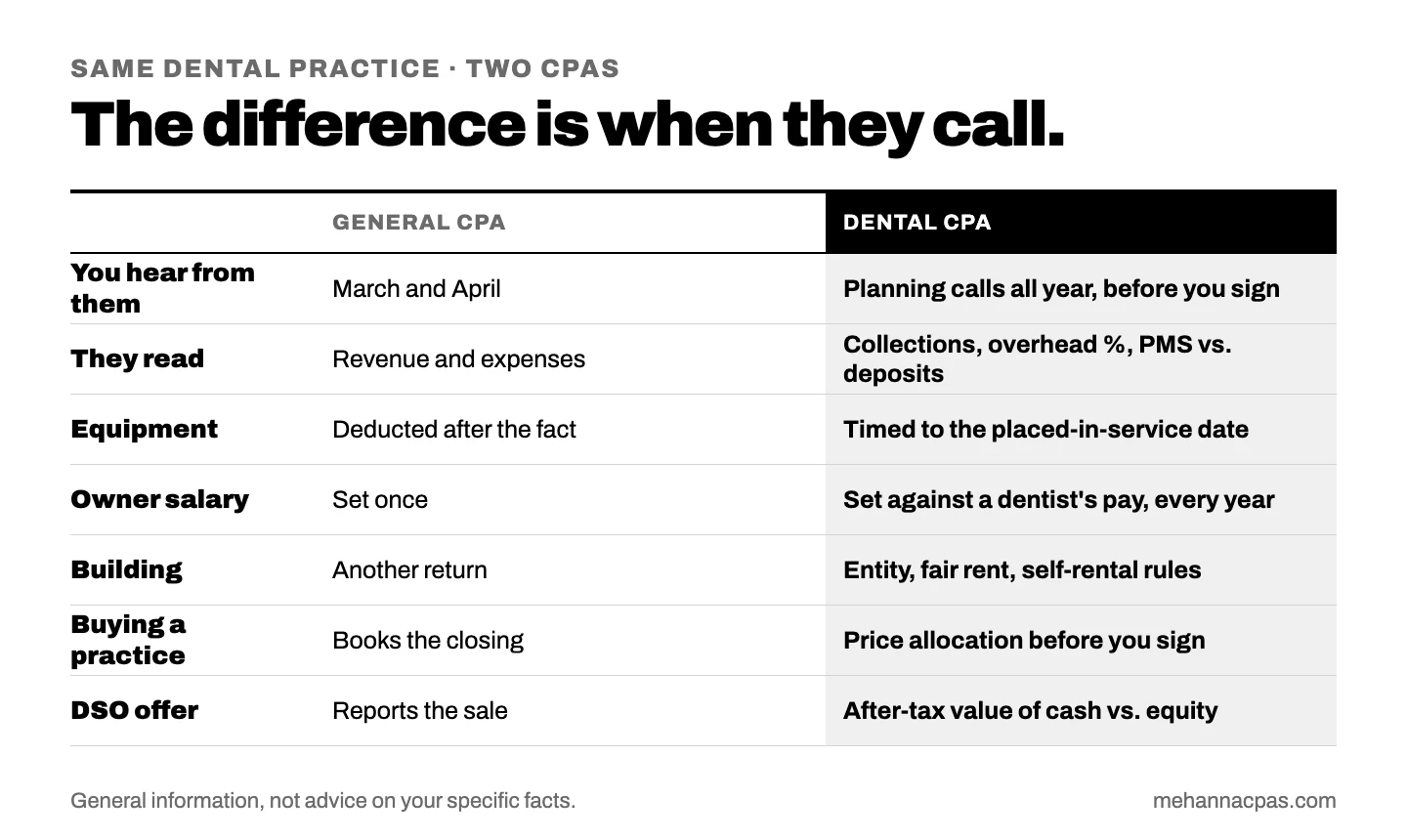
The return looks the same. The difference is what gets decided before it. These are the dental CPA services that tend to separate a specialist from a generalist. A general CPA can do any of them; a dental CPA does them by default.
1. Reads your practice in dental numbers
A dental CPA reads the P&L the way a practice runs: collections, not revenue; overhead percentage, not just total expenses; production per provider; the hygiene department; the collections ratio; what PPO write-offs do to your margin. A general CPA sees a service business. A dental CPA sees a fee schedule, a hygiene schedule and a supply line that has crept up two points this year.
2. Ties the practice management system to the bank
Your practice management system says what was collected. The bank says what arrived. A dental practice accountant knows the PMS reports and matches the two, because the gap between them is where billing errors and, in the worst case, embezzlement hide. A generalist usually codes what hits the bank account and never opens the PMS.
3. Sets the owner salary for a dentist, not for a generic owner
If your practice is an S corporation, you have to take a reasonable salary before taking distributions (IRS). What is reasonable depends on what a dentist doing your work would be paid. Inside the QBI phase-out range, W-2 wages also feed into how the deduction is calculated. A dental CPA sets the salary against the practice’s numbers and revisits it every year.
4. Times equipment to the tax year
For 2026, the Section 179 limit is $2,560,000 (Rev. Proc. 2025-32), and equipment counts in the year it is placed in service, meaning ready and available for its specific use (IRS Publication 946). A CBCT delivered on December 28 but not installed until January may fall in the wrong year. A dental CPA asks about delivery and install dates before you sign, not after.
5. Designs the retirement plan around a dental staff
For 2026, you can defer $24,500 into a 401(k), and total contributions per person can reach $72,000 (IRS Notice 2025-67). The owner’s share of the profit-sharing side depends on the staff: hygienists, assistants and front desk, their ages and their pay. A dental CPA has seen enough dental staff censuses to know which plan designs pass testing and what they cost.
6. Handles the building as its own decision
Many owners hold their building in a separate entity and rent it to the practice. The IRS treats net rental income from property you rent to a business you materially participate in as nonpassive income (IRS Publication 925), which changes how it interacts with losses from other rentals. Rent set at fair market value, a lease on paper and the right depreciation schedule are routine for a dental CPA and easy to miss for anyone else.
7. Structures a practice purchase before closing
When you buy a practice’s assets, buyer and seller both report how the price is split on Form 8594, and goodwill sits in its own class (IRS Form 8594 instructions). Goodwill and other section 197 intangibles are generally amortized over 15 years (IRS), while equipment can often be deducted much faster. That makes the allocation one of the biggest tax decisions in the deal, and it is set in the purchase agreement. Come before the closing, not after.
8. Gets associate pay right
Paying an associate on a 1099 is a classification decision, not a preference. The IRS looks at behavioral control, financial control and the type of relationship (IRS). A dental CPA has seen many associate agreements and knows which terms point to an employee.
9. Reads a DSO offer after tax
A DSO offer usually combines cash at closing, rollover equity and an employment agreement. Each piece is taxed differently and paid on a different timeline. A dental CPA can tell you what the offer is worth to you after tax, and what you are agreeing to work for in the years after the sale.
How we work as a dental CPA firm
We start from your year, not from your return. Mehanna Advisors is a CPA firm that works only with dental practice owners, founded by Bilal Mehanna, CPA, who is married to a dentist and built the firm her practice couldn’t find. The process, as we run it:
- Get the books current. Weekly coding, reconciliations and a monthly close on a fixed date, with the practice management system tied to deposits.
- Project the year. Where taxable income will land, against the brackets and the QBI range, before the year closes.
- Fix the structure. Entity, owner salary and the retirement plan, because everything else is calculated on top of them.
- Put the big decisions on a calendar. Equipment, buildouts, the building, hires and purchases, timed to the tax year they help most.
- Talk before you sign. Three planning calls a year, plus a text before you sign anything big.
- File the returns. Practice, personal and building entity, done by the same people who did the planning.
Every client gets the same three people all year: a client advisor, a client controller and a senior accountant. One plan, not a menu, because advice built on someone else’s books is a guess.
When a practice owner moves to us from a general CPA, the old returns are usually fine. What we find is a pattern of decisions made before anyone called: an S corp salary set once and never revisited, a building bought without thinking about which entity should own it, equipment signed in a vendor’s December promotion and placed in service in January. None of these is a filing error. Each one is a conversation that didn’t happen in time.
How to choose a dental CPA: which questions sort them out?
Ask about the calendar, not just the credentials. Every firm on page one of a search will tell you it knows dentistry. These questions show whether it works that way.
| Ask | A good answer sounds like | A red flag |
|---|---|---|
| How many of your clients are dental practices? | Most or all, with owners at your size | “We do all kinds of medical and dental” |
| When will I hear from you outside tax season? | Scheduled planning calls, plus a call before big purchases | “Just reach out whenever you need us” |
| Who does my books? | The same team that does the planning and the returns | “Your bookkeeper sends us the file in March” |
| Will I see a projection before December? | Yes, with the tax and the decisions still open | “We’ll know when we file” |
| How do you price? | A fixed monthly fee with a written scope | Hourly, with no estimate |
| Who exactly works on my account? | Named people who stay on it all year | “Whoever is available” |
| What would you look at first in my practice? | Owner salary, retirement plan, upcoming purchases | A list of deductions, before seeing your numbers |
What should I ask a dental CPA before hiring?
Start with the three questions that predict the year: how many dental clients they serve, when you will hear from them outside tax season, and whether the same team does your books, planning and returns. Then ask what they would look at first. A firm that answers with a savings number before seeing your return is selling, not planning.
Are dental accounting firms better than a large CPA firm?
Not automatically. A large firm can have a strong dental team, and a small dental CPA firm can be stretched thin. Compare the team that would actually work on your account, how often they would talk to you, and how many practices like yours they already serve.
What do the best dental accountants have in common?
They call first. The best CPA for dentists projects the year before it closes, explains the numbers in dental terms, and is on the phone before you sign for equipment, a building or a practice. They also tell you when a strategy isn’t worth it for you.
Want to know what a dental CPA would cost for your practice before you talk to anyone? Our plan is priced in the open. Answer a few questions and see your number.
How much does a dental CPA cost?
It depends on what is included, so compare the scope before the price. Some dental accounting services are billed hourly, some as a fee per return, and some as one monthly fee that covers books, planning and returns. A low fee that leaves out bookkeeping or planning calls is not cheaper if you still have to buy those somewhere else.
Questions that make two quotes comparable:
- Does the fee include monthly bookkeeping and a monthly close, or only the year-end return?
- How many planning calls are included, and is a projection part of them?
- Are the personal return and the building entity’s return included?
- Is payroll included or separate?
- What triggers an extra charge: a second location, a second entity, a purchase?
Our own pricing is public. The Treatment Plan starts at $997 a month for practices under three years old and under $750K in collections, and the price goes up with collections, locations and entities. You can see your exact number on the pricing page without a call. Whatever firm you choose, ask for one number for your situation and a written list of what it covers.
Dental CPA checklist: what to check before you switch
Use this to compare your current accountant with a dental CPA firm. Every row is something you can see or ask about this week.
| Check | Why it matters | Where to see it | What to bring |
|---|---|---|---|
| Credential | Only CPAs, enrolled agents and attorneys can represent you in all IRS matters | IRS preparer directory, state board | The firm’s name and the CPA’s name |
| Dental client base | Experience with your exact decisions | Ask how many clients are dental practices | Your collections and practice type |
| Owner salary | Payroll tax and the QBI calculation depend on it | Your W-2 and last year’s return | Year-to-date P&L, current salary |
| Projection | Decisions close on December 31 | Ask for one before the fourth quarter | Books through last month |
| Equipment timing | The deduction follows the placed-in-service date | Quote, delivery and install dates | Vendor quotes for the next 12 months |
| Retirement plan | Plan design depends on your staff | Plan documents, last testing results | Staff census: ages and pay |
| Building | Rent, entity and depreciation rules are specific | Lease, building entity return | Closing statement, lease |
| Practice purchase or sale | The price allocation is set in the agreement | Letter of intent, draft purchase agreement | Seller’s last three years of returns |
| Fee and scope | Quotes are only comparable with the same scope | Written proposal | Your current invoices |
Mistakes we’d avoid
Most of the expensive mistakes in choosing an accountant come from judging the return instead of the year. The ones we’d steer you away from:
- Hiring for the savings number. Anyone can promise one. A firm that leads with it before seeing your books is guessing.
- Splitting books, planning and returns across three firms. Advice built on someone else’s books is a guess, and each firm will assume the others caught the problem.
- Switching after the big decision. The structure of a purchase, a building or a DSO deal is set at the table. Come before the closing, not after.
- Choosing on the hourly rate. The cheapest hour can still be the most expensive year if nobody calls before you sign.
- Taking “we do lots of dentists” at face value. Ask how many, at what size, and who would actually work on your account.
What changed for 2026
The One Big Beautiful Bill Act, signed July 4, 2025, made several rules that dental CPAs plan around permanent, and moved the limits. The changes that matter most when you are choosing who plans your year:
- 100% bonus depreciation is permanent for property acquired after January 19, 2025 (IRS), and the Section 179 limit is $2,560,000 for 2026 (Rev. Proc. 2025-32). Equipment timing is a bigger decision than it was.
- The QBI deduction is permanent, with a new $400 minimum deduction for owners with at least $1,000 of qualified business income from an active business, starting with 2026 (IRS). The phase-out range for a dental practice on a joint return is $403,500 to $553,500.
- Retirement limits rose for 2026: $24,500 for 401(k) deferrals and $72,000 in total per person in a defined contribution plan (IRS Notice 2025-67).
On the industry side, the ADA Health Policy Institute’s August 2025 report put DSO affiliation at 16.1% of dentists in 2024, more than double the 2015 share (ADA HPI). More owners will be reading offers, and an offer is a tax question before it is a career question.
How to tell whether your dental CPA is working
You should know your number before the year ends, and you should have heard from your CPA before every big decision. Three checks:
- The projection. By the fall, you have a written estimate of this year’s tax and the decisions that could still change it. April’s number shows up in November.
- The calls. Count them. Planning calls on the calendar, plus a call before you signed for equipment, a lease or a hire.
- The numbers. Monthly financials arrive on a fixed date and someone explains them: collections, overhead percentage and what changed.
If the only time you hear from your accountant is when they need documents, the planning isn’t happening. Projections all year, three planning calls and a text before you sign are what’s included in The Treatment Plan.
Frequently asked questions
Is a dental CPA a different license from a regular CPA?
No. Every CPA is licensed by a state board, and the license is the same. “Dental CPA” describes the client base: a CPA or CPA firm whose clients are mostly or only dental practices. Check the license with the state board, then ask how many of their clients are dentists.
Do I need a tax accountant for dentists if my practice is small?
Not always. If you are a W-2 associate, or a new owner with simple books, a good general CPA or enrolled agent may be enough. A dental specialist pays off when the decisions get bigger: buying a practice, an S corp salary, a building, an associate or a large equipment purchase.
Can a dental CPA work with me if I’m in another state?
Usually, yes. Most of the work runs through cloud bookkeeping, shared documents and calls, and many dental CPA firms serve owners nationally. Ask whether the firm already files in your state and how it handles state returns if you have more than one location.
When is the best time to switch CPAs?
Before a big decision, or early enough in the year to plan it. A new firm needs time to get the books current and build a projection. Switching in the fall can still help with the current year, but some decisions close on December 31, so the earlier the better.
What does a dental CPA firm need from me to start?
Usually your last two years of business and personal returns, a current P&L, access to the bookkeeping file and bank feeds, payroll reports, and any loan, lease or purchase documents. Bring your last return and your current P&L, or don’t. You should still leave the first call knowing where you stand.
Glossary
| Term | Meaning |
|---|---|
| Dental CPA | A licensed CPA, or CPA firm, whose clients are mostly or only dental practices. |
| Enrolled agent | A tax professional authorized by the IRS to represent taxpayers in all matters. |
| Overhead percentage | Practice expenses as a share of collections. |
| Reasonable salary | The W-2 pay an S corporation owner must take for the work they do before taking distributions. |
| QBI deduction | A deduction of up to 20% of qualified business income from a pass-through business. For a dental practice it phases out between $403,500 and $553,500 of taxable income on a joint return (2026). |
| Placed in service | Ready and available for its specific use. The date that decides which year equipment is deducted. |
| Form 8594 | The form buyer and seller file to report how the price of a practice’s assets is allocated, including goodwill. |
| Rollover equity | Part of a DSO sale price paid as ownership in the buyer instead of cash. |
Sources
- IRS, Topic 254, How to choose a tax return preparer: who can represent taxpayers in all matters.
- IRS, Understanding tax return preparer credentials and qualifications: unlimited vs. limited representation rights.
- ADA Health Policy Institute, The U.S. Dentist Workforce, 2025 update (2025): earnings, practice ownership 2005 to 2023, DSO affiliation 2015 to 2024.
- eCFR, 26 CFR 1.199A-5: dentists in the definition of services in the field of health.
- IRS, Rev. Proc. 2025-32 (2025): 2026 Section 179 limit and QBI thresholds.
- IRS, Qualified business income deduction: minimum deduction for tax years beginning after 2025.
- IRS, Notice 2025-67 (2025): 2026 401(k) and defined contribution limits.
- IRS, Guidance on 100% bonus depreciation (2026).
- IRS, Publication 946, How to Depreciate Property: placed in service.
- IRS, S corporation compensation and medical insurance issues: reasonable compensation.
- IRS, Publication 925, Passive Activity and At-Risk Rules (2025): rental of property to a nonpassive activity.
- IRS, Instructions for Form 8594: asset classes in a business purchase, goodwill.
- IRS, Intangibles: 15-year amortization of section 197 intangibles.
- IRS, Independent contractor or employee?: the three categories of evidence.