

Year-end tax planning for dentists means changing the facts of your practice before December 31 so this year’s return reflects them. For 2026, the moves still open are your W-2 salary, equipment placed in service, retirement plan design, kids on payroll, health insurance on your W-2, and your last estimate. Most close by mid-December.
- To change the tax, you have to change the facts. Tax prep records the year. Planning changes it while there is still time.
- Equipment counts in the year it is placed in service, not the year you sign. For 2026, the Section 179 limit is $2,560,000 and 100% bonus depreciation is permanent.
- Owner salary, health insurance on your W-2 and 401(k) deferrals all close at the last payroll of the year. A new profit-sharing or cash balance plan can usually still be adopted after December 31.
- The finding we see most in dental S corporations: an owner salary set the year the practice opened and never touched since.
- Before December 15, it’s planning. After that, it’s triage.
December is when the equipment rep calls. The CBCT is on promotion, the financing is approved, and the pitch ends with “and you can write the whole thing off this year.” Maybe. That depends on when the machine is installed, how your practice is taxed, and what else is already on this year’s return. Those facts still have a few weeks to change. In January, they don’t.
This guide covers the year-end tax strategies still open to a dental practice owner for 2026: what each one needs, its real deadline, and when to skip it.
What is year-end tax planning, and what isn’t it?
Year-end tax planning is a projection of this year’s tax, made while the year is still open, followed by decisions that change it. You estimate where the practice will land, see what the return would look like, then decide on salary, equipment, retirement contributions and payroll before their deadlines pass.
It is not tax preparation. Tax prep happens in March or April and records what already happened. By then, almost every number on the return is fixed. A good preparer gets it right. Only planning can change it.
| Tax preparation | Year-end tax planning | |
|---|---|---|
| When | After the year closes | Before December 31 |
| What it does | Records what happened | Changes what happens |
| Your salary | Already paid | Still adjustable at the last payroll |
| Equipment | Deducted if it happened to be in service | Timed so it is in service |
| Your April number | A surprise | Known in November |
It is also not a list of last minute tax deductions found online. A strategy that only exists on paper rarely survives contact with the rules. The common one in dentistry is a management company or second entity that bills your own practice to “move income out.” When two companies share an owner, the tax code treats them as one.
Who should do year-end planning, and who can skip it?
It pays the most when this year looks different from last year, or when a big decision is still pending. In dental practices, that usually means one of these:
- You own the practice and collections grew this year, so estimates based on last year’s return are probably short.
- Your practice is an S corporation and nobody has looked at your W-2 salary since the year you opened.
- You are considering equipment over $25,000 before December 31: a CBCT, an intraoral scanner, a new operatory.
- You have children old enough to do real work in the practice.
- You want to put away more for retirement than your 401(k) allows.
You can skip most of this if you are an associate paid on a W-2. Your employer controls payroll and the retirement plan, and the decision that matters for you is the offer itself. Our W2 vs. 1099 calculator compares two offers after tax. If the practice will show a loss this year, pulling deductions into 2026 may be worth less than it looks. That is a conversation about next year, not a December rush.
Why the deadline matters for a dental practice
Most year-end moves are tied to a date, not to the return. Payroll decisions close with the last payroll. Equipment counts only if it is in service by December 31. Gifts count in the year they leave your account. The return in April can only report them.
The stakes rise with income. For 2026, a married couple filing jointly pays 32% federal tax on taxable income above $403,550 and 37% above $768,700 (IRS, Rev. Proc. 2025-32). Dentistry also counts as a health service under the tax code, so the 20% qualified business income (QBI) deduction starts phasing out at $403,500 of taxable income on a joint return and is gone at $553,500. For many practice owners, that is exactly the range where a few December decisions move the number most.
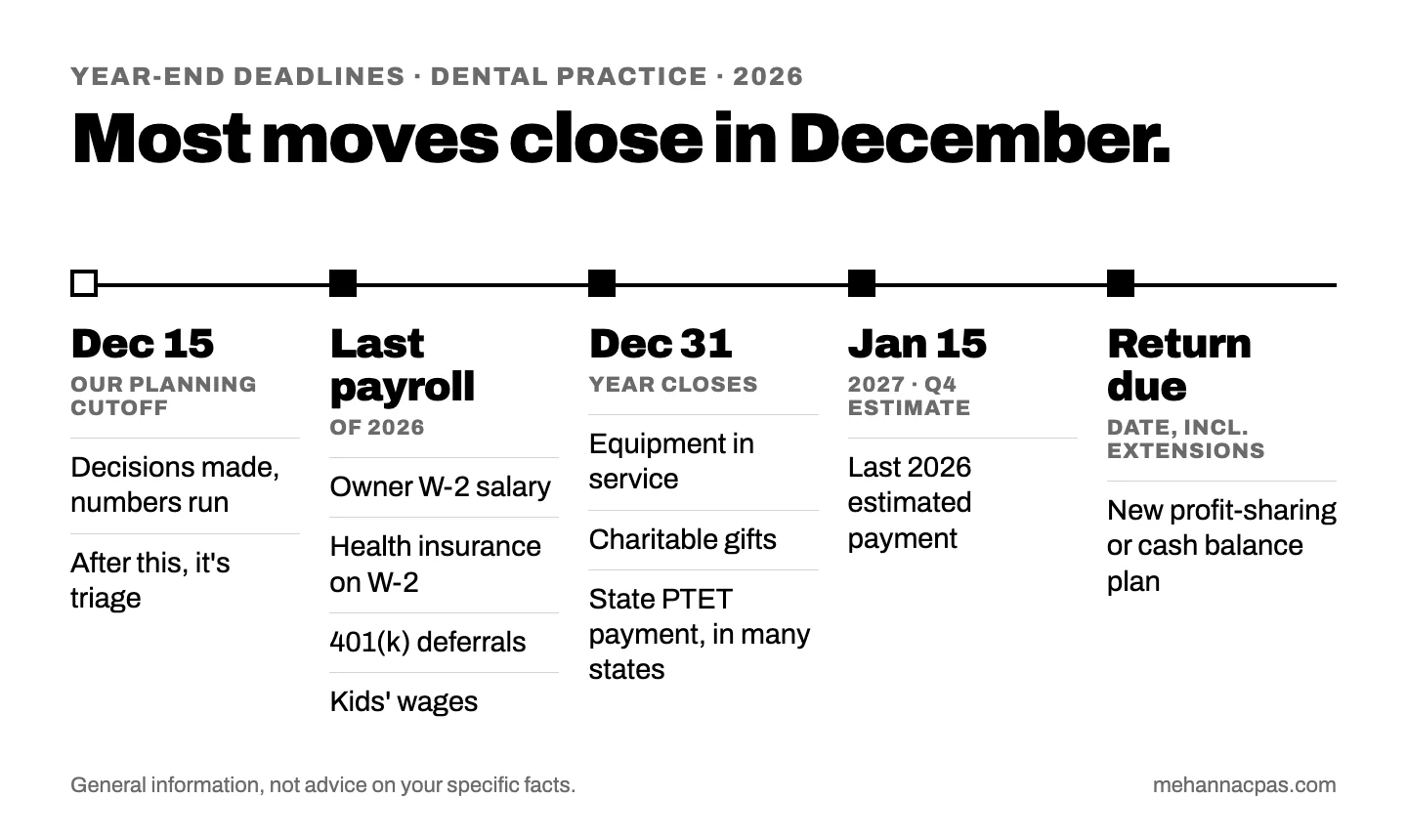
We use December 15 as our own cutoff. Anything decided after it has to fit inside the last payroll and the last bank transfers of the year, which leaves no room to do it carefully.
The year-end tax strategies still open for 2026
Eight moves, in the order we look at them. Not every one fits every practice. The checklist after the list shows who each one fits and when it closes.
1. Set your W-2 salary before the last payroll
If your practice is an S corporation, you pay yourself a W-2 salary and take the rest as distributions. The IRS requires reasonable compensation for the work you do before any distributions (IRS). Too low invites a reclassification. Too high costs payroll tax for nothing. Above the QBI threshold, your salary also changes the deduction.
The number should come from what a dentist doing your work would be paid, not from what your first accountant picked. It has to be set before the final payroll of the year, because salary paid in January is next year’s salary.
2. Put your health insurance on your W-2
If you own more than 2% of an S corporation and the practice pays your health insurance, the premiums belong in Box 1 of your W-2. They are not subject to Social Security or Medicare tax. That entry is what lets you take the self-employed health insurance deduction on your personal return (IRS). It has to be in place before W-2s are produced, so it gets handled with the last payroll.
3. Place equipment in service by December 31
Equipment is deducted in the year it is placed in service, meaning ready and available for its specific use (IRS Publication 946). A CBCT signed for on December 20 and installed on January 8 is a 2027 deduction. Delivered in its crate is not the same as ready to use.
Once it is in service, 2026 is generous. The Section 179 limit is $2,560,000, reduced once total purchases pass $4,090,000 (Rev. Proc. 2025-32), and 100% bonus depreciation is now permanent for property acquired after January 19, 2025 (IRS, Notice 2026-11). Financing doesn’t change the timing: a financed machine in service in December can be deducted this year even though most payments come later.
The deduction is not a reason to buy. At the 37% bracket, a $150,000 machine reduces federal tax by at most $55,500, and you still spent $150,000. Buy it because the practice needs it. Then time it.
Not sure which of these apply to your practice? The year-end check walks through them and shows a rough range for each. Free, and about eight minutes.
4. Use the retirement plan, and check its design
For 2026, you can defer $24,500 into a 401(k), plus a catch-up of $8,000 at age 50 or older, or $11,250 at ages 60 to 63. Employee and employer contributions together can reach $72,000 per person before catch-up (IRS).
Two details catch practice owners. First, salary deferrals come out of paychecks, so they have to run through payroll by the last pay date of the year. Second, if your FICA wages from the practice were over $150,000 in 2025, any catch-up contribution in 2026 must go in as Roth (final regulations, Federal Register).
The employer side has more room and more time. Since the SECURE Act, a practice can generally adopt a new profit-sharing or cash balance plan after year end, up to its tax return due date, and still use it for that year (Senate HELP Committee summary). A cash balance plan can let an owner in their 50s put away far more than a 401(k) allows, but it also requires contributions for staff and an actuary every year. Design it with your staff census in hand, not in a hurry. How much to put away depends on when you want work to become optional, which is what the freedom number answers.
5. Put your kids on payroll, for real work
Wages paid to your child for real work are a business expense and can fund a Roth IRA in their name. If the practice is a sole proprietorship, or a partnership owned only by the child’s parents, wages to a child under 18 are not subject to Social Security and Medicare tax (IRS). In an S corporation that exemption does not apply: payroll taxes are due like for any other employee.
The work has to be real and the pay reasonable for it: filing, cleaning, social media, front desk on a Saturday. Keep timesheets and pay through payroll, not cash. A paycheck for work nobody can describe is how this strategy ends up in an audit.
6. Check your fourth-quarter estimate
The last 2026 estimated payment is due January 15, 2027. You avoid an underpayment penalty if withholding and estimates cover 90% of this year’s tax, or 100% of last year’s, or 110% if your 2025 adjusted gross income was over $150,000 (IRS Publication 505). In a growth year, estimates built on last year’s return avoid the penalty but leave a large check for April. The projection tells you which situation you are in.
One option most owners never hear about: federal income tax withheld from wages is treated as paid evenly through the year, even if it comes out of December’s paycheck (IRS Publication 505). If you are behind, extra withholding on the last payroll can cover the gap for the whole year.
7. Give the way the 2026 rules reward
Charitable deductions changed this year. If you itemize, only giving above 0.5% of your adjusted gross income counts, and in the 37% bracket each deducted dollar is worth at most 35 cents. If you take the standard deduction, you can now deduct up to $1,000 of cash gifts, or $2,000 on a joint return (Greenberg Traurig, 2025). For owners who give every year, the questions are what to give (appreciated stock instead of cash, for example) and which year to concentrate it in. A gift counts in the year it leaves your account, so December 31 is a hard date.
8. Ask whether your state’s pass-through entity tax fits
The federal cap on state and local tax deductions rose to $40,400 for 2026, but it shrinks by 30% of modified AGI above $505,000 and is back to $10,000 at about $606,000 (Fidelity). Many states let an S corporation or partnership pay state income tax at the entity level instead, where the federal cap does not apply (IRS Notice 2020-75). The election, the deadline and the payment rules are set state by state, and some states require the payment by December 31 for it to count this year.
Three findings come up again and again. An S corp salary set the year the practice opened and never touched, which is the first thing an auditor pulls in a dental S corp file. Equipment math run by the rep who sells the equipment, not by anyone who sees the whole return. And a management company set up to move income out of the practice that doesn’t hold up once someone reads the rules.
Year-end tax planning checklist for 2026
Use this to see which moves are yours and when each one closes. “Bring” is what makes the decision fast; you don’t need all of it to start.
| Move | Fits you if | Closes | Bring |
|---|---|---|---|
| W-2 salary | You own an S corporation | Last payroll of 2026 | Year-to-date P&L, current salary |
| Health insurance on W-2 | You own over 2% of an S corp and it pays your premiums | Last payroll of 2026 | Premium statements |
| Equipment | A purchase over $25,000 is planned | In service by December 31 | Quote, delivery and install dates |
| 401(k) deferrals | The practice has a 401(k) | Last payroll of 2026 | Year-to-date deferrals |
| Profit-sharing or cash balance plan | You want to put away more than a 401(k) allows | Practice tax return due date | Staff census: ages and pay |
| Kids on payroll | Your children can do real work | Last payroll of 2026 | Job description, timesheets |
| Fourth-quarter estimate | Collections grew, or you don’t know your April number | January 15, 2027 | 2025 return, year-to-date numbers |
| Charitable gifts | You give every year | December 31 | Planned gifts, brokerage account |
| Pass-through entity tax | Your state offers it and you own an S corp or partnership | Set by your state | Last state return, projection |
Mistakes we’d avoid
Most expensive December mistakes come from deciding fast with half the numbers. The ones we’d steer you away from:
- Buying for the deduction. A deduction returns a fraction of what you spend. If the practice doesn’t need the machine, keeping the cash is the better tax plan.
- Signing in December, installing in January. Ask for the install date in writing before you sign, and plan as if it slips a week.
- Paper-only strategies. If nothing about how the practice operates changes, the tax usually doesn’t either.
- Paying estimates off last year’s return in a growth year without knowing what April will look like.
- Waiting for your CPA to call in March. By then the year is closed. The CPA should call you first, and in November.
What changed for 2026
The One Big Beautiful Bill Act, signed July 4, 2025, changed several year-end numbers. The ones that matter most to a dental practice owner:
- 100% bonus depreciation is permanent for property acquired after January 19, 2025 (IRS, Notice 2026-11).
- The Section 179 limit is $2,560,000 for 2026, reduced above $4,090,000 of purchases (Rev. Proc. 2025-32).
- The SALT cap is $40,400 for 2026, reduced above $505,000 of modified AGI but never below $10,000.
- Charitable gifts: a 0.5% of AGI floor for itemizers, a 35% cap on the value of deductions in the top bracket, and a new $1,000 or $2,000 deduction for people who don’t itemize.
- The QBI deduction is permanent, with a new $400 minimum for owners with at least $1,000 of qualified business income (Rev. Proc. 2025-32).
Separately, two retirement rules take effect this year: the 401(k) limit rose to $24,500, and catch-up contributions for anyone with more than $150,000 of 2025 FICA wages must be Roth.
How to tell whether your year-end planning worked
Compare two numbers: your projected 2026 federal tax before your decisions and after them. The difference is what planning changed. Then check that your fourth-quarter estimate matches the new projection, so April holds no surprise. If nobody can show you both numbers in November, the planning didn’t happen. Projections all year, not just in December, are part of The Treatment Plan.
Frequently asked questions
Is it too late for year-end tax planning in December?
No, but the options shrink every week. Payroll moves need time to run through the last payroll, and equipment has to be installed, not just ordered. We treat December 15 as the practical cutoff: before it, it’s planning; after it, it’s triage. The January estimate and a new employer retirement plan stay open longer.
Can I buy equipment on December 31 and deduct it for 2026?
Only if it is placed in service, meaning ready and available for its use, by December 31. Paying or signing that day is not enough. If the machine is installed and working, its full cost can generally be deducted for 2026 under Section 179 or bonus depreciation, even if it is financed.
Does a dental practice qualify for the QBI deduction?
Yes, below an income limit. Dentistry counts as a health service, so for 2026 the 20% deduction phases out between $403,500 and $553,500 of taxable income on a joint return, and above that it is gone. Below $403,500 it works like it does for any other business.
Can I still open a retirement plan for 2026 after December 31?
Generally yes for employer-funded plans, such as profit-sharing or cash balance plans, up to the practice’s tax return due date including extensions. Employee salary deferrals into a 401(k) are different: they come out of paychecks, so the plan has to be in place before those payrolls run.
What should I bring to a year-end planning conversation?
Your year-to-date P&L, last year’s return, your current salary and payroll reports, any equipment quotes, and a list of anything big coming next year. Or don’t: a rough estimate of collections and overhead is enough to see which moves are worth a closer look.
Glossary
| Term | Meaning |
|---|---|
| Placed in service | Ready and available for its specific use. The date that decides which year equipment is deducted. |
| Section 179 | An election to deduct the cost of equipment in the year it is placed in service, up to $2,560,000 for 2026. |
| Bonus depreciation | A deduction of 100% of the cost of qualifying property in the year it is placed in service, with no dollar limit. |
| Reasonable compensation | The W-2 salary an S corporation owner must take for the work they do before taking distributions. |
| QBI deduction | A deduction of up to 20% of qualified business income from a pass-through business. For a dental practice it phases out between $403,500 and $553,500 of taxable income on a joint return (2026). |
| Safe harbor | Paying enough during the year (90% of this year’s tax, or 100% or 110% of last year’s) to avoid an underpayment penalty. |
| Cash balance plan | An employer-funded pension plan with an account for each participant, often used to let owners contribute more than a 401(k) allows. |
| Pass-through entity tax | A state income tax paid by the S corporation or partnership itself, where the federal SALT cap does not apply. |
Sources
- IRS, Rev. Proc. 2025-32 (2025): 2026 tax brackets, Section 179 limits, QBI thresholds.
- IRS, Notice 2026-11 guidance on 100% bonus depreciation (2026).
- IRS, Publication 946, How to Depreciate Property: placed in service.
- IRS, 401(k) limit increases to $24,500 for 2026 (2025).
- Federal Register, Catch-up contributions, final regulations (2025).
- U.S. Senate HELP Committee, SECURE 2.0 section by section (2022): plan adoption by the tax return due date.
- IRS, S corporation compensation and medical insurance issues.
- IRS, Tax treatment for family members working in the family business.
- IRS, Publication 505, Tax Withholding and Estimated Tax.
- IRS, Notice 2020-75 (2020): state taxes paid by pass-through entities.
- Greenberg Traurig, New limitations on charitable deductions take effect in 2026 (2025).
- Fidelity, How the new SALT deduction cap could affect your taxes (2025).