

Dentists reduce taxable income legally by changing what happens in the practice, not what goes on the return: pre-tax retirement contributions, an HSA, equipment placed in service at the right time, a building depreciated by its components, family on payroll for real work, and expenses run through an accountable plan. For 2026, most of these close by December 31.
- To change the tax, you have to change the facts. Every lever in this guide changes something real: where money goes, when equipment starts working, who does the work.
- For 2026, a married couple pays 32% federal tax above $403,550 of taxable income, 35% above $512,450 and 37% above $768,700.
- Dentistry is a health service under the tax code, so the 20% QBI deduction phases out between $403,500 and $553,500 of joint taxable income. Inside that range, a deduction is worth more than your bracket rate.
- Some levers lower tax for good; others only move it to a later year. Know which one you are using before you count it.
- The order we work in with dental practices: structure first, then the retirement plan, then the timing of big purchases.
The return says you made more than ever. The check says the same thing, louder. And the question every practice owner asks at that moment, usually in April, is the right question asked at the wrong time: how do I lower this?
This guide answers it while the year is still open. It covers how to reduce taxable income as a dental practice owner in 2026: what each lever does, who it fits, what it actually changes, and when it stops being available.
What does reducing taxable income mean, and what doesn’t it mean?
Reducing taxable income means lowering the number your federal tax is calculated on, through deductions and exclusions the tax code allows for things that really happened. Taxable income is what is left after you subtract adjustments (like retirement contributions and HSA deposits) and then the standard or itemized deduction and the QBI deduction from everything you earned.
It is not the same as reducing your tax, and it is not the same as hiding income. Four kinds of moves get mixed together in most lists of tips. They are worth very different amounts.
| Kind of move | What it does | Dental example | Is the tax gone? |
|---|---|---|---|
| Deduction | Lowers taxable income by a real expense | Wages paid to your teenager for real work | Yes, at your marginal rate |
| Deferral | Moves income to a later year | Pre-tax 401(k) or cash balance contributions | Postponed, taxed when withdrawn |
| Acceleration | Takes a deduction sooner instead of over years | Section 179 on a CBCT, cost segregation on your building | Moved earlier; recaptured if you sell the asset |
| Credit | Lowers the tax itself, not the income | Employer-provided childcare credit | Yes, dollar for dollar |
| Paper-only | Changes documents, not facts | A management company that bills your own practice | Usually not, once someone reads the rules |
The distinction matters because most of the biggest numbers dentists hear about are deferrals and accelerations. They are often worth doing. They are just not the same as a permanent cut, and a plan that treats them as one runs out of road a few years later.
Who should work on lowering taxable income, and who can skip it?
It pays the most for practice owners whose income lands in the 32% bracket or higher, and for anyone inside the QBI phase-out range. In dental practices, that usually looks like one of these:
- You own the practice, collections are at or above $750K, and your household taxable income is above $400,000.
- Your practice is an S corporation and the owner salary hasn’t been looked at in years.
- You own your building, or are about to buy one, through a separate entity.
- Your 401(k) is the only retirement plan, and you are putting away less than you would like.
- Your spouse also earns a high income, so the household lands in a higher bracket than the practice alone would suggest.
You can skip most of the practice-level levers if you are an associate paid on a W-2. Your employer controls payroll and the retirement plan, and your main decisions are your own 401(k), an HSA if you qualify, and the offer itself. Our W2 vs. 1099 calculator compares two offers after tax. If you are in your first year of ownership and the practice shows a loss, extra deductions this year may be worth less than saving them for a profitable one.
Why does taxable income matter so much for a high income dentist?
Because at dental-owner income levels, several taxes stack on top of each other, and each one starts at a different number. Lowering taxable income by the same dollar can be worth very different amounts depending on where you land.
For 2026, the federal brackets for a married couple filing jointly are 24% above $211,400, 32% above $403,550, 35% above $512,450 and 37% above $768,700. The standard deduction is $32,200 (IRS).
On top of the brackets, three things change the math for high income dentist taxes:
- The QBI deduction. Pass-through owners can deduct up to 20% of qualified business income. Dentistry counts as a specified service, so on a joint return the deduction phases out between $403,500 and $553,500 of taxable income and is gone above that (Rev. Proc. 2025-32). Inside that range, each dollar you deduct also brings back part of the QBI deduction.
- The Additional Medicare Tax. A 0.9% tax on wages and self-employment income above $250,000 on a joint return (IRS).
- The net investment income tax. 3.8% on investment income, such as rent, interest and gains, once modified AGI passes $250,000 on a joint return. It does not apply to wages or to income from a business you actively run (IRS Topic 559).
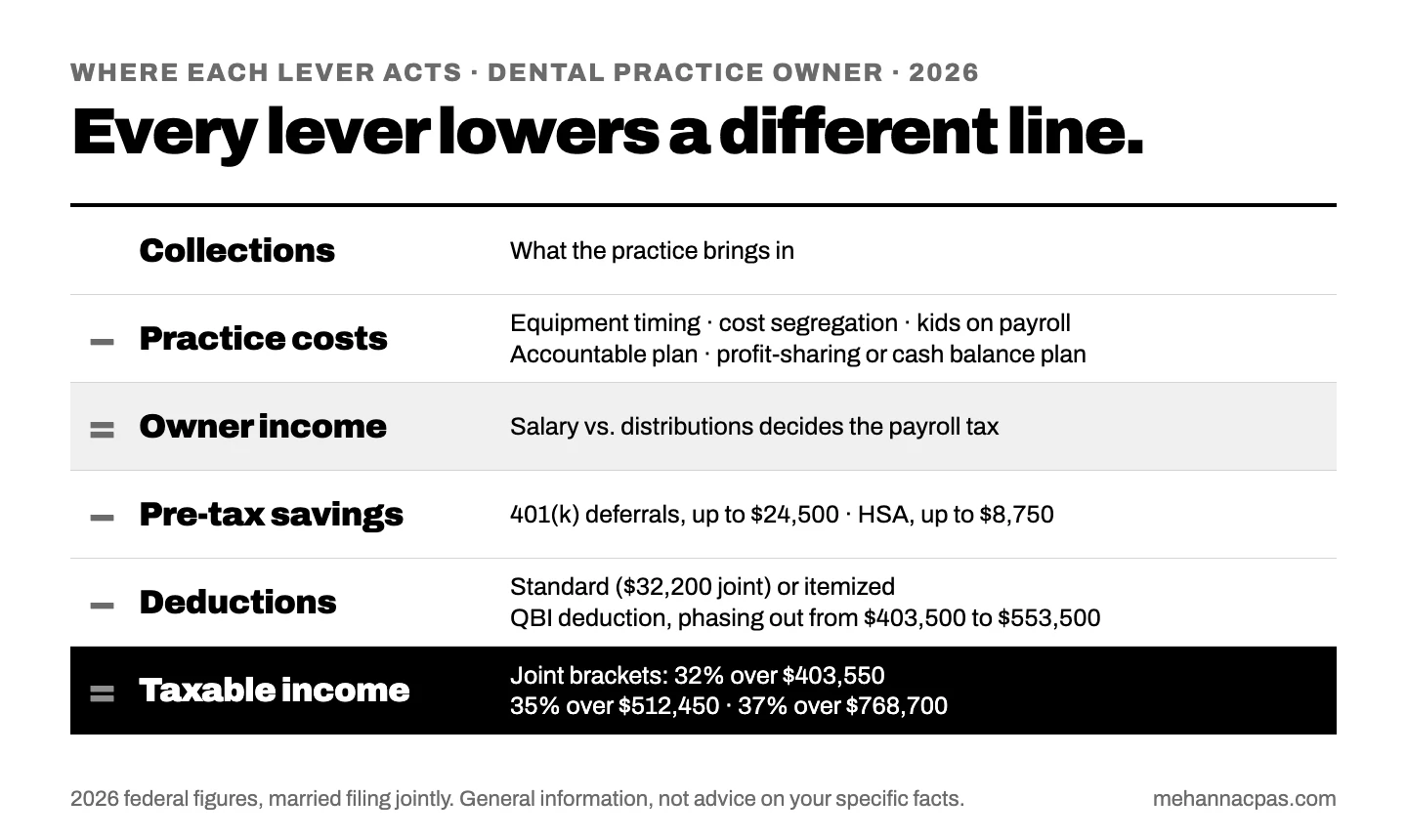
This is why the same $50,000 contribution can be worth noticeably more to one dentist than to another with the same collections. The bracket is only part of the answer. Where you land against the QBI range is the other part.
When should you work on it, and when should you skip it?
All year, with the hard deadlines in December. Good tax planning for business owners runs on the calendar of the business, not the calendar of the return. Most levers that reduce taxable income are tied to a date: the last payroll, the day equipment is placed in service, the day a gift leaves your account. The return in April can only report them.
The best times to look are when the facts are about to change: before you sign for equipment, before you buy or build a building, before a second location or an associate buy-in, and in the fall, once you can see where the year will land. Our guide to year-end tax planning for dentists covers the December deadlines one by one.
Skip a lever when it costs more than it returns. A cash balance plan that requires large contributions for a big staff, a purchase the practice doesn’t need, or a strategy that adds an entity and a return every year for a small deduction are all reasons to wait.
How we help dentists reduce taxes over the year
We start from a projection, not a list. A tip only matters if it changes your number, and you can’t know that until you know where the year will land. The process, as we run it with dental practices:
- Project the year. Books current, collections and overhead to date, last year’s return. The output is this year’s likely tax, with the bracket and the QBI position marked.
- Fix the structure. Entity type and owner salary first, because everything else is calculated on top of them.
- Design the retirement plan. 401(k) first, then profit-sharing or a cash balance plan if the numbers and the staff census support it.
- Time the big purchases. Equipment, buildouts and buildings go on a calendar, so the deduction lands in the year it is worth the most.
- Re-run it at each planning call. Three a year, plus a text before you sign anything big.
- Close the year. Last payroll, fourth-quarter estimate, and the decisions that carry into next year.
The order matters more than the list. When a practice owner comes in asking how to pay less taxes, the first findings are usually structural: an S corp salary nobody has revisited, a retirement plan that only covers what the owner defers from their own paycheck, and big purchases timed by the vendor’s promotion calendar instead of the tax year. None of these needs a clever strategy. They need someone looking at the whole return before the decisions are made.
Which tax strategies for dentists fit your practice?
It depends on three things: how your practice is taxed, whether you own the building, and how many people are on payroll. Use this as a first pass.
| Your situation | Levers to look at first | What they change |
|---|---|---|
| S corp owner, small staff | Owner salary, 401(k) plus profit-sharing, HSA | Payroll tax, taxable income, QBI position |
| S corp owner in your 50s, high profit | Cash balance plan on top of the 401(k) | Large deferral of taxable income |
| You own the building | Cost segregation, rent set at fair market value | Accelerates building depreciation |
| Big equipment or buildout planned | Section 179 or bonus depreciation, timed to the year | Accelerates the deduction |
| Children who can do real work | Family payroll | Shifts income to a lower bracket |
| High-tax state | Pass-through entity tax election | Moves state tax past the federal SALT cap |
How do doctors reduce taxes when they are W-2 employees?
With fewer levers. A W-2 dentist or physician can max out the 401(k), contribute to an HSA if enrolled in a qualifying high-deductible plan, give in the way the 2026 charitable rules reward, and choose between pre-tax and Roth. Most of the larger levers in this guide belong to whoever owns the practice.
How can dentists reduce taxes as practice owners?
By using the levers only an owner controls: the entity and salary, the retirement plan design, the timing of equipment, how the building is held, and who is on payroll. Each one is a business decision first and a tax decision second, which is also what makes it hold up.
Want to see which of these levers are still open for your practice this year? The year-end check walks through them and shows a rough range for each. Free, and about eight minutes.
9 ways dentists reduce taxable income in 2026
In the order we usually look at them. The checklist after the list shows who each one fits and when it closes.
1. Get the entity and owner salary right
An S corporation election doesn’t lower your income tax by itself. What it changes is payroll tax: you take a reasonable salary on a W-2 and the rest of the profit as distributions, which are not subject to Social Security and Medicare tax (IRS). For comparison, self-employment tax on a sole proprietor is 15.3%, with the 12.4% Social Security part applying to the first $184,500 of 2026 earnings (IRS).
The salary also affects your taxable income indirectly: the practice’s side of the payroll tax is deductible, and inside the QBI phase-out range, W-2 wages are part of how the deduction is calculated. Set too low, it invites a reclassification. Set too high, it costs payroll tax for nothing. It should come from what a dentist doing your work would be paid. Our guide to the S corp reasonable salary for dentists walks through how to set it.
2. Max out the 401(k) and put the rest of the plan to work
For 2026, you can defer $24,500 into a 401(k), plus $8,000 at age 50 or older, or $11,250 at ages 60 to 63. With employer profit-sharing, the total per person can reach $72,000 before catch-up (IRS Notice 2025-67). Pre-tax deferrals lower taxable income now; the tax comes due when you withdraw.
The employee deferral is the part most owners already use. The profit-sharing side is where the room usually is, and it is funded by the practice, so it has to be designed around your staff’s ages and pay to pass the plan’s testing.
3. Add a cash balance plan if the numbers support it
A cash balance plan is an employer-funded pension that sits on top of the 401(k). Its limit is set on the benefit at retirement, not on the yearly contribution: for 2026, $290,000 a year (IRS Notice 2025-67) or 100% of your average pay over your three highest consecutive years, whichever is lower. In an S corporation that pay is your W-2 salary, so a low salary also shrinks what the plan can hold. That is why the allowed contribution rises with age, and why owners in their 50s use it to put away far more than a 401(k) allows.
It is also a commitment: contributions for eligible staff, an actuary every year, and an expectation that the plan runs for several years. How much to defer should follow from when you want work to become optional, which is what your freedom number answers. Our guide on how much a dentist needs to retire shows how to calculate it.
4. Fund an HSA if your health plan qualifies
For 2026, you can contribute $4,400 with self-only coverage or $8,750 with family coverage, if you are enrolled in a high-deductible plan with a deductible of at least $1,700 or $3,400 (Rev. Proc. 2025-19). Contributions are deductible, growth is tax-free, and withdrawals for medical costs are tax-free too. It is small next to a cash balance plan, but it is one of the few tax-free accounts on both ends.
5. Time equipment and buildouts to the tax year
Equipment counts in the year it is placed in service, meaning ready and available for its specific use (IRS Publication 946). For 2026, the Section 179 limit is $2,560,000, and 100% bonus depreciation is permanent for property acquired after January 19, 2025 (IRS).
This is an acceleration, not a discount. A $150,000 scanner deducted this year is $150,000 you won’t depreciate later. It is worth the most in a year when the deduction lands at 35% or 37%, or pulls you back into the QBI range. Buy what the practice needs. Then choose the year.
6. Depreciate your building by its components
If you own your building, it is normally depreciated over 39 years. A cost segregation study separates the parts that qualify for shorter lives, such as certain equipment-related wiring, cabinetry and site improvements, so they can be depreciated over 5, 7 or 15 years, often with bonus depreciation (IRS Cost Segregation Audit Techniques Guide).
The IRS publishes how its examiners review these studies, which tells you what a defensible one looks like: done by someone qualified, tied to actual costs, and reconciled to the depreciation schedule. Also check how the building’s income and losses reach your return. The rules for renting a building to your own practice are specific, and they decide whether a large first-year deduction is usable now or carried forward.
7. Put your kids on payroll, for real work
Wages paid to your child for real work are a business expense, and the child’s own standard deduction ($16,100 for a single filer in 2026) can cover a meaningful part of it. If the practice is a sole proprietorship, or a partnership owned only by the child’s parents, wages to a child under 18 are also free of Social Security and Medicare tax. In an S corporation, payroll taxes apply as for any other employee (IRS).
The work has to be real and the pay reasonable for it: filing, cleaning, social media, front desk on a Saturday. Timesheets, a job description and payroll, not cash.
8. Run business expenses through an accountable plan
When you pay a practice cost personally, such as mileage between locations, a continuing education trip or a phone used for the practice, an accountable plan lets the practice reimburse you without it counting as wages. It needs a business purpose, receipts or records within a reasonable time, and return of any excess (IRS Publication 463). For S corp owners, this matters because, as employees of their own practice, they generally can’t deduct unreimbursed business expenses on their personal return. Without a plan, those costs often go undeducted.
9. Use the state and charitable rules as they stand in 2026
Many states let an S corporation or partnership pay state income tax at the entity level, where the federal cap on state and local tax deductions does not apply (IRS Notice 2020-75). The election and the deadlines are set state by state.
For charitable giving, 2026 brought new limits for those who itemize, including a cap on the benefit of itemized deductions in the 37% bracket (IRS). For owners who give every year, the questions are now what to give, such as appreciated stock instead of cash, and which year to concentrate it in.
Tax planning for dentists checklist: how to reduce taxable income in 2026
Use this to see which levers are yours and when each one closes. “Bring” is what makes the decision fast; you don’t need all of it to start.
| Lever | Fits you if | Closes | Bring |
|---|---|---|---|
| Owner salary | You own an S corporation | Last payroll of 2026 | Year-to-date P&L, current salary |
| 401(k) deferrals | The practice has a 401(k) | Last payroll of 2026 | Year-to-date deferrals |
| Profit-sharing | You want to put away more than your own deferral | Practice tax return due date | Staff census: ages and pay |
| Cash balance plan | High, steady profit; often owners in their 50s | Practice tax return due date | Staff census, 3 years of profit |
| HSA | You are on a qualifying high-deductible plan | Your 2026 return due date | Health plan summary |
| Equipment timing | A purchase is planned in the next 12 months | In service by December 31 | Quote, delivery and install dates |
| Cost segregation | You own or are buying your building | With the return for the year you choose | Closing statement, building costs |
| Kids on payroll | Your children can do real work | Last payroll of 2026 | Job description, timesheets |
| Accountable plan | You pay practice costs personally | Set up before reimbursing | Mileage log, receipts |
| Pass-through entity tax | Your state offers it and you own an S corp or partnership | Set by your state | Last state return, projection |
Mistakes we’d avoid
Most of the expensive mistakes come from counting a deduction before checking what it actually does. The ones we’d steer you away from:
- Treating deferral as savings. A pre-tax contribution or a big depreciation year moves tax, it doesn’t erase it. That is often the right move, but plan for the year the tax comes back.
- Spending to save. A deduction returns a fraction of what you spend. If the practice doesn’t need the purchase, keeping the cash is the better tax plan.
- Paper-only strategies. A second entity that bills your own practice, a family member on payroll who doesn’t work, a “rental” with no real use. If nothing about how the practice operates changes, the tax usually doesn’t either.
- Ignoring the QBI range. Two dentists with the same deduction can get very different results depending on where their taxable income lands against $403,500 and $553,500.
- Asking in April. By then, almost every lever in this guide has closed for the year.
What changed for 2026
The One Big Beautiful Bill Act, signed July 4, 2025, made several of these levers permanent and moved the limits. The ones that matter most for reducing taxable income:
- 100% bonus depreciation is permanent for property acquired after January 19, 2025 (IRS).
- The Section 179 limit is $2,560,000 for 2026, and the QBI deduction is permanent, with a new $400 minimum for owners with at least $1,000 of qualified business income (Rev. Proc. 2025-32).
- The standard deduction is $32,200 for a married couple filing jointly, and the benefit of itemized deductions is limited in the 37% bracket (IRS).
Separately, the 2026 retirement limits rose: $24,500 for 401(k) deferrals, $72,000 for total contributions to a defined contribution plan, and $290,000 for the annual benefit of a defined benefit plan (IRS Notice 2025-67). HSA limits rose to $4,400 and $8,750 (Rev. Proc. 2025-19).
How to tell whether it worked
Compare your projected taxable income before your decisions and after them, then check where it lands against the bracket and the QBI range. That difference is what planning changed. Then look at it over three years, not one: a plan built mostly on acceleration should show where the deductions went and when the tax comes back. If nobody can show you both numbers before December, the planning didn’t happen. Projections all year, with a planning call before every big decision, are part of The Treatment Plan.
Frequently asked questions
What is the fastest way to reduce taxable income before year end?
For most practice owners, the 401(k) deferral and the owner salary, because both run through the last payroll of the year. Equipment placed in service by December 31 is next. A new profit-sharing or cash balance plan can usually still be adopted after December 31, up to the practice’s return due date.
Does an S corporation reduce my taxable income?
Not directly. An S corporation mainly lowers payroll tax, because distributions above a reasonable salary are not subject to Social Security and Medicare tax. It affects income tax indirectly, through the deductible payroll tax and how the QBI deduction is calculated. Whether it fits depends on your profit and your salary.
Are tax strategies for high income earners different for dentists?
Mostly in one way: dentistry is a specified service under the QBI rules, so the 20% deduction phases out between $403,500 and $553,500 of joint taxable income for 2026. That makes deductions inside that range worth more than for many other business owners at the same income.
Is buying equipment a good way to pay less taxes?
Only if the practice needs it. The deduction returns a fraction of the price: at the 37% bracket, a $100,000 purchase lowers federal tax by at most $37,000, and you still spent $100,000. Timing a purchase you were going to make anyway is planning. Buying for the deduction is not.
Can I still lower my taxable income after December 31?
A few levers stay open: HSA contributions up to your return due date, and employer contributions to a profit-sharing or cash balance plan up to the practice’s return due date. Salary, payroll, equipment and most gifts close on December 31. Our year-end guide lists each date.
Glossary
| Term | Meaning |
|---|---|
| Taxable income | Income after adjustments, the standard or itemized deduction and the QBI deduction. The number your federal tax is calculated on. |
| QBI deduction | A deduction of up to 20% of qualified business income from a pass-through business. For a dental practice it phases out between $403,500 and $553,500 of taxable income on a joint return (2026). |
| Reasonable salary | The W-2 pay an S corporation owner must take for the work they do before taking distributions. |
| Placed in service | Ready and available for its specific use. The date that decides which year equipment is deducted. |
| Cost segregation | A study that splits a building’s cost into parts with shorter depreciation lives than the building’s 39 years. |
| Cash balance plan | An employer-funded pension plan with an account for each participant, often used to let owners contribute more than a 401(k) allows. |
| Accountable plan | A reimbursement arrangement that lets the practice repay business costs you paid personally without treating them as wages. |
| Deferral | A move that postpones tax to a later year rather than eliminating it. |
Sources
- IRS, Rev. Proc. 2025-32 (2025): 2026 brackets, Section 179 limits, QBI thresholds and minimum deduction.
- IRS, Tax inflation adjustments for tax year 2026 (2025): brackets, standard deduction, limit on itemized deductions at 37%.
- IRS, Notice 2025-67 (2025): 2026 401(k), defined contribution and defined benefit limits.
- IRS, Rev. Proc. 2025-19 (2025): 2026 HSA limits.
- IRS, Guidance on 100% bonus depreciation (2026).
- IRS, Publication 946, How to Depreciate Property: placed in service.
- IRS, Publication 5653, Cost Segregation Audit Techniques Guide (2025).
- IRS, S corporation compensation and medical insurance issues.
- IRS, Self-employment tax: 15.3% rate, 2026 Social Security wage base.
- IRS, Questions and answers for the Additional Medicare Tax.
- IRS, Topic 559, Net investment income tax.
- IRS, Tax treatment for family members working in the family business.
- IRS, Publication 463, Travel, Gift, and Car Expenses: accountable plans.
- IRS, Notice 2020-75 (2020): state taxes paid by pass-through entities.