

Cost segregation is an engineering-based study that splits the cost of a building into parts with 5-, 7- and 15-year tax lives instead of 39 years. For a dental office building, it’s worth it when you’ll keep the building for years, the purchase or build-out is large, and the deduction can actually offset your income this year.
- A study moves deductions earlier. It doesn’t create new ones, and much of what you write off early comes back as ordinary income when you sell.
- 100% bonus depreciation is permanent for qualifying property acquired after January 19, 2025, so the short-life parts a study finds can generally be deducted in year one.
- The ownership setup decides whether you can use it. If your LLC rents the building to your own practice, a loss on the building is usually passive unless the rental is properly grouped with the practice.
- It’s not too late for a building you’ve owned for years. A look-back study can catch up missed depreciation in one year with Form 3115, without amending old returns.
- What we see in dental practices: the first question isn’t “how big is the deduction?” It’s “who owns the building, and how long will you keep it?”
You closed on the building last spring. The practice pays rent to your real estate LLC, and someone at a study club told you a cost segregation study “paid for his whole down payment.”
Maybe. Before you order one, it helps to know what a study actually changes, whether your ownership setup lets you use the deduction this year, and what happens when you sell. This guide covers all three for a dental office building, plus the checklist we run before recommending a study.
What is cost segregation, and what isn’t it?
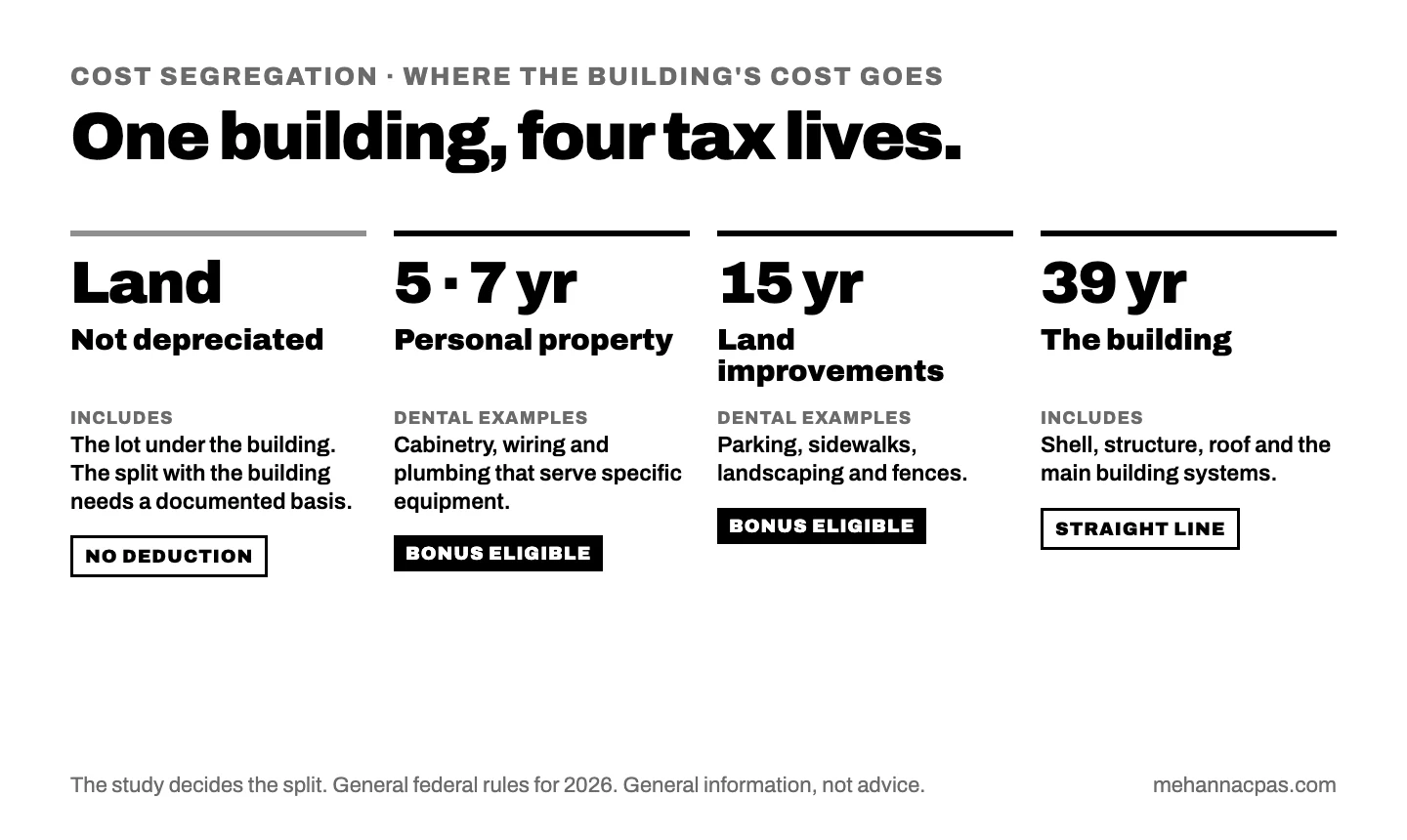
Cost segregation is a study that breaks a building’s purchase or construction cost into components and assigns each one the tax life the law gives it. A commercial building is depreciated over 39 years, but parts of it are personal property or land improvements with 5-, 7- or 15-year lives (IRS Publication 946). Without a study, all of it usually sits in the 39-year pile.
It isn’t an appraisal, it isn’t a new deduction, and it isn’t a tax credit. You recover the same total cost either way. The study changes when you deduct it.
| Cost segregation study | Appraisal | Section 179 / bonus depreciation | |
|---|---|---|---|
| What it does | Classifies the building’s cost into tax lives | Estimates what the property is worth | Lets you deduct qualifying property in year one |
| Who prepares it | Engineers and tax specialists | A licensed appraiser | Your CPA, on the return |
| What it changes | When you deduct the building’s cost | Nothing on the return by itself | How fast the short-life parts are deducted |
| How they connect | Finds the parts that qualify | Can support the land vs. building split | Applies to the parts the study finds |
For the first-year write-off rules themselves, our guide to Section 179 and bonus depreciation for dental equipment walks through both.
Who is a cost segregation study for, and who can skip it?
It’s for practice owners who own the building their practice runs in, or are buying or building one, and plan to keep it. It tends to fit when:
- You just bought a standalone dental office building, or closed on a condo unit for the practice.
- You built new or did a major build-out with plumbing and electrical runs to every operatory.
- You’ve owned the building for several years and it has always been depreciated as one 39-year asset.
- You own the building inside the practice entity, or through an LLC on a joint return with your spouse, and the practice is an S corporation or a sole proprietorship.
You can usually skip it if the building is small relative to the study’s fee, if you expect to sell within a few years, or if a loss on the building would sit unused for years. If you lease your space, a study on the whole building isn’t yours to order, but your own interior build-out has its own rules, covered below.
Why does cost segregation matter for a dental office building?
Because a dental office is unusually equipment-heavy, and a study can move a meaningful share of the building’s cost out of the 39-year schedule. The study decides how much. In a dental build-out, likely candidates include cabinetry, electrical and plumbing that serve specific equipment, and site work like parking, sidewalks and landscaping (IRS Cost Segregation Audit Techniques Guide).
The timing difference is large now. Under the 2025 law, the 100% bonus depreciation deduction is permanent for eligible property acquired after January 19, 2025 (IRS, Notice 2026-11). Parts with lives of 20 years or less generally qualify. The building shell, structure and main systems stay on the 39-year schedule, and land isn’t depreciated at all (IRS Publication 946).
Is cost segregation worth it? When to do it, and when to skip it
Cost segregation is worth it when three things line up: the building is large enough for the deduction to clearly outweigh the fee, you can use the deduction this year, and you’ll hold the building long enough for the timing to pay. If any one fails, the study can cost more than it delivers.
- Do it in the year you buy, build or finish a major renovation, when the records are fresh and the deduction lands while income is high.
- Do it later with a look-back study if you’ve owned the building for years and never had one.
- Skip it if you plan to sell or move within a few years, if the loss would be stuck as passive with nothing to offset, or if next year’s income will be much higher than this year’s.
Holding period matters because of recapture. When you sell, gain up to the depreciation taken on personal property is ordinary income, and on the building, depreciation above the straight-line amount is ordinary income too (IRS Publication 544). The straight-line part of the building’s gain is taxed at a maximum 25% rate (IRS Topic 409). The payoff depends on your exit: a sale, a practice transition, or holding the building for your heirs.
Cost segregation for a dental office: the five questions that decide it
Most of the answer comes from facts you already know. These are the questions we ask, in order.
1. Who owns the building, and who pays rent?
If the practice entity owns the building, the extra depreciation simply reduces practice income. Many owners hold the building in a separate LLC that rents to the practice. That setup is common for liability and exit reasons, and it changes how a loss is treated.
2. Can a loss on the building offset practice income?
Not automatically. When you rent property to a business you materially participate in, net rental income is treated as nonpassive, but a net rental loss stays passive (26 CFR 1.469-2(f)(6)). A big first-year depreciation deduction can turn the building into a passive loss that sits unused. A grouping election can treat the rental and the practice as one activity when each owner of the practice owns the same proportion of the building, and spouses filing jointly count as one owner (26 CFR 1.469-4). It must be disclosed in a statement with the original return (Rev. Proc. 2010-13), and grouping a C corporation’s activity with your other activities only counts for participation tests, so it doesn’t fix this for a C corporation practice. The election has ownership requirements and long-term consequences, so it’s a decision to make with your CPA, not on the return in April.
3. How long will you keep the building?
The longer the hold, the more the early deductions are worth. If a sale, a DSO deal or a move is likely in the next few years, much of the benefit reverses at the sale. If you’re weighing whether to own at all, our buy vs. rent calculator runs that decision first.
4. How was the price split between land and building?
Land isn’t depreciable, so the split drives every number after it. Publication 551 says to allocate a lump-sum price by the fair market value of the land and the building, and if you’re not certain of those values, you can use the assessed values for real estate tax (IRS Publication 551). A documented method holds up; a round-number guess doesn’t.
5. Who did you buy it from?
A study works on a building you bought used, not only on new construction. Bonus depreciation on used property requires that you didn’t use it before and didn’t acquire it from a related person, such as a parent, child or an entity you control (26 U.S.C. 168(k)). Buying the building from a retiring parent’s entity is where this usually breaks.
Bought or built out a building this year? The year-end check shows which moves are still open for your practice before December 31.
Already own the building? What a look-back study does
If you’ve owned the building for years and it was depreciated as one 39-year asset, a study can still catch up the depreciation you missed. The fix is an automatic change in accounting method on Form 3115 (Rev. Proc. 2025-23, section 6.01), not a stack of amended returns. The catch-up is a section 481(a) adjustment, and when it lowers income it is generally taken in full in the year of the change (Rev. Proc. 2015-13).
Two cautions. The catch-up follows the rules that applied when the building went into service, so an older building doesn’t automatically get today’s 100% bonus. And the passive loss question above applies to the catch-up too.
A study also keeps paying later. When you replace a roof or an HVAC unit, the component values let you elect a partial disposition and write off what’s left of the old one, instead of depreciating a part that’s already gone. The election is made on the timely filed return for the year of the replacement (26 CFR 1.168(i)-8).
Adding operatories inside a building you already use is its own category. Interior improvements to a commercial building made after it was first placed in service are qualified improvement property with a 15-year life, as long as the work doesn’t enlarge the building, add an elevator or change the internal structural framework (IRS Publication 946). That category also covers a build-out in leased space.
How we look at cost segregation with dental practices
You text before you sign, and the study decision gets made in the projection, not in April. On The Treatment Plan, the same three people who keep your books and your projection run it:
- Map the ownership. Who owns the building, the practice and each entity, and how rent flows between them.
- Check the passive loss position. Whether a building loss can offset practice income, and whether a grouping election fits.
- Set the hold horizon. Sale, transition, DSO, or holding it for the long term.
- Run the projection both ways. With and without a study, including recapture at a likely exit.
- Vet the study. An engineering-based study tied to real cost records, not a rule-of-thumb percentage.
- Record it right. Component values in the fixed asset schedule, so future roof and HVAC replacements can be written off.
The study itself is rarely the problem. The problem is ordering one before anyone checks whether the deduction can be used: a building LLC with a big paper loss that just sits there while the practice pays tax on full income. Our rule of thumb: sort out the ownership and the grouping first, then decide on the study.
Dental building cost segregation checklist
Run these before you order a study. Every row comes from the sections above.
| Check | Fits you if | Deadline | What to bring |
|---|---|---|---|
| Ownership map | You know who owns the building and the practice | Before the study | Entity documents and the lease |
| Passive loss position | A building loss can offset practice income | Before the study | Last return and the practice’s entity type |
| Grouping election | Ownership lines up and the practice isn’t a C corporation | With the original return | Ownership percentages |
| Hold horizon | You’ll keep the building for years | Before the study | Your exit or transition plan |
| Land vs. building split | The allocation is documented | Before the study | Closing statement, appraisal or tax assessment |
| Seller | The seller isn’t a related person | Before you buy | Seller name and relationship |
| Look-back | You’ve owned the building for years without a study | With the return for the year of change | Depreciation schedules since purchase |
| Study quality | It’s engineering-based and tied to cost records | Before you hire | Construction invoices, drawings, build-out costs |
Mistakes we’d avoid with cost segregation
The expensive mistakes are about using the deduction, not getting it.
- Ordering a study without checking the passive loss rules. A self-rental building with a big loss can leave the deduction stuck for years.
- Treating it as savings. It’s timing. Recapture shows up at the sale, so the hold period matters.
- Guessing the land value. Every depreciation number rests on the split; document it.
- Buying a rule-of-thumb study. The IRS guide calls the engineering approach based on actual cost records the most methodical and accurate, and it treats rule-of-thumb percentages with caution (IRS Publication 5653).
- Forgetting the old roof. Without a partial disposition election, you keep depreciating a component you already replaced.
- Believing the whole building can be written off. The new 100% deduction for qualified production property is for manufacturing and production space and excludes offices (26 U.S.C. 168(n)). A dental office isn’t it.
What changed for 2026
Three dated changes shape a cost segregation decision in 2026.
- 100% bonus depreciation is permanent for eligible property acquired after January 19, 2025, with IRS interim guidance in Notice 2026-11, issued in January 2026 (IRS, 2026).
- The new deduction for qualified production property, with interim guidance in Notice 2026-16 (February 2026), excludes space used for offices, administrative services and other functions unrelated to production (IRS, Notice 2026-16).
- The current list of automatic accounting method changes, including the depreciation change a look-back study uses, is Rev. Proc. 2025-23 (IRS, 2025).
How to tell whether the study worked
Look at three things: the deduction landed in the year planned, it offset the income you meant it to offset, and the component values are in your books. On the return, check the depreciation on the building entity and whether a loss flowed through or was suspended as passive. In the projection, compare taxable income with the plan you made before the study. In the fixed asset schedule, the building should now show separate components, so the next roof or HVAC replacement can be written off properly. That year-round view is what our services for dental practice owners are built around, and the building is one item on the longer list in how dentists reduce taxable income.
Frequently asked questions
Is cost segregation worth it for a small dental office?
Sometimes. The question is whether the accelerated deductions clearly outweigh the study fee and the extra work on the return, and whether you can use them now. A condo unit with a modest build-out may not clear that bar; a standalone building with a full build-out often does. A projection run both ways answers it.
Does cost segregation work if I lease my office space?
Not on the building itself, because the landlord owns it. Your own interior build-out in leased space can still be qualified improvement property with a 15-year life, which generally qualifies for bonus depreciation. Keep the build-out invoices itemized so the costs can be classified.
What happens to cost segregation in a 1031 exchange?
Most components a study identifies that are permanently affixed to the building still count as real property for a 1031 exchange (26 CFR 1.1031(a)-3). Movable equipment doesn’t, so plan the exchange with your CPA before you list the building.
What if I hold the building until I die?
Inherited property generally takes a basis equal to its fair market value at the date of death (IRS Publication 551), which changes the recapture math for your heirs. That’s one reason the exit plan belongs in the decision.
Can I do a cost segregation study myself?
The IRS hasn’t set standards for who prepares a study, but its examiners look for a documented, engineering-based method tied to real costs. A do-it-yourself percentage is the approach the IRS guide treats with the most caution, and the one hardest to defend in an exam.
Glossary
| Term | Meaning |
|---|---|
| Cost segregation | A study that splits a building’s cost into components with 5-, 7-, 15- and 39-year tax lives. |
| Bonus depreciation | A 100% first-year deduction for eligible property acquired after January 19, 2025, including building parts with lives of 20 years or less. |
| Self-rental | Renting property you own to a business you materially participate in, such as your LLC renting the building to your practice. |
| Passive loss | A loss from a rental or passive activity that generally can only offset passive income until you sell. |
| Grouping election | An election to treat the rental and the practice as one activity when ownership lines up, disclosed with the return. |
| Look-back study | A study on a building you already own, put into effect with Form 3115. |
| Section 481(a) adjustment | The one-time catch-up of depreciation you could have taken in earlier years. |
| Partial disposition | An election to write off the remaining value of a replaced building component, like an old roof. |
| Qualified improvement property | Interior improvements to a commercial building after it was first placed in service, excluding enlargements, elevators and structural framework. |
| Recapture | Depreciation taken earlier that is taxed as ordinary income when the property is sold. |
Sources
- IRS, Publication 946, How To Depreciate Property (2025): 39-year nonresidential real property, land not depreciable, 15-year land improvements, qualified improvement property.
- IRS, Publication 5653, Cost Segregation Audit Techniques Guide (2025): what a study does, the six approaches, engineering approach from actual cost records.
- IRS, Notice 2026-11 guidance on 100% bonus depreciation (January 2026).
- Treasury Regulations, 26 CFR 1.469-2(f)(6): self-rental net income treated as nonpassive.
- Treasury Regulations, 26 CFR 1.469-4: grouping a rental with a business, same proportionate ownership, spouses as one taxpayer, C corporation limit, consistency.
- IRS, Rev. Proc. 2010-13 (2010): disclosure statement for groupings.
- IRS, Rev. Proc. 2025-23 (2025): automatic change from an impermissible to a permissible depreciation method, section 6.01.
- IRS, Rev. Proc. 2015-13 (2015): section 481(a) adjustment period for automatic changes.
- Treasury Regulations, 26 CFR 1.168(i)-8: partial disposition election and its timing.
- IRS, Publication 544, Sales and Other Dispositions of Assets: depreciation recapture on personal property and buildings.
- IRS, Topic 409, Capital gains and losses: maximum 25% rate on unrecaptured section 1250 gain.
- IRS, Publication 551, Basis of Assets: land and building allocation, basis of inherited property.
- U.S. Code, 26 U.S.C. 168(k) and 168(n): used property and related-person rules for bonus depreciation; qualified production property excludes offices.
- IRS, Notice 2026-16 (February 2026): interim guidance on qualified production property, office space excluded.
- Treasury Regulations, 26 CFR 1.1031(a)-3: real property for like-kind exchanges.