

Good dental bookkeeping means every deposit and expense is recorded weekly, backed by a receipt or invoice, reconciled to the bank and tied to collections in your practice software, with a monthly close on a fixed date. If you are behind, catch up oldest month first, reconcile each month before the next, then stay current.
- A categorized transaction is not proof. The IRS expects supporting documents, like invoices, receipts and deposit slips, behind the entries in your books.
- Dental insurers report what they paid your practice on Form 1099-MISC, and card processors report card payments on Form 1099-K. Your books should tie to both.
- Catch-up bookkeeping can fix categories, not history. Records that had to be kept at the time, like a mileage log, can’t be created later.
- Starting in 2026, food and drinks for staff in the office are generally no longer deductible, so one “Meals” account is no longer enough.
- What we see most in dental practices: books that are “basically done” until the tax return needs them, and six months nobody reconciled.
It is February. Your CPA needs the books to start the return, and the last month anyone reconciled was August. The practice software shows collections to the dollar. QuickBooks shows a pile of uncategorized transactions, two credit cards nobody connected and a deposit from a lender that may or may not have been booked as income. You are behind on bookkeeping, and the question is no longer whether to fix it, but in what order.
This guide covers both halves: what good bookkeeping for dentists looks like when it runs every week, and how to catch up when it hasn’t, with the IRS record rules that decide what a cleanup can and can’t repair.
What is dental bookkeeping, and how is it different from dental practice accounting?
Dental bookkeeping is the weekly work of recording every dollar that comes into and goes out of the practice, with the document that proves it, in the accounting system. The IRS lets you choose any recordkeeping system that clearly shows your income and expenses, as long as it summarizes your business transactions in your books (IRS, What kind of records should I keep).
Dental practice accounting is the layer on top: turning those records into financial statements, a tax projection and decisions. Bookkeeping is the foundation. If it is late or wrong, everything built on it inherits the problem.
| Bookkeeping | Dental practice accounting | Practice software (PMS) | |
|---|---|---|---|
| What it does | Records and categorizes every transaction, reconciles accounts | Produces statements, projections, tax returns and advice | Tracks production, adjustments, collections and patient balances |
| How often | Weekly, with a monthly close | Monthly review, quarterly estimates, annual returns | Daily |
| Who usually does it | A bookkeeper or controller | Your CPA | Your front desk |
| What it can’t tell you | Whether a number is a good decision | Anything the books got wrong | Rent, payroll, debt and what you took out |
Who needs weekly bookkeeping, and who can keep it simple?
Any practice owner with staff, insurance payments and debt needs bookkeeping every week, not every quarter. It matters most when:
- Your practice collects $750,000 or more, so a missed deposit or a double-booked expense moves real money.
- Your practice is an S corporation, with payroll, distributions and owner health insurance that all have to land in the right place.
- You bought the practice recently and the seller’s books, loans and equipment need to be set up correctly from day one.
- You plan to borrow, buy equipment, add a location or sell in the next few years. A buyer reading your books is the first step in how a dental practice gets valued.
An associate paid on a W-2 doesn’t need a bookkeeping system. A 1099 associate can usually keep it simple: one business account, one card and receipts saved as they happen.
Why do clean books matter for your practice?
Because your tax return, your quarterly estimates and every outside review of your practice start from the books. The IRS says your records must show your gross income, deductions and credits, and that you need supporting documents, like invoices, receipts, deposit slips and canceled checks, behind the entries (IRS Publication 583).
Dental practices have a specific exposure here. Insurance carriers report health care payments to providers on Form 1099-MISC, box 6, even when the practice is a corporation (IRS, Instructions for Forms 1099-MISC and 1099-NEC). Card processors report your card payments on Form 1099-K (IRS, Instructions for Form 1099-K). The IRS already has those numbers. Your books should be able to explain them.
When books are unreliable, an examiner can rebuild income from the bank. The IRS audit manual describes the bank deposits method, which starts from total deposits in all of your accounts, business and personal, and notes that unidentified deposits have the inherent appearance of income (IRS, Internal Revenue Manual 4.10.4). A loan or a transfer from savings that nobody labeled can end up treated as revenue until you prove otherwise.
And clean books are what make the rest of the year work: you can’t set estimated tax payments for the year you are actually having from books that stopped in August.
What does good dental bookkeeping look like?
Six habits separate books you can trust from books that need a cleanup every spring. None of them is complicated. All of them have to happen every week.
1. One account per entity, and nothing personal in it
The IRS recommends a business checking account kept separate from your personal account, with all receipts deposited into it and the account used for business purposes only (IRS Publication 583). If you own the building in a separate entity, its rent goes into its own account. Personal spending on the practice card is how a five-minute question turns into a long one.
2. Weekly coding, with the receipt attached
Bank feeds bring the transactions in. Someone still has to put each one in the right account and attach the invoice or receipt. A card statement shows that you paid, not what you bought, and the IRS expects documents that support both (IRS Publication 583). Weekly is the cadence that keeps the backlog small enough to remember what a charge was.
3. Every deposit labeled by source
Patient payments, insurance payments, card batches, financing payouts, loan proceeds, owner contributions and transfers between accounts all land as deposits. Only some of them are income. Publication 583 suggests identifying the source of each deposit as business income, personal funds or loans. Label every non-revenue deposit when it arrives, not when someone asks.
4. A dental chart of accounts, not a generic one
The chart of accounts is the list of categories your books use. A generic setup lumps everything into “supplies” and “payroll,” and then nobody can see which cost is drifting. The table below shows the splits we would want in a dental practice’s books.
| Account group | Split it into | Why it matters |
|---|---|---|
| Income | Patient payments, insurance payments, card deposits, refunds | Ties to PMS collections and to the 1099-MISC and 1099-K you receive |
| Clinical costs | Dental supplies, lab fees, associate pay | The costs that move with the schedule |
| Staff | Hygiene, assistants, front office, payroll taxes, benefits | Payroll is usually the biggest line you control |
| Meals | Staff food in the office, client and referral meals, staff events | Each one has a different tax treatment starting in 2026 |
| Equipment | Assets (capitalized) vs. small items expensed under your written policy | Keeps the depreciation schedule clean |
| Owner | W-2 salary, distributions or draws, owner contributions | Distributions are not an expense and must never land in one |
| Debt | Each loan, split into principal and interest | Only the interest is an expense |
On equipment, most small practices without audited statements can expense items up to $2,500 per invoice or item under the IRS de minimis safe harbor, if the accounting policy is in place at the start of the year and the election is made on the return (IRS, Tangible property final regulations). We cover how those entries show up in your reports in how to read your dental practice’s financial statements.
5. Contractors set up before the first payment
Temp hygienists, IT vendors and consultants should give you a Form W-9 before you pay them. For payments made in 2026, the threshold for Form 1099-NEC is $2,000, up from $600 (IRS Publication 1099). Payments made by credit card or through a payment app are reported by the processor on Form 1099-K, not by you on a 1099-NEC (IRS, Instructions for Forms 1099-MISC and 1099-NEC), which is one more reason the payment method should be visible in the books.
6. A monthly close on a fixed date
The close is the point where the month stops changing. It is the subject of the next section.
What does a monthly close process look like?
A monthly close is a fixed sequence of checks that ends with statements you can rely on, on the same date every month. For a dental practice, it looks like this:
- Finish coding. No uncategorized transactions, no missing receipts above your threshold.
- Reconcile every account. Each bank account, credit card and loan matches its statement. Publication 583 describes the same check for the business checking account: the statement, the checkbook and the books should agree.
- Tie deposits to the practice software. Deposits for the month should trace to collections in the PMS, with card fees, financing payouts and timing differences explained.
- Tie payroll to the payroll reports. Wages, taxes and benefits match the provider’s reports, and payroll liabilities clear.
- Split loan payments. Interest to expense, principal to the loan balance, matched to the lender’s statement.
- Read the statements and list open questions. A close ends with a review, not just with balances that tie.
- Lock the period. Close the month in the software so finished months can’t change by accident.
Is QuickBooks enough for a dental practice?
For most practices, yes. QuickBooks Online and Xero both handle a dental practice well. The software is rarely the problem. A QuickBooks file for a dental practice is only as good as its chart of accounts, the weekly coding and the monthly tie-out to the PMS. A clean general ledger in either one beats a dental-specific tool nobody reconciles.
How to catch up bookkeeping when you’re behind
Start from the last month you can trust, work forward one month at a time, and don’t move on until each month reconciles. The order is the same whether you are three months behind or two years behind. Only the volume changes.
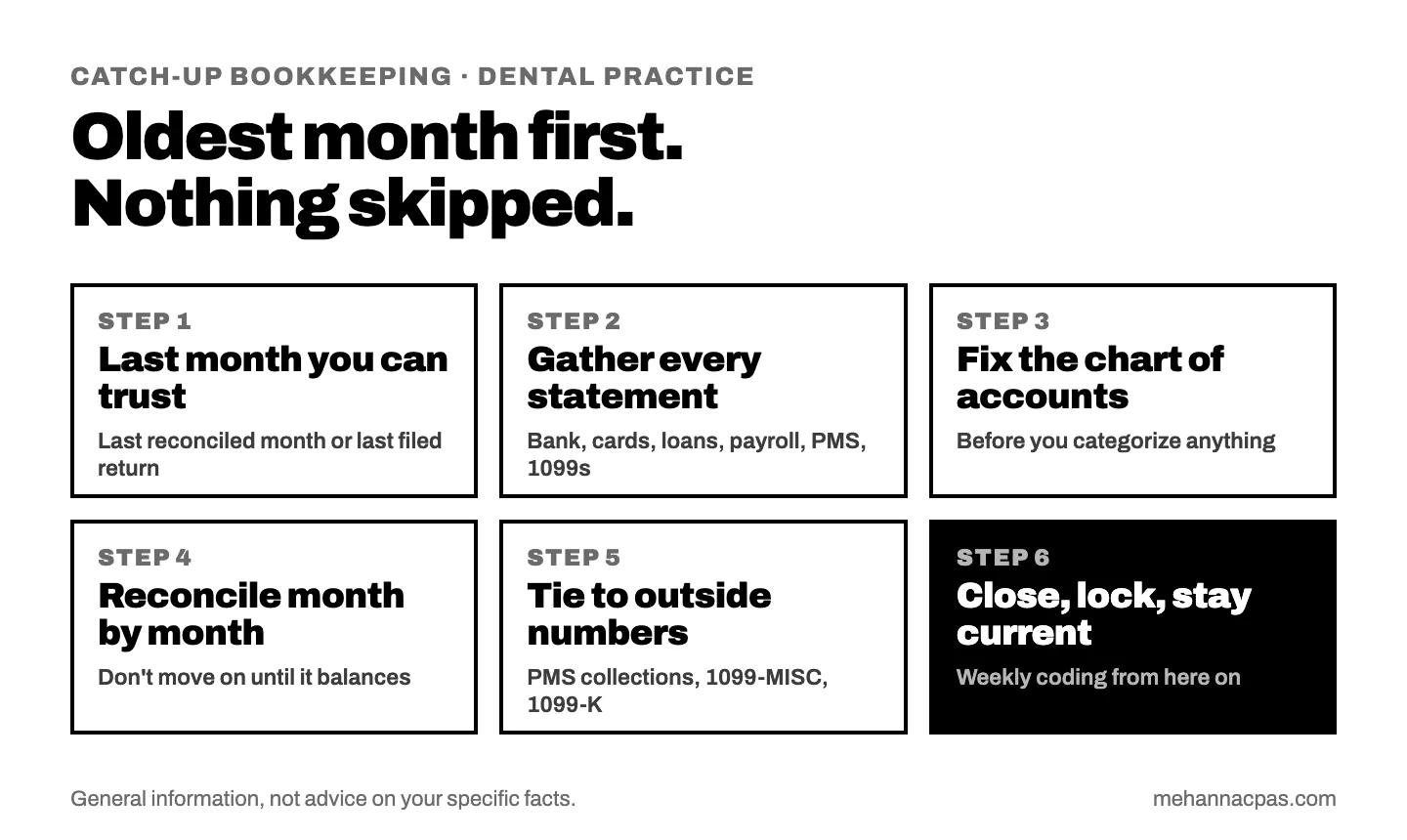
1. Find the last month you can trust
Usually the end of the last year a tax return was filed from, or the last month every account was reconciled. Compare the ending balances in your books with that return’s balance sheet. If they don’t match, fix that first.
2. Gather every statement for the gap
Bank, credit card, loan and line of credit statements for every month, payroll reports, the PMS collections report by month, and the 1099-MISC and 1099-K forms the practice received. Request older statements early. Some banks take days to produce them.
3. Fix the chart of accounts before you categorize anything
Add the accounts you will need, merge duplicates and set up the owner and loan accounts correctly. Recategorizing two years of transactions twice is the most common way a catch-up doubles in cost.
4. Reconcile oldest month first
Import, categorize, attach what documents you have, reconcile, then move on. If a month won’t balance, something was missed or entered twice. Don’t skip past it.
5. Tie the year to outside numbers
Total income should be explainable against PMS collections and against the 1099-MISC and 1099-K forms. Every non-revenue deposit gets a label: loan, owner contribution, transfer, refund.
6. Close, lock and stay current
Lock the caught-up periods, hand the year-end reports to your CPA and move straight into the weekly routine. A catch-up without a new routine is just next year’s catch-up.
What can catch-up bookkeeping not fix?
It can’t create documentation that was never kept. For car, travel and gift expenses, the IRS says a timely kept record, made at or near the time, has more value than a statement prepared later, when accurate recall is generally lacking (IRS Publication 463). A mileage log rebuilt in February for last year is weak evidence. If a cleanup reconstructs anything, label it as a reconstruction and tie it to the bank and card data. If missing books have also delayed tax returns, talk to your CPA about the order of operations before filing anything.
When should you catch up, and when is it time to change the setup?
Catch up before any event that will make someone read your books. The usual triggers in a dental practice:
- Before the tax return, ideally before the year closes, so year-end decisions rest on real numbers.
- Before a practice loan, an equipment financing application or a refinance.
- Before buying a second practice, bringing in a partner or talking to a buyer or DSO.
- When an IRS notice arrives that compares your income to a 1099.
If you have caught up twice in three years, the problem isn’t the backlog. It is the setup: who does the weekly work, who reviews the close and whether anyone ties the books to the practice software.
How we handle bookkeeping with dental practices
We treat bookkeeping as the foundation of tax planning, not a separate service. We don’t take bookkeeping-only engagements, because planning built on someone else’s books is a guess.
- Set up the books for a dental practice. A dental chart of accounts, one account per entity, owner and loan accounts split correctly.
- Code weekly in QBO or Xero. Transactions categorized and documented while they are still fresh.
- Close monthly on a fixed date. Every account reconciled and deposits tied to the practice software.
- Feed the projection. Each close updates the year’s projected tax, which sets the next estimate and the agenda for the next planning call.
- Scope any catch-up separately. Prior years that need cleanup are quoted on a call as their own project, so the monthly plan starts from clean opening balances.
It is the same three people every month, so the person closing your books already knows why that deposit in March was a loan.
Books that are “basically done” until someone needs them. The bank feed is connected, so it looks current, but nobody reconciled the cards, the loan payments went entirely to expense and the insurance 1099s were never compared with income. None of it is hard to fix. It is just far cheaper to fix in the week it happens than in the week the return is due.
Behind on bookkeeping, or not sure your books would hold up? Tell us where they stand. You’ll leave the call knowing what a catch-up involves and what we’d look at first.
Dental bookkeeping checklist
Use this to judge your current books, whether you do them yourself or pay someone.
| Item | What good looks like | How often | Red flag |
|---|---|---|---|
| Accounts | One per entity, business use only | Always | Personal charges on the practice card |
| Coding | Every transaction categorized with its receipt or invoice | Weekly | A large “uncategorized” or “ask my accountant” balance |
| Deposits | Each labeled: patient, insurance, card, loan, transfer, owner | Weekly | Deposits nobody can identify |
| Reconciliations | Every bank, card and loan account matches its statement | Monthly | A card that was never connected |
| PMS tie-out | Deposits trace to collections, differences explained | Monthly | A gap that gets “averaged out” |
| Contractors | W-9 on file before the first payment | Each new vendor | Chasing W-9s in January |
| 1099s received | Income explains the 1099-MISC and 1099-K totals | Year end | An IRS notice about missing income |
| Close | Statements on the same date, period locked | Monthly | Statements that arrive months late |
Bookkeeping mistakes we’d avoid
Most expensive bookkeeping mistakes are small habits that compound. The ones we’d steer a practice away from:
- Trusting the bank feed as if it were bookkeeping. A connected feed only imports transactions. Somebody still has to categorize, document and reconcile them.
- Booking the whole loan payment as an expense. Principal reduces the loan. Booking it as an expense understates profit until someone finds it.
- Running distributions through expense accounts. It distorts the P&L and invites questions about what is deductible.
- Keeping one “Meals” account. From 2026 on, the break-room coffee and the client dinner are treated differently. One account forces someone to dig through receipts later.
- Waiting until tax season to catch up. By then, the year-end moves that needed real numbers are gone. Our list of tax deductions for dental practice owners only works if the books can support each one.
What changed for 2026
Two federal changes reach directly into a dental practice’s chart of accounts this year.
- Staff meals in the office. For amounts paid or incurred after 2025, an employer can no longer deduct food and beverages provided to employees through an eating facility that meets the de minimis fringe rules or for the convenience of the employer. The 50% deduction that applied through 2025 is gone (IRS Publication 15-B; 26 U.S.C. 274). Recreational and social activities primarily for employees, like a staff holiday party, remain a separate exception in the same section. Ask your CPA how each of your meal costs is treated.
- Information return thresholds. For payments made in 2026, the Form 1099-NEC and 1099-MISC threshold rose to $2,000 from $600, adjusted for inflation starting in 2027. The Form 1099-K threshold for payment apps is back to over $20,000 and over 200 transactions (IRS Publication 1099).
How to tell whether your bookkeeping is working
It works when your statements arrive on the same date every month and nobody has to ask what a number is. Check four things: every account reconciled through last month, deposits tied to PMS collections, no growing “uncategorized” balance, and a year-to-date income figure you could explain against your 1099s today. If you can’t check those yourself, you should at least know who does. Weekly bookkeeping, a monthly close and the tax planning built on it are all part of The Treatment Plan. If you are still deciding who should do this work, start with what a dental CPA does and how to choose one.
Frequently asked questions
How far behind on bookkeeping is too far?
No backlog is too far to catch up, but anything past a month or two starts to cost you decisions. Once the books are a quarter behind, your estimates, distributions and equipment timing are being set without current numbers. Past a full year, the catch-up usually needs its own project and timeline.
How long should a dental practice keep its records?
Generally at least three years after filing, six years if income was underreported by more than 25%, and at least four years for employment tax records. Records for equipment and property are kept until the limitation period ends for the year you dispose of the asset (IRS, How long should I keep records).
Can I do my own dental bookkeeping?
You can, and some owners do in the first year. The cost is your time and the risk of habits that are hard to undo, like mixed accounts or loan payments booked as expenses. Once you have staff, insurance payments and debt, most owners are better off paying for weekly bookkeeping and reviewing the result.
What should dental bookkeeping services include?
At minimum: weekly categorization with documents, monthly reconciliation of every bank, card and loan account, a tie-out of deposits to PMS collections, payroll entries matched to payroll reports and monthly statements on a fixed date. If the service stops at categorizing the bank feed, it is data entry, not a close.
Do insurance payments to my practice get reported to the IRS?
Yes. Health insurers report payments to providers on Form 1099-MISC, box 6, including payments to corporations. Card payments are reported on Form 1099-K. Your books should be able to explain both totals against the income on your return.
Glossary
| Term | Meaning |
|---|---|
| Chart of accounts | The list of categories your books use for income, expenses, assets, debts and equity. |
| Reconciliation | Matching an account in your books to its bank, card or loan statement so both agree. |
| Monthly close | The fixed sequence of checks that finishes a month and produces statements you can rely on. |
| Catch-up bookkeeping | Recording and reconciling months that were never done, oldest first, until the books are current. |
| PMS tie-out | Tracing deposits in the books to collections in the practice management software. |
| Form 1099-K | The form card processors and payment apps use to report payments the practice received. |
| Form 1099-MISC, box 6 | Where health insurers report payments made to health care providers, including dental practices. |
| De minimis safe harbor | An IRS election that lets a practice expense items up to $2,500 per invoice or item instead of recording them as assets. |
Sources
- IRS, Publication 583, Starting a Business and Keeping Records: supporting documents, separate business account, identifying the source of deposits, reconciling the checking account.
- IRS, What kind of records should I keep (2026): any system that clearly shows income and expenses.
- IRS, How long should I keep records (2026): 3, 6 and 4-year retention periods and property records.
- IRS, Publication 463, Travel, Gift, and Car Expenses: timely kept records made at or near the time.
- IRS, Internal Revenue Manual 4.10.4: bank deposits method and unidentified deposits.
- IRS, Instructions for Forms 1099-MISC and 1099-NEC: box 6 medical and health care payments; card payments reported on Form 1099-K instead.
- IRS, Instructions for Form 1099-K: payment card and third party network transactions.
- IRS, Publication 1099 (2026), General Instructions for Certain Information Returns: $2,000 threshold after 2025 and Form 1099-K thresholds.
- IRS, Publication 15-B (2026), Employer’s Tax Guide to Fringe Benefits: employer meal deduction eliminated for amounts after 2025.
- Legal Information Institute, 26 U.S. Code § 274: meal disallowance effective after December 31, 2025, and the exception for employee recreational activities.
- IRS, Tangible property final regulations, FAQ: de minimis safe harbor, $2,500 or $5,000 per invoice or item.