

An S corp reasonable salary for a dentist is the W-2 pay a practice would have to offer another dentist to do the clinical and management work you do, on your schedule, in your market. The IRS sets no percentage. For context, employed general dentists averaged $191,350 a year in May 2025. Distributions come after that salary, not instead of it.
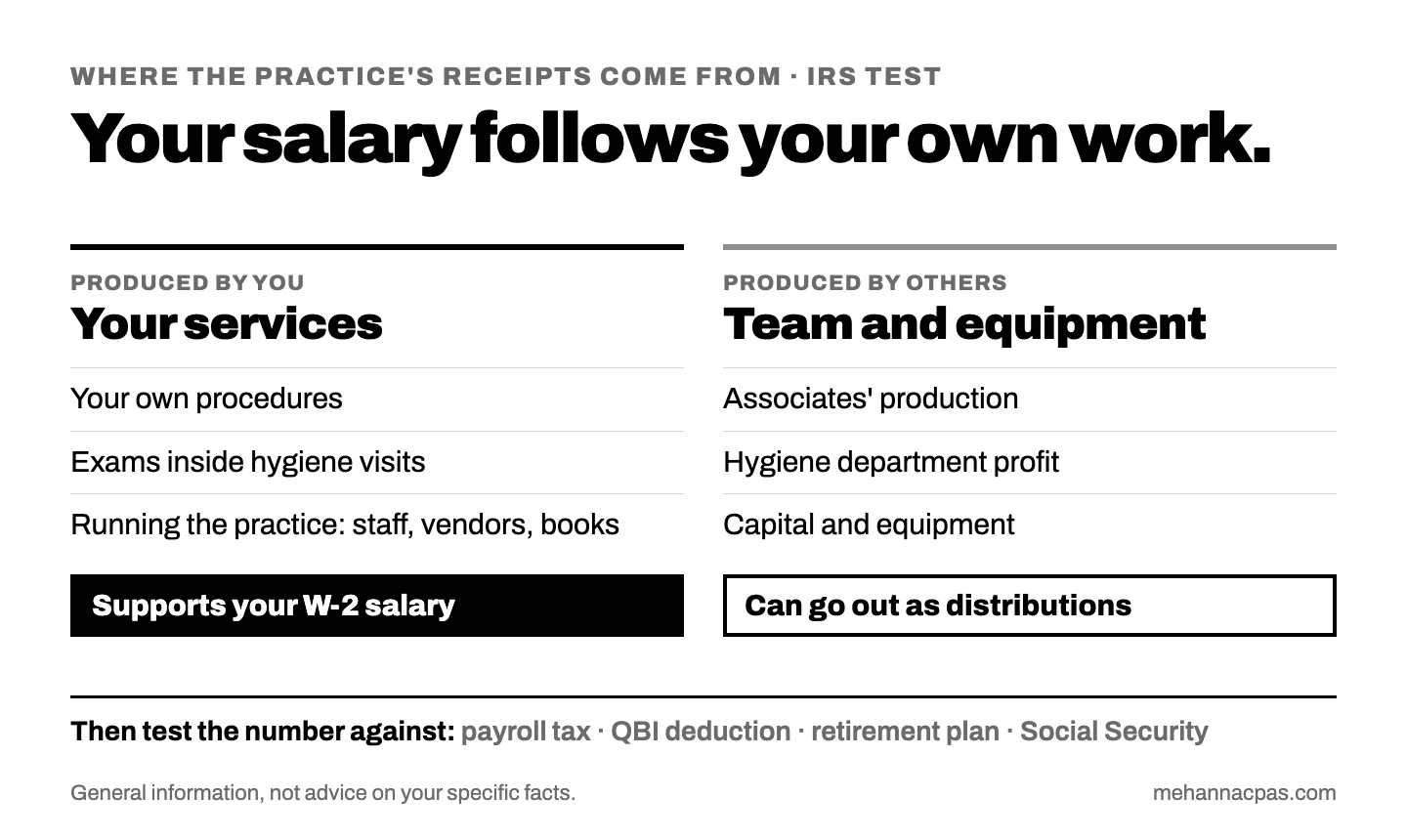
- The IRS looks at where the money comes from. Receipts from your own dentistry and management support salary. Receipts from hygiene, associates and equipment can support distributions.
- There is no 60/40 rule in the tax code. A defensible number comes from comparable pay for your work, written down.
- Above the 2026 Social Security wage base of $184,500, each extra salary dollar costs 2.9% in Medicare tax (3.8% once the additional Medicare tax applies), not 15.3%. Very low salaries chase a smaller benefit than most owners think.
- The same number sets your retirement plan room, your QBI position and your Social Security record. Set it for all of them at once.
- The finding we see most in dental S corporations: a salary picked the year the election was made and never touched since.
The S corp election went through years ago. Someone picked a salary, payroll has run it every two weeks since, and collections have grown a lot. Now a colleague in a dental group says she pays herself half of what you do, and another says the IRS will come after anyone under $200,000. Both can’t be right, and neither one has seen your practice.
This guide covers how much a dentist should pay themselves through an S corporation: what the IRS actually asks, how the number is built for a dental practice owner, what it changes besides payroll tax, and when to revisit it.
What is an S corp reasonable salary, and what isn’t it?
A reasonable salary is the W-2 wage an S corporation pays a shareholder for the services they perform, before any non-wage distributions (IRS). It runs through payroll, with income tax withheld and Social Security and Medicare paid on it. The profit left after salary and expenses can then go out as distributions, which are not subject to those payroll taxes.
It is not a percentage of profit. Neither the tax code nor the regulations set a formula; the courts decide each case on its facts (IRS Fact Sheet 2008-25). It is also not what you need to live on, and not what you happened to take last year.
| W-2 salary | Distributions | |
|---|---|---|
| What it pays for | Your work: dentistry and running the practice | Your ownership: profit from staff, associates and equipment |
| Payroll tax | Social Security up to $184,500, Medicare on all of it | None |
| How it is paid | Through payroll, on a schedule | When cash and the plan allow |
| Counts for your 401(k) and profit-sharing | Yes | No |
| Counts for your Social Security record | Yes, up to the wage base | No |
| Risk if wrong | Too high: payroll tax for nothing | Too high relative to salary: reclassified as wages |
That table is the whole S corp salary vs. distribution question in one place. For where salary fits among the other levers an owner controls, see how dentists reduce taxable income.
Who needs to set one, and who can skip it?
Any dentist who owns an S corporation and works in it needs a reasonable salary. Officers who perform more than minor services and take money out are employees for payroll tax purposes, and the fact that they are also shareholders doesn’t change that (IRS FS-2008-25). In dental practices, the question comes up most when:
- Your practice elected S status years ago and the salary hasn’t moved while collections grew.
- You hired an associate or added a hygiene day, so less of the profit comes from your own hands.
- You just bought a practice and are setting payroll for year one.
- You cut back to three clinical days, or added a second location you mostly manage.
- You want to put more into a 401(k), profit-sharing or cash balance plan.
You can skip this if your practice is a sole proprietorship or a single-member LLC without an S election. How should a business owner pay themselves in that case? With draws: there is no salary, and self-employment tax is figured on the profit itself. If you are an associate on a W-2, your employer sets your pay, and this question belongs to the day you buy in or open your own practice.
Why does the salary number matter so much?
Because one number feeds four calculations: payroll tax, the IRS reasonableness test, your QBI deduction and your retirement plan. Most owners only think about the first one.
Payroll tax. Salary carries 6.2% Social Security tax from you and 6.2% from the practice on wages up to $184,500 in 2026, plus 1.45% Medicare from each side on every dollar. Wages above $200,000 ($250,000 for a joint return) add a 0.9% additional Medicare tax (SSA 2026 fact sheet). The consequence most owners miss: past the wage base, raising your salary costs 2.9% (3.8% with the additional tax), not 15.3%. Moving from $150,000 to $200,000, for example, adds about $5,728 of combined payroll tax for 2026, half of it deductible by the practice, before any additional Medicare tax.
The reasonableness test. The IRS can reclassify distributions as wages and assess the payroll tax, penalties and interest. The leading case is an accountant whose S corporation paid him $24,000 a year while he was a partner in a firm with over $2 million of gross earnings; the court set his reasonable pay at $91,044 and taxed the difference as wages (David E. Watson, P.C. v. United States, 8th Cir. 2012). A dentist’s clinical work has a market price that is easy to look up, which makes a very low salary easy to question.
The QBI deduction. Dentistry is a health service under the tax code. For 2026, on a joint return, the 20% deduction phases out between $403,500 and $553,500 of taxable income (Rev. Proc. 2025-32). Below that range, your salary itself is not qualified business income, so a higher salary shrinks the deduction (IRS QBI FAQs). Inside the range, the deduction can be limited to 50% of the W-2 wages the practice pays, yours included. Above it, the deduction is gone and salary doesn’t affect it.
Retirement and Social Security. Plan contributions are figured on W-2 pay, never on distributions. Social Security benefits are also computed on earnings up to the yearly wage base (SSA), so years of very low salary are years of a thin earnings record.
When should you set your salary, and when should you revisit it?
Set it when the S election takes effect, then revisit it every year before the last payroll and whenever the practice changes shape. Salary paid in January is next year’s salary, so the year-end check has to happen while there are still payrolls left to run. That timing is the same one that governs the other moves in our year-end tax planning guide for dentists.
The triggers we use: a new associate or hygienist, a change in your clinical days, a second location, a big jump in collections, a practice purchase, and a plan to open or redesign a retirement plan. Each one changes what share of the profit your own work produces.
A lean year is a real exception. The IRS notes that reasonable compensation never exceeds what the shareholder actually received (FS-2008-25). In a startup year where you took little out, salary can be modest too. Once the practice pays you, the salary has to catch up.
How we set owner salary with dental practices
We build the number from your work, then test it against everything else it touches. The steps:
- Split the receipts. From the practice management system, separate your own production from hygiene, associates and other providers. That split is the IRS’s starting point too.
- Price your work. What would a practice pay a dentist with your training to do your dentistry on your schedule, in your area? Add a fair amount for the management work: hiring, schedules, vendors, the books.
- Run the four calculations together: payroll tax, QBI, retirement plan room and next year’s estimates, at two or three salary levels.
- Write it down. A short memo with your duties, hours, the comparable pay and how the number was chosen. That file is what you show if anyone asks.
- Run it through payroll, on a schedule, with your health insurance premiums on your W-2.
- Revisit it at the planning calls through the year and before the last payroll. The same three people stay on it all year, with a text before you sign anything big.
The most common finding is a round number picked the year the S corp was set up and never revisited while collections grew. The second is an owner who read “reasonable” as “as low as possible” and found out later that the same number capped the retirement plan. Neither shows up on a return that was prepared correctly. Both show up the moment someone asks how the salary was chosen.
How much should a dentist pay themselves?
Enough to match what your own clinical and management work would cost the practice to replace, and not much more. National data gives a first frame: employed general dentists earned a mean of $191,350 in May 2025 (BLS), and the median for all dentists was $176,110 (BLS Occupational Outlook Handbook). Your number moves from there with your days, specialty, market and how much of the production is yours.
| Your situation | Pushes the salary up | Pushes it down |
|---|---|---|
| Solo owner, full schedule | Most production is yours, plus all the management | Little: the profit mostly comes from your hands |
| Owner with associates | Your own production and the management of the team | Profit produced by associates |
| Strong hygiene department | Exams you do inside hygiene visits | Hygiene profit produced by hygienists |
| Specialist (endo, ortho, oral surgery) | Higher market pay for the specialty | Fewer clinical days |
| Owner on three clinical days | Management load across the week | Fewer clinical hours |
| First year after a purchase | Full schedule from day one | Cash needed for the loan and working capital |
Is there a 60/40 rule for S corp salary?
No. Splitting profit 60% salary and 40% distributions is a rule of thumb with no basis in the code, the regulations or IRS guidance. In a high-profit practice it can mean paying payroll tax on profit your team produced; in a lean one it can leave the salary too low for the work.
How much should I pay myself in an S corp in a new practice?
Start from what a dentist on your schedule would earn, then look at what you actually take out. Salary never has to exceed what you received, so a thin first year can mean a modest salary. Raise it as soon as you start taking money out of the practice.
What is a dentist reasonable salary when associates do most of the dentistry?
Lower than for a solo owner with the same profit, because more of the receipts come from people who are not shareholders. The IRS treats profit from non-shareholder employees and from capital and equipment as properly paid out as distributions (IRS). Your management of those associates still belongs in your salary.
Not sure your salary still fits your practice? The year-end check looks at owner salary along with the other moves that close at the last payroll. Free, and about eight minutes.
The factors that decide a reasonable salary for a dentist
The IRS lists the factors courts have used (FS-2008-25). Here is how each one reads in a dental practice.
1. Training and experience
Years in practice, a residency, a specialty license. An endodontist and a new general dentist doing the same hours don’t have the same market rate, and the salary should reflect that.
2. Duties and responsibilities
Your own procedures, plus what an associate would never do: hiring, payroll approval, vendor contracts, the lease, the bank. Management work counts as service even though it produces no fee directly.
3. Time devoted to the practice
Clinical days, administrative hours, and whether you also work somewhere else. A part-time owner can support a part-time salary, if the calendar shows it.
4. What comparable practices pay
Associate pay in your market for the same work is the most direct comparison. National BLS figures are a frame; local associate offers, compensation surveys and recruiter data are better evidence. Write down where each number came from.
5. What the practice pays everyone else
If your associate earns more than you for fewer days, the salary will be hard to defend. The comparison inside your own payroll is the first one anyone looks at.
6. Distribution history and bonuses
Large, regular distributions next to a small salary is the pattern the reasonableness rule exists for. A year-end bonus through payroll is a legitimate way to bring salary in line before the year closes.
7. A written method
A formula or a compensation agreement, applied the same way each year, is one of the factors on the IRS list. It doesn’t have to be long. It has to exist before anyone asks.
Dental practice owner salary checklist
Use this to see what to review and when. “Bring” is what makes the review fast; a rough estimate is enough to start.
| Item | Fits you if | When | Bring |
|---|---|---|---|
| Reasonable salary review | You own an S corporation and work in it | Before the last payroll of 2026 | Year-to-date P&L, current salary, clinical days |
| Production split | You have associates or hygienists | Before setting the number | Production by provider from the PMS |
| Comparable pay file | Anyone with an S corp salary | Updated each year | Associate offers or survey data for your market |
| Health insurance on your W-2 | You own over 2% and the practice pays your premiums | Before W-2s are produced | Premium statements |
| Retirement plan room | You want to max out a 401(k) or add profit-sharing | Last payroll for deferrals; return due date for employer contributions | Plan documents, year-to-date contributions |
| QBI position | Joint taxable income near $403,500 to $553,500 | Before the last payroll | Last year’s return, projection |
| Catch-up contributions | You are 50 or older | Check 2025 W-2 wages | Box 3 of last year’s W-2 |
Mistakes we’d avoid
Most salary problems come from treating it as a payroll-tax setting instead of a decision about the whole practice. The ones we’d steer you away from:
- Picking the lowest number that “feels safe.” The tax saved above the wage base is small, and the same number caps your retirement plan.
- Paying no salary at all. An S corporation owner who works in the practice and takes distributions with no W-2 is the case the rule was written for.
- Setting it once. A salary right for a solo practice at $700K is rarely right after an associate, a second location or a purchase.
- Using a percentage of profit. It ignores who produced the profit, which is the IRS’s actual question.
- Fixing it in January. Salary paid next year is next year’s salary. The decision has to land before the last payroll.
What changed for 2026
Several numbers that interact with your salary moved this year.
- The Social Security wage base rose to $184,500, from $176,100 in 2025 (SSA).
- The compensation a retirement plan can count rose to $360,000; the 401(k) deferral limit is $24,500 and the total defined contribution limit is $72,000 (IRS Notice 2025-67).
- Catch-up contributions must be Roth for anyone whose 2025 FICA wages from the employer were over $150,000 (final regulations, Federal Register). For an S corp owner, those are your W-2 salary, so this year’s salary decides next year’s catch-up type.
- On a joint return, the QBI phase-out for a dental practice now runs from $403,500 to $553,500 of taxable income (Rev. Proc. 2025-32).
In an owner-only 401(k), the employer contribution for you is limited to 25% of your W-2 compensation (IRS). At a $100,000 salary that is $25,000; reaching the $72,000 total with a $24,500 deferral takes about $190,000 of W-2 pay. In a plan that covers staff the math depends on the design, but it still starts from your salary. If retirement is the reason you care about the number, see how much a dentist needs to retire.
How to tell whether your salary is right
You can answer three questions in one page: how the number was chosen, what it does to your taxes, and what it does to your retirement plan. The memo names your duties, days and the comparable pay. The projection shows payroll tax, QBI and the federal tax at your salary and at one level above and below. The plan shows how much you can put away at that salary. If any of the three is missing, the salary is a habit, not a decision.
This is the kind of work a dental CPA does that a general CPA usually won’t. Owner salary is reviewed with the projections all year as part of The Treatment Plan.
Frequently asked questions
Can I pay myself only distributions from my S corporation?
Not if you work in the practice and take money out. The IRS treats S corporation officers who perform more than minor services as employees, and distributions can be reclassified as wages up to a reasonable salary, with back payroll tax, penalties and interest. Salary comes first; distributions come after it.
Does my health insurance count as part of my salary?
It goes on your W-2. If you own more than 2% and the practice pays your premiums, they are added to Box 1 wages but not to Social Security and Medicare wages. That is what lets you take the self-employed health insurance deduction on your personal return, if the other conditions are met.
Can I change my salary in the middle of the year?
Yes. Salary is a payroll setting, and you can raise or lower it for the remaining pay periods, or add a bonus through payroll before year end. What counts is the total W-2 for the calendar year, so the review has to happen before the last payroll.
Should my spouse be on payroll too?
Only for real work at a fair rate, with timesheets and a job description. A spouse’s wages can open their own retirement plan room, and they also carry payroll tax. Pay for work nobody can describe tends to fail the first time someone looks.
What happens if the IRS says my salary was too low?
It can reclassify part of your distributions as wages and assess the employer and employee payroll tax on them, plus penalties and interest. A written method with comparable pay is the best evidence that the number was reasonable when you set it.
Glossary
| Term | Meaning |
|---|---|
| Reasonable salary | The W-2 pay an S corporation owner must take for the work they do before taking distributions. |
| Distribution | Profit paid out to an S corporation shareholder as an owner. Not subject to Social Security and Medicare tax. |
| Wage base | The yearly cap on wages subject to Social Security tax: $184,500 for 2026. Medicare has no cap. |
| Additional Medicare tax | An extra 0.9% on wages above $200,000, or $250,000 on a joint return. |
| QBI deduction | A deduction of up to 20% of qualified business income from a pass-through business. For a dental practice it phases out between $403,500 and $553,500 of joint taxable income (2026). |
| Reclassification | The IRS treating distributions as wages and assessing payroll tax on them. |
| 2% shareholder | An owner of more than 2% of an S corporation. Their health insurance paid by the practice goes on their W-2. |
Sources
- IRS, S corporation compensation and medical insurance issues: reasonable compensation, sources of gross receipts, court cases.
- IRS, FS-2008-25, Wage Compensation for S Corporation Officers (2008): factors courts use, health insurance on the W-2.
- U.S. Court of Appeals, Eighth Circuit, David E. Watson, P.C. v. United States (2012).
- Social Security Administration, 2026 COLA fact sheet (2025): tax rates, 2026 wage base, additional Medicare tax.
- Social Security Administration, Contribution and benefit base: wage base also used in benefit computation.
- IRS, Rev. Proc. 2025-32 (2025): 2026 QBI thresholds.
- IRS, Section 199A qualified business income deduction FAQs: S corporation officer wages and QBI.
- IRS, Notice 2025-67 (2025): 2026 retirement plan limits.
- IRS, One-participant 401(k) plans: employer contributions up to 25% of compensation.
- Federal Register, Catch-up contributions, final regulations (2025).
- U.S. Bureau of Labor Statistics, Occupational Employment and Wage Statistics, May 2025, Table 1 (2026): dentists, general.
- U.S. Bureau of Labor Statistics, Occupational Outlook Handbook, Dentists (2026): 2025 median pay.