

A CP2000 is an IRS notice proposing changes to your return because a W-2, 1099 or other form the IRS received doesn’t match what you reported. It isn’t a bill and it isn’t a field audit. Reply by the date on the notice, usually 30 days from the notice date, to agree, partly agree or disagree with documents.
- A CP2000 is a proposal. The IRS matched third-party forms against your personal return and found a gap. Nothing is final while you can still reply.
- If you agree and have nothing else to report, you sign the response form. You don’t need to amend the return.
- Many CP2000s also propose a 20% accuracy penalty. It applies only above a threshold and can be removed for reasonable cause, so treat it as a separate question.
- Ignoring the notice leads to a Statutory Notice of Deficiency, which gives you 90 days to go to the U.S. Tax Court before the tax is assessed.
- What we see with practice owners: the mismatch usually traces back to a form issued under the wrong number, or one that arrived after the return was filed.
The envelope from the IRS is sitting on the front desk, under the lab invoices. Inside is a notice with a table of numbers, a proposed balance due with interest, and a date about a month away. Most practice owners open it on a Friday night and assume the worst.
It is usually less dramatic than it looks. This guide covers what a CP2000 means for a dental practice owner, why dentists get them, how to reply, what to do about the penalty and interest, and when an IRS letter is a sign of something bigger, such as unfiled tax returns.
What is a CP2000, and what isn’t it?
A CP2000 is a notice of proposed changes to your individual return, generated when information the IRS received from employers, insurers, banks and other payers doesn’t match what you reported. The IRS’s Automated Underreporter program compares Forms W-2, 1099 and 1098 to your Form 1040, and a tax examiner reviews the gap before the notice goes out (IRS Topic 652). The change can raise your tax, lower it, or leave it the same (IRS, Understanding your CP2000 notice).
It is not a bill, and the IRS describes it as a notice to see whether you agree, not a formal audit (IRS fact sheet FS-2019-10). It is also narrow: it covers the items listed on the notice, not your whole return.
| CP2000 | Audit (examination) | Balance-due bill (CP14) | |
|---|---|---|---|
| What triggers it | A form the IRS received doesn’t match your return | The IRS selects your return or specific items to examine | Tax on the return, or already assessed, isn’t paid |
| What it asks for | Agree, partly agree or disagree with the listed items | Records supporting income, deductions or credits | Payment |
| Is the amount final? | No, it is a proposal | No, until the exam closes | Yes, it has been assessed |
| Usual response | Signed response form plus documents, by the date on the notice | Meeting or correspondence with an examiner | Pay or set up a payment plan |
A related notice, the CP2501, sometimes comes first. It asks you to explain the difference before the IRS calculates any tax. If you agree with it, a CP2000 follows (IRS Publication 5181).
Who gets one, and who can relax?
Anyone whose personal return doesn’t line up with a form filed under their Social Security number can get a CP2000. That includes S corporation owners, because the notice is about your individual return, not the practice’s. The dental situations behind most of these letters:
- An insurance carrier still pays under your Social Security number. Insurers report payments to dental providers on Form 1099-MISC, box 6, including payments to professional corporations (IRS, Instructions for Forms 1099-MISC and 1099-NEC). If you converted to an S corporation, or bought a practice, and a carrier’s records still show your personal number, its 1099 points at your 1040 while the income sits on the company’s return.
- Associate, locum or teaching income. A 1099-NEC for a few months of work at another office, or a speaking fee, that never reached your preparer. Our guide to 1099 taxes for associate dentists covers how that income should be reported.
- A form that arrived after you filed. A late or corrected 1099, or a brokerage statement, after the return was already in. The IRS’s own advice is to wait for all income documents before filing.
- Card payments on Schedule C. Card processors report gross card payments on Form 1099-K with no minimum amount (IRS, Form 1099-K FAQs, FS-2025-08). A practice run as a sole proprietorship that books deposits net of processing fees needs a reconciliation that ties the return back to that gross figure.
You can relax a little if the notice shows a refund or no change: read it, check the numbers, and follow its instructions. If the IRS letter you received is not a CP2000, look up its number on the IRS notice page before doing anything else.
Why does an IRS notice matter for your practice?
Because silence turns a proposal into an assessment, and interest runs the whole time. The CP2000 usually includes interest figured from the return’s original due date to 30 days after the notice date, and interest keeps accruing until the balance is paid (IRS Topic 652). The underpayment rate is 7% a year for the fourth quarter of 2026 and 8% from January 1, 2027, compounded daily (IRS, IR-2026-144).
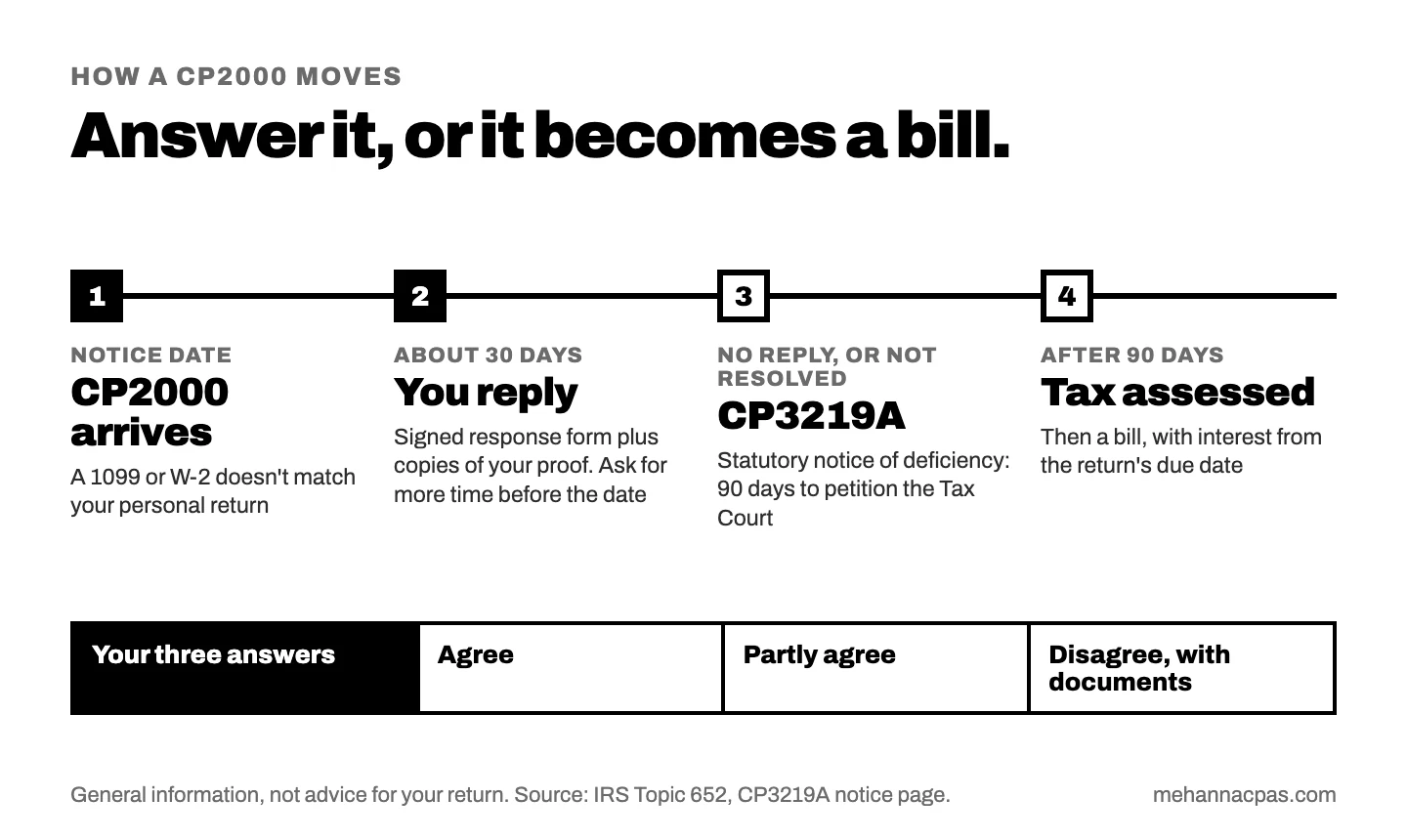
If you don’t reply, or the IRS can’t accept your explanation, it sends a CP3219A, the Statutory Notice of Deficiency. That gives you 90 days to petition the U.S. Tax Court; after that, the tax is assessed and billed (IRS, Understanding your CP3219A notice). Collection follows a bill that goes unpaid.
The second stake is the pattern. The IRS asks you to check prior years for the same issue. A carrier paying under the wrong number usually did it every year, so one notice can point to two or three more.
When should you act, and when can it wait a day?
Act the week it arrives: find the response date, put it on the calendar, and send the notice to your CPA. The reply is due by the date printed on the notice, generally 30 days from the notice date (60 if you live outside the United States). If you need more time, call the number on the notice before the date passes (IRS Topic 652).
What can wait a day: paying. You can pay the proposed amount now or wait for the IRS to adjust your account and bill you, but interest runs while you wait. Paying within 30 days of the notice stops additional interest on that amount.
One thing never waits: a letter that asks you to pay by gift card, wire or a link in an email. Real CP2000s arrive by mail, and most IRS notices also show up under Notices and Letters in your IRS online account. Check there if you aren’t sure a letter is real.
IRS letter, what to do: how to answer a CP2000 step by step
Compare each line of the notice to your return and your records, choose a position, and reply in writing with copies of your proof.
1. Find the three dates and the tax year
The notice date, the response date and the tax year are on page one. Check the tax year first: it may not be the return you filed most recently, so pull the right one.
2. Match every line to a document
The notice lists each payer, its ID number, the form type and the amount (IRS Topic 652). For each row, decide whether the income was missing, was reported somewhere else (for example on the S corporation’s return or inside a larger total), or is wrong.
3. Get a corrected form if the payer made the mistake
If the payer reported the wrong amount or the wrong number, ask it for a corrected form or a statement explaining the error (IRS). For a carrier paying under your Social Security number, also fix the number on file so next year’s form goes to the practice.
4. Choose agree, partly agree or disagree
If you agree and have no other income, credits or expenses to report, sign the response form; you don’t amend. If you file jointly, both spouses sign. If you disagree with some or all of it, check that box and include a signed statement and documents that address each item (IRS). If the notice is right but you also have deductions or credits you missed, file a Form 1040-X with “CP2000” written at the top (IRS Topic 652).
5. Send it so you can prove it arrived on time
The fastest route is the IRS document upload tool or the fax number on the notice. If you mail it, use certified mail and keep the stamped receipt. Since December 24, 2025, a postmark can reflect when a letter was first processed, not when you dropped it off (USPS final rule, Federal Register), and the Taxpayer Advocate recommends a counter receipt near any deadline (National Taxpayer Advocate). Under the regulations, the date on a certified mail receipt counts as the postmark (26 CFR 301.7502-1). Send copies, keep the originals, and keep a copy of everything you send.
6. Let your CPA talk to the IRS
The response form has an authorization section, and Form 2848 lets your CPA represent you on that year (IRS, About Form 2848). It saves you the hold time and keeps the conversation on the numbers.
Got a CP2000 or another IRS notice on your desk? Send it before the reply date and we’ll tell you what it means and what we’d answer.
What about the penalty and the interest?
Treat the penalty as its own question: it can come off even when the tax stays. A CP2000 may propose the 20% accuracy-related penalty. For substantial understatement it applies when the understatement is more than the greater of 10% of the correct tax or $5,000. If your return claims the qualified business income deduction, as many practice owners’ returns do, the line drops to the greater of 5% or $5,000. Leaving off income shown on a 1099 can also be treated as negligence (IRS, Accuracy-related penalty).
The IRS can remove or reduce penalties when you acted in good faith and show reasonable cause, and when a reply shrinks the understatement below the threshold, the substantial understatement penalty no longer fits. Ask in writing, with the facts.
Two limits are worth knowing. First Time Abate covers failure-to-file, failure-to-pay and failure-to-deposit penalties, not the accuracy penalty on a CP2000 (IRS, Administrative penalty relief). And interest is not removed for reasonable cause; it only comes off when the tax or penalty it was charged on is reduced (IRS, Interest).
Is a CP2000 a sign of a small business IRS audit, or of something bigger?
Usually not. A CP2000 is a matching notice, but it can point to a bigger issue in two cases: the same gap in other years, and unfiled tax returns.
How far back can the IRS go?
Generally three years after the return was filed. Six years if you left out income of more than 25% of the gross income shown on the return. There is no limit if a return was never filed or was fraudulent (IRS, How long should I keep records?). An S corporation owner’s personal return has its own clock, so keep the records behind both returns.
What if some returns were never filed?
File them before the IRS does it for you. If you don’t file, the IRS may prepare a substitute return that might not give you credit for your deductions, then send a CP3219N with 90 days to file or petition (IRS, Filing past due tax returns). IRS policy normally enforces filing for the past six years (IRM 4.12.1). If your books are behind too, start with our guide to catching up dental bookkeeping.
Does a dentist IRS audit start with a letter like this?
An examination is a different process, and the IRS tells you it is an audit. A CP2000 that you answer clearly and on time often ends with the notice. Not answering is what moves it forward, to a notice of deficiency and then a bill.
How we handle IRS notices with dental practices
We read the notice against the return and the practice’s books before anyone calls the IRS.
- Same day: the date. Response date on the calendar, and a request for more time if the documents can’t be ready.
- Trace every line. Each payer on the notice is matched to the 1040, the S corporation return or the deposit records.
- Fix the source. Corrected forms from payers, and the carrier’s records updated to the practice’s EIN, so the same letter doesn’t come back next year.
- Answer in writing. One signed statement, item by item, with copies, sent in a way that proves the date.
- Check the other years. If the gap repeats, we decide with you whether to amend before the IRS writes again.
A mismatch letter for a practice owner is rarely about hidden income. More often the income was reported, just on a different return or under a different number than the payer used. The answer is a clear trail from the form to the return, and a fix at the payer so it stops.
CP2000 checklist
| Item | Fits you if | Deadline | What to bring |
|---|---|---|---|
| Response date on the calendar | Any CP2000 | The day it arrives | The notice |
| Line-by-line match | Any CP2000 | Before the response date | The return for that year, all W-2s and 1099s |
| Corrected form from the payer | The payer’s amount or number is wrong | Before the response date | Payer contact, your EIN letter |
| Signed response form | You agree, or partly agree | Response date (both spouses if joint) | Response form, payment or Form 9465 |
| Signed statement and documents | You disagree with some or all items | Response date | Copies, each tied to a line of the notice |
| Penalty relief request | A 20% penalty is proposed | With the reply | Facts showing reasonable cause and good faith |
| Prior-year check | The same payer or issue appears in other years | Before the IRS writes about them | Returns and 1099s for open years |
| Payer records update | A carrier or payer still has your SSN | Before year end | Practice EIN, Form W-9 |
Mistakes we’d avoid
- Ignoring it because “it’s just a proposal.” It is a proposal until the date passes. Then it is a notice of deficiency, and then a bill.
- Paying the full amount without checking. The matching program can’t see income that sits on the S corporation’s return. Paying first and asking later is harder than answering on time.
- Filing an amended return when the notice already covers it. If you agree and have nothing else to report, the IRS says the signed response form is enough. You don’t need to amend.
- Calling the IRS without the numbers. Know which lines you agree with before anyone picks up the phone.
- Fixing the year and not the source. If the payer still has the wrong number, next year’s return gets the same letter.
What changed for 2026
- 1099-NEC and most 1099-MISC thresholds: $2,000 for payments made in 2026, up from $600, which includes medical and health care payments in box 6 (IRS, Instructions for Forms 1099-MISC and 1099-NEC). Fewer forms doesn’t mean less taxable income: you report it either way.
- Form 1099-K: payment apps and marketplaces report above $20,000 and 200 transactions again; card payments still have no minimum (IRS, FS-2025-08).
- Postmarks: since December 24, 2025, a USPS postmark can carry a later date than the day you mailed (Federal Register).
- Interest rate: 8% a year for underpayments from January 1, 2027, up from 7% (IRS, IR-2026-144).
How to tell whether your reply worked
The IRS writes back. If it accepts your explanation, you get a letter saying the case is closed or the return was accepted as filed. If it accepts part of it, a revised notice shows the new amount. If you agreed, a notice with the adjusted tax follows. Check the balance for that year in your IRS online account a few weeks later, and confirm that no interest is still running.
The real test is next year: no letter for the same payer. If the carrier and payer records point at the practice and every form reaches the return before it is filed, you shouldn’t see this notice again. Our tax services for dental practices include that kind of year-round reconciliation, and our comparison of a CPA vs. a tax preparer explains who should be answering these letters.
Frequently asked questions
I received a letter from the IRS. Is it a CP2000?
Look at the top right corner of the first page for the notice number. A CP2000 says it proposes changes to your return and includes a response form. Other numbers mean other things, and the IRS has a page for each one. If you can’t tell, send it to your CPA before replying.
Can I get more time to answer a CP2000?
Yes, usually. Call the number on the notice, or ask by mail or fax, before the response date passes. Interest keeps running during the extra time, so if you agree with part of the notice, paying that part early still helps.
Does a CP2000 mean the IRS thinks I committed fraud?
No. It means a form and your return don’t match. Most mismatches have an ordinary explanation, such as income reported on a business return or a form issued under the wrong number. Answer it clearly and on time.
What if I can’t pay the balance?
Return the signed response form by the date anyway, then pay what you can and ask for a payment plan with Form 9465 or online. If the IRS is stuck or the problem is causing real financial harm, the Taxpayer Advocate Service may help for free.
My S corporation reported the income. Why did I get the notice?
Because the payer used your Social Security number, so the IRS looked for that income on your personal return. Show where it was reported on the S corporation return, include the K-1 trail, and ask the payer to use the practice’s EIN from now on.
Glossary
| Term | Meaning |
|---|---|
| CP2000 | An IRS notice proposing changes to an individual return when third-party forms don’t match it. |
| Automated Underreporter (AUR) | The IRS program that compares W-2s, 1099s and 1098s with individual returns. |
| CP3219A | The Statutory Notice of Deficiency that follows an unanswered or unresolved CP2000, with 90 days to petition the Tax Court. |
| Accuracy-related penalty | A 20% penalty on an underpayment caused by negligence or a substantial understatement of tax. |
| Reasonable cause | Facts showing you acted in good faith, which can get a penalty removed. |
| Form 2848 | The power of attorney that lets a CPA represent you before the IRS. |
Sources
- IRS, Understanding your CP2000 series notice (2026): not a bill, reply by the date, no amendment if you agree, check prior years.
- IRS, Topic 652, Notice of underreported income, CP2000 (2026): Automated Underreporter, 30 days, interest, Form 1040-X marked CP2000.
- IRS, FS-2019-10, IRS explains CP2000 notices (2019): not a formal audit notification, extra time by phone.
- IRS, Publication 5181, Tax Return Reviews by Mail (2022): CP2501, response options, extensions.
- IRS, Understanding your CP3219A notice: 90-day period, corrected forms from payers.
- IRS, Instructions for Forms 1099-MISC and 1099-NEC (12/2026): $2,000 thresholds, box 6 medical payments, payments to professional corporations.
- IRS, FS-2025-08, Form 1099-K FAQs (2025): $20,000 and 200 transactions for payment apps, no minimum for card payments.
- IRS, Accuracy-related penalty: 20%, 10% or $5,000, 5% with the QBI deduction, reasonable cause.
- IRS, Administrative penalty relief: penalties eligible for First Time Abate.
- IRS, Interest: no interest relief for reasonable cause or first-time relief.
- IRS, IR-2026-144 (2026): 8% underpayment rate for January to March 2027.
- IRS, How long should I keep records?: 3-year, 6-year and unlimited periods.
- IRS, Filing past due tax returns: substitute returns and CP3219N.
- IRS, Internal Revenue Manual 4.12.1, Nonfiled Returns: six-year enforcement period.
- IRS, Online account for individuals: digital notices and authorizations.
- IRS, About Form 2848, Power of Attorney.
- U.S. Postal Service, Postmarks and Postal Possession, final rule (2025): effective December 24, 2025.
- National Taxpayer Advocate, New USPS postmark rules (2026): proof of mailing near deadlines.
- Code of Federal Regulations, 26 CFR 301.7502-1: certified mail receipt date treated as the postmark.