

The most reliable signs of embezzlement in a dental office are in the numbers: deposits that don’t match collections in your practice software, rising adjustments and refunds, and deposits made every few days instead of daily. Behavior signs, like a manager who never takes vacation, help, but a daily check of deposits against the day sheet is what catches it early.
- In an ADA survey published in 2020, nearly half of responding dental practices had experienced employee theft, and almost half of those more than once.
- Across industries, the typical fraud runs 12 months before anyone finds it, and the longer it runs, the bigger the loss.
- Payroll tax theft hurts twice. If a payroll company or employee diverts your tax deposits, the practice still owes the IRS, and owners can be held personally liable for the withheld part.
- Money stolen from the practice can generally be deducted as a theft loss in the year you discover it, reduced by what you expect to recover.
- What we see most in dental practices: one trusted person who takes the payment, posts it, makes the deposit and reads the bank statement. That setup is the risk, whoever the person is.
Your collections look fine on the monthly report. Your office manager has been with you for nine years, never misses a day and handles everything at the front desk so you can stay in the operatory. Then a patient calls, upset about a balance she says she paid in cash last spring, and you can’t find the payment anywhere. Is an employee stealing money, or is it a posting error?
Most dental embezzlement is found exactly like that: by accident, long after it started. This guide covers the signs of embezzlement worth taking seriously, how office manager embezzlement usually works and hides, and the daily check that makes it hard to start in the first place.
What is dental embezzlement, and what isn’t it?
Dental embezzlement is when someone you trusted with the practice’s money, usually an employee, takes it for themselves and hides it in the records. The IRS lists embezzlement as a form of theft: the taking of money or property with the intent to deprive the owner of it, illegal under state law, done with criminal intent (IRS Publication 547).
What makes it different from a break-in is the second half: the person has access to the books, so the theft is usually covered by an adjustment, a deleted payment or a payroll entry that looks normal. That is also why it gets confused with honest mistakes.
| Embezzlement | Bookkeeping error | Theft of supplies | |
|---|---|---|---|
| What happens | Money is taken and the records are changed to hide it | A payment is posted wrong or a deposit is missed | Products or supplies walk out the door |
| Who does it | Someone with access to payments, posting, payroll or the bank | Anyone who touches the books | Anyone with physical access |
| Pattern | Repeats, grows, hides in adjustments and refunds | Random, usually corrects itself when found | Shows up as supply costs drifting up |
| How it is found | Matching deposits to collections, reviewing adjustments, tips | The monthly close | Inventory counts |
Who is most at risk, and who can relax a little?
Any practice where one person controls a payment from the moment it arrives until it shows up in the bank is at risk. The risk is highest when:
- The same person takes patient payments, posts them in the practice software, prepares the deposit and receives the bank statement.
- One person enters payroll, approves it and gets the payroll reports.
- The owner never looks at the adjustment report, the refunds or the bank statement directly.
- The practice collects $750,000 or more, so a few hundred dollars a week disappears into normal variation.
- A long-tenured manager runs the business side alone. Years of trust are exactly why nobody checks.
You can worry less if duties are already split, you or someone outside the front desk checks deposits against the day sheet every business day, and patient payments are mostly card and insurance payments that land in the bank with a clear trail. Less risk is not no risk.
Why does dental office embezzlement cost more than the money taken?
Because it usually runs for a long time, it is rarely recovered and it can create tax debts on top of the theft. The best dental embezzlement statistics come from an ADA Council on Dental Practice survey: nearly 49% of responding practices had experienced employee theft, and nearly 46% of those had been hit more than once (ADA News, February 2020). The most common types included taking cash and padding hours worked.
Across all industries, the 2026 study of occupational fraud by the Association of Certified Fraud Examiners found a median loss of $104,000 per case and a typical scheme lasting 12 months before detection. Frauds caught in the first six months had a median loss of $40,000, while schemes that ran more than five years passed $1.1 million (ACFE, Occupational Fraud 2026). Only 15% of victim organizations reported a full recovery (ACFE, Report to the Nations 2026).
The part most owners never hear about is payroll taxes. If the person or company running payroll keeps the tax deposits, the practice still owes them. The IRS says the employer is ultimately responsible for the deposits, and is liable for the taxes, penalties and interest if a third party fails to pay; the employer may also be held personally liable for certain unpaid federal taxes (IRS, Outsourcing payroll duties).
What are the signs of embezzlement in a dental office?
The signs that matter most are in your reports, not in anyone’s personality. Behavior can point you to where to look, but it proves nothing on its own. Start with the numbers.
1. Deposits don’t match collections in the practice software
Every day, the cash, checks and card batches posted in your practice management system should equal what reaches the bank. A gap that gets “averaged out” at month end is the classic place money hides.
2. Adjustments, write-offs and refunds keep creeping up
A common scheme: take a cash or check payment, then adjust the balance off so the patient’s account looks settled. Refunds to a card that was never charged work the same way. Watch the adjustment and refund reports by person and by reason.
3. Deposits are made every few days instead of daily
A pile of undeposited checks and cash makes it easy to swap, delay or skim. Daily deposits close that window.
4. Patients complain about balances they say they paid
Patient complaints about statements are one of the few outside alarms you get. Take every one seriously, and have someone other than the front desk look into it.
5. Collections are flat while production grows
If you are busier than ever and the collections ratio is drifting down, something is leaking. It may be insurance follow-up, or it may be theft. We cover the ratio in the dental KPIs that tell you if the practice is healthy.
6. Payroll looks slightly off
Extra hours, a bonus you don’t remember approving, a paycheck split in two, or a name on the W-2s you don’t recognize. Payroll is one of the quietest places to steal, because nobody looks at it twice.
7. IRS or state notices you never see
Payroll tax theft often shows up first as a notice. If notices go only to the person running payroll, they can disappear. The IRS strongly suggests that employers keep their own address of record, not the payroll provider’s, so notices reach the business (IRS, Outsourcing payroll duties).
8. Behavior that guards the books
The ACFE found that 84% of fraudsters showed at least one behavioral red flag, such as financial trouble or living beyond their means (ACFE, May 2026). In dental offices, the ones to notice are a manager who won’t cross-train, never takes vacation, comes in alone early or late, and gets defensive when you ask about a report. Plenty of honest people do some of these. Use them as a reason to check the numbers, not as an accusation.
How does dental office manager embezzlement usually work?
Most cases use a handful of schemes, each with a report that exposes it. Whether it is a dental office manager stealing from the front desk or a bookkeeper working the payables, this is how to detect employee theft without hiring an investigator first.
| Scheme | How it hides | The report that exposes it |
|---|---|---|
| Skimming cash or check payments | Payment never posted, or posted and adjusted off | Daily deposit vs. day sheet; adjustment report |
| Deleted or reversed payments | Payment posted, then removed after the patient leaves | Deleted transactions or audit trail report in the PMS |
| Refunds to their own card | Looks like a normal patient refund | Refund report matched to the original charges |
| Payroll padding | Extra hours, bonuses, a duplicate paycheck | Payroll register you approve before it runs; W-2 review in January |
| Fake vendors or personal bills | Paid as supplies or a “vendor” with their own address | Vendor list and bank statement read by the owner |
| Diverted payroll taxes | Reports and returns look correct | Your own IRS payment history |
Dental embezzlement cases often combine several of these at once, and they are rarely caught by the practice’s own reports. In the ACFE’s 2026 study, 43% of frauds were detected by tips, nearly three times as many as the next most common method (ACFE, 2026). A daily check is how you stop depending on luck.
What is the daily check that stops it?
The daily check is a short routine where someone other than the person who took the payments matches what was collected to what reached the bank, every business day. It takes minutes when it is done daily and hours when it is done monthly.
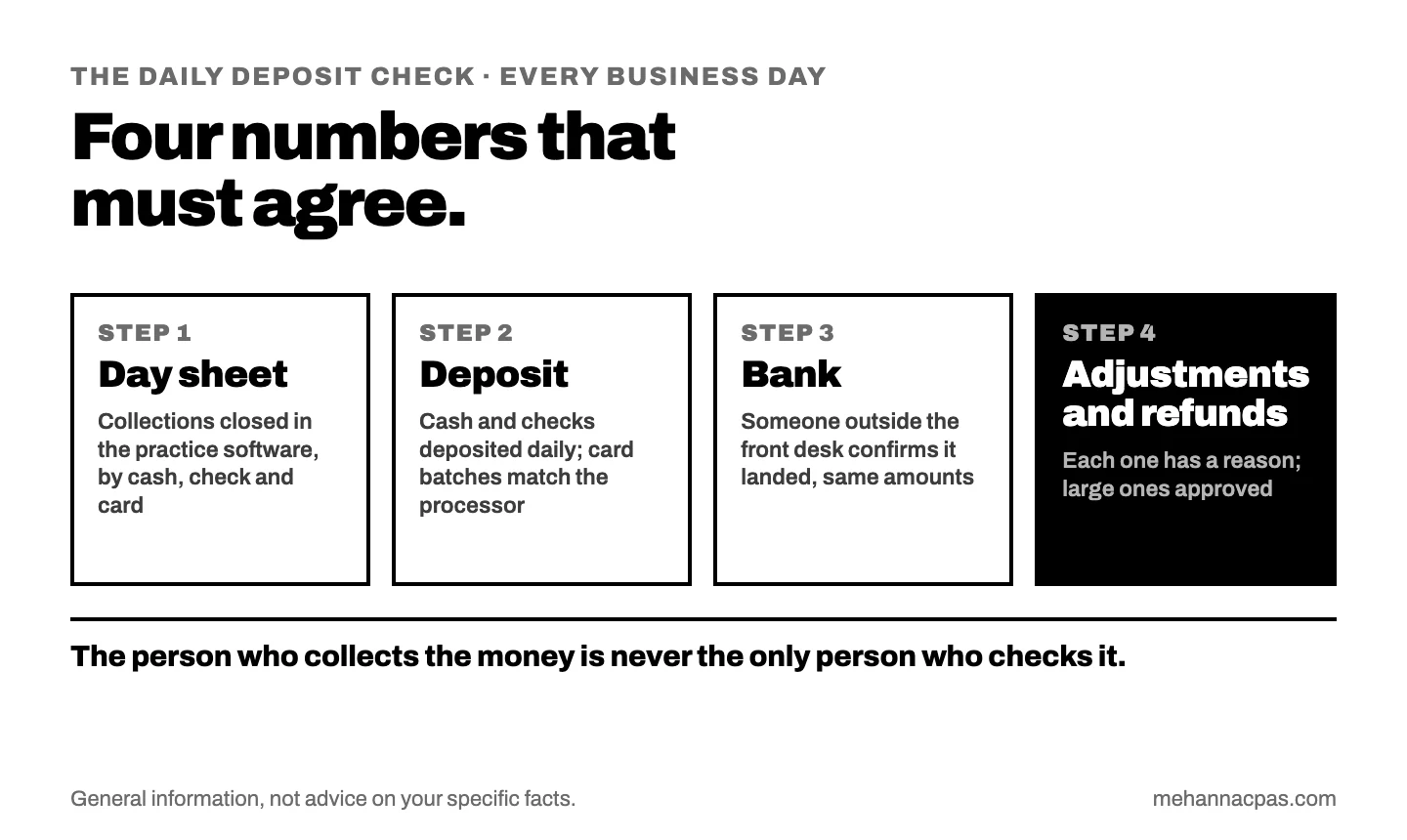
- Close the day sheet. The front desk closes the day in the practice software and prints or exports the collections by payment type: cash, checks, cards.
- Match the deposit. Cash and checks go into a deposit that matches the day sheet to the dollar. Card batch totals match the card processor’s report.
- Confirm the bank. The next business day, someone outside the front desk confirms the deposit and the card batches landed in the bank for the same amounts.
- Review adjustments and refunds. Every adjustment and refund over a threshold you set has a reason. Anything unusual gets a question the same day.
The rule behind it is simple: the person who collects or records the money is never the only person who checks it. If you want a test, ask yourself one question: if I wanted to steal from this practice, where would I start? Then put a second set of eyes there.
How to prevent embezzlement in a dental office
Prevention is mostly about splitting duties and making sure you see a few things directly. None of these takes much of your time once it is set up.
Which controls matter most?
- Split the money trail. The person who takes payments shouldn’t also post adjustments without approval, prepare the deposit alone and receive the bank statement.
- See the bank yourself. Read-only online banking and alerts for large withdrawals, new payees and returned items go to you, not to the office.
- Approve payroll before it runs. Review the register for hours, bonuses and new names, and scan the W-2s every January.
- Set an adjustment threshold. Adjustments and write-offs above it need your approval or a second person’s.
- Require vacations and cross-training. Schemes that need daily upkeep tend to surface when someone else covers the desk.
- Check references before hiring. Ask previous dental employers directly, not only the references the applicant lists.
- Ask about coverage. Many business policies offer employee dishonesty or crime coverage. Know whether you have it and what its limit is.
How do I check that payroll taxes were actually paid?
A withdrawal from your bank account only proves the money left. It doesn’t prove the IRS got it. The IRS recommends that employers register for their own access to the Electronic Federal Tax Payment System (EFTPS) and use it to periodically verify payments, with 16 months of payment history online, and says a red flag should go up the first time a provider misses or is late on a payment (IRS, Outsourcing payroll duties). The IRS Business Tax Account also shows payment history and notices. Once a month, compare what payroll says was deposited with what the IRS shows.
Using a payroll company doesn’t shift the responsibility. The IRS says a payroll service provider assumes no liability for its clients’ employment tax duties (IRS, Third party arrangements).
What should you do if you suspect embezzlement?
Protect the evidence first, then bring in your CPA before you confront anyone. Confronting too early gives someone time to delete records or “fix” the books.
- Quietly secure the records. Back up the practice software, keep bank and card statements, and change passwords and bank access you can change without tipping anyone off.
- Call your CPA, and a forensic accountant if the amounts are large. They can size the problem and keep the work organized for insurance, police and taxes.
- Check payroll taxes right away. If deposits are missing, talk to your CPA before you pay other bills. For the IRS trust fund recovery penalty, using available funds to pay other creditors when the business can’t pay its employment taxes is an indication of willfulness (IRS, Trust Fund Recovery Penalty). The penalty equals the unpaid income tax withheld plus the employees’ share of Social Security and Medicare, and it can be assessed against responsible people personally, not only the practice.
- Notify your insurer and file a police report. The ADA’s guidance encourages dentists not to hesitate to take a case to law enforcement, so the person can’t do it again at another practice (ADA News, 2020).
- Document what you found and when. It matters for the insurance claim and for taxes.
Can I deduct money that was embezzled from my practice?
Generally, yes, as a theft loss of the business. Federal law treats a theft loss as sustained in the year you discover it (26 U.S.C. 165(e)). You don’t need a conviction, but you should be able to show the money was stolen, when you discovered it, and whether a claim for reimbursement exists with a reasonable prospect of recovery, which reduces or delays the deduction (IRS Publication 547). How much is deductible depends on how the stolen money was recorded in your books, so this is a conversation to have with your CPA early, not at tax time.
How we handle deposit control with dental practices
We treat fraud prevention as part of good bookkeeping, not as a separate investigation. Every plan includes weekly bookkeeping and a monthly close that ties deposits to the practice software. For practices that want more, Daily Deposit Control is an add-on: every business day we match cash, check and card deposits to your practice management system, and any shortage, any amount, you hear about it that day.
- Map who touches the money. We look at who takes payments, posts, deposits, runs payroll and receives statements, and where one person holds too much of the chain.
- Set up the tie-out. Day sheet, deposit and bank, checked by someone outside your front desk.
- Watch payroll. Payroll entries tie to the payroll reports in every monthly close, so a change you didn’t approve stands out.
- Tell you the same day. A shortage, any amount, reaches you that day, with the detail you need to ask the right question.
The practices most exposed aren’t careless. They trust one great person with everything, because it frees the dentist to do dentistry. The fix is rarely firing anyone. It is a second set of eyes on the deposit every day and on payroll every month, which protects the honest manager as much as it protects you.
Want a daily deposit check without doing it yourself? Daily Deposit Control is an add-on to the plan. See what it would cost for your practice.
Signs of embezzlement checklist
Use this to check your practice this month.
| Check | What good looks like | How often | Red flag |
|---|---|---|---|
| Deposits vs. day sheet | Match to the dollar, checked by someone outside the front desk | Every business day | Gaps “averaged out” at month end |
| Deposit timing | Cash and checks deposited daily | Daily | Deposits every few days |
| Adjustments and refunds | Each has a reason, large ones approved | Daily or weekly | Rising totals, refunds to cards never charged |
| Deleted payments | Rare and explained | Weekly | Payments posted, then removed |
| Payroll register | Approved by you before it runs | Each payroll | Extra hours, unapproved bonuses, new names |
| Payroll tax deposits | IRS payment history matches payroll reports | Monthly | A missing or late deposit |
| Bank statements and IRS mail | Reach you directly | Monthly | Only the office manager sees them |
| Coverage | Employee dishonesty coverage with a known limit | At renewal | No one knows if it exists |
Embezzlement mistakes we’d avoid
Most losses grow because of habits, not because the thief was clever.
- Trusting the monthly report someone else prepares. If the person who could steal also builds the summary you read, the summary can’t protect you. Look at reports straight from the practice software and the bank.
- Treating the bank withdrawal as proof the IRS was paid. Check the IRS side yourself.
- Letting the payroll provider’s address replace yours with the IRS. Notices about missing deposits then never reach you.
- Confronting before securing records. It invites deleted data and a cleaner cover story.
- Waiting until tax season. A monthly close that ties deposits to collections is cheaper than any investigation. Our guide to what good dental bookkeeping looks like covers the close step by step.
What changed for 2026
Two updates this year are worth knowing.
- New fraud benchmarks. The ACFE published Occupational Fraud 2026 in May 2026, based on 2,402 cases: median loss of $104,000 per case, down from $145,000 in the 2024 edition, with the typical scheme still running 12 months before detection (ACFE, 2026; ACFE, 2024).
- More visibility into IRS payments. In July 2026 the IRS described expanded Business Tax Account features, including viewing recently processed payments made through EFTPS, wire transfers and checks, and whether any payment was returned or refused (IRS, FS-2026-11). That makes the monthly payroll tax check easier for an owner to do directly.
How to tell whether your controls are working
They work when a missing deposit would be noticed within a day and a payroll change within one pay period. Test it: ask who would notice if $300 in cash didn’t make it to the bank tomorrow, and when. Also check that the adjustment report is reviewed by someone other than the person who enters adjustments, and that your IRS payment history matches payroll for the last three months. If the answers depend on one person, the controls are that person’s honesty. Our guide to reading your dental practice’s financial statements shows what to look for each month, and The Treatment Plan covers the bookkeeping and monthly close this depends on.
Frequently asked questions
How common is embezzlement in dental offices?
Common enough to plan for. In the ADA Council on Dental Practice survey reported in 2020, nearly 49% of responding practices had experienced employee theft, and nearly 46% of those more than once. The survey covered all kinds of theft, from cash to padded hours and products.
How long does embezzlement usually go on before it’s caught?
The typical case in the ACFE’s 2026 study ran 12 months before detection, across industries. Longer schemes cost much more: cases caught within six months had a median loss of $40,000, while those running more than five years passed $1.1 million.
Is my payroll company responsible if it doesn’t pay my payroll taxes?
Not in the eyes of the IRS. The employer remains responsible for the deposits, plus penalties and interest, and a payroll service provider assumes no liability for its clients’ employment tax duties. A certified professional employer organization (CPEO) is the main exception, under its own rules.
Can I report a payroll provider that didn’t deposit my taxes?
Yes. The IRS accepts complaints about payroll service providers on Form 14157, and says those complaints get expedited handling (IRS, Outsourcing payroll and third-party payers). Talk to your CPA about the missing deposits at the same time.
Should I press charges against an employee who stole?
That is your decision, made with your attorney. The ADA encourages dentists not to hesitate to involve law enforcement, partly so the person can’t repeat it at another practice. A police report also helps document the theft for insurance and taxes.
Glossary
| Term | Meaning |
|---|---|
| Day sheet | The daily report in your practice management system showing production, payments and adjustments for the day. |
| Adjustment | An entry that changes a patient’s balance without a payment, such as a PPO write-off or a courtesy discount. |
| Skimming | Taking a payment before it is recorded, so it never appears in the books. |
| EFTPS | The Electronic Federal Tax Payment System, where federal tax deposits are made and an employer can see its payment history. |
| Business Tax Account | The IRS online account where a business can see balances, payment history and notices. |
| Trust fund recovery penalty | An IRS penalty equal to unpaid withheld income tax and the employees’ share of Social Security and Medicare, assessed against responsible people personally. |
| Theft loss | A deduction for money or property stolen from the business, generally taken in the year the theft is discovered. |
Sources
- IRS, Outsourcing payroll duties: employer remains responsible; address of record; EFTPS verification and 16 months of history.
- IRS, Third party arrangements: a payroll service provider assumes no liability for clients’ employment tax duties.
- IRS, Outsourcing payroll and third-party payers: Form 14157 complaints about payroll providers.
- IRS, Employment taxes and the Trust Fund Recovery Penalty: responsible persons, willfulness, paying other creditors, penalty amount.
- IRS, Business Tax Account (2026) and FS-2026-11 (July 2026): payment history and expanded features.
- IRS, Publication 547, Casualties, Disasters, and Thefts: embezzlement as theft, no conviction needed, theft loss proof, reasonable prospect of recovery.
- Legal Information Institute, 26 U.S. Code § 165(e): theft losses treated as sustained in the year of discovery.
- ADA News, Survey: Nearly half of dental practices experience theft from staff (February 2020): ADA Council on Dental Practice survey results and guidance on law enforcement.
- Association of Certified Fraud Examiners, Occupational Fraud 2026: A Report to the Nations, key findings and press release (May 2026): median loss, duration, recovery, behavioral red flags.
- Association of Certified Fraud Examiners, Occupational Fraud 2024: A Report to the Nations: 2024 median loss for comparison.