

Keep the dental office lease when you need cash for the practice, flexibility, or a location you can’t buy. Buy the building when the location is proven, you expect to stay ten years or more, and the after-tax math beats rent. If you buy, the building usually belongs in its own LLC that leases to the practice.
- Compare two ten-year futures, not rent vs. mortgage. Down payment, repairs, taxes, depreciation and what you’d net from a sale all belong in the math.
- Renting property to your own business has its own tax rules. Net rent from your building LLC is generally nonpassive, while a loss on it is generally passive unless the rental is properly grouped with the practice.
- Rent between you and your practice has to be fair market rent. The IRS only allows a deduction for reasonable rent, and an SBA loan caps what a building LLC can charge.
- The lease is a practice asset too. Term, renewal options and the right to assign it to a buyer shape what your practice is worth when you sell.
- What we see in dental practices: the building decision goes best when it’s made with the practice’s tax projection open, before the purchase agreement, not after.
Your lease renewal just landed on your desk with a higher number. Or the building owner mentioned he’d sell. Either way, you’re asking the question every established practice owner asks sooner or later: should I buy my dental office building, or keep renting?
There’s no universal answer, and anyone who tells you rent is “throwing money away” is skipping half the math. This guide walks through what you’re really comparing, the tax rules that change once you’re both landlord and tenant, how an SBA 504 loan fits, and the lease terms worth fighting for if you stay a tenant.
What is the lease vs. buy decision, and what isn’t it?
The lease vs. buy decision for a dental office is a comparison of two long-term plans: paying a landlord for the space, or owning the real estate, usually in a separate company that rents it to your practice. It is a real estate investment decision layered on top of a practice decision. It isn’t a monthly payment comparison, and it isn’t the same as buying the practice itself.
The question also looks different from a general lease vs. buy commercial property analysis, because the tenant is a business you control. That changes how the rent is taxed, what rent you’re allowed to charge, and what happens when you sell the practice.
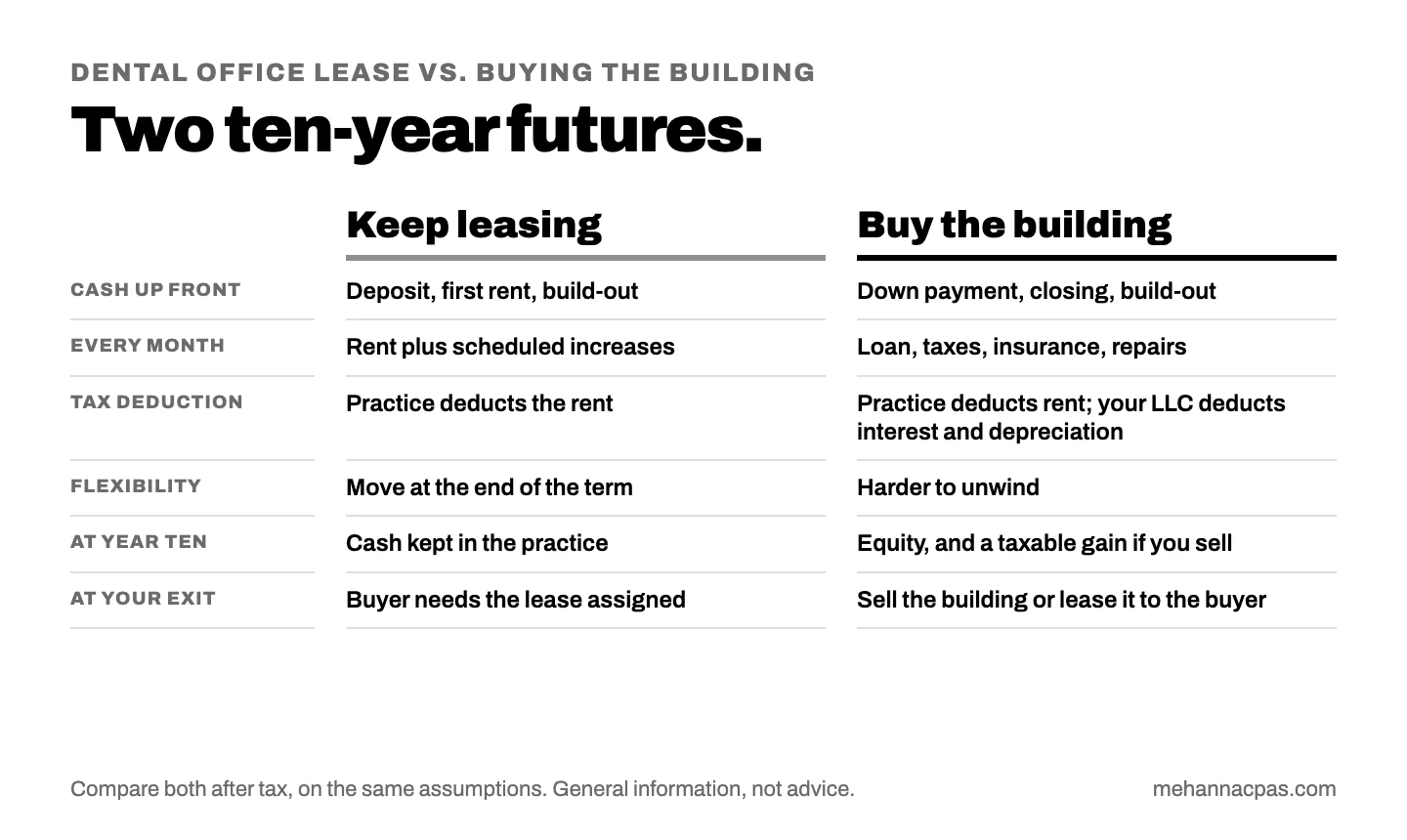
| Keep leasing | Buy the building | |
|---|---|---|
| Cash up front | Deposit and first rent; build-out, often with a landlord allowance | Down payment, closing costs and build-out |
| Monthly cost | Rent, often plus a share of taxes, insurance and common area costs | Loan payment, property taxes, insurance, repairs |
| Tax deduction | Rent is deductible by the practice | Practice deducts rent it pays your LLC; LLC deducts interest, depreciation and costs |
| Control | Landlord approves changes; renewal is negotiated | You decide on layout, expansion and timing |
| Flexibility | You can move at the end of the term | Selling or re-leasing the building takes time |
| At your exit | The buyer needs the lease assigned or renewed | Sell the building, or keep it and collect rent |
The same structure is behind our buy vs. rent calculator, which runs a first pass on your own numbers.
Who should consider buying, and who should keep the lease?
Buying tends to fit an owner with a proven location, a stable practice and a long horizon; leasing tends to fit everyone still building one of those three. Buying is worth a serious look when:
- You’ve been in the same location for years, the patient base is local, and you expect to practice there for at least another decade.
- The building comes up for sale, or your landlord offers a renewal that makes owning look cheaper.
- You need space the landlord won’t approve: more operatories, a second hygiene wing, a CBCT room.
- You’re planning your exit and like the idea of keeping the building and leasing it to the buyer.
Keep the lease if you’re in a startup’s first years, if the cash would leave the practice thin, if the best location in your market simply isn’t for sale, or if you might relocate, merge or sell within a few years. An associate who doesn’t own a practice yet should settle the practice first; our guide on how much practice you can actually afford comes before any dental office real estate.
Why does the building decision matter so much for a dental practice?
Because occupancy is one of the largest fixed costs in the practice, and the choice locks in for a decade or more either way. A dental office is expensive to move: plumbing, vacuum, compressed air and electrical runs to every operatory make a relocation a construction project, not a moving day. That’s why both a long lease and a purchase are commitments.
The tax treatment also differs more than most owners expect. A commercial building is depreciated over 39 years, and land isn’t depreciated at all (IRS Publication 946). Rent you pay a landlord is generally deductible as you pay it (IRS Publication 334). Owning trades a simple deduction for a set of deductions spread across two entities, plus equity, plus a taxable gain when you sell.
When should you run the math, and when can you skip it?
Run it before you sign anything: a renewal, a letter of intent on a building, or a practice purchase that includes real estate. The useful moments are:
- 12 to 18 months before the lease ends, while you still have time to negotiate or find another option.
- When a building comes up for sale, before you make an offer.
- When you buy a practice and the seller owns the building, because the seller may offer a sale or a new lease.
- Three to five years before you plan to sell the practice, since the building and the practice can be sold separately. Our guide to planning a dental practice transition covers that timeline.
You can skip the full exercise if the lease has years left, your plans are uncertain, and nothing is for sale. Revisit it at the next trigger.
Dental office lease vs. buy: how to run the math
Build two ten-year scenarios on the same assumptions and compare where you end up after tax. These are the five questions we work through, in order.
1. What does each option really cost per year?
For leasing: base rent, scheduled increases, and any share of taxes, insurance and common area charges. For owning: loan payments, property taxes, insurance, repairs, and a reserve for the roof and HVAC. Include the cash each option takes on day one, and what that cash could have done inside the practice.
2. What are the tax deductions on each side?
On the lease side, the practice deducts the rent. On the ownership side, the practice deducts the rent it pays your building LLC, and the LLC reports that rent as income and deducts mortgage interest, property taxes, insurance and depreciation. The year you buy also sets two numbers that last for decades: the split between land and building, which follows fair market value (IRS Publication 551), and whether a cost segregation study makes sense for the building.
3. What will the building be worth when you leave?
Ownership builds equity as the loan is paid down, and the value can rise or fall. When you sell, the gain is taxed, and depreciation you took earlier comes back into the calculation (IRS Publication 544). Model a sale, and also the option of keeping the building and leasing it to whoever buys the practice.
4. Can the practice carry both loans?
A building loan on top of a practice acquisition loan or an equipment loan can squeeze cash flow, especially in the first years. Check the combined payments against the practice’s real cash flow, not its best month.
5. What does the decision do to your flexibility?
If a partner leaves, a DSO calls or your family plans change, a building is harder to unwind than a lease. Put a price on that, even if it’s only a sentence in your notes.
Lease renewal on your desk or a building for sale down the street? Walk through both ten-year scenarios before you sign.
Renting property to your own business: the tax rules that change
Once you own the building and your practice pays you rent, you’re both landlord and tenant, and several tax rules treat that differently from an ordinary rental.
1. Keep the building out of the practice entity
Most owners who buy hold the building in a separate LLC that leases it to the practice. It keeps the real estate apart from the practice’s liabilities and lets you sell the practice without selling the building. Holding real estate inside a C corporation is the setup we’d avoid: the corporation pays tax on its profit, and you’re taxed again when it’s distributed to you (IRS, Forming a corporation).
2. Net rent is nonpassive, but a loss is passive
When you rent property to a business you materially participate in, net rental income is treated as nonpassive, but a net loss stays passive (26 CFR 1.469-2(f)(6)). So a profitable building can’t absorb passive losses from other rentals, and a building loss, for example in the year of a cost segregation study, may not offset practice income. A grouping election can treat the rental and the practice as one activity when each owner holds the same proportion of both, and spouses filing jointly count as one owner (26 CFR 1.469-4). It doesn’t work the same way with a C corporation practice, and it is disclosed with the return (Rev. Proc. 2010-13). Decide it the year you buy.
3. The rent generally stays out of the 3.8% net investment income tax
Rental income that is nonpassive under the self-rental rule, or because the rental is grouped with your practice, is treated as earned in the ordinary course of a trade or business for the net investment income tax (26 CFR 1.1411-4(g)(6)). Ordinary rent from an unrelated tenant is generally part of net investment income (IRS Topic 559).
4. Charge fair market rent, and write it down
The IRS doesn’t allow a deduction for unreasonable rent, and rent paid to a related person is reasonable if it’s what you’d pay a stranger for the same space (IRS Publication 334). Keep a signed lease and support for the number, such as a broker’s opinion. High rent also doesn’t replace a reasonable salary if your practice is an S corporation; our guide to S corp reasonable salary for dentists explains why.
5. Interest follows the money
Mortgage interest on the building is generally deductible against the rent. A later cash-out refinance is different: interest is allocated by how you use the loan proceeds, not by the property that secures the loan (26 CFR 1.163-8T). Cash pulled out for a vacation home isn’t building interest.
How does an SBA 504 loan work for a dental office?
An SBA 504 loan is long-term, fixed-rate financing for owner-occupied real estate and major fixed assets, made through a Certified Development Company together with a bank. A typical structure is a bank first mortgage for about 50% of the project, the SBA-backed portion for about 40%, and about 10% from you, with 10-, 20- or 25-year terms (SBA, 504 fact sheet). Startups and special-purpose properties may need a larger contribution, and 504 proceeds can’t be used to invest in rental real estate (SBA, 504 loans).
Three rules matter for a dental office:
- Occupancy. For an existing building, the practice must occupy at least 51% of the rentable space and can lease out the rest; for new construction, at least 60% (13 CFR 120.131).
- A building LLC can be the borrower. SBA allows a separate property company that leases the building to the practice, with the practice as guarantor or co-borrower and a written lease at least as long as the loan (13 CFR 120.111).
- The rent is capped. In that setup, rent can’t exceed the loan payment plus the property company’s direct costs, such as maintenance, insurance and property taxes (13 CFR 120.111(a)(3)). Plan the rent with both this cap and fair market value in mind.
Lenders also look at the practice’s cash flow, your personal credit and the other debt you carry, so get the numbers together before you make an offer.
If you keep the dental office lease: terms that protect the practice
A strong lease gives you much of the security owners buy a building for. Before you sign or renew, look at:
- Term and renewal options long enough to outlast your practice loan and your build-out.
- Assignment. The right to assign the lease to a buyer of the practice. A short or non-assignable lease makes the practice harder to sell and finance.
- Use and exclusivity. Dental use permitted, and ideally no other dental office in the same center.
- Relocation and demolition clauses, which can undo the rest of the lease.
- Build-out allowance and rent abatement during construction.
- Personal guaranty. How much of the lease you sign for personally, and whether it shrinks over time.
- Purchase option or right of first refusal, so you get a chance to buy if the owner sells.
Two tax points for tenants. Your own interior build-out in leased space can be qualified improvement property with a 15-year life, which generally qualifies for bonus depreciation (IRS Publication 946). Improvements are depreciated over their tax life regardless of how long the lease runs (26 CFR 1.167(a)-4), and if you abandon them when the lease ends, the remaining basis is generally deductible as a loss (26 CFR 1.168(i)-8). And if a lease gives you equity in or title to the property, the payments aren’t deductible as rent (IRS Publication 334), so read a lease-to-own offer closely.
How we run the lease vs. buy decision with dental practices
You text before you sign, and the building decision gets made inside the practice’s tax projection. On The Treatment Plan, the same three people who keep your books and your projection work through it:
- Read the lease. Term, renewals, assignment, increases, and what the landlord can change.
- Build both scenarios. Ten years of leasing and ten years of owning, after tax, including a sale or a lease to the next owner.
- Check the practice’s cash. Combined debt payments against real monthly cash flow.
- Set up the ownership. Building LLC, lease, fair market rent and the grouping decision, before closing.
- Plan the first-year return. Land and building split, cost segregation or not, and where a first-year loss would land.
- Revisit at each planning call. Rent, refinancing and the exit plan as the practice changes.
The expensive mistakes rarely come from the choice itself. They come from the setup: a building bought in the practice’s name, rent set by guesswork, or a lease nobody can assign when it’s time to sell. Our rule of thumb: decide the ownership structure and the rent before you sign the purchase agreement, then let the numbers decide whether to buy.
Buying a dental office building: checklist
Run these before you renew or make an offer. Every row comes from the sections above.
| Check | Fits you if | When | What to bring |
|---|---|---|---|
| Ten-year comparison | Owning beats leasing after tax at year ten | Before an offer or renewal | Current lease, building price, loan quote |
| Cash flow test | The practice can carry both loans | Before an offer | 12 months of financials, current debt |
| Ownership structure | Building sits in its own LLC, not a C corporation | Before closing | Entity documents for the practice |
| Fair market rent | Rent is supported by market data | Before the lease is signed | Broker opinion or comparable rents |
| Grouping decision | Ownership lines up and the practice isn’t a C corporation | With the first return after you buy | Ownership percentages |
| SBA 504 fit | The practice occupies at least 51% of an existing building | Before the loan application | Floor plan with rentable square footage |
| Land vs. building split | The allocation is documented | At closing | Appraisal or tax assessment |
| Lease terms (if you stay) | Term, renewal and assignment fit your exit | 12 to 18 months before the lease ends | The lease and any amendments |
Mistakes we’d avoid
Most of these are setup mistakes, made in the weeks around the closing.
- Comparing rent to the mortgage payment. It leaves out the down payment, repairs, taxes, depreciation and the sale.
- Putting the building inside the practice entity. It ties the real estate to the practice’s liabilities and to the practice sale, and in a C corporation it adds a second layer of tax.
- Setting rent by feel. Too high and part of the deduction can be denied; with an SBA loan, the rent is capped anyway.
- Ignoring the self-rental rules. A first-year loss on the building can sit unused if the grouping isn’t decided in time.
- Signing a lease you can’t assign. It quietly lowers what your practice is worth to a buyer.
- Buying the building to “stop throwing money away.” Rent buys flexibility and keeps cash in the practice. Sometimes that’s worth more.
What changed for 2026
One dated change touches a building or build-out decision in 2026.
- 100% bonus depreciation is permanent for eligible property acquired after January 19, 2025, which includes qualified improvement property and the shorter-life parts a cost segregation study finds; IRS interim guidance is Notice 2026-11, issued in January 2026 (IRS, 2026). For a tenant, that can mean the interior build-out is deducted in the year it’s placed in service; for an owner, it’s one more reason to plan the first-year return before closing.
How to tell whether the decision worked
Look at three things after the first full year: occupancy cost against the plan, the tax result, and the setup. Total occupancy cost (rent or loan payment, taxes, insurance and repairs) should land near what you projected. On the return, check that the rent appears on both sides, the building LLC’s depreciation is right, and any loss went where the plan said. The lease, the rent support and the grouping statement should all be on file. If you kept the lease, the test is simpler: renewal and assignment terms that fit your exit. That year-round view is what our services for dental practice owners are built around.
Frequently asked questions
Should I buy my dental office building?
Buy it if the location is proven, you expect to practice there ten years or more, the practice can carry the extra debt, and the ten-year after-tax comparison favors owning. If any of those is shaky, a strong lease with renewal and assignment rights is usually the safer choice for now.
Can my practice pay rent to my own LLC?
Yes. It’s a common setup. The rent should match what an unrelated tenant would pay, under a written lease, and the LLC reports it as rental income. The self-rental rules decide how that income and any loss are treated, so set it up with your CPA before the first payment.
Is an SBA 504 loan available for a dental office?
Generally yes, for an owner-occupied building that meets SBA’s size and occupancy rules: at least 51% of an existing building, or 60% of new construction. The loan goes through a Certified Development Company working with a bank.
What happens to the building when I sell the practice?
If it’s in a separate LLC, you choose: sell it to the buyer, sell it to someone else, or keep it and lease it to the new owner. If it’s inside the practice entity, separating it can be harder and may be taxable, which is one reason to set up the LLC from the start.
Is dental office real estate a good retirement asset?
It can be, if it’s bought at a sensible price, leased at market rent and paid down over your career. It also concentrates your wealth in one local property tied to one tenant. Treat it as part of your retirement plan, not the whole plan.
Glossary
| Term | Meaning |
|---|---|
| Building LLC | A separate company that owns the building and leases it to your practice. |
| Self-rental | Renting property you own to a business you materially participate in, such as your LLC renting the building to your practice. |
| Passive loss | A loss from a rental or passive activity that generally can only offset passive income until you sell. |
| Grouping election | An election to treat the rental and the practice as one activity when ownership lines up, disclosed with the return. |
| Net investment income tax | A 3.8% tax on certain investment income, including ordinary rental income, above income thresholds. |
| Fair market rent | The rent an unrelated tenant would pay for the same space. |
| SBA 504 loan | Long-term, fixed-rate financing for owner-occupied real estate, made through a Certified Development Company and a bank. |
| Qualified improvement property | Interior improvements to a commercial building after it was first placed in service, excluding enlargements, elevators and structural framework. |
| Assignment clause | The lease term that decides whether you can transfer the lease to a buyer of the practice. |
Sources
- IRS, Publication 946, How To Depreciate Property (2025): 39-year nonresidential real property, land not depreciable, qualified improvement property.
- IRS, Publication 334, Tax Guide for Small Business (2025): rent expense, unreasonable rent between related persons, no rent deduction with equity or title.
- IRS, Publication 551, Basis of Assets: allocating a purchase price between land and building.
- IRS, Publication 544, Sales and Other Dispositions of Assets: gain and depreciation recapture when a building is sold.
- IRS, Forming a corporation (2026): C corporation profits taxed to the corporation and again to shareholders.
- Treasury Regulations, 26 CFR 1.469-2(f)(6): self-rental net income treated as nonpassive.
- Treasury Regulations, 26 CFR 1.469-4: grouping a rental with a business, same proportionate ownership, spouses as one taxpayer, C corporation limit.
- IRS, Rev. Proc. 2010-13 (2010): disclosure statement for groupings.
- Treasury Regulations, 26 CFR 1.1411-4(g)(6): self-rental and grouped rental income treated as trade or business income for the net investment income tax.
- IRS, Topic 559, Net investment income tax: 3.8% tax and rental income.
- Treasury Regulations, 26 CFR 1.163-8T: interest allocated by the use of the loan proceeds.
- Treasury Regulations, 26 CFR 1.167(a)-4 and 26 CFR 1.168(i)-8: leasehold improvements depreciated regardless of lease term; loss on abandonment.
- IRS, Notice 2026-11 guidance on 100% bonus depreciation (January 2026).
- U.S. Small Business Administration, 504 loans and the 504 Loan Program fact sheet (2025): program, 50/40/10 structure, terms.
- SBA regulations, 13 CFR 120.131 and 13 CFR 120.111: occupancy thresholds; property company leasing to the operating business, lease term and rent cap.