


1099 taxes are income tax plus self-employment tax on what a practice pays you as a contractor, with nothing withheld. In 2026, self-employment tax alone takes about 14.1% of profit up to the wage base. Many 1099 associates should move roughly 25% to 35% of each deposit aside, then pay it in four quarterly estimates.
- A 1099 associate pays both halves of Social Security and Medicare. For 2026 that is 15.3% on 92.35% of net earnings up to $184,500, then 2.9%.
- The set-aside is a percentage of profit, not of production. Your state rate, your spouse’s income and your retirement contributions move it more than any rule of thumb.
- Estimates are due April 15, June 15 and September 15, 2026, and January 15, 2027. Paying 110% of last year’s tax on time avoids the penalty when last year’s AGI was over $150,000.
- An S corporation only helps if the practice contracts with and pays the entity. Depositing a personal 1099 into a company account doesn’t move the income.
- What we see most with associates: the first 1099 year is planned like a W-2 year, and April arrives with no money set aside.
The offer letter says $1,100 a day, or 30% of collections, paid on a 1099. It looks bigger than the W-2 offer from the practice down the street. Then the first deposit lands, and nothing has been taken out of it. No federal tax, no state tax, no Social Security, no Medicare. All of that is still owed, and now it is your job to send it.
This guide covers 1099 taxes for associate dentists in 2026: what you owe on top of income tax, how much to set aside from each deposit, the quarterly due dates and safe harbors, the deductions that lower the number, and when an S corporation actually helps.
What are 1099 taxes, and what aren’t they?
“1099 taxes” is shorthand for the federal income tax, self-employment tax and state tax you owe on contractor income, which you pay yourself during the year. The 1099-NEC form only reports what the practice paid you. It doesn’t create the tax, and the tax is owed whether or not a form arrives. Self-employment tax is the part most new contractors miss: it is Social Security and Medicare for people who work for themselves, figured on Schedule SE (IRS, Self-employment tax).
It is not a separate, higher income tax rate. Your income tax brackets are the same as a W-2 associate’s. What changes is who withholds, who pays the employer’s half of payroll taxes, and which expenses you can deduct.
| W-2 associate | 1099 associate | |
|---|---|---|
| Income tax | Withheld from each paycheck | Paid by you, in quarterly estimates |
| Social Security and Medicare | 7.65% from you, 7.65% from the practice | 15.3% from you, on 92.35% of net earnings, half of it deductible |
| CE, licenses, malpractice, loupes | Not deductible if you pay them yourself | Deductible business expenses |
| Retirement plan | The practice’s 401(k), if it offers one | Your own SEP IRA or solo 401(k) |
| Health insurance | Often subsidized by the practice | You buy it; the premiums may be deductible |
| QBI deduction | Not available on wages | Possible, phased out at higher incomes |
Whether you are really a contractor isn’t decided by the contract’s title. The IRS looks at behavioral control, financial control and the type of relationship (IRS Topic 762). An associate who works the practice’s schedule, with its staff and supplies, often looks like an employee on those tests. That is mostly the practice’s risk, but it is worth knowing before you sign.
Who is this for, and who can skip it?
This is for any dentist paid on a 1099, full time or on the side. The situations we see most:
- A new graduate taking a 1099 associate position because it pays a higher daily rate or percentage.
- An associate working two offices: a W-2 job at one and 1099 days at another.
- A dentist switching from W-2 to 1099 in the middle of the year, with withholding for part of it and none after.
- An associate on a 1099 who plans to buy a practice within a few years and wants clean returns for the lender.
You can skip most of this if every dollar you earn is on a W-2: withholding does the work. If you already own a practice, start with our guide to estimated tax payments for practice owners, which covers S corporation distributions and K-1 income.
Why does a 1099 offer cost more in tax than it looks?
Because you pay the employer’s half of Social Security and Medicare, and you pay it from the first dollar of profit. The self-employment tax rate is 15.3%: 12.4% for Social Security and 2.9% for Medicare. It applies to 92.35% of your net earnings, and the Social Security part stops at $184,500 of combined wages and net earnings for 2026 (IRS, IRS Topic 554). In practice that is about 14.1% of profit before any income tax.
Two things soften it. You deduct the employer-equivalent half of self-employment tax when figuring adjusted gross income, and you deduct real business costs before any of this is figured. Two things add to it: Medicare never stops, and an extra 0.9% Medicare tax applies once wages and self-employment income pass $200,000 single or $250,000 on a joint return.
That is why the W-2 vs. 1099 decision is a math problem, not a feeling. The W-2 vs. 1099 associate calculator puts both offers side by side after self-employment tax, the benefits you would buy yourself and the retirement you would fund, and shows the 1099 daily rate that makes the two even.
How much should a 1099 dentist set aside for taxes?
Set aside enough for three layers: self-employment tax, federal income tax at your top bracket, and state tax. For most full-time 1099 associates, that lands somewhere between 25% and 35% of profit. Where you land depends on your state, your filing status, your spouse’s income and what you put into a retirement plan.
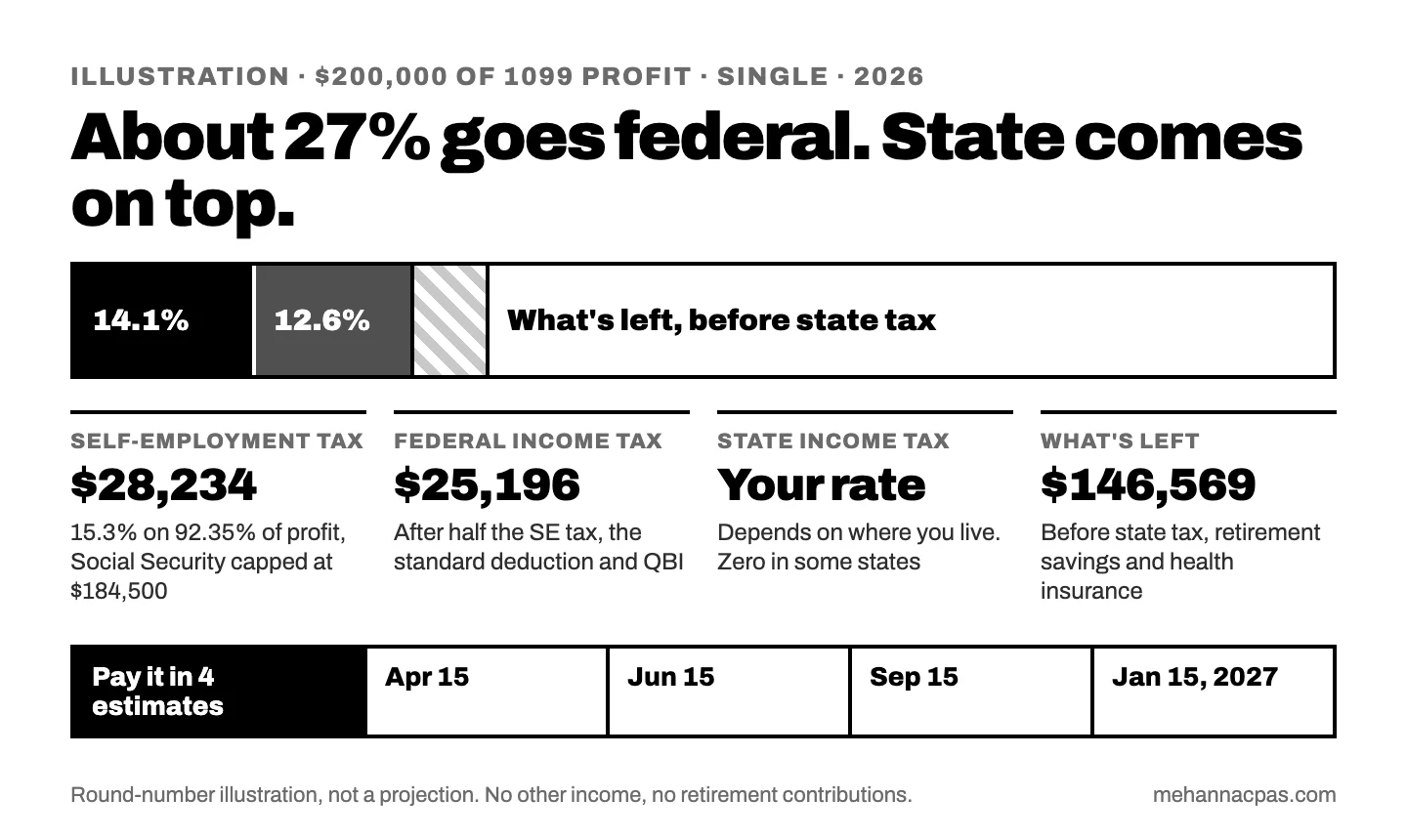
Here is how that illustration works, using 2026 rules. $200,000 of net 1099 profit, single, no other income:
- Self-employment tax: 92.35% of $200,000 is $184,700. Social Security on the first $184,500 plus Medicare on all of it comes to about $28,234.
- Income tax: subtract half the self-employment tax, the $16,100 standard deduction and the qualified business income deduction. Taxable income is about $135,826, and federal income tax at 2026 rates is about $25,196 (IRS, 2026 rates and standard deduction).
- Total federal: about $53,431, or 26.7% of profit. Your state rate goes on top.
How much should I set aside for taxes as an independent contractor?
Start from your last return, or from a projection if this is your first 1099 year, and set one percentage for federal plus one for state. Apply it to every deposit after business expenses, the same day the money lands. If you are single in a state with a 5% income tax, the illustration above points to a little over 30%. If you live in a state with no income tax, less. Run the projection again at midyear, because collections-based pay rarely stays flat.
How much to save for taxes on 1099 income if you’re married?
Your 1099 profit stacks on top of your spouse’s wages, so it is taxed at your household’s top bracket, not at the rate a calculator shows for you alone. In 2026, a married couple pays 24% on taxable income up to $403,550 and 32% above it (IRS). If your spouse earns a high salary, your set-aside can be several points higher than a single associate’s at the same profit.
When are independent contractor quarterly taxes due, and how much is enough?
Independent contractor quarterly taxes for 2026 are due April 15, June 15 and September 15, 2026, and January 15, 2027. You generally have to pay estimates if you expect to owe $1,000 or more when you file (IRS, Estimated taxes). They carry self-employment tax as well as income tax.
How much is enough to avoid the penalty: payments and withholding that cover 90% of this year’s tax, or 100% of last year’s. If last year’s adjusted gross income was over $150,000, the prior-year figure becomes 110% (26 U.S.C. § 6654, IRS Publication 505). The target is cumulative: a quarter by April, half by June, three quarters by September.
| Due date | Covers income earned | Cumulative target under the 110% rule |
|---|---|---|
| April 15, 2026 | January 1 to March 31 | 27.5% of last year’s tax |
| June 15, 2026 | April 1 to May 31 | 55% |
| September 15, 2026 | June 1 to August 31 | 82.5% |
| January 15, 2027 | September 1 to December 31 | 110% |
Three details matter most for associates.
- Your first 1099 year. If you were on a W-2 last year, last year’s total tax can anchor the safe harbor. That is often a low number for a recent graduate, so the safe harbor is easy to meet. It protects you from the penalty, not from the bill: the rest is due in April.
- A W-2 job, yours or your spouse’s. Federal income tax withheld from wages is treated as paid in equal parts on each due date, unless you choose otherwise (IRS, Instructions for Form 2210). Raising withholding on a W-4 can cover tax on your 1099 days, and a December increase still counts toward earlier quarters. On a joint return, your spouse’s withholding counts too.
- Income that starts late in the year. If your 1099 work began in the fall, the annualized income method can match required payments to when the income came in (IRS). Paying a missed quarter late stops the penalty from growing, but doesn’t erase what already ran.
The penalty works like interest. The IRS rate is 7% a year, compounded daily, for the fourth quarter of 2026 and rises to 8% on January 1, 2027 (IRS, IR-2026-144). For the quarter-by-quarter mechanics, see our guide to quarterly estimated tax payments.
Weighing a 1099 offer, or already on one and not sure the set-aside is right? Bring the offer or your last return. You’ll leave knowing the number.
Which deductions lower what a 1099 dentist sets aside?
As a contractor you deduct ordinary and necessary business costs, and some of them lower self-employment tax as well as income tax. A W-2 associate who pays the same costs out of pocket can’t deduct them: unreimbursed employee expenses are no longer deductible for most employees (IRS Publication 529). Five items cover most of what moves the number.
1. Business costs you pay yourself
Malpractice insurance, state license and DEA renewals, professional dues, loupes and instruments you buy, and mileage between offices are business expenses on Schedule C when they are ordinary and necessary for your work (IRS, Deducting business expenses). Keep a separate card for them, so the year’s total is one download.
2. Continuing education
CE that maintains or improves the skills of your current work, including what your license requires, is deductible for the self-employed. Education that qualifies you for a new profession is not (IRS Topic 513). A residency that leads to a new specialty is the gray area to ask about first.
3. Health insurance
Premiums you pay for medical, dental and vision coverage for yourself, your spouse and dependents can be deductible, up to your net profit. Not for any month you were eligible for a subsidized plan through any employer, including your spouse’s or your W-2 office’s, even if you didn’t enroll (IRS, Instructions for Form 7206).
4. A SEP IRA or solo 401(k)
A self-employed person can contribute about 20% of net self-employment earnings to a SEP IRA, because the 25% plan rate is figured after the contribution itself (IRS Publication 560). A SEP for 2026 can still be set up and funded until your return due date, including extensions. A solo 401(k) adds an employee deferral of up to $24,500, within a $72,000 total for 2026 (IRS, 2026 limits). The $24,500 deferral limit is per person across all your plans, so it is shared with a W-2 office’s 401(k).
5. An HSA and the QBI deduction
With a qualifying high-deductible health plan, you can put $4,400 (self-only) or $8,750 (family) into an HSA for 2026, plus $1,000 from age 55 (Rev. Proc. 2025-19). And 1099 dental income can qualify for the 20% qualified business income deduction. Dentistry is a specified service, so for 2026 the deduction phases out between $201,750 and $276,750 of taxable income for single filers, and between $403,500 and $553,500 on a joint return (Rev. Proc. 2025-32). Retirement contributions can pull a household back under those lines.
Does a 1099 dentist need an S corp?
Sometimes, and only if the entity is the one the practice hires and pays. With an S corporation, you pay yourself a reasonable salary through payroll, and the rest of the profit comes out as distributions without self-employment tax (IRS). The salary has to hold up for the work you do, which for a full-time clinician is a real number. Our guide to S corp reasonable salary for dentists covers how to set it.
The step most 1099 dentist S corp setups skip: the practice has to contract with the S corporation, issue the 1099 to its EIN and pay its account. If the agreement and the 1099 stay in your name and Social Security number, the income is yours. Moving it into a company account afterward, or calling it a management fee, doesn’t change who earned it. Income is taxed to the person who earns it, however the paperwork is arranged afterward (Lucas v. Earl, 281 U.S. 111 (1930)). To change the tax, you have to change the facts, and here the fact is the contract.
An S corporation also brings payroll, its own return, separate books and, in many states, professional entity rules. It tends to make sense once 1099 profit is high and steady, and the contracting practice agrees to pay the entity. If your income is still ramping up, or the practice won’t contract with an entity, wait. Our comparison of S corp vs. LLC for dentists walks through the trade-offs.
How we handle 1099 taxes with associate dentists
Most associates we talk to are on their way to owning, so we set up the 1099 years the way we would want them to look at closing.
- Compare the offers before you sign. W-2 and 1099 offers side by side, after tax and after what you would pay yourself. You text before you sign, not after.
- Set one percentage. A projection gives you a federal and a state set-aside rate for every deposit, plus a separate tax savings account.
- Schedule the four estimates. Safe harbor amounts on the calendar, with withholding from any W-2 job counted in.
- Pick the retirement plan by year end. SEP or solo 401(k), sized to your profit and to the W-2 deferrals you already made.
- Review the entity once income is steady. Only when the practice will contract with the entity.
The associates who get surprised in April usually planned their first 1099 year like a W-2 year: they assumed tax was handled because a payroll company existed somewhere. The fix is boring and it works. Move the set-aside on the day the deposit lands, before the money looks like income you can spend.
1099 taxes checklist
| Item | Fits you if | Deadline | What to bring |
|---|---|---|---|
| Set-aside percentage | Any 1099 income | First deposit, then midyear | Last return, the offer, your state |
| Quarterly estimates | You expect to owe $1,000 or more | Apr 15, Jun 15, Sep 15, Jan 15 | Last year’s total tax and AGI |
| W-4 withholding increase | You or your spouse also have a W-2 job | Last payroll of the year | Projected shortfall |
| Business expense record | You pay malpractice, licenses, CE or instruments | All year | A separate card and receipts |
| Health insurance deduction | No subsidized plan available through any employer | Month by month | Premium statements, spouse’s benefit options |
| SEP IRA or solo 401(k) | You want to lower tax and save for ownership or retirement | Return due date for a SEP | Net profit, W-2 deferrals made elsewhere |
| S corporation review | Steady, high 1099 profit and a practice willing to pay the entity | Before the contract is signed | The associate agreement |
Mistakes we’d avoid
- Applying a freelancer’s rule of thumb to a dental income. A flat 25% was built for lower incomes. Above about $200,000 of household income, or in a high-tax state, it often falls short.
- Setting aside from production instead of from what you’re paid. Your contract pays on production or collections after adjustments. Base the set-aside on the deposit, minus business costs.
- Waiting for the 1099 to show up. Payments made in 2026 only require a 1099-NEC at $2,000 or more, and the tax is owed either way. Your own deposit record is the source of truth.
- Opening an S corporation after the contract is signed in your name. The entity has to be the party the practice hires. Otherwise it adds cost without moving any income.
- Treating the safe harbor as the bill. It stops the penalty. In a year when your income doubles, the April balance can still be large.
What changed for 2026
- Social Security wage base: $184,500 for 2026 (IRS).
- Brackets and standard deduction: the 2026 standard deduction is $16,100 single and $32,200 joint, and the 37% bracket starts at $640,600 single and $768,700 joint (IRS).
- QBI deduction: a wider phase-out range than in 2025 for specified services such as dentistry: $201,750 to $276,750 single, $403,500 to $553,500 joint (Rev. Proc. 2025-32).
- 1099-NEC threshold: $2,000 for payments made in 2026, up from $600 (IRS).
- Retirement limits: $24,500 employee deferral and $72,000 total defined contribution limit for 2026 (IRS).
- Underpayment rate: 8% a year for January to March 2027, up from 7% (IRS, IR-2026-144).
How to tell whether your set-aside worked
Two numbers on your return tell you. First, Form 2210 or your software shows no underpayment penalty. Second, the balance due in April is small and already sitting in your tax account. If the account held more than you owed, the percentage was too high, and you can lower it for next year. If you had to borrow or use a card to pay April, it was too low, or the estimates weren’t paid on time.
The year after that, look at the bigger picture: what the 1099 arrangement actually left you after tax, compared with the W-2 offer you turned down. If you are planning to own, the same habits carry into practice ownership. If you want someone to run that comparison with you, book a call with Bilal.
Frequently asked questions
Do I pay 1099 dentist taxes if the practice never sends me a 1099?
Yes. The form only reports the payment. Contractor income is taxable whether or not you receive a 1099-NEC, and for payments made in 2026 practices only have to send one at $2,000 or more. Report what you were actually paid, using your own deposit records.
Can I pay all my estimated taxes at once?
You can pay early, and paying the full year’s safe harbor by April 15 covers every quarter. Paying it all in January does not fix the earlier quarters, because the penalty is figured separately for each due date. Weekly or monthly payments work too, as long as each quarter’s total is in by its date.
Is disability insurance deductible for a 1099 associate?
Premiums for your own disability income policy are generally treated as a personal expense, not a business deduction. The upside is on the other end: benefits from a policy you paid for with after-tax money aren’t taxable income (IRS).
I’m W-2 at one office and 1099 at another. Do I still need estimates?
Often, yes, unless you raise withholding at the W-2 job enough to cover the 1099 days. Withholding counts as paid evenly through the year, so a W-4 change can replace estimates. Remember that your Social Security wage base of $184,500 is shared between the two jobs.
Should a new graduate take a 1099 associate offer?
It depends on the numbers after tax, benefits and retirement, not on the daily rate. Run both offers through the W-2 vs. 1099 calculator before you decide, and read the contract for who pays lab fees, malpractice and CE.
Glossary
| Term | Meaning |
|---|---|
| Self-employment tax | Social Security and Medicare paid by people who work for themselves: 15.3% on 92.35% of net earnings, with the Social Security part capped. |
| Wage base | The $184,500 of 2026 earnings above which the 12.4% Social Security part stops. |
| Estimated tax payments | The four payments a contractor sends the IRS during the year for income with no withholding. |
| Safe harbor | Paying 90% of this year’s tax, or 100% (110% above $150,000 AGI) of last year’s, on time, which avoids the underpayment penalty. |
| QBI deduction | A deduction of up to 20% of qualified business income, phased out for specified services such as dentistry at higher incomes. |
| Reasonable salary | The W-2 pay an S corporation owner who works in the business must take before distributions. |
Sources
- IRS, Self-employment tax (Social Security and Medicare taxes) (2026): 15.3% rate, $184,500 wage base, 0.9% Additional Medicare thresholds, deductible half.
- IRS, Topic 554, Self-employment tax: 92.35% of net earnings.
- IRS, Estimated taxes: $1,000 rule, W-4 withholding, annualized method.
- IRS, Publication 505, Tax Withholding and Estimated Tax (2026): due dates and safe harbors.
- U.S. Code, 26 U.S.C. § 6654: 90%, 100% and 110% required installments.
- IRS, Instructions for Form 2210: withholding treated as paid in equal parts.
- IRS, IR-2026-144 (2026): 8% underpayment rate for January to March 2027.
- IRS, Working Families Tax Cuts: individuals and workers: 2026 rates and standard deduction.
- IRS, Rev. Proc. 2025-32 (2025): 2026 QBI thresholds and phase-in ranges.
- IRS, Rev. Proc. 2025-19 (2025): 2026 HSA limits.
- IRS, COLA increases for retirement plan limits (2026): $24,500 and $72,000.
- IRS, Publication 560, Retirement Plans for Small Business: SEP deduction limit for the self-employed.
- IRS, Instructions for Form 7206: self-employed health insurance deduction and the subsidized-plan rule.
- IRS, Topic 513, Work-related education expenses.
- IRS, Publication 529, Miscellaneous Deductions: unreimbursed employee expenses.
- IRS, Deducting business expenses: ordinary and necessary.
- IRS, Topic 762, Independent contractor vs. employee.
- IRS, Form 1099-NEC and independent contractors: $2,000 threshold for payments after 2025.
- IRS, S corporation compensation and medical insurance issues: reasonable compensation.
- U.S. Supreme Court, Lucas v. Earl, 281 U.S. 111 (1930): income is taxed to the person who earns it.
- IRS, Life insurance and disability insurance proceeds: tax treatment of disability benefits.