

A dental practice transition is the plan for handing your practice to its next owner, and it starts three to five years before the sale. Those years decide who can buy, how the price is taxed and what you keep. Fix the structure, clean the books and pick the buyer path first. The listing comes last.
- The sale is the last step, not the first. Entity structure, the books and the big deductions are much easier to fix years ahead than once a buyer is reading your returns.
- A practice sale is usually a sale of each asset, not one asset. Goodwill, equipment, receivables and the non-compete are each taxed their own way (IRS Publication 544).
- Equipment you wrote off with Section 179 or bonus depreciation can come back as ordinary income in the year of sale, even when the buyer pays you over time (IRS Publication 537).
- Buyer and seller report the same price split to the IRS on Form 8594, and a written allocation is binding on both, so the allocation is part of the deal, not paperwork after it.
- What we see in dental practices: owners spend years on the clinical handoff and weeks on the tax side. The tax side is where the plan pays off.
You’ve started saying “a few more years.” Maybe an associate has asked about buying in. Maybe a broker called, or a DSO sent a letter. Either way, the question has changed from “if” to “how.”
This guide is for the owner at that point. It covers what a dental practice transition is, the paths to a sale, how the sale of a dental practice is taxed, and a year-by-year plan that starts well before anyone sees a listing.
What is a dental practice transition, and what isn’t it?
A dental practice transition is the whole process of moving your practice, its patients, team and goodwill to a new owner, on a timeline you choose. The sale contract is one piece of it. The rest is the years of preparation before and the handoff after.
It is not the same as listing the practice or getting a valuation. A valuation tells you what the practice might sell for today. A transition plan decides what you do in the years before the sale so that the price, the tax and the timing work for you. The path you choose changes almost everything else:
| Transition path | Who buys | How you’re usually paid | Do you stay? | What to watch |
|---|---|---|---|---|
| Sale to an outside dentist | A dentist, often bank financed | Mostly cash at closing | A short handoff period | Price allocation, non-compete, patient retention |
| Associate buy-in or buyout | A dentist already in your practice | Cash, a seller note, or both, sometimes in stages | Often, during a phased handoff | Note terms, interest, what happens if the buyer leaves |
| Sale to a DSO | A DSO or a dentist-owned entity aligned with it | Cash plus rollover equity, earnout or holdback | Usually, as an employee for several years | Equity terms, employment term, irrevocability |
| Partner buyout | Your co-owner or the practice entity | As set in the buy-sell agreement | Depends on the trigger | Valuation method, funding, estate tax |
In many states only a dentist can own the clinical practice, so the pool of buyers is other dentists and DSO-aligned entities (ADA, Business Services Agreements with DSOs). For how a buyer arrives at a price, see our guide to dental practice valuation.
Who needs a transition plan now, and who can wait?
You need a plan now if you can picture the year you stop owning the practice, even roughly, and it is within ten years. It usually comes up in situations like these:
- “I want to sell my dental practice in three to five years, and I don’t know where to start.”
- An associate is producing well and has asked about ownership.
- You own the practice with a partner, and nobody has read the buy-sell agreement since it was signed.
- You are a dentist retiring and selling the practice to fund the next stage, and the sale price is a big part of your retirement math.
- A DSO or broker made contact, and you want to know your options before you answer.
You can wait if you are early in ownership, still growing, and have no date in mind. Even then, two things are worth doing now: keep personal costs out of the practice books, and make sure your partner or estate has a plan if something happens to you. If the real question is when work can become optional, start with your freedom number, then see how much of it the sale needs to cover.
Why does the transition plan matter for your practice?
Because the practice is usually one of your largest assets, you sell it once, and most of what decides the after-tax result is set before a buyer shows up. Dentists are working longer: the average retirement age of U.S. dentists was 68.1 in 2025, up from 64.7 in 2001 (ADA Health Policy Institute, 2026). A later exit gives you more time to plan, but only if you use it.
The tax side is where a late start costs the most. The IRS treats the sale of a business as a sale of each of its assets, and each asset can produce capital gain or ordinary income (IRS Publication 544). The same headline price can leave very different amounts in your account depending on how the price is split, how the practice is held and how much equipment you have already written off.
The ADA’s own guidance for sellers puts a valuator, an attorney and an accountant experienced in dental practice sales on the team, and lists contract terms to read closely: patient records, restrictive covenants, goodwill, receivables, the lease, leased equipment and staff (ADA, What to Do When Selling a Practice). Every one of those is easier to settle with time.
When should you start, and when is it too late?
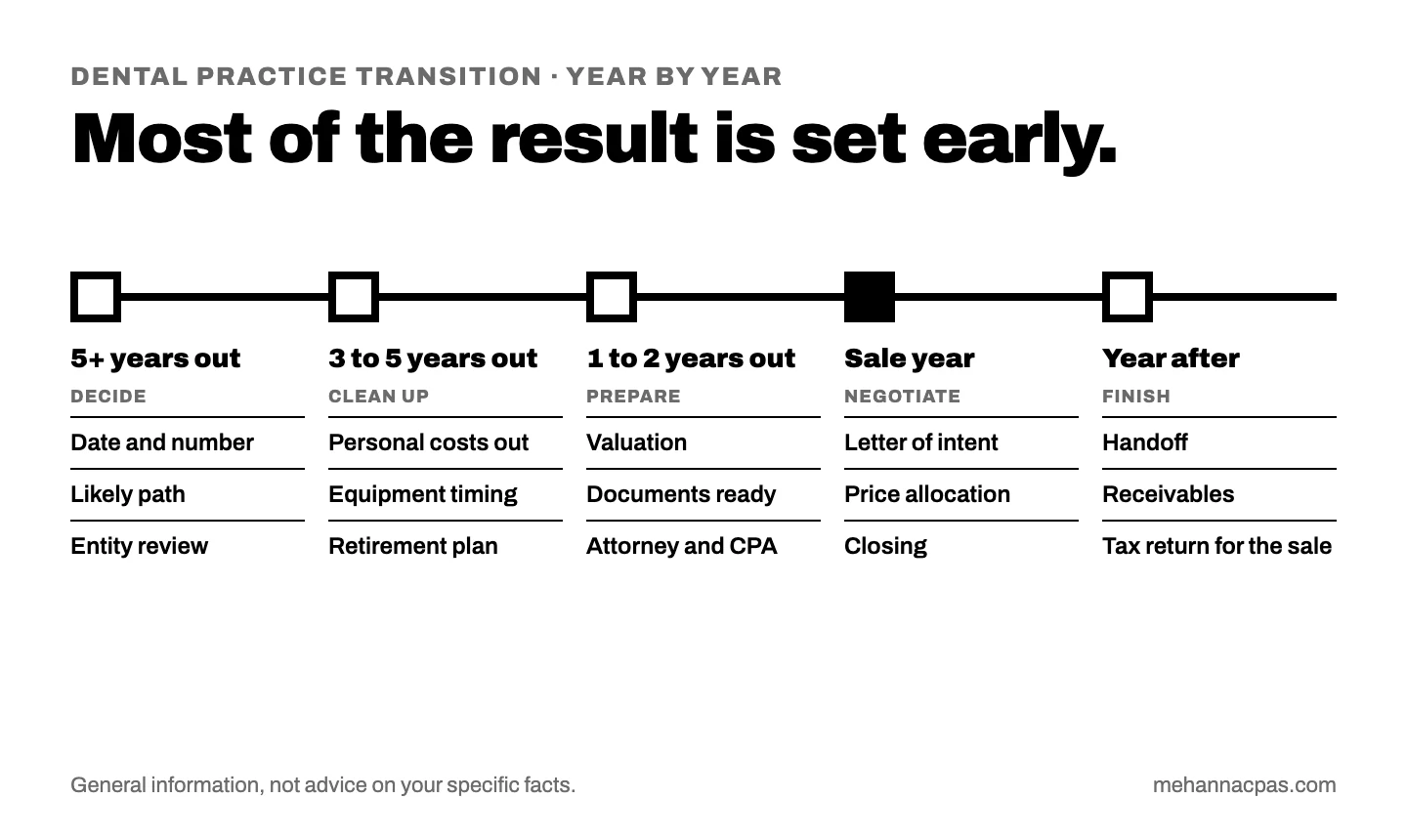
Start three to five years before the date you want to be out, and earlier if your practice is a C corporation or you plan to sell to an associate. Here is how the years usually break down:
- Five or more years out: set the target date and the number you need, choose the likely path, and review the entity and any agreements you have with your own company.
- Three to five years out: clean the books, stop running personal costs through the practice, and plan big equipment purchases with the sale in mind.
- One to two years out: get a valuation, gather the documents a buyer will ask for, and line up the attorney and the CPA.
- The sale year: negotiate the letter of intent and the price allocation, then close. The ADA suggests a short window from listing to closing, about four to six weeks, so fewer patients look elsewhere during the change (ADA).
It is rarely too late to plan, but some options close. Once a letter of intent is signed you have less leverage, and once the year of sale starts, the deductions you took in earlier years are already on the record.
How is the sale of a dental practice taxed?
Most dental practice sales are asset sales, and the price is split among the assets, each taxed its own way. Buyers usually prefer to buy assets rather than your entity: their tax basis in the assets is set by what they pay (Instructions for Form 8594), and the entity’s history stays with you. If your practice is a sole proprietorship or a single-member LLC taxed as one, it is an asset sale for tax purposes by default. An S corporation, partnership or PLLC with several owners can sell the ownership interest instead, but buyers often ask for a lower price or other terms to accept it.
In an asset sale, buyer and seller split the price using the residual method: cash and receivables first, then equipment and other tangible assets at fair market value, then other intangibles such as the non-compete, and whatever is left is goodwill (Form 8594 instructions). If both sides agree in writing on the split, the agreement binds both of them unless the IRS finds it inappropriate (26 U.S.C. 1060). Here is how the main pieces are usually taxed for the seller:
- Goodwill and the patient base. Generally capital gain if you held it more than a year. For 2026, the 20% rate applies once taxable income passes $613,700 on a joint return (Rev. Proc. 2025-32).
- Equipment. Gain up to the depreciation you took, including Section 179, is recaptured as ordinary income (IRS Publication 537). If you wrote off your CBCT and chairs in the year you bought them, most of what the buyer pays for them can be ordinary income. Our guide to the Section 179 deduction for dental equipment covers the trade-off.
- Accounts receivable. Receivables are not capital assets, so gain on them is ordinary income (IRS Publication 544). Many sellers keep and collect their own receivables instead. Either way, decide it in the contract.
- The non-compete. Money allocated to your covenant not to compete is ordinary income to you (The Tax Adviser, 2021), while the buyer amortizes it over 15 years, the same as goodwill. That is why the split is worth negotiating.
How the practice is held can change the result before any of this. In a C corporation, an asset sale can be taxed at the corporate level and again when the money comes out. In a well-known dental case, goodwill was found to belong to the doctor’s corporation because of his employment agreement and non-compete with it, and the proceeds were taxed as a dividend instead of capital gain (Howard v. United States, 9th Cir. 2011). If your S corporation was once a C corporation, a corporate-level built-in gains tax can apply to assets sold within five years of its first S corporation year (26 U.S.C. 1374). Both are reasons to review the structure years ahead, not in the sale year.
How we plan a dental practice sale with practice owners
A sale or DSO offer review is a project we scope and price on a call, and it works best years before the sale, not the month of it. If you’re closing on a practice, come before the closing, not after. The structure decisions happen at the table. Here is how it runs:
- Set the target. The date you want to be out, the number you need from the sale after tax, and how long you are willing to keep working for a buyer.
- Review the structure. Entity type, any agreements you have with your own corporation, past C corporation history, real estate held separately, and partner agreements.
- Clean the numbers. Books that a buyer and a lender can read without a long list of add-backs, and owner pay set the way a buyer will reset it.
- Plan the deductions around the sale. Equipment purchases, retirement contributions and the timing of income in the years before and the year of the sale.
- Model the sale. Each path, each likely price split, with the tax on each piece, so you compare offers on what you keep.
- Stay on it through closing. The same three people work with you and your attorney on the letter of intent, the allocation and the final return, and you text before you sign.
The owners who are happiest after a sale decided the path early and gave themselves room to change course. The pattern we watch for: a practice with heavy Section 179 write-offs in its last two years, a seller expecting capital gain on the whole price, and a buyer who wrote the allocation. Each of those is fixable, but only with time.
Which path is the best way to sell a dental practice for you?
The best way to sell a dental practice is the path that gets you to your number on the cash you’re sure to receive, with the years of work you’re willing to give. Price matters, but terms and taxes decide what you keep.
I want to sell my dental practice. Where do I start?
Start with two numbers: the date you want to be out and the after-tax amount you need from the sale. Then review your entity and agreements with a CPA, before you talk to buyers. The valuation comes next, then the path.
How is a dental practice sale price set?
Buyers price on cash flow, usually after resetting the owner’s pay to what an associate would earn, plus the risk that patients and staff won’t stay. A dental practice sale price can differ a lot between two practices with the same collections. See how a dental practice is valued for the methods.
Should I sell to my associate with a seller note?
It can work when the associate can’t get full bank financing. On the installment method you generally pay tax as payments arrive, but depreciation recapture is taxed in the year of sale, so you can owe tax before most of the cash comes in. The note needs at least the IRS test rate of interest, based on the applicable federal rates, or part of each payment is treated as interest. If you sell to a related person, such as your child, and they resell within two years, you can be taxed as if you received the payment then (IRS Publication 537).
Should I sell my dental practice to a DSO?
Only after you have compared the cash at closing, after tax, with a sale to a dentist. DSO offers often mix cash, rollover equity and an earnout, and come with an employment term. Our guide to what DSO rollover equity is really worth walks through the terms.
What if I own the practice with a partner?
Then the buy-sell agreement is your first transition plan. Check its triggers (death, disability, retirement, loss of license, divorce), how the price is set, and how a buyout is funded. In 2024 the Supreme Court held that life insurance a company holds to redeem a deceased owner’s shares counts toward the company’s value for estate tax (Connelly v. United States). If your agreement is funded that way, have your attorney review it.
Thinking about selling in the next few years? Bring your last two returns and a rough date. You’ll leave knowing what to fix first.
The dental practice transition plan, step by step
Each step has a window. Miss it and the option usually gets more expensive, not impossible.
1. Decide what “done” looks like
Pick the year and the number. Decide whether you want to walk away, work a few days a week for a buyer, or stay for years under a DSO. Every other choice follows from this one.
2. Fix the structure
Five or more years out, review how the practice is held. If it is a C corporation, look at your employment agreement and non-compete with your own company, since they can decide who owns the goodwill. If it is an S corporation that used to be a C corporation, check whether the five-year built-in gains period has run. If you own the building, decide whether it is sold, leased to the buyer or kept.
3. Get the books buyer-ready
Three to five years out, stop running personal costs through the practice. Buyers and lenders read several years of tax returns, financial statements, payroll records, the lease and staff agreements. Every add-back you have to explain is a question about the rest of your numbers, and unanswered questions tend to end in a lower price or a larger holdback.
4. Plan the big deductions around the sale
A large equipment purchase in the last year or two can cut tax now and raise ordinary income at the sale. The last high-income years are also when a larger retirement plan, such as a cash balance plan, may fit, but it has to be planned around the sale date and your team.
5. Value the practice and choose the path
One to two years out, get an independent valuation and compare the paths in dollars after tax: a sale to a dentist, an associate buyout, a DSO. If you want an associate to buy, hire with that in mind and give them time to grow into it.
6. Negotiate the letter of intent and the allocation
The letter of intent sets price, structure and usually an exclusive period. Agree on the price allocation in writing before you sign the purchase agreement, and make sure both sides will report the same numbers on Form 8594.
7. Close and hand off
Plan the patient letter, the staff meeting and your role after closing. Settle who collects the receivables, what happens to retreatment cases, and how long you stay. The sale shows up on next year’s return, so keep the closing statement and the allocation together.
Dental practice transition checklist
Use this to see what is open and what is already late. Every row comes from the sections above.
| Item | Fits you if | When | What to bring |
|---|---|---|---|
| Target date and after-tax number | You can picture your last year of ownership | 5+ years out | Freedom number, current net worth, spending |
| Entity and agreement review | C corporation, former C corporation, or several owners | 5+ years out | Entity documents, employment agreements, S election date |
| Buy-sell agreement review | You have a partner | Now | Buy-sell agreement, insurance policies |
| Clean books | Personal costs run through the practice | 3 to 5 years out | Financial statements, tax returns, add-back list |
| Equipment and retirement plan timing | Big purchases or contributions planned | 3 to 5 years out | Depreciation schedule, plan documents |
| Valuation and path | You’re within two years of selling | 1 to 2 years out | Collections, overhead, lease, equipment list |
| Seller note terms | Selling to an associate or family member | Before the letter of intent | Proposed note, interest rate, buyer’s financing |
| Price allocation | Every asset sale | Before signing | Draft Form 8594 split, depreciation schedule |
| Handoff plan | Every sale | Sale year | Patient letter, staff plan, receivables report |
Mistakes we’d avoid when selling a dental practice
Most of them come from starting late. The ones we’d steer you away from:
- Starting with the listing. By the time a buyer reads your returns, the structure and the last few years of deductions are fixed.
- Assuming the whole price is capital gain. Recapture on equipment, receivables and the non-compete are ordinary income.
- Letting the buyer write the allocation. Both sides report it, and a written split binds you.
- Carrying a note without a plan for the tax. Recapture is due in the year of sale, whatever the payment schedule says.
- Ignoring the C corporation question. Agreements you signed with your own company years ago can change how the sale is taxed.
- Comparing offers by headline price. Compare cash after tax, then the years of work each offer requires.
What changed for 2026
Three dated changes touch a practice sale this year: capital gain thresholds, equipment depreciation and the federal non-compete rule.
- For 2026, the 20% long-term capital gain rate starts above $613,700 of taxable income on a joint return and $545,500 for single filers (Rev. Proc. 2025-32).
- 100% bonus depreciation is permanent for property acquired after January 19, 2025 (IRS, Notice 2026-11). Equipment written off at once has a low basis, so more of what a buyer pays for it can be ordinary income at the sale.
- The FTC’s nationwide non-compete rule never took effect and was formally removed in February 2026 (Federal Register, 2026). Non-competes in a practice sale remain a matter of state law, so have your attorney check yours.
How to tell whether your transition worked
Measure it against the numbers you set at the start: the after-tax cash you kept, the date you were out, and how the practice did after you left. A good transition gets you to your number on cash you were sure of, not on an earnout or equity you can’t control. On the tax side, check that the allocation on your Form 8594 matches the contract and the buyer’s, and that the ordinary income from recapture was planned, not a surprise on the return. For the practice, the signs are patients and staff who stayed and a buyer who paid on time. If a DSO is one of your paths, read our guide to rollover equity in a DSO offer before you compare.
Frequently asked questions
How long does it take to sell a dental practice?
The sale itself can move fast. The ADA suggests about four to six weeks from listing to closing to limit patient loss. The preparation is what takes time: three to five years to fix structure and books, and one to two years for valuation, documents and choosing the path.
Can I sell part of my practice and keep working?
Yes. An associate can buy a share now and the rest later, or a DSO can buy the practice and employ you. Each stage is its own sale for tax purposes, so plan the allocation and the timing of each one, and put the terms for the second stage in writing at the start.
Do I pay tax when I sell my dental practice?
Generally, yes, in the year of the sale for most of it. Goodwill is usually capital gain. Equipment recapture, receivables and the non-compete are ordinary income. A seller note can spread the capital gain over the payment years, but recapture is taxed in the year of sale.
Should I sell the building with the practice?
It depends on your goals. Selling it with the practice gives you cash at once. Keeping it and leasing it to the buyer gives you rent, but ties you to the buyer’s success. Decide early, because the lease terms affect what a buyer will pay for the practice.
What documents will a buyer ask for?
Expect several years of tax returns and financial statements, production and collections reports, a receivables aging report, the lease, an equipment list, staff and associate agreements, and payroll records. Having them ready shortens the process and keeps questions from turning into price cuts.
Glossary
| Term | Meaning |
|---|---|
| Dental practice transition | The whole process of moving a practice to its next owner, from planning years ahead to the handoff after closing. |
| Asset sale | A sale of the practice’s assets (goodwill, equipment, records) rather than the entity that owns them. |
| Price allocation | How the price is split among the assets, reported by buyer and seller on Form 8594. |
| Residual method | The required order for the split: cash and receivables, then tangible assets, then other intangibles, with goodwill last. |
| Depreciation recapture | Gain on equipment up to the depreciation and Section 179 you took, taxed as ordinary income. |
| Seller note | A loan you make to the buyer for part of the price, paid back over time. |
| Built-in gains tax | A corporate-level tax on an S corporation that used to be a C corporation, on gains that existed at the conversion. |
| Buy-sell agreement | A contract between co-owners that sets when and at what price one owner’s share is bought out. |
Sources
- IRS, Publication 544, Sales and Other Dispositions of Assets (2025): sale of a business, receivables, allocation agreement, Form 8594.
- IRS, Publication 537, Installment Sales (2025): recapture in the year of sale, test rate of interest, related-person resale rule.
- IRS, Instructions for Form 8594: who files, residual method, asset classes.
- U.S. Code, 26 U.S.C. 1060, Special allocation rules for certain asset acquisitions: written allocation binding on both parties.
- U.S. Code, 26 U.S.C. 1374, Tax imposed on certain built-in gains: five-year recognition period.
- IRS, Rev. Proc. 2025-32 (2025): 2026 capital gain thresholds.
- IRS, Notice 2026-11 guidance on 100% bonus depreciation (2026).
- U.S. Court of Appeals, Ninth Circuit, Howard v. United States, No. 10-35768 (2011): dental practice goodwill owned by the C corporation.
- Supreme Court of the United States, Connelly v. United States, No. 23-146 (2024): company-owned life insurance and redemption obligations in estate tax value.
- Federal Register, Removal of the Non-Compete Rule (February 2026).
- American Dental Association, What to Do When Selling a Practice: advisory team, contract terms, listing-to-closing window.
- American Dental Association, Business Services Agreements with DSOs (updated 2021): dentist ownership rules in many states.
- ADA Health Policy Institute, Dentist Workforce (2026): average dentist retirement age 68.1 in 2025, 64.7 in 2001.
- The Tax Adviser (AICPA), Handling tax issues related to noncompete agreements (2021): non-compete payments as ordinary income, 15-year amortization for the buyer.