

Rollover equity is the part of a DSO or private equity offer you take as shares in the buyer instead of cash. If the deal is structured correctly, tax on that part is deferred, but the shares are illiquid, priced by the buyer and worth only what the platform is worth when it sells again, often years later. Value it as a separate investment, not as cash.
- The headline price is not the closing wire. A DSO offer usually mixes cash at closing, rollover equity, sometimes an earnout and a holdback. Only the cash is certain.
- Rollover equity can be tax deferred under Section 721 or Section 351, but only when the deal is built that way. The cash you receive is generally taxed in the year of the sale.
- The ADA calls a sale into a DSO-aligned professional entity generally irrevocable, and notes that taking equity in the DSO can mean a longer employment term and less ability to leave.
- The value of rolled shares depends on terms most sellers never read: the price per unit, the share class, the platform’s debt, vesting and what happens if you leave.
- What we see in dental practices: owners compare offers by headline price. The better comparison is cash after tax at closing, plus a realistic value for everything else.
The letter of intent says one number. It’s big, bigger than any dentist-to-dentist sale you’ve heard about. Then you read the second page: 70% at closing, the rest “rolled” into the buyer’s holding company, five years of employment, and a non-compete.
This guide is for the owner holding that letter. It covers what rollover equity is, how it is taxed, what decides what it is really worth, and the questions to settle before you sign anything, including whether selling to a DSO fits you at all.
What is rollover equity, and what isn’t it?
Rollover equity is the share of your sale price that you reinvest in the buyer’s company instead of taking as cash, so you become a minority owner of the group that bought your practice. In a DSO deal it is usually equity in the DSO’s holding company or in a local joint venture, not in your own practice. You get paid on it when the platform is sold or recapitalized again.
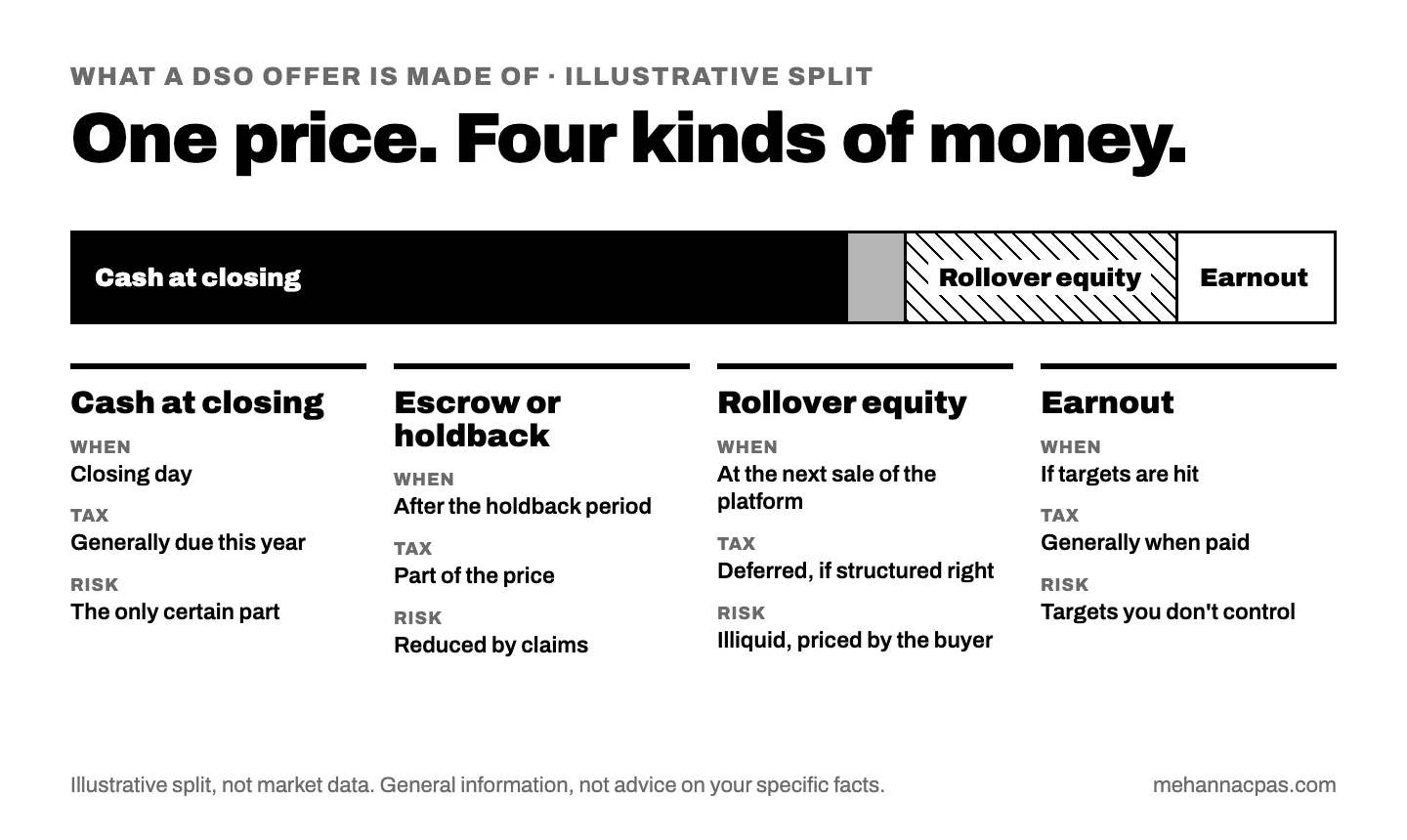
It is not a deferred payment, a note or a promise of a set amount. It is an investment in a private company you don’t control, made with money you would otherwise have received at closing. Here is how it compares with the other pieces of a typical offer.
| Piece of the offer | What it is | When you get it | Main risk |
|---|---|---|---|
| Cash at closing | Money wired when the deal closes | At closing | Tax due on it this year |
| Rollover equity | Shares or units in the buyer’s company | When the platform sells or recapitalizes, often years later | Illiquid, priced by the buyer, can fall to zero |
| Earnout | Extra price paid if the practice hits targets | Over the earnout period | Targets missed, or measured in ways you don’t control |
| Escrow or holdback | Part of the price held back for claims | After the holdback period, if no claims | Reduced by indemnity claims |
| Seller note | A loan you make to the buyer | In scheduled payments | Buyer doesn’t pay |
Rollover is a feature of a private equity buyout. Sponsors like it because it keeps the seller invested in the result and reduces the cash they need at closing. Dentist-to-dentist sales usually don’t include it. For how either kind of buyer arrives at the price in the first place, see our guide on how to value a dental practice.
Who should look hard at a DSO offer, and who can skip it?
A DSO offer deserves real analysis when your practice is large enough to attract institutional buyers and you are open to working as an employee for several years. “Should I sell my practice to a DSO?” usually comes up in situations like these:
- You are within five to ten years of wanting work to be optional, and nobody inside the practice can buy it.
- You own more than one location, and the work of running them is crowding out the dentistry.
- A DSO approached you first, and you want to know whether the number is good before you say no.
- You want to keep practicing, but stop carrying payroll, leases and hiring on your own.
You can probably skip it if you want to stay in control of clinical and staffing decisions for the long run, if you are planning to bring in an associate as a future buyer, or if the cash at closing would not change anything you want to do. DSO vs private practice is a question about the next ten years of your life, not only about price. If the real question is when you can stop, start with your freedom number, then see whether the offer gets you there.
Why does rollover equity matter for your practice?
Because it can be a large share of the price, it comes with strings attached, and the decision is hard to undo. Advisors who work on these deals commonly describe rollover at roughly 10% to 30% of the price, and sometimes more (McLerran & Associates, 2026). On a large practice, that is a lot of money taking the risk of someone else’s business plan.
DSOs are a growing share of the market. The share of U.S. dentists affiliated with a DSO more than doubled, from 7.2% in 2015 to 16.1% in 2024 (ADA Health Policy Institute, 2025), and more than 1 in 4 dentists up to 10 years out of dental school were affiliated (ADA News, 2025). That is why more owners in their peak years are getting letters.
The ADA’s guide to DSO arrangements is direct about the stakes. A sale to a professional entity aligned with a DSO is “generally irrevocable”, and receiving equity in the DSO can lead to longer employment terms and less ability to terminate the arrangement (ADA, Business Services Agreements with DSOs). In other words, rollover equity can tie your second payout to staying, on their terms.
When should you take rollover equity, and when should you push back?
Take rollover when you understand the platform, can afford to have that money locked up for years, and the terms treat your shares the same as the sponsor’s. It is easier to accept when the cash at closing already covers what you need, debts and taxes included.
Push back, or ask for more cash, when:
- The buyer won’t tell you who backs it, how much debt it carries or when it expects to sell again.
- Your shares are a different class from the sponsor’s, with the sponsor paid first.
- Your equity can be forfeited or bought back cheaply if your employment ends.
- You need the money within the next few years for a house, a buyout or retirement.
Timing matters too. The terms that decide what the rollover is worth are easiest to change before you sign the letter of intent, while the buyer still wants the deal more than you do.
How is rollover equity taxed?
The cash part of a sale is generally taxed in the year of the sale, while the rolled part can be tax deferred if it is a qualifying contribution to the buyer’s company. The rules depend on what the buyer’s holding company is.
- Partnership or LLC holding company. Contributing property to a partnership in exchange for an interest in it is generally tax free under Section 721. The trap is the disguised sale rules: when the partnership also pays you cash, the two can be treated as a sale, and transfers within two years of each other are presumed to be one unless the facts clearly show otherwise (Treas. Reg. 1.707-3).
- Corporate holding company. Section 351 can defer tax on stock received for property, but only if the people contributing property control the corporation right after the exchange. Cash received in the same exchange is taxable gain, up to the amount of the cash.
Deferral is not forgiveness. Your tax basis carries into the new shares, and you pay when they are sold. If the deal isn’t structured as a qualifying contribution, a “rollover” can be a taxable sale followed by a new investment: you owe tax on money you never received in cash.
The cash side has its own rules. A practice sale is generally treated as a sale of each asset, and buyer and seller both report how the price was split on Form 8594 (IRS Publication 544). Goodwill is usually capital gain. Depreciation you took on equipment comes back as ordinary income. Money allocated to your non-compete is ordinary income too (The Tax Adviser, 2021), so the allocation is worth negotiating.
For 2026, long-term capital gain on a joint return is taxed at 20% once taxable income passes $613,700 (Rev. Proc. 2025-32). The 3.8% net investment income tax applies above $250,000 of modified AGI on a joint return, though it generally doesn’t reach income from an active business (IRS Topic 559). How your practice is held changes the result: in a well-known dental case, goodwill was found to belong to the doctor’s C corporation because of his employment agreement and non-compete with it, so the sale proceeds were taxed as a dividend instead of capital gain (Howard v. United States, 9th Cir. 2011).
How we review a DSO offer with dental practices
A sale or DSO offer review is a project we scope and price on a call, and we do it before you sign the letter of intent, not after. If you’re closing on a practice, come before the closing, not after. The structure decisions happen at the table. Here is how it runs:
- Read the offer as four numbers. Cash at closing, rollover, earnout and holdback, each in dollars, each with its conditions.
- Rebuild the buyer’s math. DSOs usually price on adjusted EBITDA, with your pay reset to what an associate would earn. We check their adjustments against your books.
- Model the tax on the cash. Price allocation, depreciation recapture, the non-compete, your entity type and the state you live in, so you know the after-tax cash at closing.
- Read the equity terms. Where the shares sit, their class, the price per unit, vesting, forfeiture, and what happens if you leave.
- Compare it with staying, or with a sale to a dentist. Same years, same work, different paths, measured against your freedom number.
- Then the conversation. A list of terms worth pushing back on, for you and your attorney to take to the buyer. The same three people stay on it until closing, and you text before you sign anything.
Owners rarely regret the price. They regret not knowing what they would actually keep. The pattern we watch for: two offers compared by headline number, when the lower one pays more cash at closing, carries less debt behind the equity and lets the doctor leave without losing the shares. On paper the higher offer wins. In the bank, it often doesn’t.
What is your rollover equity really worth?
Rolled shares are worth what the platform sells for next time, minus its debt and anyone paid ahead of you, discounted for the years you wait and the chance it goes badly. Sell-side advisors describe rollover as something that might be worth a multiple of the original amount if the group performs, or nothing if it struggles (McLerran & Associates, 2026). That range is the point: it is an investment, not a payment.
Is rollover equity worth it?
It can be, when you would have invested that money anyway and the terms match the sponsor’s. It is a poor fit when you need liquidity soon, can’t get answers about the platform’s debt, or your shares can be forfeited if you leave. Decide how much of your net worth you want in one private company you don’t run.
What happens to DSO rollover equity if I leave?
It depends on the documents. Some agreements let you keep vested shares; others let the company buy them back at cost or at a discount, especially if you are terminated “for cause” or break a non-compete. Read the vesting, forfeiture and repurchase sections before you sign, not after.
Selling dental practice to private equity or to another dentist: which pays more?
A private equity platform often shows a higher headline price, partly paid in equity and earnout. A dentist buyer usually pays mostly in cash at closing, often financed by a bank. Compare the after-tax cash, the realistic value of everything else, and the years of work each one requires.
Holding a letter of intent? Bring the offer and your last two years of numbers. You’ll leave knowing what you would actually keep.
Seven terms that decide what rollover equity is worth
The percentage rolled matters less than the terms attached to it. Ask for each of these in writing.
1. The price per unit
Your shares should be issued at the same price per unit the sponsor pays. If you roll at a higher value than the sponsor’s cash buys in at, you start behind.
2. The class of shares
Preferred units, preferred returns and liquidation preferences mean someone is paid before you when the platform sells. Ask whether your units are the same class as the sponsor’s.
3. Where the equity sits
Equity in the top holding company rides on the whole platform. Equity in a local joint venture rides on a few offices, possibly including yours. Each has different risks and different paths to a payout.
4. The platform’s debt
Equity sits behind every lender. A group that grew on borrowed money can sell for a good price and still leave little for shareholders. Ask how much debt it carries and what it pays in interest.
5. Vesting, forfeiture and repurchase
This is where rollover equity ties you to your employment agreement. Know exactly what you keep if you leave, are let go, become disabled or die.
6. When and how you can sell
Tag-along rights let you sell when the sponsor sells. Drag-along rights let the sponsor force you to sell on its terms. Ask about the fund’s timeline and when the next recapitalization is expected.
7. Taxes while you wait
In an LLC holding company you are a partner: you get a K-1 each year and may owe tax on income you didn’t receive in cash. Ask whether the operating agreement pays tax distributions to cover it.
Rollover equity checklist before you sign a DSO letter of intent
Use this to compare offers on what you keep, not what you’re quoted. Every row comes from the sections above.
| Check | Why it matters | Ask for | Good answer |
|---|---|---|---|
| Cash at closing, in dollars | The only certain part of the price | Each piece of the offer as its own dollar figure | Enough cash to cover your plans and the tax |
| Tax structure of the rollover | Decides whether the rolled part is taxed now | Section 721 or 351 analysis from the buyer’s counsel | A qualifying contribution, reviewed by your CPA |
| Price allocation | Goodwill vs. non-compete vs. equipment changes the tax | Draft Form 8594 allocation | Agreed before signing, not drafted by the buyer alone |
| Share class and price | Decides who is paid first at the next sale | The operating agreement or cap table | Same class and price as the sponsor |
| Platform debt | Debt is paid before equity | Leverage and next expected sale | Clear answers, in writing |
| Leaving early | Forfeiture can erase the rollover | Vesting and repurchase terms | Vested shares kept at fair value |
| Employment and non-compete | Equity can mean a longer term and less freedom to leave | Employment agreement with the purchase agreement | A term and radius you can live with |
Mistakes we’d avoid when selling to a DSO
Most expensive mistakes happen before the letter of intent is signed, when the seller still has leverage. The ones we’d steer you away from:
- Comparing headline prices. Compare after-tax cash at closing, then add a cautious value for the rest.
- Treating rollover as cash you’ll get later. It is an investment in a company you don’t control. Size it like one.
- Signing the LOI before anyone reads the equity terms. Class, price, vesting and debt are much harder to change once you are exclusive with one buyer.
- Letting the buyer write the price allocation. What goes to goodwill, equipment and the non-compete changes your tax, and both sides report it to the IRS.
- Testing only one buyer. Without a second offer, there is no evidence of what the practice is worth to the market.
- Ignoring the employment agreement. With equity on the line, the length of the term and the exit terms matter as much as the salary.
What changed for 2026
Three dated changes touch a DSO sale this year: capital gain thresholds, the federal non-compete rule and equipment depreciation.
- For 2026, the 20% long-term capital gain rate starts at $613,700 of taxable income on a joint return and $545,500 for single filers (Rev. Proc. 2025-32).
- The FTC’s nationwide non-compete rule never took effect. A court set it aside in 2024, the FTC dropped its appeals on September 5, 2025, and the rule was formally removed from the Code of Federal Regulations in February 2026 (Federal Register, 2026). Non-competes in a practice sale stay a matter of state law, so have your attorney check yours.
- 100% bonus depreciation is permanent for property acquired after January 19, 2025 (IRS, Notice 2026-11). Equipment you wrote off quickly has a low basis, so more of what a buyer pays for it can come back as ordinary income.
How to tell whether the DSO deal worked for you
Measure it against three numbers you set before signing: after-tax cash at closing, the years of work required, and the date work becomes optional. A good deal gets you to your freedom number on the cash alone and treats the rollover as upside. A deal that only works if the equity pays off is a bet on someone else’s business. After closing, track the K-1s and any distributions on your shares, and keep asking when the next sale is expected. Your W-2 pay as an employee also changes your retirement plan options, which is the same lever we cover in how owners set a reasonable salary. For the kind of firm to have on your side, see what a dental CPA does that a general CPA won’t.
Frequently asked questions
Is rollover equity taxed at closing?
Not if it qualifies as a contribution under Section 721 or Section 351. Then tax on the rolled part is deferred until you sell the shares. The cash you receive at closing is generally taxable that year. If the rollover isn’t structured as a qualifying contribution, you can owe tax on the full price, including the part you never got in cash.
What are the DSO pros and cons for a practice owner?
The pros: cash at closing, no more payroll, leases and hiring on your own, and a possible second payout through equity. The cons: you become an employee, the sale is generally irrevocable, the equity is illiquid, and the non-compete and employment terms limit what you can do next.
Is selling a dental practice to corporate the same as selling to a DSO?
Usually, yes. “Corporate” dentistry normally means a DSO, often backed by private equity. In many states only a dentist can own the clinical practice, so a dentist-owned professional entity buys the clinical assets while the DSO buys the non-clinical assets, including goodwill.
Can I negotiate the rollover percentage?
Often, yes, especially before the letter of intent is signed. Some buyers will trade more cash for a lower price, or adjust terms like the share class or vesting instead. Decide first how much you are willing to have locked up, then negotiate the terms around it.
How long until rollover equity pays out?
There is no fixed date. It pays when the platform is sold or recapitalized, which the sponsor decides. Ask the buyer when the fund was raised and when it expects the next sale, and plan as if the money may be tied up for years.
Glossary
| Term | Meaning |
|---|---|
| Rollover equity | The part of the sale price you reinvest as shares in the buyer’s company instead of taking as cash. |
| DSO | Dental support organization: a company that runs non-clinical functions such as billing, marketing and HR for affiliated practices. |
| Private equity buyout | A purchase led by an investment fund, usually with borrowed money, planning to sell the company again after several years. |
| Recapitalization | A sale of part or all of the platform to new investors, when rolled shares are often bought out. |
| Adjusted EBITDA | Earnings before interest, taxes, depreciation and amortization, after resetting the owner’s pay and one-time costs. DSOs price practices on it. |
| Earnout | Part of the price paid later only if the practice hits agreed targets. |
| Disguised sale | A contribution to a partnership plus a payment back to you that the tax rules treat as a sale. |
| Form 8594 | The IRS form on which buyer and seller report how the price of a business was split among its assets. |
Sources
- U.S. Code, 26 U.S.C. 721, Nonrecognition of gain or loss on contribution: tax-free contributions to a partnership.
- U.S. Code, 26 U.S.C. 351, Transfer to corporation controlled by transferor: control test, gain recognized up to cash received.
- Code of Federal Regulations, 26 CFR 1.707-3, Disguised sales of property to partnership: two-year presumption.
- IRS, Publication 544, Sales and Other Dispositions of Assets (2025): sale of a business, Form 8594, depreciation recapture.
- IRS, Rev. Proc. 2025-32 (2025): 2026 capital gain thresholds.
- IRS, Topic 559, Net investment income tax: 3.8% rate, thresholds, active business exception.
- IRS, Notice 2026-11 guidance on 100% bonus depreciation (2026).
- U.S. Court of Appeals, Ninth Circuit, Howard v. United States, No. 10-35768 (2011): dental practice goodwill owned by the C corporation.
- Federal Register, Removal of the Non-Compete Rule (February 2026).
- American Dental Association, Business Services Agreements with DSOs: What a Dentist Should Know (updated 2021): irrevocable sales, equity and employment terms.
- ADA Health Policy Institute, The U.S. Dentist Workforce, 2025 update: DSO affiliation 7.2% (2015) to 16.1% (2024).
- ADA News, HPI: More new dentists affiliated with DSOs (2025): DSO affiliation in 2024.
- The Tax Adviser (AICPA), Handling tax issues related to noncompete agreements (2021): non-compete payments as ordinary income.
- McLerran & Associates, How to vet a DSO before selling and How to compare a cash vs. equity dental practice sale (2026): industry ranges for rollover, not official data.