

A W2 vs 1099 calculator shows which associate offer leaves you more after tax and after the benefits you would buy yourself. On a 1099 you pay both halves of Social Security and Medicare and lose the practice’s health plan, 401(k) match and paid days off, so the 1099 rate has to be clearly higher just to break even.
- Neither form is better by default. A 1099 offer wins only when the higher rate and the deductions outweigh the extra payroll tax and the benefits you now pay for.
- On $200,000 of pay, a 1099 associate owes about $13,895 more in Social Security and Medicare than a W-2 associate in 2026, before half of it comes back as a deduction.
- A W-2 associate can’t deduct CE, licenses or malpractice paid out of pocket, and since the 2025 tax law that is permanent. Ask the practice to pay or reimburse them instead.
- Being “1099” is a set of facts, not a contract clause. The IRS looks at control, money and the relationship, not at the label.
- What we see most: associates compare daily rates and stop there. The gap usually lives in benefits and days off.
Two offers sit on the table. One practice pays $800 a day on a W-2, with health insurance, a 401(k) match and ten paid days off. The other pays $950 a day on a 1099, and nothing else. The second number is bigger. Whether it is the bigger paycheck is a different question, and it has an answer.
This guide walks through how to compare a W-2 and a 1099 associate offer line by line, what the W2 vs. 1099 associate calculator does with your numbers, how the IRS decides whether you are really a contractor, and what to negotiate whichever way you go.
What does a W2 vs 1099 calculator compare, and what doesn’t it?
A W2 vs 1099 calculator puts two offers on the same footing: what each one leaves you after income tax, payroll tax and the costs you would carry yourself. It answers one question, which offer pays more, and a second one that matters as much: what 1099 rate would make the two even.
It doesn’t decide whether you are an employee or a contractor. That depends on how the job actually works, not on which form the practice prefers to send. It also can’t price things that aren’t money, like a mentor who teaches you implants, or a path to buy in.
| W-2 associate | 1099 associate | |
|---|---|---|
| Social Security and Medicare | 6.2% + 1.45% from you, a matching 7.65% from the practice | 15.3% from you on 92.35% of net earnings, half of it deductible |
| Income tax | Withheld from each paycheck | Paid by you in quarterly estimates |
| Health insurance | Practice-paid coverage isn’t taxed as wages | You buy it; premiums may be deductible |
| Retirement | The practice’s 401(k) and any match | Your own SEP IRA or solo 401(k) |
| CE, licenses, malpractice you pay | Not deductible | Business expenses on Schedule C |
| Days off | Often paid | Unpaid |
Who should run this comparison, and who can skip it?
Run it whenever an associate offer could be paid either way, or when two offers come on different forms. The situations we see most:
- A new graduate holding a W-2 offer and a higher 1099 offer from another practice.
- An associate whose practice offers to “switch you to 1099” at contract renewal.
- A dentist adding 1099 days at a second office on top of a W-2 job.
- An associate planning to buy a practice in a few years who wants to know what the next three years should look like on paper.
You can skip most of it if both offers are W-2: then compare pay, benefits and the contract terms directly. If you already own a practice and are hiring an associate, this is the other side of the same decision, and the classification section below matters more to you than the math.
Why does a 1099 offer have to be higher just to break even?
Because on a 1099 you pay the half of Social Security and Medicare the practice would have paid, and you lose the benefits it would have paid for. A W-2 associate pays 6.2% Social Security and 1.45% Medicare, and the practice matches both (IRS Topic 751). A 1099 associate pays the full 15.3% as self-employment tax, figured on 92.35% of net earnings, with the Social Security part capped at $184,500 for 2026 (IRS, Self-employment tax).
On the same $200,000, single, here is the gap:
- W-2: 6.2% on $184,500 plus 1.45% on $200,000 is about $14,339 from you.
- 1099: 12.4% on $184,500 plus 2.9% on $184,700 (92.35% of $200,000) is about $28,234.
- Difference: about $13,895 more on the 1099. Half of the self-employment tax is deductible when you figure adjusted gross income, so part of it comes back through income tax, not all of it.
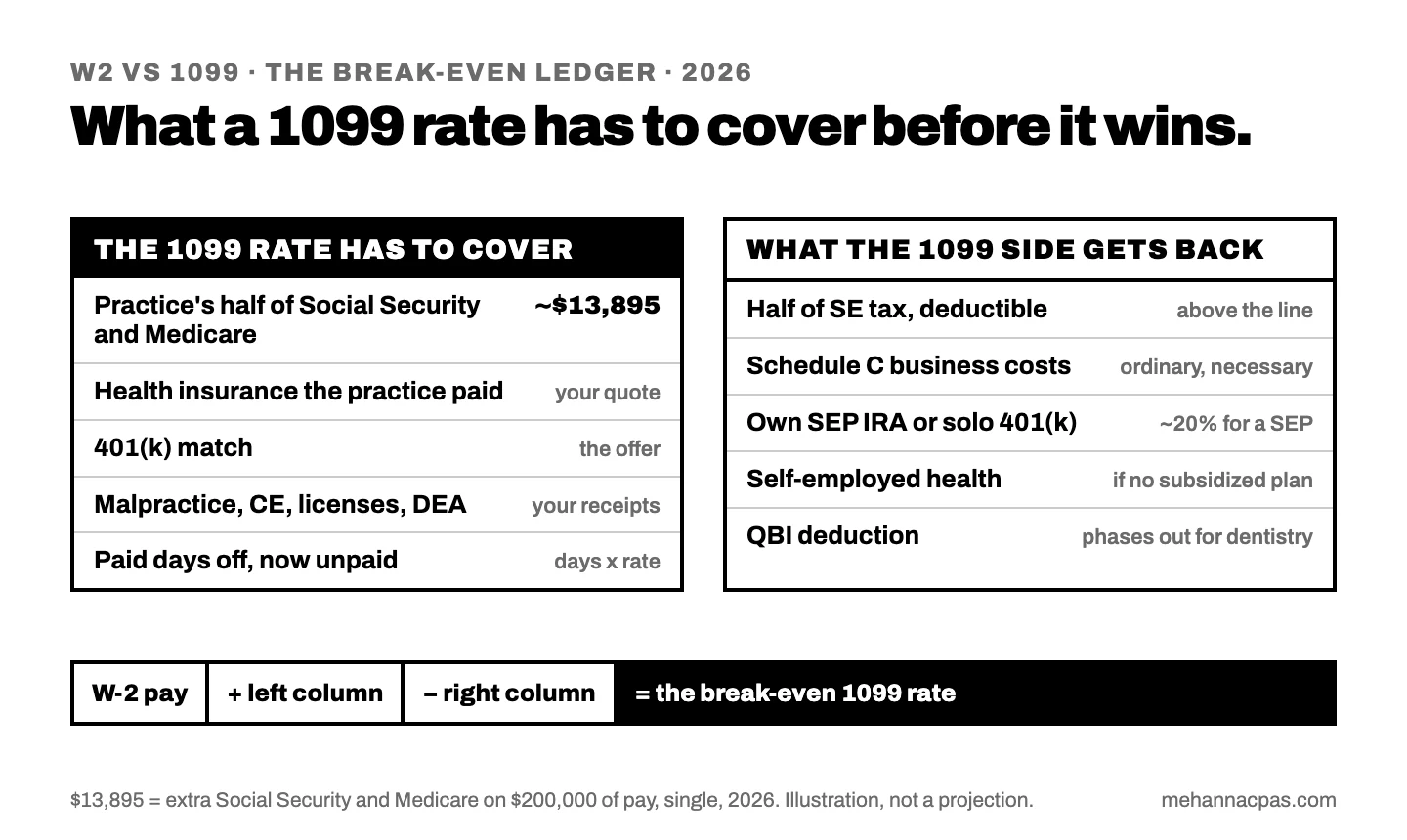
Then come the benefits. Health coverage the practice pays for isn’t taxed as wages to you (IRS Publication 15-B), so replacing it as a contractor costs after-tax dollars unless you qualify for the self-employed health insurance deduction. A 401(k) match is money you would now fund yourself. Paid days off become unpaid days. Our guide to 1099 taxes for associate dentists covers the set-aside side of this in detail.
When should you run the numbers?
Before you sign, and again at every renewal or change in how you’re paid. Once the contract is signed, the pay structure, who pays lab fees and who pays malpractice are fixed for its term. The useful moments:
- Before signing a first associate contract, with both offers in hand.
- When a practice proposes moving you from W-2 to 1099, because the same daily rate is a pay cut on a 1099.
- Before adding a second office, since two jobs share one Social Security wage base and one 401(k) deferral limit.
- A year or two before buying a practice, because lenders read your returns and the structure of your income shows up there.
Skip a formal comparison for a short locum stint of a few days: the tax difference is small and the rate is usually what it is.
Is a 1099 dentist really an independent contractor?
Not because the contract says so. The IRS decides worker status from the facts of the relationship. It looks at three groups of facts: behavioral control (who directs what work is done and how), financial control (unreimbursed expenses, your investment in tools, whether you can make a profit or take a loss, how you’re paid) and the type of relationship (written contracts, employee-type benefits, permanency, and whether your work is a key part of the business) (IRS Topic 762). No single factor decides it, and there is no set number that tips it (IRS).
Applied to a dental office, as a reading of those factors rather than a ruling: when the practice books your patients, sets your hours, supplies the chair, staff and materials, and offers you its benefits, the facts look like employment. Your own instruments and malpractice policy, several offices you work for, and real risk of loss point the other way. Either the practice or the worker can ask the IRS for a determination on Form SS-8.
Misclassification is mainly the practice’s payroll tax risk. It still affects you: an arrangement that is later treated as employment can change how your income and deductions were reported. That is one more reason to read the facts before you sign, not after.
How do you compare a W2 and a 1099 offer, line by line?
Turn both offers into after-tax dollars per year, then find the 1099 daily rate that makes them equal. Five steps cover it, and the W2 vs 1099 calculator runs all five with your numbers.
1. Put both offers on the same days
Count the days you would actually work. A W-2 offer of $800 a day over 220 working days, plus 10 paid days off, pays for 230 days: about $836 per day worked. The 1099 rate only pays for days in the chair. If either offer pays a percentage of collections instead of a daily rate, use your realistic collections, not the production schedule.
2. Add the payroll tax gap
Take the extra half of Social Security and Medicare from the section above. It shrinks once your combined earnings pass the $184,500 wage base, because only the 2.9% Medicare part continues above it.
3. Price the benefits you would buy yourself
Health insurance for you and your family, the 401(k) match, malpractice, CE, licenses and DEA renewals, and disability coverage. One detail on disability: if the practice pays the premiums, benefits you later receive from that policy are taxable; on a policy you pay for with after-tax money, they aren’t (IRS).
4. Subtract what the 1099 side can deduct
Ordinary and necessary business costs go on Schedule C (IRS), including CE that maintains your current skills (IRS Topic 513). Health insurance premiums can be deductible, but not for months you were eligible for a subsidized plan through any employer, including a spouse’s (IRS, Form 7206 instructions). A SEP IRA takes about 20% of net self-employment earnings (IRS Publication 560). The qualified business income deduction can apply, but dentistry is a specified service, so for 2026 it phases out between $201,750 and $276,750 of taxable income single, and $403,500 to $553,500 joint (Rev. Proc. 2025-32).
5. Solve for the break-even 1099 rate
The rate where the 1099 take-home, after tax and after what you pay yourself, matches the W-2 package. If the 1099 offer is above it, the 1099 pays more. If it’s below, the bigger number is the smaller paycheck. The calculator shows that rate directly.
Holding two offers and not sure which one really pays more? Bring both. You’ll leave knowing the number.
1099 vs W2: which is better for an associate dentist?
The one that leaves you more after tax, benefits and days off, with terms you can live with. The patterns below are where each one tends to come out ahead; your numbers decide.
| Your situation | Tends to favor | Why |
|---|---|---|
| Rates are close, W-2 includes health insurance and a match | W-2 | The 1099 has to cover payroll tax and benefits with no cushion |
| Spouse has subsidized family coverage at work | Depends | You don’t need the practice’s plan, but you can’t take the self-employed health deduction either |
| You pay your own CE, licenses and malpractice either way | 1099 | Deductible on a 1099, not deductible on a W-2 |
| You want to put large amounts into retirement | 1099 | Your own SEP or solo 401(k), sized to your profit |
| High household income | Narrower edge for 1099 | The QBI deduction phases out for dentistry at higher incomes |
| You plan to take several weeks off a year | W-2 | Paid days off are real pay; 1099 days off earn nothing |
Is 1099 better for a dentist?
Only when the 1099 rate clears the break-even, and only when the job really works like contracting. A higher daily rate that barely covers the extra payroll tax and the health plan you now buy leaves you about even, with more paperwork and quarterly estimates.
Can a 1099 dentist use an S corporation?
Sometimes, once 1099 profit is high and steady, and only if the practice contracts with and pays the entity. Our guide to S corp vs. LLC for dentists walks through when it fits.
If you take the W-2 offer, what should you negotiate?
Have the practice pay or reimburse your professional costs, because as an employee you can’t deduct them. Since 2018 most employees can’t claim unreimbursed employee expenses, and the 2025 tax law made that disallowance permanent (IRS, Internal Revenue Bulletin 2026-4, IRS Publication 529). CE, license renewals, DEA, dues and malpractice you pay yourself on a W-2 come out of after-tax pay.
Reimbursed through an accountable plan, the same costs aren’t wages to you at all. The plan needs a business connection, receipts within a reasonable time and the return of any excess. The IRS treats 60 days to account for an expense and 120 days to return an excess as reasonable (IRS Publication 15, Publication 463).
Also worth asking for in writing: who pays lab fees, whether malpractice includes tail coverage when you leave, and how a percentage of collections treats PPO write-offs.
How we look at associate offers with dentists
Most associates we talk to are on their way to owning, so we look at the offer as the first step of that path.
- Both offers, side by side. After tax, after benefits, per day actually worked. You text before you sign, not after.
- The break-even rate. The 1099 number that makes the two offers equal, so you know what to ask for.
- The facts behind the form. Whether the job works like contracting, and what that means if it doesn’t.
- The setup that follows. On a 1099, the set-aside, quarterly estimates and retirement plan. On a W-2, the reimbursements worth negotiating.
- The ownership timeline. What your returns should look like when a lender reads them.
Associates tend to compare the two daily rates and stop there. The difference between offers usually sits in the parts that don’t show up on the first line: the health plan, the match, the paid days off, and who pays for malpractice. Put those in dollars before deciding, and the bigger number is often not the winner.
W2 vs 1099 offer checklist
| Item | Fits you if | When | What to bring |
|---|---|---|---|
| Days actually worked | Any offer | Before signing | Schedule, paid days off, holidays |
| Payroll tax gap | One offer is 1099 | Before signing | Expected pay, other wages |
| Benefits in dollars | The W-2 offer includes health, a match or disability | Before signing | Benefit summary, premium quotes |
| Professional costs | You pay CE, licenses, malpractice or instruments | Before signing | Last year’s receipts |
| Accountable plan reimbursement | You take the W-2 offer | In the contract | A list of costs to cover |
| Classification facts | The offer is 1099 | Before signing | The contract, how scheduling and supplies work |
| Break-even 1099 rate | One offer is 1099 | Before you counter | All of the above, in the calculator |
Mistakes we’d avoid
- Comparing daily rates as if they were the same thing. A W-2 rate comes with a payroll tax match and benefits; a 1099 rate comes with neither.
- Using a generic calculator built for freelancers. It won’t know about malpractice, CE, licenses, lab fees or paid days off, which is where dental offers differ.
- Accepting a switch to 1099 at the same rate. The same daily rate on a 1099 is a pay cut, before you count the benefits.
- Assuming the contract settles your status. The facts of the job do. A label the facts don’t support helps nobody.
- Taking the W-2 and paying your own CE and licenses. They aren’t deductible for you. Negotiate reimbursement instead.
What changed for 2026
- Social Security wage base: $184,500 for 2026, for wages and self-employment earnings combined (IRS Topic 751).
- Employee expenses: the 2025 tax law (section 70110) made the disallowance of miscellaneous itemized deductions, including unreimbursed employee expenses, permanent (IRS, IRB 2026-4).
- QBI deduction: a wider 2026 phase-out range for specified services such as dentistry: $201,750 to $276,750 single, $403,500 to $553,500 joint (Rev. Proc. 2025-32).
- Retirement limits: $24,500 employee deferral, shared across all your plans, and $72,000 total defined contribution limit (IRS).
- 1099-NEC threshold: $2,000 for payments made in 2026, up from $600 (IRS). The income is taxable either way.
How to tell whether you picked the right offer
After the first full year, compare what the job actually left you with what the other offer would have. Take the year’s after-tax income, subtract what you paid for health insurance, retirement you funded and professional costs, and divide by the days you worked. Do the same for the offer you turned down, using its terms. If your number is higher, the choice held up. If it’s lower, that is your opening for the renewal conversation, with numbers rather than a feeling.
On a 1099, two more signs: no underpayment penalty on your return, and an April balance already sitting in your tax account. If you are heading toward ownership, our guide to how much practice you can afford shows what lenders look for in those years.
Frequently asked questions
How much higher should a 1099 rate be than a W-2 rate?
There is no fixed percentage. It has to cover the extra half of Social Security and Medicare, roughly 7% of net earnings up to the wage base, plus every benefit the W-2 offer includes and the days off it pays for. The more generous the W-2 package, the higher the break-even rate.
Can I be W-2 at one office and 1099 at another?
Yes, if each relationship supports its form. The two jobs share one Social Security wage base of $184,500 for 2026 and one $24,500 401(k) deferral limit. You will usually need quarterly estimates or extra withholding at the W-2 job to cover the 1099 days.
Does being a dentist independent contractor hurt a practice loan application?
It doesn’t rule it out. Many lenders look for a track record of self-employment income, and they read the net profit on your return, not the gross. Clean books and returns that match your deposits help.
Is the W2 vs 1099 calculator on your site free?
Yes. It runs in your browser, needs no email, and uses 2026 federal brackets, self-employment tax and the QBI phase-out. It is an estimate, not tax advice for your situation.
Glossary
| Term | Meaning |
|---|---|
| Self-employment tax | Social Security and Medicare paid by people who work for themselves: 15.3% on 92.35% of net earnings, with the Social Security part capped. |
| Wage base | The $184,500 of 2026 earnings above which the Social Security part stops. |
| Break-even rate | The 1099 rate that leaves you the same after tax and benefits as the W-2 offer. |
| Accountable plan | A reimbursement arrangement with receipts and return of excess, under which reimbursed costs aren’t wages. |
| QBI deduction | A deduction of up to 20% of qualified business income, phased out for specified services such as dentistry at higher incomes. |
| Form SS-8 | The form a practice or worker files to ask the IRS to decide employee or contractor status. |
Sources
- IRS, Topic 751, Social Security and Medicare withholding rates (2026): 6.2% and 1.45% each side, $184,500 wage base.
- IRS, Self-employment tax (2026): 15.3% rate, wage base, deductible employer-equivalent half.
- IRS, Topic 762, Independent contractor vs. employee: behavioral, financial and relationship facts.
- IRS, Independent contractor (self-employed) or employee?: no single factor decides.
- IRS, About Form SS-8: worker status determinations.
- IRS, Internal Revenue Bulletin 2026-4 (2026): section 70110 made the miscellaneous itemized deduction disallowance permanent.
- IRS, Publication 529, Miscellaneous Deductions: unreimbursed employee expenses.
- IRS, Publication 15 (2026), Employer’s Tax Guide: accountable plan rules and reasonable periods.
- IRS, Publication 463, Travel, Gift, and Car Expenses: accountable plans, 60 and 120 day safe harbors.
- IRS, Publication 15-B (2026): employer-provided accident and health coverage excluded from wages.
- IRS, Life insurance and disability insurance proceeds: tax treatment of disability benefits.
- IRS, Deducting business expenses: ordinary and necessary.
- IRS, Topic 513, Work-related education expenses.
- IRS, Instructions for Form 7206: self-employed health insurance and the subsidized-plan rule.
- IRS, Publication 560, Retirement Plans for Small Business: SEP limit for the self-employed.
- IRS, Rev. Proc. 2025-32 (2025): 2026 QBI thresholds and phase-in ranges.
- IRS, COLA increases for retirement plan limits (2026): $24,500 and $72,000.
- IRS, Form 1099-NEC and independent contractors: $2,000 threshold for payments after 2025.