

Associate dentist salary is usually a percentage of production or collections, a daily minimum, or a base salary plus a bonus. The ADA’s latest survey puts the median net income of employed general dentists at $165,520 for 2025. The contract decides your real number: the pay base, lab fees, benefits and who pays your professional costs.
- Employed general dentists earned a median of $165,520 in 2025, and the middle half fell between $129,280 and $191,470, according to the ADA Health Policy Institute. Owner general dentists’ median was $199,140.
- The same percentage on a different base is a different offer. In the ADA’s crown example, 35% of collections pays $227.50 and 30% of total production pays $450.
- A W-2 associate can’t deduct the costs they pay out of pocket. That rule is now permanent, so who pays CE, licenses, malpractice and tail coverage is part of your pay.
- The FTC’s 2024 noncompete ban is gone. Whether your noncompete holds up is a state law question.
- What we see with associates: the path to ownership written into the contract often matters more than the last point of percentage.
The offer letter says 30%. The practice wants it back by Friday. Before you sign, you need to know 30% of what, paid when, and what it costs you to do the job. That is what this guide covers: how associate pay works, what the numbers look like, and the contract terms that change what you actually keep.
What is associate dentist pay, and what isn’t it?
Associate dentist pay is what a practice pays a non-owner dentist for clinical work, set by a formula in the employment or contractor agreement. The ADA describes four common models: straight salary, salary plus a commission, straight commission on production or collections, and net profit, where expenses come off your billings first (ADA, Dentist compensation). Many offers mix them, for example a daily minimum or the percentage, whichever is higher.
It isn’t the same as your income from owning a practice, and it isn’t the headline percentage. Two offers at 30% can pay very different amounts, because the base, the lab fee rule and the patient mix change the dollars underneath.
| Pay model | How it is figured | Who carries the risk | What to ask |
|---|---|---|---|
| Straight salary | A fixed annual, monthly or daily amount | The practice | Is there a production target, and what happens if you miss it? |
| Salary plus commission | A base plus a percentage of production above a level | Shared | Where does the commission start, and is it measured monthly or yearly? |
| Percentage of production | A percent of the fees for the work you do, total or adjusted | Mostly you | Total fee schedule or the PPO-adjusted amount? |
| Percentage of collections | A percent of what the office actually collects on your work | You | What is the office’s collection rate, and when is a collection credited? |
| Daily minimum | A floor per day, often paid against the percentage | Shared | If the daily minimum beats the percentage, do you owe the difference back later? |
| Net profit | Your billings minus expenses named in the contract | You | Which expenses, direct or overhead, come off before you are paid? |
What is the average associate dentist salary in 2026?
The most recent primary data is the ADA’s 2026 Survey of Dental Practice, which covers 2025: employed general dentists in private practice had a median net income of $165,520 and an average of $164,510. The middle half earned between $129,280 and $191,470. Owner general dentists had a median of $199,140 (ADA Health Policy Institute, 2026 Survey of Dental Practice).
Read those numbers with care. The employed figure comes from 65 responses, and the ADA counts year-end bonuses and retirement plan payments as income. Employee dentists also worked 5.2 fewer hours per week than owners on average in 2024 (ADA HPI, Trends in Dentists’ Income, Revenue and Hours Worked). There is no official “standard” associate percentage. The ranges you see online come from job boards and trade press, so treat them as context, not as a benchmark.
The more useful number is the one you can test against an offer: what you would have to produce to earn what you want. At 30% of collections, $165,000 of pay takes $550,000 collected on your work. If the office collects 95% of what it bills, that is about $579,000 of production, or roughly $2,750 a day if you work 210 clinical days a year.
Is 30% of collections the same as 30% of production?
No. Collections are what the office actually receives after PPO write-offs and unpaid balances, so a percentage of collections is a percentage of a smaller number. The ADA’s crown example shows the gap: a $1,500 fee, a $1,000 PPO maximum and $950 collected.
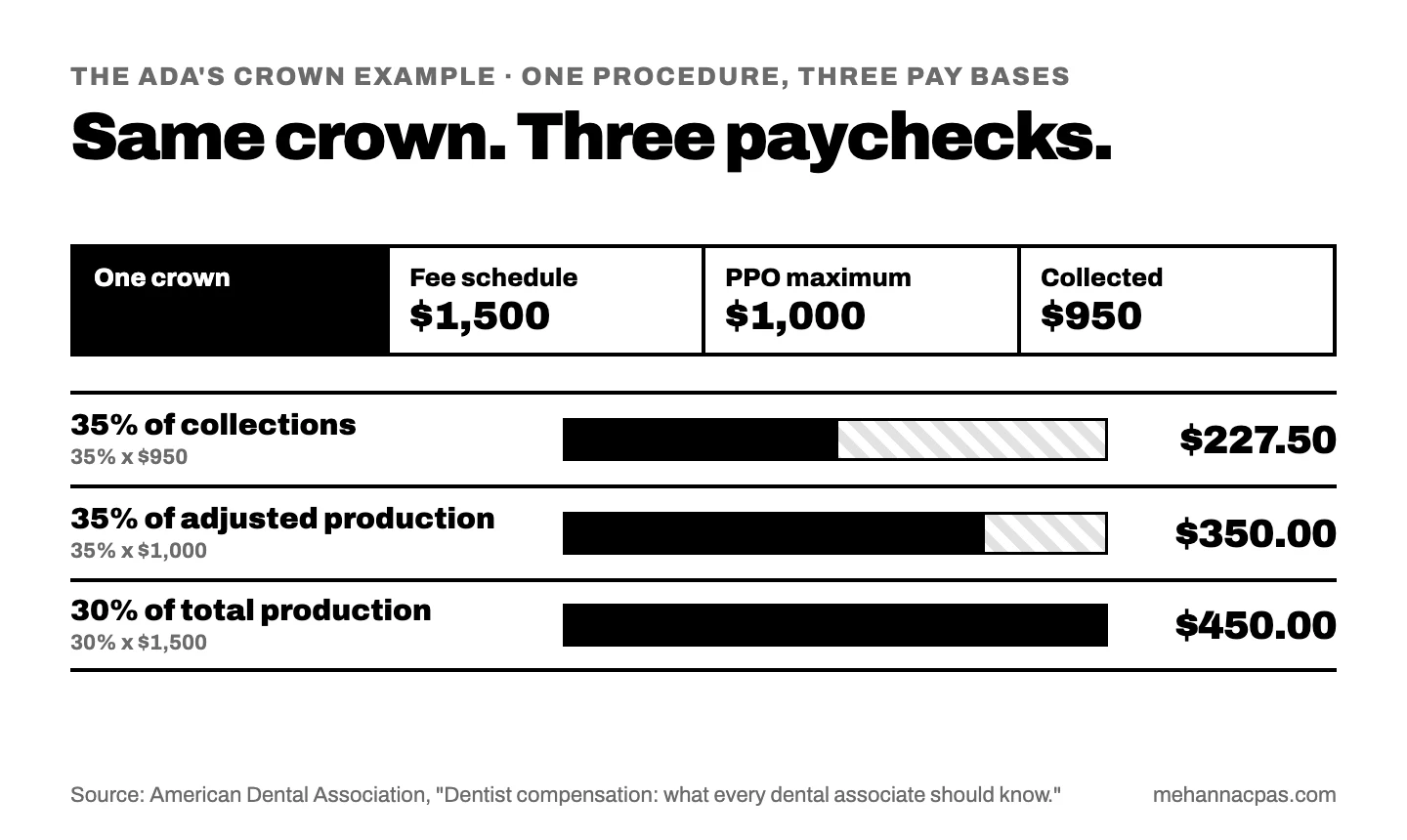
If most of the schedule you’d see is PPO patients, the gap between total and adjusted production is large. The ADA suggests asking whether newer associates see most of the PPO patients while the owner keeps the fee-for-service ones (ADA, How associate pay can vary).
Who should read this before signing, and who can skip it?
This is for dentists about to sign or renew an associate agreement, especially if they plan to own one day. It fits you if:
- You are a new graduate comparing two or three first offers with different pay bases.
- A practice offered you a 1099 contract and you are not sure it pays more than the W-2 one.
- Your contract mentions a future buy-in, and you want to know what that clause actually commits anyone to.
- The practice you work for is being sold, and a new owner or DSO sent you a new agreement.
You can skip most of it if you are already on a straight salary with full benefits and no plan to change offices. If you own a practice and are hiring an associate, the same terms apply from the other side of the table.
Why does the contract matter more than the headline number?
Because the formula, not the percentage, decides your pay. The same dentist doing the same dentistry gets a different check depending on the base, the collection rate of the office and the lab fee rule. Benefits move it again: the ADA notes that lower pay with health insurance, a retirement plan and more time off can be the better package (ADA).
Then there is tax. A W-2 associate can’t deduct unreimbursed work costs: the 2025 tax law made the disallowance of these miscellaneous itemized deductions permanent (IRS, Notice 2026-10, citing § 70110 of Public Law 119-21). So a $3,000 CE course you pay for yourself costs you $3,000. The same course paid by the practice costs you nothing.
When should you review an associate dentist contract?
Before you sign, every time. The terms that matter are hard to change once you’ve started. The other moments worth a full read:
- Before a renewal. Ask for the year’s numbers: your production, collections and what you were paid.
- Before switching from W-2 to 1099, or the other way around. The tax picture changes completely.
- Before a buy-in conversation. The associate agreement often sets the price formula, or doesn’t, and that matters later.
- When the practice is sold. Check whether your agreement can be assigned to the buyer, and what happens to your noncompete if it is.
Which associate dentist contract terms change your pay?
Nine terms do most of the work. Each one is something to ask for in writing before you sign.
1. The pay base
Total production, adjusted production or collections. Ask for a worked example with real procedures from the office’s fee schedule, and for the collection rate over the last 12 months. Ask when a collection is credited to you: the month the patient pays, or the month the work was done.
2. Lab fees and supplies
Some contracts subtract lab fees from your production before the percentage applies, some split them, some ignore them. On a crown-heavy schedule, that one line can move your pay more than a point of percentage.
3. The daily minimum, and how it is reconciled
A daily minimum is a floor. Read whether it is a true floor or a draw: under a draw, if the daily minimum pays more than your percentage, the deficit can carry forward and come out of later checks. Ask how often the comparison runs, daily, per pay period or yearly, and what happens to a deficit if you leave.
4. Who pays your professional costs
CE, state license and DEA renewals, professional dues and malpractice insurance. As an employee you can’t deduct what you pay yourself. If the practice reimburses you under an accountable plan, meaning you substantiate the expense and return any excess, the reimbursement isn’t taxable wages (IRS Publication 463). A lower percentage with these costs covered can beat a higher one without them.
5. Malpractice tail coverage
If the practice carries a claims-made policy, coverage for past work ends when you leave unless someone buys a tail. Some contracts make the departing associate pay for it. As a W-2 employee you can’t deduct that cost, so asking the practice to pay for the tail, even in exchange for a slightly lower rate, can be the better deal after tax. As a 1099 contractor, malpractice you pay is a business expense (IRS, Deducting business expenses).
6. The retirement plan
Ask whether there is a 401(k), when you become eligible, what the practice matches and whether the plan has a Roth option. For 2026 you can defer up to $24,500, plus $8,000 from age 50, or $11,250 at ages 60 to 63 (IRS, 2026 limits). Starting in 2026, if your prior-year wages from that employer were over $150,000, catch-up contributions have to go in as Roth (IRS, Catch-up contributions). In a plan with no Roth option, a higher-earning associate may not be able to make catch-up contributions at all (26 CFR § 1.414(v)-2).
7. Disability and health insurance
Employer-paid disability coverage is valuable, but benefits from a policy your employer paid for are taxable. Benefits from a policy you paid for yourself with after-tax money are not (IRS Publication 525). Ask whether you can pay the premium yourself if you would rather have tax-free benefits. For health insurance, ask what share of the premium the practice pays and when coverage starts.
8. Noncompete, termination and assignment
Read the radius, the duration and what triggers it. The FTC’s 2024 rule banning most noncompetes never took effect, and in September 2025 the FTC dropped its appeals and acceded to the rule being vacated. In February 2026 it removed the rule from the Code of Federal Regulations (FTC, 91 FR 6507). Enforceability is back to your state’s law, which varies widely, so a dental attorney in your state should read this clause. Check the notice period on both sides too, and whether the contract can be assigned to a buyer.
9. W-2 or 1099
The label doesn’t decide it. The IRS looks at behavioral control, financial control and the relationship (IRS Topic 762). A 1099 offer has to pay meaningfully more just to cover both halves of payroll tax and the benefits you’d buy yourself. Our W-2 vs. 1099 comparison for associate dentists walks through the break-even, and if you take the 1099, read what to set aside for 1099 taxes.
Have an associate offer on the table? Send it before you sign. You’ll know what it pays after tax and which clauses to push back on.
How we look at associate contracts with dentists
Most associates we talk to want to own a practice one day, so we read the contract the way a future buyer would.
- Translate the formula into dollars. Your expected production, the office’s collection rate and the lab fee rule, turned into a yearly number.
- Put a price on the benefits and the costs. Health insurance, the 401(k) match, malpractice, tail coverage, CE and licenses: who pays, and what it is worth after tax.
- Compare W-2 and 1099 on the same days. After payroll tax and benefits, not on the headline rate.
- Flag the clauses for your attorney. Noncompete, termination, assignment and any buy-in language. We look at the money; your attorney looks at enforceability.
- Plan the next step. If ownership is the goal, what you save and how you file as an associate shows up later on a loan application. You text before you sign, not after.
Associates tend to negotiate the percentage and skim the rest. The terms that end up costing the most are usually the quiet ones: a daily minimum that turns out to be a draw, a tail policy the associate has to buy on the way out, or a buy-in clause that says “to be discussed” and never sets a formula.
Associate dentist contract checklist
| Item | Fits you if | When | What to ask for |
|---|---|---|---|
| Pay base and worked example | Any percentage-based offer | Before signing | Real procedures from the fee schedule, run through the formula |
| Collection rate | You are paid on collections | Before signing | The office’s last 12 months, and when a collection is credited |
| Lab fee rule | Crown, implant or denture-heavy schedule | Before signing | Deducted, split or ignored, in writing |
| Daily minimum reconciliation | Your offer has a daily floor | Before signing | True floor or draw, how often it is compared, deficits on exit |
| Professional costs | W-2 offer | Before signing | Who pays CE, licenses, DEA, dues and malpractice, and the reimbursement policy |
| Tail coverage | Claims-made malpractice policy | Before signing | Who buys the tail when you leave |
| 401(k), match and Roth option | W-2 offer | Before signing, then each January | Eligibility date, match formula, Roth feature |
| Noncompete and assignment | Every agreement | Before signing and when the practice is sold | Radius, duration, triggers, review by a dental attorney |
| Buy-in language | You want to own | Before signing | A valuation method and a timeline, not “to be discussed” |
Mistakes we’d avoid
- Comparing percentages instead of dollars. 35% of collections and 30% of production are not the same offer. Run both through the same set of real procedures.
- Treating a daily minimum as income. If it is a draw, money paid over your percentage can come back out of later checks.
- Paying your own professional costs on a W-2. None of it is deductible. Negotiate for the practice to pay or reimburse.
- Ignoring the tail. Find out who pays it before you start, not when you give notice.
- Taking a 1099 offer for the bigger number. Unless it clears the break-even after payroll tax and benefits, it pays less.
- Assuming the noncompete won’t be enforced. The federal ban is gone, so your state decides. Have it read before you sign.
What changed for 2026
- Retirement limits: $24,500 employee deferral, $8,000 catch-up from age 50 and $11,250 at ages 60 to 63 (IRS, IR-2025-111).
- Roth catch-up: from 2026, catch-up contributions must be Roth for participants whose prior-year wages from the employer exceeded $150,000 (IRS; final regulations T.D. 10033, September 2025).
- Employee expenses: the disallowance of unreimbursed employee expenses, suspended since 2018, became permanent with the law signed July 4, 2025 (IRS, Notice 2026-10).
- Noncompetes: the FTC acceded to the vacatur of its noncompete rule on September 5, 2025, and removed it from the Code of Federal Regulations on February 12, 2026 (91 FR 6507).
- New income data: the ADA’s 2026 Survey of Dental Practice reports 2025 incomes: $165,520 median for employed general dentists, up from $156,130 the year before (ADA HPI).
How to tell whether your contract worked
After 12 months, divide your total pay by the collections on your work. That effective rate is the number to compare with the offer and with the next one. Ask the office for the year’s production and collections report; a fair practice will share it.
Then check three things: you never owed back a daily minimum deficit you didn’t expect, you didn’t pay a professional cost the practice could have covered, and you are closer to the next step you wanted, whether that is a raise, a partnership or your own practice. If ownership is next, our guide to buying a dental practice covers what to check before that signature.
Frequently asked questions
Is 30% a good percentage for an associate dentist?
It depends on the base. 30% of total production pays more than 30% of collections, and a contract that deducts lab fees first pays less than one that doesn’t. No official body publishes a standard rate. Turn the offer into dollars with the office’s real fee schedule and collection rate, then compare.
Can an associate dentist negotiate the contract?
Usually, yes. Beyond the percentage, the terms worth negotiating are who pays CE, licenses and tail coverage, how the daily minimum is reconciled, the start date for benefits and the noncompete radius. Ask for changes in writing, in the agreement itself, not in an email.
Does a dental associate noncompete hold up?
It depends on your state. With the federal rule vacated, state law and the specific terms decide: some states limit or ban noncompetes, others enforce reasonable ones. Radius, duration and what you received in exchange all matter. A dental attorney licensed in your state is the right person to read it.
My spouse owns a practice. Does my health plan at work affect their taxes?
It can. A self-employed owner can’t deduct health insurance premiums for any month they were eligible for a subsidized plan through an employer, including a spouse’s employer, even without enrolling (IRS, Instructions for Form 7206). In two-dentist households, compare both plans before choosing.
Should I take a W-2 or a 1099 associate position?
Compare them after tax and benefits. A 1099 rate has to be higher just to break even, because you pay both halves of payroll tax and buy your own benefits. The W-2 vs. 1099 calculator runs both offers side by side.
Glossary
| Term | Meaning |
|---|---|
| Total production | What the office bills for your work at its full fee schedule. |
| Adjusted production | The amount the office is contractually allowed to collect, usually set by PPO plans. |
| Collections | What the office actually receives for your work, after write-offs and unpaid balances. |
| Collection rate | Collections divided by production, on total or adjusted production. |
| Daily minimum | A minimum pay per day. Under a draw, any amount over your percentage can be recovered later. |
| Tail coverage | An add-on to a claims-made malpractice policy that covers past work after you leave. |
| Accountable plan | An employer reimbursement policy where you substantiate expenses and return any excess, so reimbursements aren’t taxable wages. |
| Noncompete | A clause that limits where and for how long you can practice after leaving. |
Sources
- ADA Health Policy Institute, Selected 2025 results from the Survey of Dental Practice (2026): net income of employed and owner general dentists, 2025.
- ADA Health Policy Institute, Trends in Dentists’ Income, Revenue and Hours Worked (2025): hours of employee vs. owner dentists, what the survey counts as income.
- American Dental Association, Dentist compensation: what every dental associate should know: pay models, definitions, crown example.
- American Dental Association, More than meets the eye: how associate pay can vary: PPO mix and collection percentages.
- IRS, Internal Revenue Bulletin 2026-4, Notice 2026-10 (2026): permanent disallowance of unreimbursed employee expenses under § 70110.
- IRS, Publication 463, Travel, Gift, and Car Expenses: accountable plan reimbursements.
- IRS, Deducting business expenses: ordinary and necessary expenses of the self-employed.
- IRS, COLA increases for retirement plan limits (2026): $24,500, $8,000 and $11,250.
- IRS, IR-2025-111 (2025): 2026 retirement limits.
- IRS, Retirement topics: catch-up contributions: Roth catch-up above $150,000 of prior-year wages.
- Federal Register, T.D. 10033, Catch-up contributions (2025): final Roth catch-up regulations.
- eCFR, 26 CFR § 1.414(v)-2: catch-up contributions required to be Roth.
- IRS, Publication 525, Taxable and Nontaxable Income: tax treatment of disability benefits.
- IRS, Instructions for Form 7206: self-employed health insurance and the subsidized-plan rule.
- IRS, Topic 762, Independent contractor vs. employee.
- Federal Trade Commission, Removal of the Non-Compete Rule to conform to federal court decisions, 91 FR 6507 (February 12, 2026): the September 5, 2025 vote to accede to vacatur and the removal of 16 CFR part 910.