

To read your dental practice’s financial statements, start with the profit and loss statement (what the practice earned and spent this month), then the balance sheet (what it owns and owes today), then the cash flow view that explains why profit and the bank balance don’t match. Three reports, read in that order, every month.
- The P&L shows a period. The balance sheet shows a single day. You need both, because profit alone can’t tell you where the money went.
- Owner distributions, loan principal and big equipment purchases never show up as expenses on the P&L. They are the usual reason the bank balance looks nothing like the profit line.
- If your practice is an S corporation, you can owe tax on its profit whether or not you took the cash out.
- On the cash basis, patient and insurance balances not yet collected are not income, and writing off an old balance does not create a tax deduction.
- What we see most in dental practices: an owner who reads collections in the practice software and never opens the balance sheet.
The bookkeeper’s email arrives on the 20th with a PDF attached. Net income looks strong. The practice checking account, meanwhile, went down this month, and there is a CBCT quote on your desk. Which number do you trust? Both are right. They answer different questions, and once you know which question each report answers, the PDF takes fifteen minutes to read.
This guide shows how to read financial statements the way a dental practice owner needs to: the P&L, the balance sheet and the bridge between profit and cash, with the tax rules that make dental numbers look the way they do.
What are financial statements, and what aren’t they?
Financial statements are the reports that show where a business’s money came from, where it went and where it is now. The SEC’s beginner’s guide lists four: the balance sheet, the income statement, the cash flow statement and the statement of owners’ equity (SEC, Beginners’ Guide to Financial Statements). For a dental practice, the first three do almost all the work.
The income statement is what most owners call the P&L, or profit and loss statement. It covers a period, usually a month and year to date. The balance sheet is a snapshot of one date: assets on one side, liabilities and equity on the other, and the two sides always balance. The cash flow statement explains how cash moved during the period.
Financial statements are not the reports in your practice management software, and they are not your tax return. Dental owners mix these up constantly, and each one answers a different question.
| Practice software reports | Financial statements | Tax return | |
|---|---|---|---|
| Who produces it | Your front desk and PMS | Your bookkeeper or CPA, from the books | Your CPA, once a year |
| What it measures | Production, adjustments, collections, AR by patient and carrier | Income, expenses, assets, debt, equity | Taxable income under the tax rules |
| How often | Daily | Monthly, after the books close | Annually |
| Best question it answers | Is the schedule turning into money? | Is the practice profitable, and where did the cash go? | What do I owe? |
| What it misses | Rent, payroll, debt, your distributions | Production by provider, hygiene detail | Anything that happened after December 31 |
Who should read them every month, and who can skip it?
Every practice owner should read them monthly, and the stakes rise with size. In dental practices, the monthly read pays off most when:
- You own a practice collecting $750,000 or more, so a small percentage drift in overhead is real money.
- Your practice is an S corporation, and your tax bill depends on profit you may not have taken out.
- You are weighing a big purchase, an associate hire or a second location in the next six months.
- You bought the practice in the last three years and still carry acquisition debt.
- You are talking to a lender, a buyer or a DSO, all of whom will read these reports more closely than you do.
You can skip the monthly routine if you are an associate. Your financial picture is your W-2 or 1099 and your personal accounts. If you are planning to buy, the skill still matters: reading a seller’s P&L is the first step in learning how to value a dental practice before you buy.
Why do financial statements matter for your practice?
Because your tax bill is figured on profit, not on what is left in the bank. If your practice is an S corporation, the IRS instructions to shareholders say it plainly: you may be liable for tax on your share of the corporation’s income, whether or not it was distributed to you (IRS, Shareholder’s Instructions for Schedule K-1 (Form 1120-S)). A year with strong profit and a big loan payoff can leave you with a large tax bill and very little cash to pay it.
The same profit number drives your quarterly estimates. An owner who only watches the bank balance tends to find out about a strong year in April. For how much to set aside as the year goes, see our guide to estimated tax payments for practice owners.
Your statements also decide how outsiders see you. Lenders, landlords, buyers and DSOs all start with the P&L and the balance sheet. Clean, consistent monthly statements are cheaper to produce every month than to rebuild under pressure the week before a closing.
How to read a profit and loss statement
Read the P&L from the top down, in the same order every month: income, clinical costs, overhead, owner pay, then the bottom line. Check the header first: which period it covers and whether it is on the cash or accrual basis. Under the cash method, income counts when it is actually or constructively received and expenses count when they are paid (IRS Publication 538).
What does the income line actually mean?
On a cash-basis P&L, income is collections deposited, not production. Production is the dentistry you did; collections are the money that arrived. The gap between them lives in your practice software as adjustments, PPO write-offs and unpaid balances. If income on the P&L doesn’t roughly match collections in the PMS for the same month, ask why before you read anything else. Refunds to patients belong against income, not hidden in an expense line.
Where should staff, supplies and lab fees sit?
Group the costs that move with the schedule: clinical staff pay and benefits, dental supplies and lab fees. Then the costs that stay put: rent, software, insurance, marketing, office supplies. Practices that lump everything into a few broad lines can’t see which group is drifting. Read each line as a percentage of income, and compare it with the same month last year and with your own rolling twelve months, not with someone else’s chart.
Why doesn’t my distribution show up as an expense?
Because it isn’t one. If your practice is an S corporation, your W-2 salary is an expense on the P&L, and setting it right is its own decision (see S corp reasonable salary for dentists). The cash you take out on top of that is a distribution: it reduces equity on the balance sheet and never touches the P&L. The same goes for owner draws in a sole proprietorship or partnership. That is why a P&L can show a healthy profit while the account is empty: you already took it.
Why did that equipment purchase skip the P&L?
Small items go straight to expense. Under the IRS de minimis safe harbor, a practice without audited financial statements can expense tangible property up to $2,500 per invoice or item ($5,000 with an applicable financial statement), as long as it follows a consistent accounting policy in place at the beginning of the year and makes the election with its return (IRS, Tangible property final regulations). A new curing light or a laptop usually lands on the P&L as an expense.
Bigger purchases, like a chair, a scanner or a CBCT, go on the balance sheet as assets and reach the P&L through depreciation. For taxes, the cost may be deducted much faster through Section 179 or bonus depreciation (IRS Publication 946). If you are weighing a big purchase, see when the Section 179 write-off is worth it.
How to read a balance sheet
The balance sheet answers one question: on this date, what does the practice own, what does it owe, and what is left for you? Assets always equal liabilities plus equity (SEC). Read it top to bottom, and compare it with the same date last month.
- Cash. Should match the bank statements after reconciliation. If it doesn’t, the rest of the report is suspect.
- Equipment and improvements. Shown at cost, less accumulated depreciation. A big number here with a small depreciation balance usually means recent purchases.
- Loans and credit lines. The practice loan, equipment financing, credit cards. Watch whether these balances fall month after month or quietly climb.
- Payroll liabilities. Taxes withheld from paychecks and not yet deposited. These should clear every pay cycle.
- Equity. Your contributions, plus accumulated profit, minus everything you have taken out. Distributions show up here.
Why aren’t my patient balances on the balance sheet?
Many dental practices keep their books on the cash basis, so money patients and carriers still owe you is not income yet and usually doesn’t appear as an asset on the balance sheet. Your accounts receivable report lives in the practice software. There is a tax consequence too: because those amounts were never included in income, a cash-basis practice generally can’t take a bad debt deduction when it writes off an old patient balance (IRS, Topic 453). Writing it off cleans up the AR report. It doesn’t lower your tax.
Where do loan payments go?
Split in two. The interest is an expense on the P&L, and business interest is generally deductible (IRS Publication 334). The principal is not an expense at all: it reduces the loan balance on the balance sheet. A practice paying down a large acquisition loan can show a healthy profit and still feel short of cash every month.
Why don’t profit and cash match?
Because several big movements of cash never pass through the P&L, and one big expense never uses cash at all. The cash flow statement, or a simple bridge your accountant builds each month, walks from net income to the change in your bank balance.
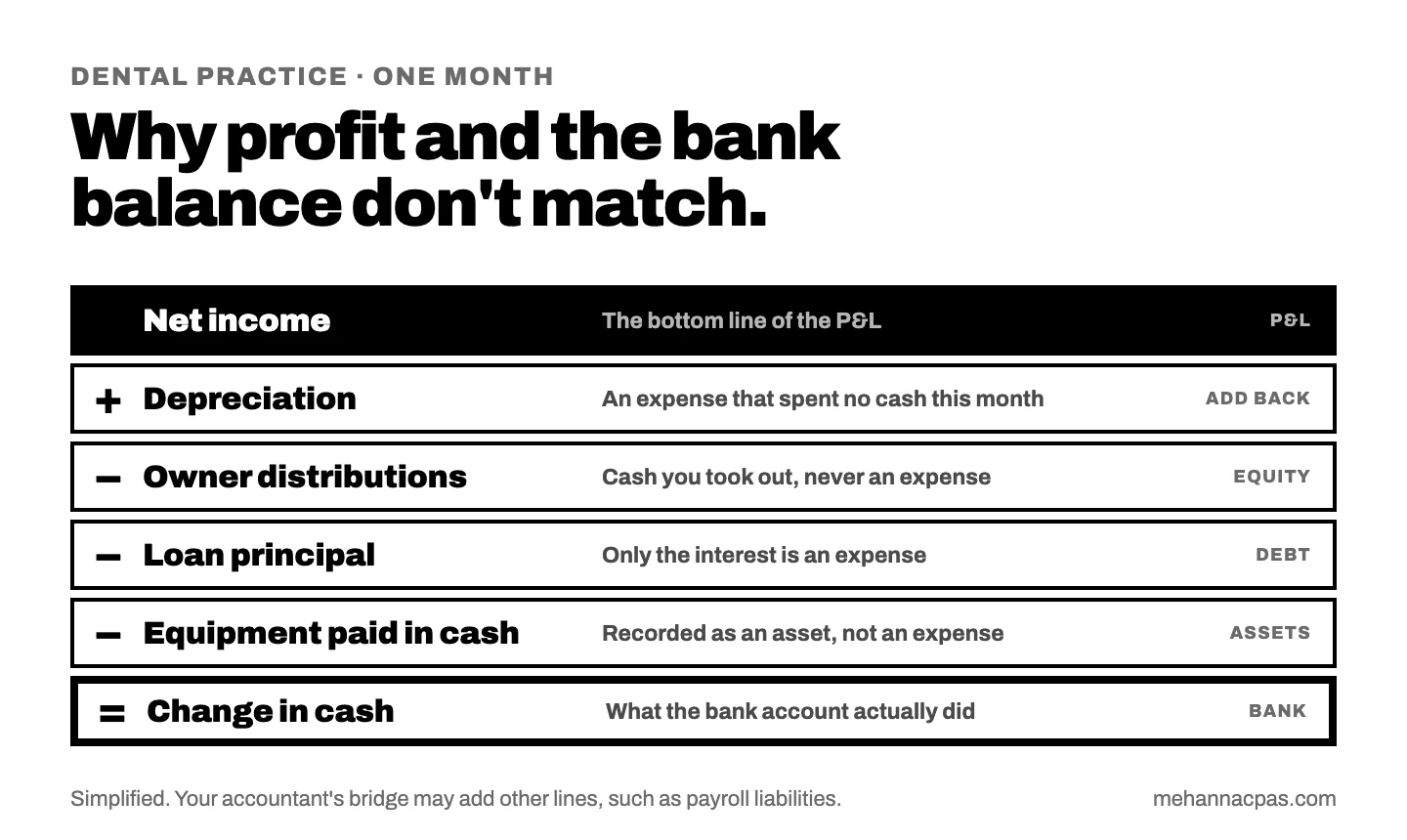
Read it left to right. Depreciation reduced profit but spent no cash this month, so it is added back. Distributions, loan principal and equipment paid in cash all left the account without showing up as expenses. When the bridge is complete, the mystery of the empty account usually turns into one or two lines you can name.
When should you review them, and when can you skip a month?
Review them every month, within a few weeks of month end, and always before a big decision. The decisions that should never be made without current statements:
- Before signing for equipment, a buildout or a second location.
- Before each estimated tax payment, so the payment matches the year you are actually having.
- Before a large distribution, to confirm the practice can spare it after payroll, debt and taxes.
- Before a lender, buyer or DSO asks for them.
- Before year end, when the projection decides which moves are still worth making.
Skipping a month is fine when the books are current and nothing big is pending. Skipping three is how small problems, like a deposit that never got posted or a credit card that stopped being reconciled, become year-end cleanups.
How to read financial statements the way we do with dental practices
We read them the way you would if you had the time: the same order every month, tied back to the practice software and to the tax projection.
- Close the month on a fixed date. Weekly bookkeeping, reconciliations, and a monthly close on the same day each month, so the statements arrive when you can still act on them.
- Tie the books to the practice software. Deposits on the P&L should trace back to collections in the PMS. Gaps get explained, not averaged away.
- Read the P&L as percentages. Each major line against income, against last year and against the rolling twelve months.
- Read the balance sheet for movement. Debt going down, payroll liabilities clearing, equity changing by what you expected.
- Build the profit-to-cash bridge. So you know where the money went before you ask where it is.
- Feed the tax projection. Every close updates the year’s projected tax, which sets the next estimate and the agenda for the next planning call.
It is the same three people every month, so the person reading your statements already knows why March looked different.
The owner knows collections to the dollar from the practice software and has never opened the balance sheet. The P&L shows a good year, the account is thin, and the explanation is almost always the same: distributions and loan principal that nobody connected to the profit line. Once the bridge is on one page, the conversation shifts from “where did the money go” to “what do we do next.”
Which report answers your question?
Match the question to the report before you start reading. Most frustration with financial statements comes from asking one report a question only another can answer.
| Your question | Open this | Look at |
|---|---|---|
| Did the practice make money this month? | P&L | Net income, month and year to date |
| Is overhead creeping? | P&L | Each expense line as a % of income, against last year |
| Where did the cash go? | Cash flow bridge | Distributions, loan principal, equipment |
| How much do I still owe on the practice? | Balance sheet | Loan balances, month over month |
| Can I afford a big distribution? | Balance sheet + projection | Cash after payroll, debt payments and the next estimate |
| Is the schedule turning into money? | PMS reports | Production, adjustments, collections |
| What will I owe in April? | Tax projection | Year-to-date profit carried to year end |
Have statements you can’t read, or none at all? Bring your last P&L, or don’t. You’ll leave the call knowing where you stand and what we’d look at first.
Dental practice financial statements checklist
Use this every month after the books close. Ten minutes with it catches most problems while they are still small.
| Check | Where | What good looks like | Red flag |
|---|---|---|---|
| Period and basis | P&L header | Last month and year to date, cash or accrual stated | No date range, or a basis nobody can name |
| Income vs. collections | P&L + PMS | Deposits match collections for the month | A gap nobody can explain |
| Expense lines | P&L | Staff, supplies, lab and rent on their own lines, stable as a % | A large “miscellaneous” or “ask my accountant” line |
| Owner pay | P&L + balance sheet | Salary on the P&L, distributions in equity | Distributions booked as an expense |
| Cash | Balance sheet | Matches the reconciled bank statements | Unreconciled accounts or old uncleared items |
| Debt | Balance sheet | Loan balances fall each month | Credit card balances that keep growing |
| Payroll liabilities | Balance sheet | Close to zero after each tax deposit | A balance that keeps growing |
| Profit to cash | Bridge | Every big movement named | “The money just went” |
Mistakes we’d avoid
Most expensive misreadings come from trusting one number without its context. The ones we’d steer you away from:
- Reading collections and calling it profit. Collections are the top line. Overhead, debt and taxes all come out before anything is yours.
- Taking distributions off the bank balance. The balance doesn’t know about next month’s payroll, the loan payment or the estimate due on the 15th.
- Accepting statements months late. A P&L from last quarter tells you what already happened. Decisions need last month.
- Letting the PMS and the books disagree. If deposits and collections don’t tie, either money is missing or the books are wrong. Both are worth knowing.
- Buying for the tax write-off. A purchase that makes the tax return look better can still leave the balance sheet weaker. Read both before you sign.
What changed for 2026
The One Big Beautiful Bill Act, signed July 4, 2025, changed a few things that show up in a practice’s books.
- 100% bonus depreciation is permanent for qualified property acquired after January 19, 2025 (IRS, Notice 2026-11). Your tax return can deduct a CBCT in full the year it goes into service while your books depreciate it over several years, so ask which one your P&L shows.
- For payments made after December 31, 2025, Forms 1099-NEC and 1099-MISC are required once payments to a recipient reach $2,000, up from $600 (IRS, Form 1099-K FAQs, FS-2025-08). Vendor and contractor names in your books still need to be clean for this.
- The Form 1099-K threshold for payment apps went back to over $20,000 and over 200 transactions, but card processors report payment card transactions with no minimum (IRS Publication 1099). The amount is gross, before refunds and fees (IRS, Instructions for Form 1099-K), so it won’t match your P&L income line. Your accountant should be able to reconcile the two.
How to tell whether your monthly financials are working
They work when you can answer three questions in five minutes: did we make money, where did the cash go, and what will we owe in April. Check that the statements arrive by the same date every month, that P&L income ties to PMS collections, that the bridge explains the bank balance, and that the tax projection moved when the numbers did. If any of those is missing, the reports are bookkeeping, not information. Monthly financials, projections and three planning calls a year are all part of The Treatment Plan.
Frequently asked questions
How do I read a balance sheet for a small dental practice?
Start with cash and confirm it matches the bank. Then look at equipment net of depreciation, the loan balances, payroll liabilities and equity. Compare each with the same date last month. Debt should fall, payroll liabilities should clear, and equity should change by profit minus what you took out.
What is the difference between profit and cash flow?
Profit is income minus expenses on the P&L. Cash flow is what actually moved through the bank. They differ because distributions, loan principal and equipment purchases use cash without being expenses, while depreciation is an expense that uses no cash this month.
Should a dental practice use cash or accrual accounting?
Many dental practices keep their books on the cash basis because it tracks deposits and payments and is simpler to run. The method has to be applied consistently and match how the tax return is prepared (IRS Publication 538). Your CPA should confirm which one fits your entity and size.
Why does my P&L show profit but my bank account is low?
Usually because cash left through lines the P&L doesn’t show: owner distributions, the principal on practice or equipment loans, and purchases recorded as assets. A profit-to-cash bridge from your accountant names each one, so the gap stops being a mystery.
How often should I review my practice’s financial statements?
Monthly, within a few weeks of month end, and always before a big decision such as an equipment purchase, a large distribution or an estimated tax payment. Quarterly is too slow to catch overhead creep or a reconciliation problem before it compounds.
Glossary
| Term | Meaning |
|---|---|
| P&L | The profit and loss statement, or income statement: income and expenses for a period. |
| Balance sheet | A snapshot of one date: assets, liabilities and equity. Assets always equal liabilities plus equity. |
| Cash basis | Income counts when received and expenses when paid. The method many dental practices keep their books on. |
| Accrual basis | Income counts when earned and expenses when incurred, regardless of when cash moves. |
| Equity | What is left for the owners after liabilities: contributions plus accumulated profit minus distributions. |
| Distribution | Cash an S corporation owner takes out beyond W-2 salary. It reduces equity and is not an expense. |
| Depreciation | The cost of equipment spread over its useful life on the books, an expense that uses no cash in the month it is recorded. |
| De minimis safe harbor | An IRS election that lets a practice expense items up to $2,500 per invoice or item instead of recording them as assets. |
| Accounts receivable (AR) | What patients and insurance carriers still owe the practice. On the cash basis it lives in the practice software, not in income. |
Sources
- IRS, Shareholder’s Instructions for Schedule K-1 (Form 1120-S) (2025): tax on your share of S corporation income whether or not distributed.
- IRS, Publication 538, Accounting Periods and Methods: cash method, income actually or constructively received.
- IRS, Tangible property final regulations, FAQ: de minimis safe harbor, $2,500 or $5,000 per invoice or item, policy in place at the beginning of the year.
- IRS, Topic 453, Bad debt deduction: cash-method taxpayers generally can’t deduct unpaid fees never included in income.
- IRS, Publication 334, Tax Guide for Small Business (2025): deducting business interest.
- IRS, Publication 946, How to Depreciate Property: depreciation, Section 179 and bonus depreciation.
- IRS, Notice 2026-11 guidance on 100% bonus depreciation (2026).
- IRS, Form 1099-K frequently asked questions, FS-2025-08 (2025): $2,000 threshold for Forms 1099-NEC and 1099-MISC for payments after December 31, 2025, and the restored Form 1099-K threshold.
- IRS, Publication 1099 (2026), General Instructions for Certain Information Returns: Form 1099-K thresholds.
- IRS, Instructions for Form 1099-K: gross amount without adjustments for refunds or fees.
- U.S. Securities and Exchange Commission, Beginners’ Guide to Financial Statements: the four statements and the accounting equation.