

Buying a dental practice goes well when you check four things before you sign the letter of intent: what the practice really earns after a market salary for you, whether that covers the loan with room to spare, how the price is allocated for tax, and which contracts, licenses and people actually transfer to you on day one.
- The letter of intent is where the deal gets built. The ADA notes it is mostly non-binding, yet it sets the price, the terms and the timeline everything else follows.
- Due diligence typically runs about 45 days, according to the ADA. Ask for the documents before you sign, not after.
- With an SBA 7(a) loan, the lender orders its own valuation, total debt is capped at that valuation, and an initial acquisition needs at least a 10% equity injection (SBA SOP 50 10 8.1, effective October 1, 2026).
- A DEA registration can’t be assigned to you without the DEA’s written consent, and a new owner generally needs a new EIN. Plan the first 90 days before closing.
- What we see most with buyers: the price gets the attention, while the loan payment plus a real salary, and the price allocation, get checked too late.
The seller accepted your number. The broker wants the letter of intent signed this week, and the lender says the loan “shouldn’t be a problem.” This is the moment that decides the next ten years, and most of what matters isn’t on the one-page summary you were sent.
This guide covers how to buy a dental practice in the order the decisions actually happen: what to check before you commit, what due diligence should prove, what the purchase really costs, and what has to be ready the day you become the owner.
What does buying a dental practice involve, and what isn’t it?
A dental practice acquisition is the purchase of a going concern: the patient base, goodwill, equipment, supplies, records, systems and usually the lease, plus the team you hope will stay. Most dentist-to-dentist deals are asset purchases. You buy the assets through your own entity, and the seller keeps their old company and, generally, its past liabilities. The ADA’s sale guidance lists the documents in order: a letter of intent, due diligence, then an asset purchase agreement that is fully binding (ADA).
Buying a practice gets confused with a few neighbors. They are different decisions:
| What you get | What you take on | The main question | |
|---|---|---|---|
| Buying a practice (asset purchase) | Patients, goodwill, equipment, systems, often the lease | Acquisition debt, the transition, the team | Will the earnings pay the loan and you? |
| Buying the seller’s entity (stock purchase) | The company itself, with its contracts | Its history, including liabilities you didn’t see | What exactly comes with the company? |
| Buying into a practice (partner buy-in) | A share of an existing practice | A partner, a buy-sell agreement | How will the later buyout be priced? |
| Starting from scratch | A location and a lease, no patients yet | Build-out debt and a ramp-up period | How long until it covers your pay? |
| Buying the dental office building | Real estate | A mortgage, the landlord’s role | Own or rent, separately from the practice |
Whether to buy the dental office building is its own decision with its own math. Our buy vs. rent calculator runs that comparison separately from the practice purchase.
Who should buy a practice now, and who should wait?
Buying makes sense when you are ready to own the decisions, you have lender options lined up, and the practice’s earnings support a salary for you on top of the loan. The buyers we hear from most:
- An associate with a few years of production who has found a practice whose owner wants to retire in the next year or two.
- An owner buying a second location, where the new debt sits on top of the first practice’s debt.
- A dentist moving to a new market who would rather buy an existing patient base than start from zero.
- An associate offered a buy-in by the current owner, with a price that came from the owner’s side.
Waiting can be the better call if you can’t yet show a lender steady income, if you plan to move within a few years, or if the only practice available needs the seller to keep producing most of the dentistry long after closing. If you are still deciding between an associate offer and ownership, compare what each pays you after tax before you start looking at listings.
Why the first decisions matter most
Your loan, your equity check and your first years of cash flow are fixed by terms you agree to early, often in the letter of intent. Three rules set the frame for most financed purchases.
The lender’s valuation caps the debt. For an SBA 7(a) change of ownership, total debt, including seller financing that is not on full standby, is limited to the business valuation, which the lender orders from an independent qualified appraiser. Anything you pay above it comes from your own equity, in addition to the minimum 10% equity injection for an initial acquisition (SBA SOP 50 10 8.1). The 7(a) maximum loan is $5 million, and the same loan can include working capital (SBA).
The cash flow has to cover the payments with room to spare. For an initial acquisition, the SBA requires debt service coverage of at least 1.25 to 1 (SBA SOP 50 10 8.1). Conventional dental lenders set their own terms. The ADA notes banks see dental practices as safe loans and that many will finance the full price plus working capital, which is exactly why the bank saying yes doesn’t mean the price is right (ADA).
The allocation sets your deductions for years. In an asset purchase, buyer and seller report how the price splits across asset classes on Form 8594. Equipment can often be deducted quickly, while goodwill, the patient base and a non-compete are generally amortized over 15 years (IRS).
How the price itself is built, from a percentage of collections to normalized earnings, is covered in how to value a dental practice before you buy.
When should you check what, and when is it too late?
Check the earnings, the loan and the structure before the letter of intent, and use due diligence to prove what you assumed. After the purchase agreement is signed, the leverage is mostly gone.
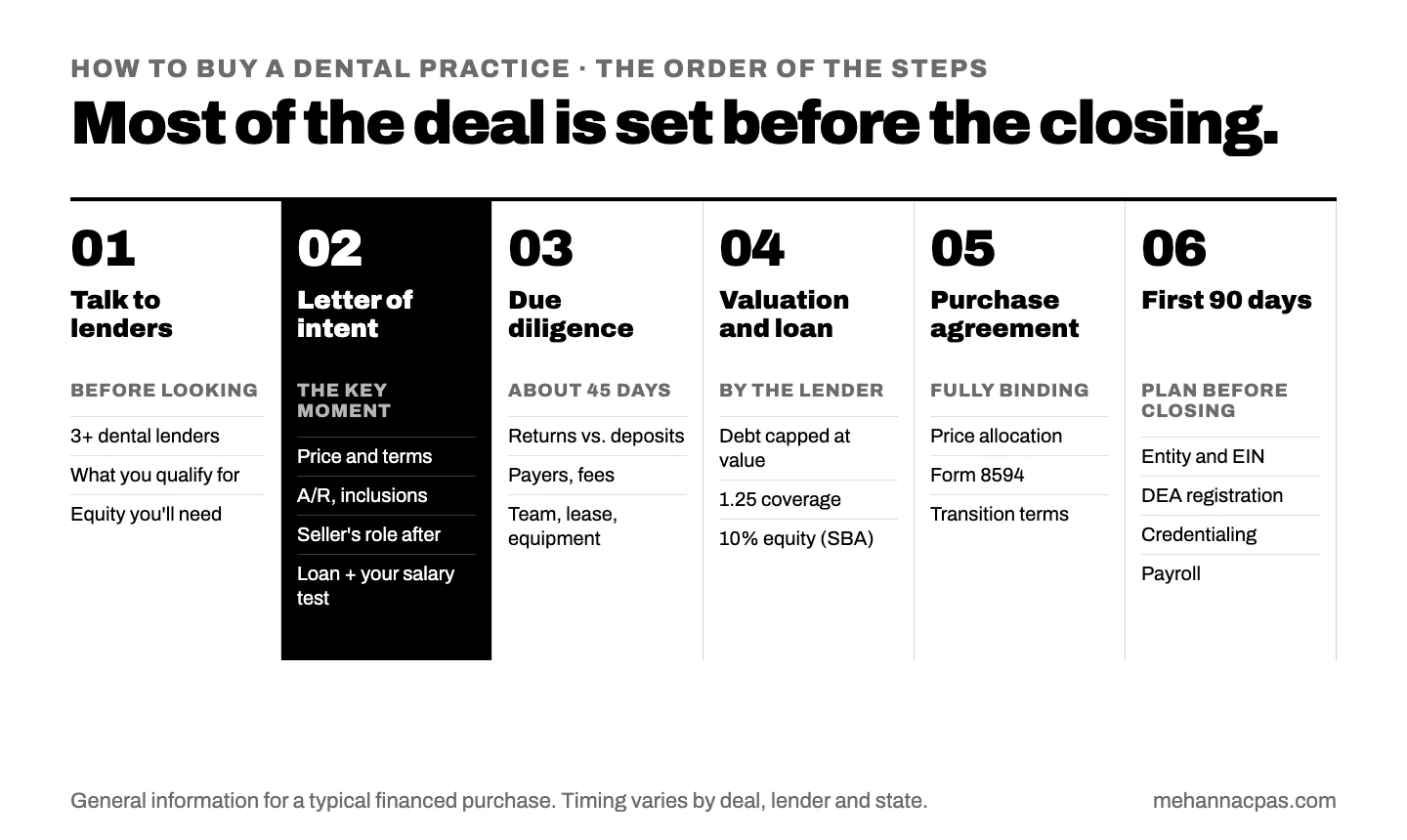
- Before you look at listings: talk to at least three lenders who finance dental practices, as the ADA suggests, so you know what you qualify for.
- Before the letter of intent: the last three years of returns and P&Ls, production and collections by provider, and a first pass at what the practice pays you after the loan.
- During due diligence: verify everything the summary claimed, and agree the allocation.
- Before closing: your entity, payroll, insurance credentialing and DEA registration, so day one isn’t spent on paperwork.
If you’re closing on a practice, come before the closing, not after. The structure decisions happen at the table.
How we review a practice purchase with dental buyers
We start from what the practice can pay you, then work back to the price, the structure and the first year. A practice acquisition analysis is a project we scope and price on a call. The steps:
- Rebuild the earnings from three to five years of returns and P&Ls, reconciled to the practice management system and the bank deposits.
- Replace the seller’s pay with what a market associate would earn for the same dentistry, and strip out personal and one-time costs.
- Run the loan at your real rate and term, test it against the lender’s coverage rule, and see what’s left for you.
- Read the deal terms in the letter of intent: what’s included, what’s excluded, who keeps the accounts receivable, the seller’s role after closing.
- Model the allocation across equipment, intangibles and goodwill, and what it does to your deductions in years one to five.
- Set up year one: entity, S corp timing, owner salary, payroll and a projection so the first April holds no surprise. Then the same three people stay on it all year, with a text before you sign anything big.
Buyers rarely overpay because they misread collections. The trouble is what nobody put on one page: the loan payment plus a fair salary for the new owner, measured against what the practice earns once the seller’s personal costs come out. The second gap is the allocation, which often shows up from the seller’s side after the price is agreed. Both are easier to fix before the letter of intent than after it.
Is buying a dental practice worth it for you?
It is worth it when the practice pays your loan and a market salary from its own earnings, with a cushion, and the patients are likely to stay after the transition. Run these questions before you commit:
| Question | Good sign | Warning sign |
|---|---|---|
| Does it pay you and the loan? | Coverage holds after a market salary for you | It only works if you take no salary |
| Who produces the dentistry? | Hygiene and associates carry a real share | The seller produces almost everything |
| Will patients stay? | Steady new patients, active recare | An “active” count full of patients not seen in years |
| What does a procedure pay? | Payer mix and fee schedule you can live with | Recent PPO contracts with deep write-offs |
| Can you stay in the space? | Long lease term or renewal options | A short remaining term, landlord consent unclear |
What is the cost to buy a dental practice?
More than the price. Budget for the purchase price, your equity injection, working capital for the first months, closing costs (the lender’s fees, your attorney, any independent appraisal) and the equipment you’ll replace in year one. The price itself usually starts from a percentage of collections and should be tested against earnings, as our dental practice valuation guide explains.
How long does it take to buy a dental practice?
Usually several months from the first conversation to closing. The ADA puts due diligence at about 45 days, and lender underwriting, the independent valuation and credentialing run alongside it. A seller who can’t produce documents quickly is the most common delay.
Looking at a practice right now? Walk through the numbers before you sign the letter of intent. Bring the broker’s package, or don’t.
Dental practice purchase due diligence: what to verify
Due diligence when buying a business is where you prove the numbers and find what the summary left out. In a dental purchase, these are the items that move the deal.
1. The financials
Three to five years of tax returns and P&Ls, production and collections by provider, and accounts receivable aging. Reconcile collections to bank deposits. A gap between the practice management reports and the tax return is the first question to ask, not the last.
2. The patients and the payers
New patients per month, recare, and the payer mix. Insurance contracts don’t follow the practice automatically. Ask each insurer, early, whether you can be credentialed under your entity and at what fee schedule, because the fees you inherit decide what a crown actually pays.
3. The team
Who stays, what they earn, and what is owed. In an asset purchase the seller’s employees typically become your new hires. Check accrued paid time off, any associate agreements and non-competes, and who holds the key relationships with patients.
4. The lease and the equipment
The remaining lease term, renewal options, rent increases and whether the landlord must consent to an assignment. List the equipment with its age, and price in anything near the end of its life, especially imaging and sterilization.
5. The licenses and registrations
A DEA registration can’t be assigned or transferred except with the DEA’s written consent (21 CFR 1301.52), so plan your own registration for the location. A sole proprietor who buys an existing business needs a new EIN, and so does a new entity (IRS Publication 5845). Your state dental board sets its own rules on practice ownership.
6. The tax structure
The allocation on Form 8594, the entity you buy through and the timing of an S corp election. A new corporation that wants S status from its first day generally files Form 2553 within 2 months and 15 days of the start of that tax year (IRS).
Buying a dental practice checklist
Use this table to see what to collect, when, and what each item protects. Before any purchase, dental practice buyers can work down it row by row. Every row comes from the steps above.
| Item | When | Where it comes from | What it protects |
|---|---|---|---|
| Pre-approval from 3+ dental lenders | Before looking | Lenders | Knowing your real budget |
| Returns and P&Ls, 3 to 5 years | Before the LOI | Seller’s CPA | A price built on real earnings |
| Production and collections by provider | Before the LOI | Practice management system | Knowing how much leaves with the seller |
| Loan payment plus your salary test | Before the LOI | Your CPA | A practice that pays you |
| Letter of intent terms | Before signing | Your attorney and CPA | Price, inclusions, A/R, seller’s role, timeline |
| Payer contracts and fee schedules | Due diligence | Seller, insurers | What a procedure pays after closing |
| Staff roster, pay, accrued PTO | Due diligence | Payroll records | No surprise liabilities, a team that stays |
| Lease and landlord consent | Due diligence | Lease, landlord | Your right to stay in the space |
| Equipment list with age | Due diligence | Seller, invoices | Your year-one capital budget |
| Price allocation (Form 8594) | Before the purchase agreement | Purchase agreement | Your deductions in years one to five |
| Entity, EIN, S corp timing, payroll | Before closing | Your CPA, IRS | Getting paid correctly from day one |
| DEA registration and credentialing | Before closing | DEA, insurers | Seeing patients without a gap |
Mistakes we’d avoid
Most expensive acquisition mistakes are decisions made too late, not bad luck. The ones we’d steer you away from:
- Signing the letter of intent first and asking for numbers second. It is mostly non-binding, but it anchors the price and the terms.
- Treating loan approval as proof of value. The bank checks that it gets repaid. Whether you get paid is your question.
- Leaving the allocation to the closing documents. Equipment and goodwill are deducted on very different schedules. Agree the split with the price.
- Assuming the insurance contracts come with the practice. Credentialing takes time, and the fee schedule you get may differ from the seller’s.
- Forgetting the seller’s role after closing. If most production leaves with the seller, put the transition period and introductions in writing.
What changed for 2026
The SBA rewrote its rules for financing a practice purchase, effective October 1, 2026. The changes that matter most to a buyer using a 7(a) loan:
- SOP 50 10 8.1 replaced SOP 50 10 8 on October 1, 2026 (SBA Information Notice 5000-880695).
- The independent valuation must come from an accredited appraiser and be ordered by and prepared for the lender. A valuation you commissioned is for your own decision, not the loan. An internal lender valuation is now allowed only for 7(a) Small and SBA Express loans with a business purchase price of $350,000 or less (SBA SOP 50 10 8.1).
- A quality of earnings report is now required for initial acquisitions with a business purchase price of $3 million or more.
- The 10% equity injection for an initial acquisition can’t be reduced.
On the tax side, 100% bonus depreciation is permanent for property acquired after January 19, 2025 (IRS, Notice 2026-11), and the 2026 Section 179 limit is $2,560,000 (Rev. Proc. 2025-32). That makes the equipment line of the allocation worth more to a buyer in year one, while goodwill stays on a 15-year schedule.
How to tell whether the purchase worked
At twelve months, check three numbers: debt coverage, your own pay and patient retention. The practice should cover its loan payments the way the lender measures them, pay you at least what an associate would earn for the same dentistry, and keep collections close to where they were before the transition. If one of those only works on paper, find which assumption broke: patients who left with the seller, a lower fee schedule, or an add-back that wasn’t real. Year-round projections and planning calls after a purchase are part of The Treatment Plan, and our guide to what a dental CPA does that a general CPA won’t shows where that help usually shows up.
Frequently asked questions
How much do you need to put down to buy a dental practice?
It depends on the loan. An SBA 7(a) initial acquisition requires at least a 10% equity injection, plus anything paid above the lender’s valuation. The ADA notes many conventional dental lenders will finance the full price plus working capital. Compare at least three lenders before you make an offer.
Is the letter of intent binding?
Mostly not. The ADA describes it as non-binding except for specific clauses the document calls out, while the asset purchase agreement is fully binding. In practice, the letter sets the price and terms the rest of the deal follows, so have your attorney and CPA review it before you sign.
Should I buy the practice through an entity?
Usually yes, and the choice should be made before closing, not after. The entity determines how you pay yourself, how the purchase is reported and what an S corp election would require. Your state dental board also sets rules on who may own a practice. Decide it with your CPA and attorney together.
Can I deduct the price of a dental practice?
Over time, and on different schedules. Equipment can often be deducted quickly through bonus depreciation or Section 179. Goodwill, the patient base and a non-compete are generally amortized over 15 years. That is why the allocation of the price matters as much as the price.
Should I buy the dental office building with the practice?
Treat it as a second decision. If the seller owns the building, you can often buy the practice and lease the space, or buy dental office real estate later. The ADA notes the real estate is valued separately and may carry different loan terms. Run the own-versus-rent math on its own numbers.
Do I need a dental CPA to buy a practice?
You need someone who will rebuild the earnings, test the loan and model the allocation before you sign. A CPA who works with dental practices has seen what the documents usually hide. Bring them in before the letter of intent, when their findings can still change the deal.
Glossary
| Term | Meaning |
|---|---|
| Letter of intent (LOI) | The mostly non-binding document that sets the price, terms and timeline before due diligence. |
| Due diligence | The period after the LOI when the buyer verifies the financials, contracts, team and equipment. |
| Asset purchase agreement | The binding contract that transfers the practice’s assets to the buyer at closing. |
| Equity injection | The buyer’s own money in the deal. At least 10% for an SBA 7(a) initial acquisition. |
| Debt service coverage | Earnings divided by all business loan payments. The SBA requires at least 1.25 for an initial acquisition. |
| Price allocation | How the price splits across asset classes, reported by both sides on Form 8594. |
| Goodwill | The part of the price above the identifiable assets. Amortized over 15 years by the buyer. |
| Credentialing | Getting approved by each insurer to be paid as an in-network provider under your entity. |
Sources
- U.S. Small Business Administration, SOP 50 10 8.1, Lender and Development Company Loan Programs (effective October 1, 2026): change of ownership valuation, debt cap, equity injection, debt service coverage, quality of earnings.
- U.S. Small Business Administration, Information Notice 5000-880695, Issuance of SOP 50 10 8.1 (2026).
- U.S. Small Business Administration, 7(a) loans: $5 million maximum, uses including changes of ownership and working capital.
- IRS, Instructions for Form 8594: allocation of the price in an asset acquisition.
- IRS, Intangibles: 15-year amortization of section 197 intangibles.
- IRS, Publication 5845, Do you need a new EIN? (2023): new EIN when ownership or structure changes.
- IRS, Instructions for Form 2553: when to file an S corporation election.
- IRS, Notice 2026-11 guidance on 100% bonus depreciation (2026).
- IRS, Rev. Proc. 2025-32 (2025): 2026 Section 179 limit.
- Electronic Code of Federal Regulations, 21 CFR 1301.52: DEA registrations can’t be transferred without written consent.
- American Dental Association, What makes a successful sale: letter of intent, due diligence of about 45 days, asset purchase agreement.
- American Dental Association, Talk to 3 banks: the first step in buying a dental practice: lender views and financing of the full price.