

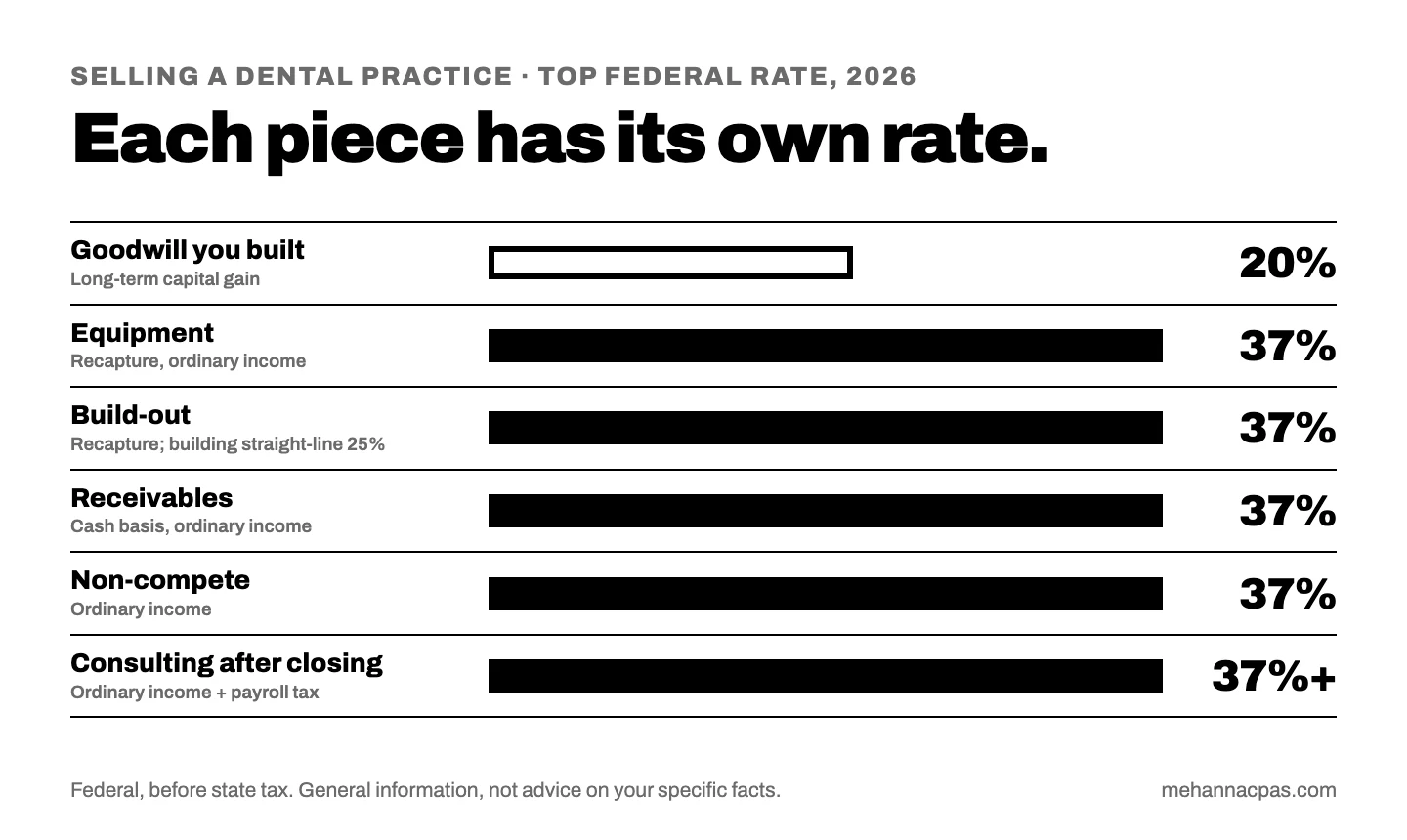
The taxes on selling a dental practice are figured piece by piece, not on the price as a whole. Goodwill is usually long-term capital gain, taxed at up to 20% federally in 2026. Equipment you wrote off, cash-basis receivables and the non-compete are ordinary income, at up to 37%. Your entity and your state come on top.
- There is no single tax rate on a practice sale. The IRS treats the sale of a business as a sale of each of its assets, and each one is taxed on its own terms (IRS, Sale of a business).
- For 2026, the gap between the top ordinary rate (37%) and the top long-term capital gain rate (20%) is 17 points, so where each dollar of the price lands matters as much as the price.
- If you worked in the practice, the gain on its assets generally escapes the 3.8% net investment income tax. Stock in a C corporation does not.
- A seller note can spread the capital gain over the payment years, but recapture on equipment is taxed in the year of sale.
- What we see in dental practices: sellers compare offers on the headline price, and the after-tax number arrives months later, on the return.
The offer is on the table, and the number looks good. Then someone asks the question that matters: how much of it do you actually keep? The honest answer is that nobody can tell you from the price alone. It depends on how the price is split, how the practice is held, what you wrote off over the years and where you live.
This guide walks through the taxes on sale of a dental practice, one piece at a time, so you can read an offer the way the IRS will. If you’re earlier in the process, start with our dental practice transition plan, which covers the years before the sale.
What are the taxes on selling a dental practice, and what aren’t they?
They are the federal and state income taxes on the gain from each asset you sell, plus a few taxes that sit on top in a sale year. The gain on each asset is the price allocated to it minus your adjusted basis, which is what you paid less the depreciation you already took. For a practice you built, much of the price often has a basis close to zero, so much of the price is gain.
They are not a flat percentage of the price, and they are not only capital gains tax. Here is how the usual pieces of a dental practice sale are taxed for the seller in 2026:
| Piece of the price | Usually taxed as | Top federal rate, 2026 | When it is taxed |
|---|---|---|---|
| Goodwill and the patient base you built | Long-term capital gain | 20% | As you are paid, if the installment method applies |
| Equipment you depreciated or expensed | Ordinary income up to the depreciation taken (recapture) | 37% | The year of sale |
| Build-out and leasehold improvements | Ordinary income for Section 179 and the faster part of bonus depreciation | 37% (25% on straight-line depreciation of a building) | The year of sale |
| Receivables of a cash-basis practice | Ordinary income | 37% | When sold or collected |
| Non-compete | Ordinary income | 37% | As paid |
| Consulting or employment after closing | Pay for your work: ordinary income plus payroll or self-employment tax | 37% | As earned |
Rates come from the 2026 tax tables in Rev. Proc. 2025-32 and the capital gain rules in IRS Topic 409.
Who needs to run these numbers, and who can wait?
Run them if a sale is likely in the next three years, or if you have an offer in hand. The situations where we see it matter most:
- A DSO or a buyer has sent a letter of intent, and you want to compare it with another path on what you keep.
- You bought new equipment or remodeled in the last few years and wrote it off at once.
- Your practice is a C corporation, or an S corporation that used to be one.
- You plan to sell to an associate and carry part of the price as a note.
- You live in a state with a high income tax, or you are thinking of moving before or after the sale.
You can wait if a sale is more than five years away. Even then, the decisions you make now, such as how you depreciate a large purchase, will show up in the sale-year return.
Why does the tax on a practice sale matter so much?
Because the same price can be taxed at very different rates, and you usually sell a practice once. For 2026, a married couple filing jointly reaches the 37% bracket above $768,700 of taxable income, and the 20% capital gain rate above $613,700 (Rev. Proc. 2025-32). A practice sale can push a seller past both lines in a single year.
At those rates, every $100,000 of the price that lands in the non-compete instead of goodwill costs $37,000 of federal tax instead of $20,000. That is $17,000 per $100,000, before state tax, on the same headline price. The buyer, meanwhile, amortizes both the non-compete and goodwill over 15 years, so the split often matters more to you than to them.
When should you work out the tax, and when is it too late?
Work it out before you sign the letter of intent, and settle the price allocation before you sign the purchase agreement. Buyer and seller both report the split on Form 8594, and if you agree on it in writing, the agreement binds both of you unless the IRS finds it inappropriate (26 U.S.C. 1060).
After closing, very little can change. The split is on the contract, the depreciation you took in past years is on past returns, and the sale year’s income is what it is. What you can still do then is pay the right estimates for the sale year, so the April bill is not a surprise.
How is capital gains tax on sale of business figured, piece by piece?
Each asset gets its own gain and its own character, and the residual method decides how much of the price each one gets. Cash and receivables come first, then equipment and other tangible assets at fair market value, then intangibles such as the non-compete, and goodwill takes whatever is left (Instructions for Form 8594).
1. Goodwill and the patient base
Goodwill you built yourself is generally long-term capital gain if you held the practice more than a year, taxed at 0%, 15% or 20% depending on taxable income. For 2026 the 0% rate runs to $98,900 and the 15% rate to $613,700 on a joint return, and to $49,450 and $545,500 for single filers (Rev. Proc. 2025-32). If you bought the practice, the goodwill you paid for and amortized is different: the gain up to the amortization you took is recaptured as ordinary income (IRS Publication 544).
2. Equipment you already wrote off
Gain on equipment, up to the depreciation and Section 179 you claimed, is ordinary income (IRS Publication 544). If your chairs, CBCT and scanners were expensed when you bought them, their basis is close to zero, so nearly every dollar allocated to them is taxed at ordinary rates. Our guide to the Section 179 deduction for dental equipment shows that trade-off from the buying side.
3. Build-out, leasehold improvements and the building
Office build-out follows the same logic with one twist. The part you expensed under Section 179 is recaptured as ordinary income, and so is depreciation taken faster than straight line, such as bonus depreciation (26 U.S.C. 1250; Publication 544). If you own the building, the straight-line depreciation you took is taxed at up to 25% as unrecaptured Section 1250 gain (IRS Topic 409), and the rest of the gain is usually capital gain.
4. Accounts receivable
A cash-basis practice has never reported its insurance and patient receivables as income, so they carry no basis. Receivables are not capital assets (IRS Publication 544), so they are ordinary income whether you sell them to the buyer or keep and collect them yourself. The choice changes when the cash arrives and how the allocation looks, not the character of the income.
5. The non-compete and your work after closing
Money allocated to a covenant not to compete is ordinary income. Payments for consulting or for staying on as an employee are also ordinary income, and they carry payroll or self-employment tax as well (The Tax Adviser, 2021). The IRS looks closely at large consulting payments when little consulting is actually done, so the labels have to match what happens.
How does your entity change the tax bill?
If your practice is an S corporation or an LLC, the gain is generally taxed once, on your personal return. A C corporation can be taxed twice. The structure also decides whether you are selling assets or an ownership interest:
| How the practice is held | What is usually sold | How the gain is taxed | What to check |
|---|---|---|---|
| Sole proprietorship or single-member LLC | The assets | Once, on your return, asset by asset | Recapture on equipment and build-out |
| S corporation | Usually the assets; sometimes the stock | Once: the gain passes through to you, asset by asset | Whether it was ever a C corporation |
| Partnership or multi-member LLC | The assets, or your interest | Once; on a sale of your interest, the part tied to receivables and recapture is ordinary income | The partnership agreement and the buy-sell terms |
| C corporation | The assets, by the corporation | The corporation pays 21%, then you are taxed again when the proceeds come out | Who owns the goodwill |
The partnership rule comes from the IRS’s own summary: an interest in a partnership is a capital asset, but the part of the gain from unrealized receivables or inventory is ordinary (IRS, Sale of a business), and depreciation recapture counts as an unrealized receivable (IRS Publication 541). In a C corporation, the corporation pays tax on its gain at 21% (26 U.S.C. 11), and what you receive when it liquidates is treated as a sale of your stock (26 U.S.C. 331).
Who owns the goodwill can change that. In a dental case, goodwill was found to belong to the dentist’s C corporation because of his employment agreement and non-compete with it, and the proceeds were taxed as a dividend rather than as capital gain (Howard v. United States, 9th Cir. 2011). If your S corporation used to be a C corporation, a corporate-level built-in gains tax can apply to assets sold within five years of the S election (26 U.S.C. 1374). For how the entity choice plays out while you own the practice, see S corp vs. LLC for dentists.
Which taxes come on top in a sale year?
Three things can add to the federal income tax: the net investment income tax, your state and the alternative minimum tax. A fourth, an old business loss, can quietly turn capital gain into ordinary income.
Does the 3.8% net investment income tax apply to a practice sale?
Usually not, if you worked in the practice. The 3.8% tax applies above $250,000 of modified AGI on a joint return and $200,000 for single filers, but it doesn’t reach income from an active business or gains on property held in one (IRS Topic 559). Where it does show up: stock in a C corporation, and a practice you owned without working in it.
How does my state tax the sale?
Your state taxes the gain too, and the rules differ more than the federal ones. California, for example, has no lower rate for capital gains and taxes them as ordinary income (California Franchise Tax Board). Where you live on the date of the sale, and where the practice is, both matter.
Can the sale trigger the alternative minimum tax?
It can raise the exposure. For 2026, the AMT exemption on a joint return is $140,200, starts phasing out at $1,000,000 of alternative minimum taxable income and is gone at $1,280,400 (Rev. Proc. 2025-32). A sale year can cross those lines, so the projection should run both calculations.
What if the practice had a loss on business assets in recent years?
A net gain on business assets held more than a year, such as equipment sold above its recapture, is ordinary income to the extent of net losses of the same kind you deducted in the previous five years (IRS Publication 544). It is a small item for most practices, but worth checking.
How we work out what you keep from a practice sale
A sale or DSO offer review is a project we scope and price on a call, and it is most useful before the letter of intent is signed. Here is how it runs:
- Read the offer as a tax return. Price, the proposed allocation, the note, any earnout or equity, and your role after closing.
- Pull the history. Depreciation schedules, how the practice bought its equipment and build-out, entity history and any agreements you signed with your own company.
- Model each piece. Gain, character and year for every line of the allocation, federal and state, with the net investment income tax and AMT checked.
- Compare paths on cash kept. The same model for each offer or path, so you see after-tax dollars side by side.
- Bring it to the table. We work with you and your attorney on the allocation before the purchase agreement, and you text before you sign.
- Close it out. Estimates for the sale year, the Form 8594, and the return that reports the sale.
The surprise is rarely the capital gain. It is the recapture: equipment and build-out written off in the last few years come back as ordinary income in the sale year, even when most of the cash arrives later. The second one is the allocation written by the buyer and signed without a model. Both are easy to see in advance and hard to fix after closing.
Have an offer, or expect one in the next few years? Bring the letter of intent or your last two returns. You’ll leave knowing which pieces of the price drive your tax.
Can you spread the tax over several years?
Partly. A seller note spreads the capital gain over the years you are paid, but not the recapture. On the installment method you report gain as payments arrive, while depreciation recapture, including Section 179, is reported in the year of sale whether or not you received a payment that year (IRS Publication 537). Interest on the note is ordinary income.
Two limits are worth knowing. The note has to carry at least the IRS test rate of interest, or part of each payment is treated as interest. And if the sales price is over $150,000 and your installment obligations outstanding at year end total more than $5 million, you pay interest on the deferred tax (IRS Publication 537). The note also leaves you carrying the buyer’s credit risk for its full term.
DSO offers often add rollover equity or an earnout, which have their own timing and risk. Our guide to DSO rollover equity walks through how those are taxed and valued.
Dental practice sale tax checklist
Bring these to the first conversation. Every row comes from the sections above.
| Item | Matters if | When | What to bring |
|---|---|---|---|
| Proposed price allocation | Every asset sale | Before the purchase agreement | Letter of intent, draft Form 8594 split |
| Depreciation history | You expensed equipment or build-out | Before the letter of intent | Depreciation schedules, Section 179 and bonus elections |
| Purchased goodwill | You bought the practice | Before the letter of intent | Your purchase agreement and its allocation |
| Entity history | C corporation, former C corporation, partnership | Years ahead if possible | Entity documents, S election date, agreements with your own company |
| Receivables plan | Cash-basis practice | Before the purchase agreement | Receivables aging report |
| Non-compete and consulting terms | The buyer wants you to stay or not compete | Letter of intent | Draft covenant and employment or consulting agreement |
| Seller note or earnout | Part of the price is paid later | Letter of intent | Note terms, interest rate, payment schedule |
| State and AMT check | Every sale | Sale-year projection | State of residence, prior-year return |
| Sale-year estimates | Every sale | After closing | Closing statement, projection |
Mistakes we’d avoid when selling a dental practice
Most of them come from reading the price instead of the split. The ones we’d steer you away from:
- Assuming the whole price is capital gain. Recapture, receivables, the non-compete and consulting pay are ordinary income.
- Signing the buyer’s allocation without a model. A written split binds you, and both sides report it.
- Writing off a big purchase right before the sale without running the numbers. The deduction is real, but much of it can come back as ordinary income at the sale.
- Forgetting the purchased goodwill. If you bought the practice, part of what you amortized is recaptured.
- Counting on a seller note to defer everything. Recapture is taxed in the year of sale.
- Ignoring the C corporation question. Agreements with your own company can decide who owns the goodwill and how often it is taxed.
What changed for 2026
Three dated changes touch the tax on a practice sale this year.
- The 2026 thresholds: the 20% capital gain rate starts above $613,700 of taxable income on a joint return, and the 37% bracket above $768,700 (Rev. Proc. 2025-32).
- The AMT exemption for a joint return starts phasing out at $1,000,000 and is gone at $1,280,400, under the 2026 amounts that reflect the One, Big, Beautiful Bill Act (Rev. Proc. 2025-32).
- 100% bonus depreciation is permanent for property acquired after January 19, 2025 (IRS, Notice 2026-11). More equipment written off at once means more recapture when the practice sells.
How to tell whether you kept what you planned
Compare the after-tax cash from the sale with the number you modeled before the letter of intent. The checks that tell you the plan held: the allocation on your Form 8594 matches the contract and the buyer’s form, the recapture on the return matches the model, no estimate penalty showed up for the sale year, and any note is being paid on schedule. If the number came in far below the model, the allocation or the recapture is usually where it went. If a sale is still ahead of you, the transition plan is where those numbers get set.
Frequently asked questions
Do I pay capital gains tax on the whole sale of my dental practice?
No. Only the part of the price allocated to capital assets held more than a year, mainly the goodwill you built, is long-term capital gain. Recapture on equipment and build-out, cash-basis receivables, the non-compete and any consulting pay are ordinary income, taxed at your regular rates.
What are the taxes on sale of business assets versus stock?
In an asset sale, each asset is taxed on its own, so part of the gain can be ordinary income. A sale of stock is generally capital gain, but most buyers of a dental practice want the assets, and C corporation stock gain can carry the 3.8% net investment income tax.
Can I avoid tax on a practice sale by moving to a state with no income tax?
Sometimes it changes the state tax, but it is not simple. State rules on residency and on where a gain is taxed differ, and a move made close to a sale tends to get a close look. Plan it with your CPA and attorney well ahead, not in the sale year.
Who pays the tax when the practice sells, me or the buyer?
You pay tax on your gain. The buyer gets a basis in what they bought, equal to what they paid, and recovers it through depreciation and amortization. That is why buyers push for more on equipment, which they can write off quickly, and less on goodwill.
Glossary
| Term | Meaning |
|---|---|
| Adjusted basis | What you paid for an asset, less the depreciation you already took. Gain is the price minus this. |
| Depreciation recapture | Gain on equipment or build-out up to the depreciation and Section 179 you took, taxed as ordinary income. |
| Unrecaptured Section 1250 gain | Gain on a building from straight-line depreciation, taxed at up to 25%. |
| Residual method | The required order for splitting the price: cash and receivables, then tangible assets, then other intangibles, with goodwill last. |
| Net investment income tax | A 3.8% federal tax on investment income above set income levels; it generally doesn’t apply to an active business. |
| Installment method | Reporting gain as payments arrive on a seller note, instead of all in the year of sale. |
| Built-in gains tax | A corporate-level tax on an S corporation that used to be a C corporation, on gains that existed at the conversion. |
Sources
- IRS, Rev. Proc. 2025-32 (2025): 2026 tax brackets, capital gain rate thresholds, AMT exemption and phaseout.
- IRS, Sale of a business: each asset taxed separately, partnership interests, corporate liquidations.
- IRS, Publication 544, Sales and Other Dispositions of Assets (2025): recapture under Sections 1245 and 1250, receivables, the five-year Section 1231 loss rule.
- IRS, Publication 537, Installment Sales (2025): recapture in the year of sale, interest on deferred tax above $5 million.
- IRS, Publication 541, Partnerships: recapture treated as an unrealized receivable on the sale of a partnership interest.
- IRS, Instructions for Form 8594: residual method and asset classes.
- IRS, Topic 409, Capital gains and losses: 25% maximum rate on unrecaptured Section 1250 gain.
- IRS, Topic 559, Net investment income tax: 3.8% rate, thresholds, active business exception.
- IRS, Notice 2026-11 guidance on 100% bonus depreciation (2026).
- U.S. Code, 26 U.S.C. 1060: written allocation binding on both parties.
- U.S. Code, 26 U.S.C. 1250: additional depreciation above straight line recaptured as ordinary income.
- U.S. Code, 26 U.S.C. 1374: built-in gains tax, five-year recognition period.
- U.S. Code, 26 U.S.C. 11: 21% corporate tax rate.
- U.S. Code, 26 U.S.C. 331: liquidating distributions treated as a sale of stock.
- U.S. Court of Appeals, Ninth Circuit, Howard v. United States, No. 10-35768 (2011): dental practice goodwill owned by the C corporation.
- California Franchise Tax Board, Capital gains and losses: no lower rate for capital gains in California.
- The Tax Adviser (AICPA), Handling tax issues related to noncompete agreements (2021): non-compete and consulting payments as ordinary income, payroll tax on consulting.