

Estimated tax payments are the four checks a practice owner sends the IRS during the year for income nobody withholds tax from. For 2026 they are due April 15, June 15 and September 15, 2026, and January 15, 2027. To avoid the penalty, pay at least 90% of this year’s tax or 110% of last year’s if your 2025 AGI was over $150,000.
- The safe harbor protects you from the penalty, not from the bill. In a growth year you can pay every estimate on time and still owe a large balance in April.
- The target is cumulative: a quarter of the required amount by April 15, half by June 15, three quarters by September 15. A big January payment does not fix an empty April.
- If you own an S corporation, extra federal withholding on your own paycheck counts as if it were paid evenly through the year. That makes the last payroll the best place to catch up.
- For 2026 the IRS charges 7% a year on underpayments, compounded daily, and figures it separately for each quarter.
- What we see most in dental practices: estimates copied from last year’s return, in a year when collections grew.
As an associate, withholding did the work for you, and April often meant a refund. As an owner, every dollar of tax passes through your hands first. The practice deposits collections, you take distributions, and somewhere in there is money that belongs to the IRS. The question is how much to set aside, and when to send it.
This guide covers estimated tax payments for dental practice owners in 2026: who has to pay them, how much to set aside, the due dates, how the underpayment penalty works, and how to fix a short year before it closes.
What are estimated tax payments, and what aren’t they?
Estimated tax payments are how you pay tax during the year on income that has no withholding. Tax is pay-as-you-go: the IRS expects most of it as you earn, either through withholding from wages or through quarterly payments (IRS, Estimated taxes). Estimates cover more than income tax. They also carry self-employment tax and the alternative minimum tax.
They are not a deposit you make once your return is done, and they are not optional because a refund is likely. You can owe a penalty for a late or short quarter even if you are due a refund when you file (IRS).
| Withholding | Estimated tax payments | Balance due in April | |
|---|---|---|---|
| Who sends it | Payroll, from each paycheck | You, four times a year | You, with the return |
| Covers | Tax on your W-2 salary | Tax on profit, K-1 income, investments | Whatever is left |
| Timing for the penalty | Treated as paid evenly through the year | Counted on the day you pay | Too late to count |
| Can still change in December | Yes, at the last payroll | Only for the January 15 payment | No |
Who has to pay quarterly estimated taxes, and who can skip them?
You generally need quarterly estimated taxes if you expect to owe $1,000 or more after withholding and credits. The Form 1040-ES worksheet stops you there: under $1,000, no estimates are required (IRS Publication 505). For a dental practice owner, how the practice is taxed decides what the estimates have to carry.
- Sole proprietor or single-member LLC. Nothing is withheld for you. Your estimates carry income tax and self-employment tax on the whole profit.
- Partnership or multi-owner LLC. Same as above. Partners are not employees and should not be on a W-2 from the partnership (IRS, Paying yourself), so there is no withholding to lean on.
- S corporation. Payroll withholds tax on your W-2 salary. Your estimates cover the profit that flows to you on the K-1, plus investment income and anything your withholding misses.
You can usually skip this if you are an associate paid on a W-2 and have little other income: withholding does the work. An associate paid on a 1099 is in the sole proprietor group.
Why does the underpayment penalty matter for a practice owner?
The underpayment penalty works like interest on money you should have sent earlier. The IRS figures it from the size of the shortfall, how long it lasted, and its quarterly underpayment rate (IRS). For the fourth quarter of 2026 that rate is 7% a year, compounded daily (IRS, IR-2026-98). The rate is reset every quarter.
Two details make it more expensive than it looks. The penalty is figured separately for each payment period (Publication 505), so a short April is penalized from April 15 even if you overpay later. And when you do catch up, your payments go first to the oldest unpaid quarter (Instructions for Form 2210).
For most owners, though, the penalty is the smaller problem. The bigger one is cash: a balance due in April that nobody planned for, in the same month the first 2027 estimate is due.
How much should a dentist set aside for taxes?
Set aside enough to cover two numbers: the safe harbor that avoids the penalty, and the tax you will actually owe. They are not the same, and the gap between them is the April surprise.
The safe harbor is the smaller of 90% of this year’s tax or 100% of last year’s tax. If your adjusted gross income on last year’s return was over $150,000 ($75,000 if married filing separately), the prior-year figure becomes 110% (26 U.S.C. § 6654(d)). Most practice owners are over that line, so the 110% rule is the one that applies.
An illustration with round numbers, not a projection for any practice: your 2025 federal tax was $80,000 and your AGI was over $150,000. 110% of $80,000 is $88,000, or $22,000 per due date. If your 2026 tax comes in at $120,000, paying $22,000 on time each quarter means no penalty, because $88,000 is less than 90% of $120,000. You still owe $32,000 in April.
How much should I set aside for taxes if I’m self-employed?
If you run the practice as a sole proprietor or partnership, set aside for three things on every dollar of profit: federal income tax at your top bracket, state income tax, and self-employment tax. Self-employment tax is 15.3% on the first $184,500 of combined wages and net earnings in 2026, then 2.9% for Medicare on everything above it, plus an extra 0.9% Medicare once income passes $250,000 on a joint return (IRS, IRS Topic 560).
That is why the “set aside 25% to 30%” rule you see online rarely fits an owner. It was built for freelancers. In 2026, a married couple pays 32% federal tax on taxable income above $403,550 and 37% above $768,700 (IRS, Rev. Proc. 2025-32), before state tax. Your last dollars of profit are taxed at your top rate, not your average one.
How much should a dentist set aside for taxes in an S corporation?
Payroll handles the tax on your salary, if your W-4 is set right. Set aside separately from each distribution, at your top federal and state rates, because that profit has no withholding. The salary itself is its own decision; see how much an S corp dentist should pay themselves. In practice, the cleanest habit is a separate savings account: every time you take a distribution, move the tax share there the same day.
When are 2026 estimated tax payments due, and when can you skip one?
For 2026 the due dates are April 15, June 15 and September 15, 2026, and January 15, 2027. If a date falls on a weekend or legal holiday, the next business day counts (Publication 505).
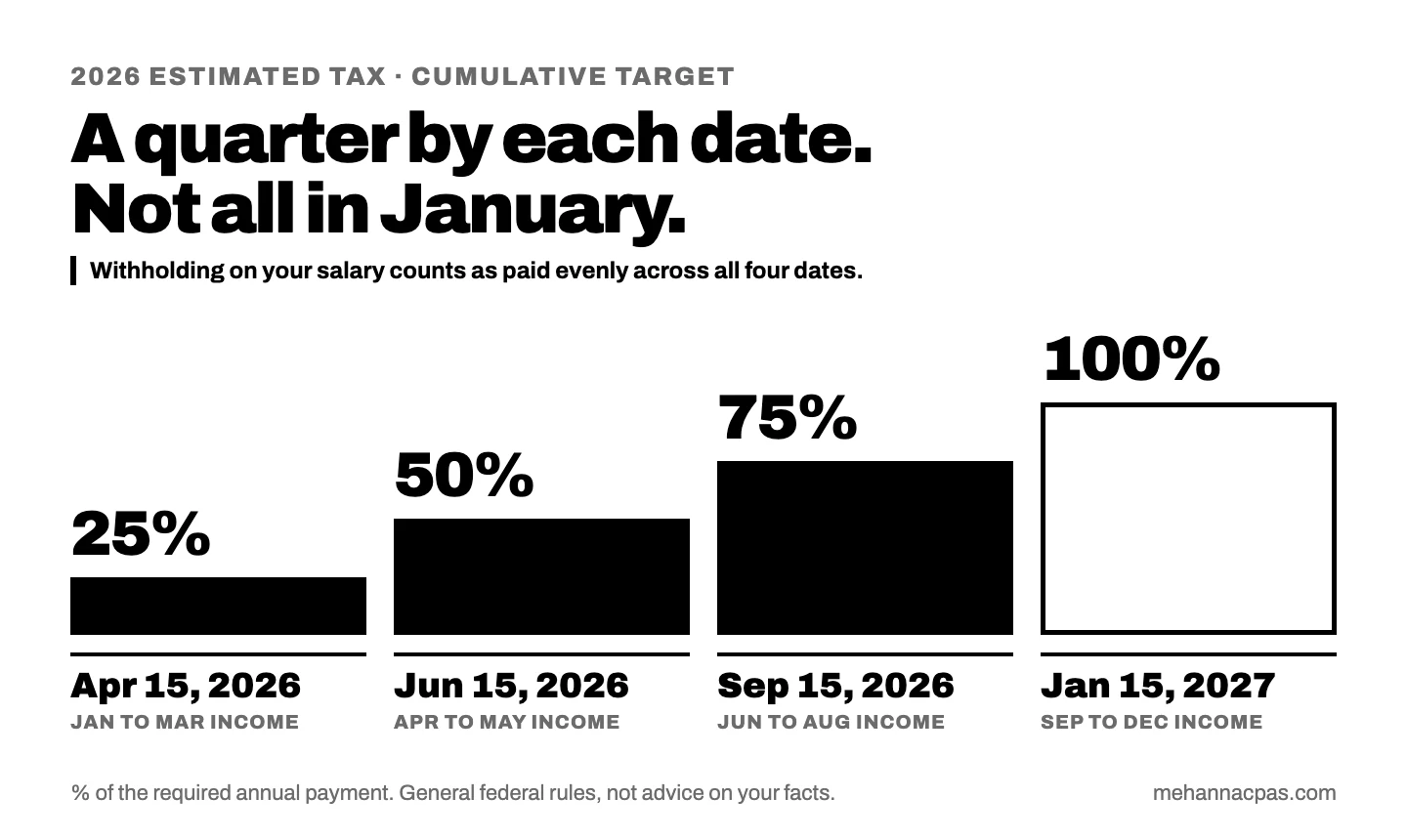
Each required installment is 25% of the required annual payment (26 U.S.C. § 6654(d)). Under the 90% route, that means at least 22.5% of this year’s tax by each date. Under the 110% route, 27.5% of last year’s tax.
There is one payment you can skip. If you file your 2026 return by the end of January 2027 and pay everything you owe with it, you don’t need the January 15 payment (Publication 505). Few practice owners have their K-1s that early, so plan on making it.
Uneven income has its own method. If most of your income lands late in the year, the annualized income installment method lets early payments match early income. You figure it on Form 2210, Schedule AI, and file the form with your return (Instructions for Form 2210). It matters most in the year you sell, for example to a DSO; if that’s on the table, read what rollover equity is really worth first.
How we handle estimated taxes with dental practices
We treat the estimate as an output of the projection, not a copy of last year’s return. The steps:
- Project the year in January. Expected collections, overhead, owner salary and big decisions, such as an associate, equipment or a second office.
- Pick the route. Prior-year safe harbor when this year looks bigger, current-year 90% when it looks smaller. Then set the four amounts.
- Schedule the payments. All four, electronically, in January, so nobody has to remember a date in June.
- Refresh at each planning call. Three a year on The Treatment Plan, Standard. If collections are running ahead, the next payment goes up before a gap forms.
- Close the gap in December. If the year still runs short, we use extra withholding on the last payroll, then set the January 15 payment off the final projection.
The most common setup we find: estimates copied from last year’s return, in a year when collections grew. No penalty, so it looks fine, until a large balance and the first estimate of the new year land in the same April. The second is a sole proprietor or partner setting aside the same percentage an employee has withheld, with nothing reserved for self-employment tax.
Before you size your January 15 payment, see which year-end moves could still change your 2026 number. Free, and about eight minutes.
How to fix a short year before it closes
If your estimates are behind in November, you still have three good options and one to skip. In the order we look at them:
1. Add withholding on your last payroll
Federal income tax withheld from wages is treated as paid in equal parts on each due date, unless you choose to show the actual dates (26 U.S.C. § 6654(g)). So extra withholding on December’s paycheck counts back to April. If you own an S corporation, that is the cleanest fix: raise the withholding on the salary you already pay yourself. A new bonus just to cover the gap is a different decision, because extra wages carry payroll tax of their own. Ask before you add salary.
2. Pay a missed quarter now
The penalty runs from the due date until you pay. A catch-up payment stops it from growing, but it doesn’t erase what has already accrued. Because payments go to the oldest unpaid quarter first (Form 2210 instructions), paying now helps even if you are also short on a later quarter.
3. Check whether the annualized method fits
If a large share of your 2026 income arrived after the summer, from a sale, a large one-time payment or a strong fourth quarter, the annualized method on Schedule AI may reduce or remove the penalty on the early quarters. It takes real bookkeeping by period, so it is worth running only when the income was truly uneven.
4. Pay electronically, not by mail
A mailed payment counts on its postmark date, and the 2026 edition of Publication 505 warns that the postmark is now the date the payment is processed at a postal facility, which may be later than the day you dropped it off (Publication 505). Paying through IRS Direct Pay or EFTPS (IRS, Payments) removes that risk. If you still mail a check, use certified mail or ask for a hand postmark at the counter (USPS).
Estimated tax payments checklist for 2026
Use this to see which items apply to you and when each one closes.
| Item | Applies if | Deadline | Bring |
|---|---|---|---|
| Required annual payment | You expect to owe $1,000 or more after withholding | Set in January, refresh each quarter | 2025 return (tax and AGI), 2026 projection |
| Quarterly payments | Profit, K-1 income or investments have no withholding | April 15, June 15, Sept. 15, 2026; Jan. 15, 2027 | Bank account, IRS online account or EFTPS login |
| Extra withholding on your salary | You own an S corporation and estimates are short | Last payroll of 2026 | Year-to-date payroll report, current W-4 |
| Tax savings account | You take distributions or owner draws | Every distribution | Your top federal and state rates |
| Annualized method | Most income arrived late in the year | Filed with the 2026 return | Income by period (Form 2210, Schedule AI) |
| State estimates | Your state taxes income and you owe above its threshold | Set by your state | Last state return; any pass-through entity tax the practice paid |
Mistakes we’d avoid
Most estimate problems come from treating last year’s number as this year’s plan. The ones we’d steer you away from:
- Treating “no penalty” as “no balance.” The prior-year safe harbor says nothing about what April will cost in a growth year.
- Back-loading the year. Paying everything on January 15 leaves the first three quarters short, and each one is penalized from its own date.
- Spending the distribution before reserving the tax. If the tax share stays in the operating account, it ends up paying for something else.
- Using an employee’s withholding rate as an owner. A sole proprietor or partner also owes self-employment tax, and nobody withholds it.
- Mailing the January payment on January 15. With the postmark rules, mail early or pay online.
What changed for 2026
The rules behind estimated taxes didn’t change for 2026, but several numbers and one procedure did.
- Publication 505 now warns that a postmark reflects the date a payment is processed at a postal facility, not necessarily the day you mailed it (IRS, Publication 505 (2026)).
- The Social Security wage base is $184,500 for 2026, up from $176,100 (SSA). It caps the 12.4% part of self-employment tax.
- The underpayment rate was 7% in the first quarter, 6% in the second, and 7% again in the third and fourth (IRS, Quarterly interest rates).
- New 2026 tax brackets: 32% above $403,550 and 37% above $768,700 of taxable income on a joint return (Rev. Proc. 2025-32).
For the other moves still open before December 31, see year-end tax planning for dentists.
How to tell whether your estimated tax payments worked
Check two things when the return is done: the penalty line is zero, and the April balance is close to the number you planned for. If the balance surprised you, the estimates followed last year instead of this year’s projection. If you got a large refund, you lent the IRS money at no interest that the practice could have used. Projections all year, with the quarterly estimates set from them, are part of The Treatment Plan.
Frequently asked questions
Can I owe an underpayment penalty and still get a refund?
Yes. The penalty is figured quarter by quarter, so a short or late payment early in the year can be penalized even if your total payments end up larger than your tax. The refund and the penalty are calculated separately (IRS).
Can I pay all my estimated taxes at once?
You can pay the whole year by April 15, which covers every quarter. Paying it all at the end does not work the same way: each quarter has its own due date, so a single January payment leaves the first three quarters short and penalized.
Do I need to make state estimated tax payments too?
Usually, if your state has an income tax and you owe above its threshold. Each state sets its own dates and safe harbor rules. If your practice elected your state’s pass-through entity tax, part of your state tax is paid by the practice, so recalculate both your state and your federal estimates.
Does the IRS tell me if I owe the penalty?
Yes. You can figure it yourself on Form 2210, or let the IRS calculate it and send you a notice (IRS). You do need to file Form 2210 if you use the annualized method or treat withholding as paid on its actual dates.
Should my spouse’s withholding count toward our estimates?
On a joint return, the safe harbor looks at the total tax and the total payments on that return. If your spouse has a W-2 job, raising the withholding there is another way to close a gap, and it is treated as paid evenly through the year like your own.
Glossary
| Term | Meaning |
|---|---|
| Estimated tax payments | Quarterly payments of income tax and self-employment tax on income with no withholding. |
| Required annual payment | The smaller of 90% of this year’s tax or 100% of last year’s (110% if last year’s AGI was over $150,000). |
| Safe harbor | Paying at least the required annual payment on time, which avoids the underpayment penalty. |
| Underpayment penalty | A charge at the IRS underpayment rate on each quarter’s shortfall, from its due date until it is paid. |
| Annualized income installment method | A way to size each payment to the income earned so far, for years when income is uneven. Figured on Form 2210, Schedule AI. |
| Self-employment tax | Social Security and Medicare tax for owners of sole proprietorships and partnerships: 15.3% up to the wage base, 2.9% above it. |
| K-1 | The form that reports your share of an S corporation’s or partnership’s profit for your personal return. |
Sources
- IRS, Publication 505 (2026), Tax Withholding and Estimated Tax: due dates, $1,000 threshold, January payment exception, penalty by period, postmark caution.
- Cornell LII, 26 U.S.C. § 6654: required installments, 110% rule, withholding treated as paid in equal parts.
- IRS, Instructions for Form 2210: annualized method, order payments are applied, waivers.
- IRS, IR-2026-98, Interest rates remain the same for the fourth quarter of 2026 (2026).
- IRS, Quarterly interest rates (2026).
- IRS, Underpayment of estimated tax by individuals penalty.
- IRS, Estimated taxes.
- IRS, Self-employment tax: 15.3% rate, $184,500 wage base for 2026.
- IRS, Topic 560, Additional Medicare tax.
- IRS, Paying yourself: partners are not employees.
- IRS, Rev. Proc. 2025-32 (2025): 2026 tax brackets.
- IRS, Payments: Direct Pay, EFTPS and other ways to pay.
- Social Security Administration, Contribution and benefit base: $176,100 for 2025, $184,500 for 2026.
- USPS, Mailing your tax return: manual postmarks and certified mail.