

The Section 179 deduction lets a dental practice elect to deduct the cost of qualifying equipment in the year it is placed in service, up to $2,560,000 for 2026. Since 100% bonus depreciation became permanent, Section 179 is mostly a control tool. The write-off is worth it when you’d buy the equipment anyway and it’s in service by December 31.
- Bonus depreciation is the default in 2026. Qualifying property acquired after January 19, 2025 gets a 100% first-year deduction unless the practice elects out, and that rule no longer phases down.
- Section 179 is the dial. It is elected item by item and for any part of the cost, but it can’t exceed your business income for the year.
- December 31 means in service, not ordered. Equipment that isn’t installed and ready to use by year-end is a next-year deduction.
- A write-off is mostly timing. The deduction lowers the equipment’s tax basis, and it comes back as ordinary income if you sell the equipment or the practice.
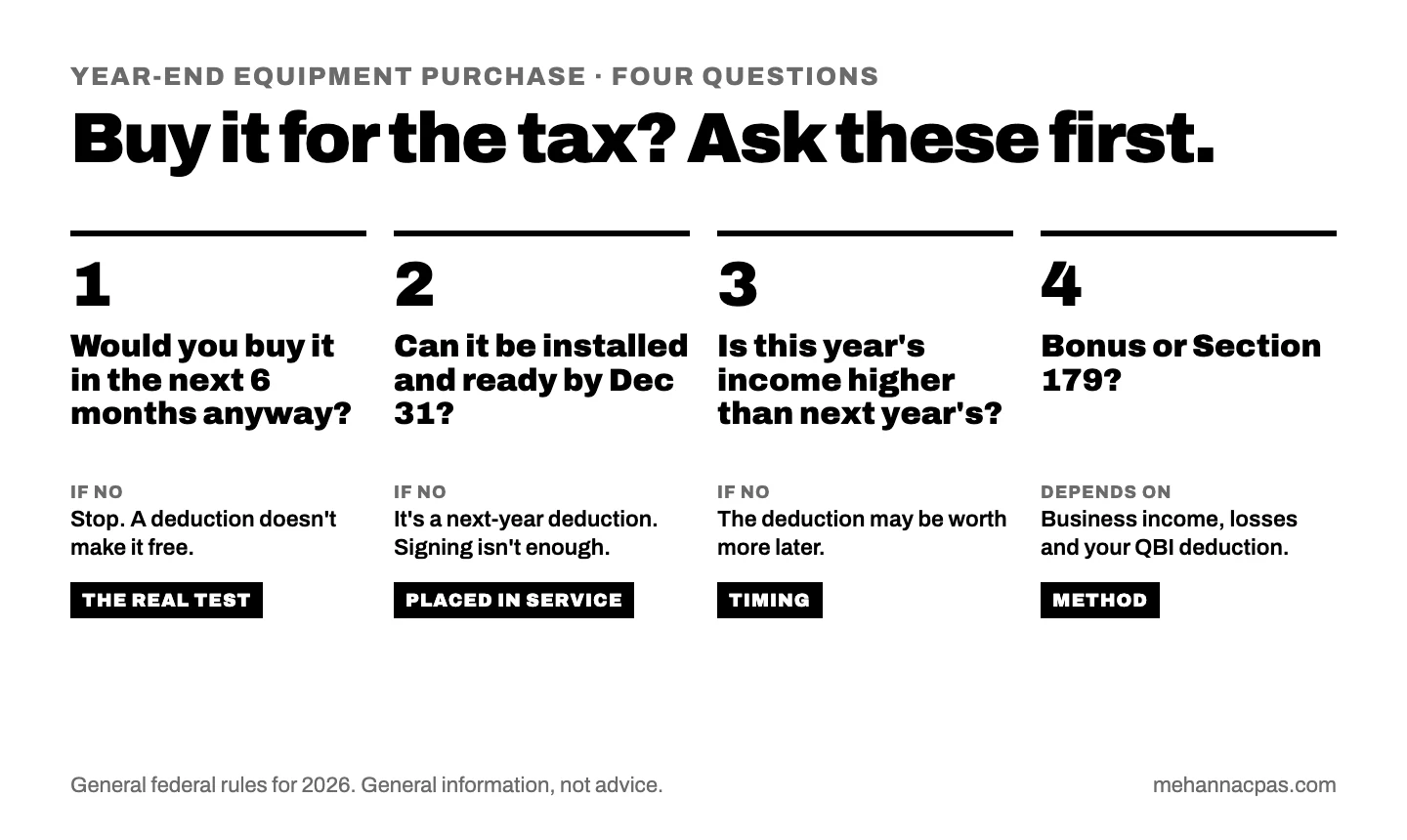
- What we see in dental practices: the useful December question isn’t “what can I buy?” It’s “what was I going to buy in the next six months anyway?”
It’s the second week of December. Your rep calls with a year-end price on a new operatory package, and your colleague in the study club says he “zeroed out his taxes” with Section 179 last year.
Before you sign, it helps to know what Section 179 actually does in 2026, how it differs from bonus depreciation, and when buying equipment for the tax write-off makes sense for a practice owner. This guide covers all three, plus the checklist we run before a year-end purchase.
What is the Section 179 deduction, and what isn’t it?
The Section 179 deduction is an election to expense all or part of the cost of qualifying business property in the year you place it in service, instead of depreciating it over several years (IRS Publication 946). For a dental practice, qualifying property includes chairs, imaging, scanners, sterilization equipment, computers and off-the-shelf software.
It is not a separate pot of money, and it isn’t a tax credit. It changes when you deduct a cost you were already allowed to recover. It also isn’t the same thing as bonus depreciation, which reaches the same first-year result through different rules.
| Section 179 | Bonus depreciation (2026) | Regular depreciation | |
|---|---|---|---|
| How you get it | You elect it on Form 4562, item by item | Automatic unless the practice elects out | What’s left after either one |
| How much in year one | Any amount you choose, up to the limits | 100% of the cost of qualifying property | A slice of the cost each year |
| Dollar cap | $2,560,000, reduced above $4,090,000 of purchases | None | None |
| Business income limit | Yes, the excess carries forward | No, it can create a loss | No |
| Flexibility | Pick the asset and the amount | All or nothing for a whole class of property | Fixed schedule |
| Roof, HVAC, fire and security systems | Can qualify | Generally no | Yes, over 39 years |
The bonus rules come from Publication 946 and the IRS guidance in Notice 2026-11. When both apply, Section 179 comes first and bonus depreciation applies to what’s left.
Who is the Section 179 deduction for, and who can skip it?
It’s for practice owners who are already buying equipment and want the deduction to land in a specific year, in a specific amount. It tends to matter when:
- You’re replacing chairs, a pano or a scanner this year and income is higher than usual.
- You’re remodeling operatories or upgrading the HVAC in a building the practice owns or improves.
- You bought a lot this year, and a full bonus write-off would create a loss you can’t use yet.
- You want to expense one asset fully and depreciate another normally to smooth income across years.
You can mostly skip the Section 179 vs. bonus question if the purchase is small, income is steady and bonus depreciation gives the result you want by default. If you’re an associate, this is your employer’s decision; it becomes yours when you buy in.
Why does the equipment write-off matter for your practice?
Because a dental equipment tax deduction can move this year’s taxable income by six figures, and the same deduction changes other numbers on your return. Three of them matter most for dentists.
First, the QBI deduction. Dentistry is a health service, a specified service business under the QBI rules. For 2026, on a joint return, the 20% QBI deduction phases out between $403,500 and $553,500 of taxable income (Rev. Proc. 2025-32; IRS QBI FAQs). A large write-off can pull an owner back into that range and restore part of the deduction. For an owner already below it, the same write-off lowers qualified business income and trims a deduction they were already getting.
Second, losses. If bonus depreciation pushes the practice into a loss, the excess business loss rule caps how much offsets other income: $512,000 on a joint return in 2026 (Rev. Proc. 2025-32). The rest becomes a net operating loss carryover for later years (IRS Instructions for Form 461), not a refund this year.
Third, the back end. A write-off taken now reduces the equipment’s basis. When the equipment or the practice is sold, the gain up to the depreciation you took is generally ordinary income (IRS Publication 544). That is why we treat most equipment write-offs as timing, not savings.
When should you buy equipment before year end, and when should you wait?
Buy equipment before year end when you’d buy it within the next few months anyway and it can be installed and ready by December 31. Publication 946 is specific: property is placed in service when it is ready and available for its specific use, and a machine delivered one year but not installed and operational until the next is placed in service the next year.
- Buy now when the purchase was already planned, this year’s income is high, the install date fits, and the payment works in a normal month.
- Wait when the only reason is the deduction, when next year’s income will likely be higher (a deduction is worth more in a higher bracket), or when the install can’t happen in time.
- Plan the mix when you buy a lot in the fourth quarter. If the practice elects out of bonus depreciation and more than 40% of the year’s depreciable property goes into service in the last three months, the mid-quarter convention applies to everything placed in service that year (IRS Publication 946).
Equipment is one item on a longer list. Our guide to year-end tax planning for dentists covers the other moves with a December 31 deadline.
Section 179 or bonus depreciation in 2026: which fits your practice?
In most years a practice simply uses bonus depreciation; Section 179 earns its place when you need control over how much you deduct and where. Here is how the choice usually plays out.
| Your situation | What usually fits | Why |
|---|---|---|
| One planned purchase, steady income | Bonus depreciation, by default | Full first-year deduction with no election |
| Want part of the cost now, part later | Section 179 on part, elect out of bonus for that class | Section 179 can expense any portion of an asset |
| Startup or heavy buying year with a loss | Run both in a projection | Section 179 is capped at business income and carries forward; bonus can create a loss subject to the loss limits |
| Roof, HVAC, fire or security system | Section 179 | These building improvements can qualify for Section 179, not bonus |
| Interior remodel of the office | Either | Qualified improvement property can use Section 179 or bonus depreciation |
| Used equipment from a family member’s practice | Neither, generally | Purchases from related persons don’t qualify |
What is bonus depreciation in 2026?
It’s a 100% first-year deduction for qualifying property acquired and placed in service after January 19, 2025, and the 2025 law made it permanent (IRS, Notice 2026-11). Many articles still describe a phase-down to 20% or 0%; that schedule now applies only to property acquired before January 20, 2025. Opting out is an election for an entire class of property, attached to the return, and in an S corporation the practice makes it (IRS Publication 946).
Can Section 179 create a loss?
No. The deduction can’t exceed your taxable income from the active conduct of a trade or business, and wages you earn as an employee count toward that income. What’s blocked carries forward. In an S corporation, the limits apply to the practice and again to each shareholder (IRS Publication 946). How you pay yourself feeds this test, which is one more reason to set your S corp reasonable salary on purpose.
Does used dental equipment qualify?
It can. Bonus depreciation covers used property you didn’t use before, and both rules require that you buy it rather than receive it from a related person, such as your spouse, parents, children or an entity you control (26 U.S.C. 168(k); IRS Publication 946). Buying a retiring parent’s equipment is where it usually breaks.
Equipment lease vs buy: does a lease get Section 179?
It depends on what the contract really is. A lease with a nominal buyout is generally treated as a purchase, so the practice depreciates the equipment and can use Section 179 or bonus. A true fair market value lease is rent: you deduct the payments and take no depreciation. We walk through the tests, with a loan and two lease types side by side, in is a CBCT worth it? Cost, financing and the tax math.
Planning an equipment purchase before December 31? The year-end check shows which moves are still open for your practice this year and a rough range for each.
How we time equipment purchases with dental practices
You text before you sign, and we answer with the cash impact and where the deduction lands, before the rep’s deadline. On The Treatment Plan, the same three people who keep your books and your projection run the decision:
- Start with the purchase list. What the practice needs in the next 6 to 12 months, from the dentists and the team, before any tax talk.
- Price it all in. Equipment, install, software and service, so the comparison is real.
- Place it in the projection. This year’s income against next year’s, QBI, estimated taxes and any loss limits.
- Choose the method. Bonus by default, Section 179 where we want a specific amount, regular depreciation where spreading it is worth more.
- Lock the date. Delivery, install and go-live in writing if the deduction matters this year.
- Record it right. Invoices, placed-in-service dates and elections, so the return and the books match.
The December rush rarely goes wrong on the tax rules. It goes wrong on the purchase: equipment nobody asked for, bought to “use up” a good year, then paid for in a slower one. Our rule of thumb: pull a planned purchase forward if it fits; never invent one for the deduction.
The four Section 179 dental equipment rules that trip owners up
Most surprises with Section 179 dental equipment come from four rules that sit outside the headline limit.
1. Business use has to stay above 50%
Section 179 is available only for property used more than 50% for business, and if business use later drops to 50% or less, part of the deduction comes back as ordinary income (IRS Publication 946). That’s rarely an issue for a chair or a scanner. It matters for a laptop that lives at home or a vehicle.
2. Small items may not need Section 179 at all
With the de minimis safe harbor election, a practice without audited financial statements can expense items costing up to $2,500 per invoice or item, as long as it expenses them on its books too (IRS, Tangible property regulations). Handpieces, small instruments and tablets often fit here.
3. The building isn’t equipment, but some of it qualifies
Interior improvements to a commercial building after it was first placed in service can qualify, as can a new roof, HVAC, fire protection and alarm systems, and security systems. Enlarging the building, elevators and the internal structural framework don’t (IRS Publication 946).
4. Your state may not follow
These are federal rules. Some states don’t follow federal bonus depreciation or use a lower Section 179 limit, so the state return can show a different deduction for the same purchase. Check your state before you count on the full write-off.
Section 179 equipment purchase checklist
Run these before a year-end purchase. Every row comes from the sections above.
| Check | Fits you if | Deadline | What to bring |
|---|---|---|---|
| Planned purchase | You’d buy it in the next 6 months anyway | Before you sign | The equipment list from your team |
| Placed in service | It can be installed and ready to use | December 31 | Delivery, install and go-live dates in writing |
| Income year | This year’s income is higher than next year’s | Before you sign | Year-to-date P&L and projection |
| Bonus or Section 179 | You need a specific amount, not all or nothing | With the return | Itemized invoices by asset |
| Business income limit | Section 179 doesn’t exceed business income | With the return | Owner W-2 and practice income |
| Seller | The seller isn’t a related person | Before you sign | Seller name and relationship |
| QBI and loss limits | You know how the deduction moves both | Before you sign | A run of this year’s projection |
| State return | You know if your state follows | Before you sign | Your state’s depreciation rules |
Mistakes we’d avoid with a year-end equipment write-off
The expensive mistakes are about the purchase, not the paperwork.
- Buying equipment for the tax write-off. If you ask “should I buy equipment for a tax write-off?”, the answer is only if you’d buy it anyway. A deduction lowers tax on money you spent; it doesn’t make the purchase free.
- Counting the signing date. Ordered in December and installed in January is a next-year deduction.
- Taking every dollar in a low year. A deduction in a year with lower income is worth less. Sometimes spreading it is the better move.
- Forgetting the QBI side. For owners below the phase-out range, a big write-off also reduces the QBI deduction.
- Treating it as permanent savings. The basis drops, and recapture shows up when the equipment or the practice is sold.
- Quoting old numbers. The $1,250,000 limit and the bonus phase-down you may still read about are out of date for 2026 purchases.
What changed for 2026
Three dated changes set the rules for 2026 purchases.
- 100% bonus depreciation is permanent for qualifying property acquired after January 19, 2025, with IRS interim guidance in Notice 2026-11, issued January 14, 2026 (IRS, 2026).
- The Section 179 limit for tax years beginning in 2026 is $2,560,000, reduced once Section 179 property placed in service passes $4,090,000; the heavy SUV cap is $32,000 (Rev. Proc. 2025-32; IRS Publication 946).
- The excess business loss threshold for 2026 is $256,000, or $512,000 on a joint return (Rev. Proc. 2025-32).
How to tell whether the write-off worked
Look at three things on the return and the books: the deduction landed in the year planned, it landed in the amount planned, and the equipment is being used. On the return, check Form 4562 for the Section 179 amount and the bonus depreciation, and confirm estimated payments were adjusted. In the projection, compare taxable income and the QBI deduction with the plan you made before buying. In the practice, the equipment should be in daily use, not in a closet. That year-round view, with the projection updated before each big purchase, is what our services for dental practice owners are built around.
Frequently asked questions
Is Section 179 better than bonus depreciation?
Neither is better in every case. Bonus depreciation is automatic, has no dollar cap and can create a loss. Section 179 lets you pick the asset and the amount, reaches roofs and HVAC, and is limited to business income. Many practices use bonus by default and Section 179 where control matters.
Do I have to pay for the equipment in full to take Section 179?
No. Financed equipment the practice owns is deducted based on its cost, not the payments made so far, and loan interest is deducted separately as it’s paid. The equipment still has to be in service by December 31 to count for this year.
Can I use Section 179 on a vehicle for the practice?
Sometimes. A heavy SUV is capped at $32,000 under Section 179 for 2026, lighter vehicles fall under separate annual limits, and business use must be more than 50%. Vehicles carry more recordkeeping and recapture risk than clinical equipment, so plan them separately.
Can I change my mind about Section 179 after filing?
Generally, yes. Publication 946 says a Section 179 election can be revoked without IRS approval by filing an amended return within the time allowed, and once revoked, that revocation can’t be undone. It’s easier to decide right the first time, with a projection in hand.
Does Section 179 reduce self-employment or payroll taxes?
It depends on your entity. In an S corporation, the deduction lowers the income that passes through to you, but your W-2 salary and its payroll taxes don’t change. The amounts are different for a sole proprietor, so check with your CPA before assuming either way.
Glossary
| Term | Meaning |
|---|---|
| Section 179 | An election to expense all or part of the cost of qualifying property in the year placed in service, up to a dollar limit and your business income. |
| Bonus depreciation | A 100% first-year deduction for qualifying property acquired and placed in service after January 19, 2025, unless you elect out. |
| Placed in service | The date property is ready and available for its specific use. The deduction starts then. |
| Business income limit | The cap that keeps Section 179 from exceeding taxable income from your active businesses, including wages. |
| Qualified improvement property | Interior improvements to a commercial building after it was first placed in service, excluding enlargements, elevators and structural framework. |
| Mid-quarter convention | A rule that reduces first-year depreciation when more than 40% of the year’s property goes into service in the last three months. |
| Recapture | Depreciation taken earlier that is taxed as ordinary income when equipment is sold or business use drops to 50% or less. |
| De minimis safe harbor | An election to expense items up to $2,500 per invoice or item, like supplies. |
| QBI deduction | The deduction of up to 20% of qualified business income from a pass-through business, limited for dentists at higher incomes. |
Sources
- IRS, Publication 946, How To Depreciate Property (2025, with 2026 limits): Section 179 rules and 2026 limits, business income limit, S corporation rules, related persons, qualified real property, placed in service, election out of bonus by class, mid-quarter convention, recapture, revoking an election.
- IRS, Rev. Proc. 2025-32 (2025): 2026 Section 179 limits, QBI thresholds and excess business loss amounts.
- IRS, Notice 2026-11 guidance on 100% bonus depreciation (January 2026).
- U.S. Code, 26 U.S.C. 168(k): used property acquisition requirements for bonus depreciation.
- IRS, Instructions for Form 461: excess business loss treated as a net operating loss carryover.
- IRS, Publication 544, Sales and Other Dispositions of Assets: depreciation recapture on equipment.
- IRS, Section 199A qualified business income deduction FAQs: health as a specified service business.
- IRS, Tangible property final regulations: de minimis safe harbor, $2,500 per invoice or item without an applicable financial statement.