

A new dental CBCT machine usually costs about $30,000 to $150,000, depending on field of view, before software, room preparation and service. It is worth it when the scans you already refer out or skip would carry the payment. Financing doesn’t shrink the federal write-off, but the machine has to be in service by December 31.
- The quote is not the cost. Software licenses, room shielding, IT, training and the service contract sit on top of the machine price.
- A loan doesn’t delay the deduction. The IRS treats you as the owner of property even when it is subject to a debt, so a financed CBCT is depreciated on its full cost.
- Signing is not enough for this year. Depreciation starts when the machine is ready and available for use, so a CBCT installed in January is a next-year deduction.
- The label on the contract doesn’t decide the tax. A “lease” with a nominal buyout is generally a purchase for tax purposes; a true fair market value lease is rent.
- What we see in dental practices: the year-end write-off is the reason given most often for signing, and it is the weakest one. Buy the CBCT for the dentistry and the numbers, then time it for the tax.
Tuesday, 2:14 PM. The equipment rep is in your office with a CBCT quote, a financing form and a promotion that ends Friday. He wants a signature today, and he says you can “write the whole thing off this year.”
Some of that may be true. This guide is for the owner holding that quote: what a CBCT machine really costs, whether it pays for itself in your practice, how to compare a loan, a $1 buyout lease and a fair market value lease, and how the tax math works before you sign anything.
What does a CBCT machine cost, and what isn’t in the quote?
The CBCT machine cost on a quote is the hardware price; the real cost is everything it takes to take a usable scan for as long as you own it. Dealer price guides put most new dental units between roughly $30,000 and $150,000, driven mostly by field of view, the size of the area one scan captures (Dental TI, 2026; Medical Outfitters, 2026). These are industry estimates, not official data, and every system is quoted individually. If you’ve been searching for a dental CT scan machine cost, it’s the same category: a cone beam unit built for dental imaging, not a hospital CT scanner.
| Field of view | Typical clinical use | Dealer estimate, new | What changes the price |
|---|---|---|---|
| Small (about 4 x 4 to 8 x 8 cm) | Endodontics, single implants | About $30,000 to $60,000 | Resolution, software bundle |
| Medium (about 8 x 8 to 10 x 10 cm) | Full-arch implant planning, general diagnostics | About $55,000 to $100,000 | Ceph option, upgrade path |
| Large (above 10 x 10 cm) | Orthodontics, TMJ, airway, oral surgery | About $100,000 to $180,000 | Detector size, brand, imaging modes |
| Refurbished, dental | Same uses, older platforms | About $20,000 to $90,000 | Software version, tube and detector condition, service coverage |
The dental CBCT price is only the start. Dealer guides list annual imaging software fees of about $2,000 to $8,000 and room shielding or build-out of about $5,000 to $20,000, depending on state rules (Dental TI, 2026). Add the acquisition computer, installation, team training and the service contract after the warranty ends. Two quotes with the same machine price can be very different investments once those lines are in.
Who is a CBCT worth it for, and who can skip it?
A CBCT tends to earn its keep in practices that already need 3D images every week and are sending those patients somewhere else to get them. If you’re asking “should I buy a CBCT?”, it usually fits when:
- You place implants, or want to start, and you refer out for every scan.
- You do enough endodontics, extractions of impacted teeth or airway work that 3D images change your treatment decisions.
- Patients drop off between the referral scan and the treatment visit, and you want the case to stay in your chair.
- An associate is joining who will use it, and the schedule has room for the scans.
You can probably skip it, or wait, if you would order a handful of scans a year, if the machine would mostly be a marketing feature, or if the practice is in its first lean years and cash is the constraint. The FDA notes that dental CBCT exams typically deliver more radiation than conventional dental X-rays, so a machine bought to be “used more” is the wrong goal (FDA, Dental Cone-beam Computed Tomography). Buy for the scans your patients need.
Why does the CBCT decision matter for your practice?
Because it is a five- or six-figure commitment that usually comes with years of payments, and the pitch arrives with a deadline. The FDA lists the uses that make a CBCT valuable: implant planning, abnormal teeth, evaluation of the jaws and face, endodontic diagnosis and dental trauma, among others (FDA). Those are real reasons. “The promotion ends Friday” is not.
The tax pitch adds pressure because it is half right. Under 2026 federal rules, a practice can often deduct the full cost of qualifying equipment in the year it is placed in service. But the deduction depends on when the machine is ready to use, how the contract is written, who buys it and what else is on your return. The decision is easier to undo before the signature than after.
When should you buy a CBCT, and when should you wait?
Buy when the case volume is already there and the machine can be installed, tested and ready to scan by the date the plan assumes. If the year-end deduction is part of the plan, the date that matters is December 31, and installation lead times count against it.
- Buy now when you are already referring out scans every week, the room and IT are ready, and the payment fits a normal month, not a good one.
- Wait when the install can’t happen before year-end and the only reason to rush was the deduction, when a bigger change is coming (an associate, a move, a sale), or when you haven’t seen the all-in cost in writing.
- Talk to your CPA first when this year’s income is unusual. A deduction is worth more in a high-income year and less in a low one.
Our guide to year-end tax planning for dentists covers the other moves that have to be done before December 31, so the equipment decision fits the whole year.
How is a CBCT purchase taxed in 2026?
A CBCT the practice owns is generally deducted through depreciation, and in 2026 the full cost can often be deducted in the year the machine is placed in service, whether you paid cash or financed it. Four federal rules do most of the work.
- 100% bonus depreciation. It is permanent for qualifying property acquired after January 19, 2025 (IRS, Notice 2026-11). It isn’t capped by your business income the way Section 179 is.
- Section 179. For tax years beginning in 2026, the limit is $2,560,000, reduced once total Section 179 property placed in service passes $4,090,000 (IRS Publication 946). The deduction can’t exceed your taxable income from active business, and the unused part carries forward. In an S corporation, the limits apply to the corporation and again to each shareholder.
- Placed in service. Property is in service when it is ready and available for its specific use. Publication 946’s own example: a machine delivered one year but not installed and operational until the next is placed in service the next year.
- Financing. You are considered the owner of property even if it is subject to a debt. A loan or a $1 buyout lease doesn’t shrink the deduction to the payments you made this year.
The write-off also moves other numbers. Dentistry is a health service, which the QBI rules treat as a specified service business. For 2026, on a joint return, the 20% QBI deduction starts phasing out above $403,500 of taxable income and is gone for a specified service business above $553,500 (Rev. Proc. 2025-32; IRS QBI FAQs). A large deduction can pull an owner back into that range and restore part of the QBI deduction. For an owner already below it, the same deduction lowers QBI and shrinks a deduction they were already getting. How you pay yourself changes this math too, which is why we connect it to your S corp reasonable salary.
Two more limits matter in a big purchase year. If the deductions create a business loss, the excess business loss rule caps how much of it offsets other income: $512,000 on a joint return in 2026 (Rev. Proc. 2025-32). And these are federal rules. Your state may not follow federal bonus depreciation, so the state result is its own calculation.
Should you buy, finance or lease a CBCT?
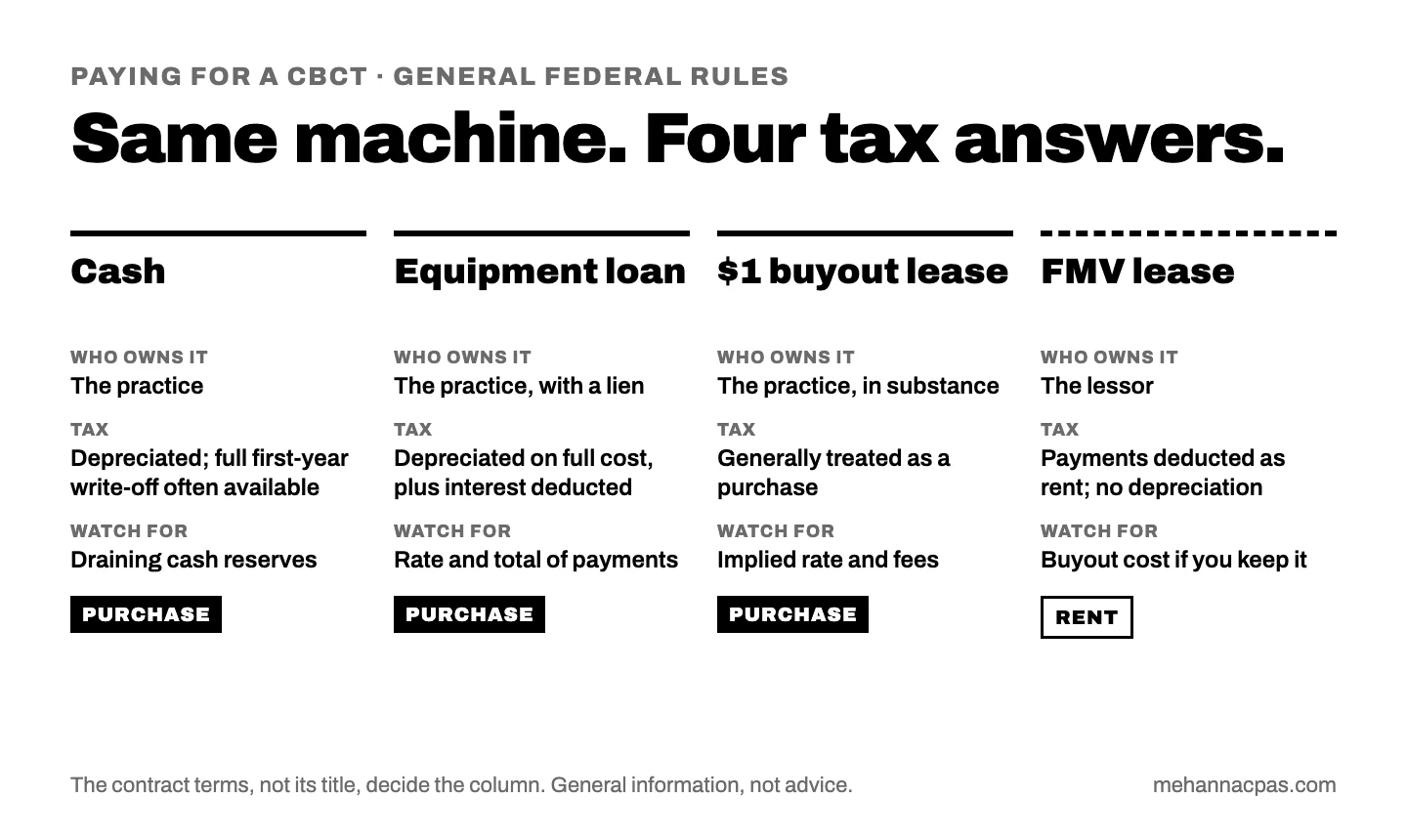
Choose the structure for the cash flow and total cost first, then confirm the tax treatment; the tax difference between buying and leasing is mostly about timing. Here is how the four common options compare.
| Option | Who owns it | General federal tax treatment | Fits when |
|---|---|---|---|
| Cash | The practice, from day one | Depreciated; first-year expensing often available | Strong cash reserves and a small or refurbished unit |
| Equipment loan | The practice, lender holds a lien | Depreciated on full cost; interest deducted | A machine you will keep for many years |
| $1 buyout lease | The practice, in substance | Generally treated as a purchase | You want ownership with vendor paperwork |
| Fair market value lease | The lessor | Payments deducted as rent; no depreciation for you | You expect to replace the technology at the end of the term |
Is a $1 buyout lease really a lease?
For tax purposes, usually not. The IRS looks at substance: an agreement can be a conditional sales contract when payments build equity, you get title after the payments, you pay much more than fair rental value, or you can buy at a nominal price (IRS Publication 535, 2022). Then you depreciate the machine and deduct the interest, not the payments.
Dental equipment lease vs buy: which costs less?
Buying with cash or a loan usually costs less in total if you keep the CBCT for its useful life. A fair market value lease has lower payments, but if you end up buying the machine at the end, payments plus buyout often cost more. Ask every lender for the interest rate and the total of payments, not just the monthly figure.
What about dental equipment financing rates?
Rates depend on your credit, the term and the lender, so compare a bank or SBA option with the vendor’s offer on the same terms. SBA 7(a) loans can be used to purchase and install machinery and equipment (SBA). A loan for dental equipment is a cost, even when the interest is deductible.
Is the interest on a dental equipment loan deductible?
Generally, yes, as a business expense. The federal cap on business interest doesn’t apply to businesses that meet the small business gross receipts test, $32 million of average annual gross receipts for 2026 (IRS), which covers most practices.
Should the practice buy the CBCT, or should I buy it and rent it to the practice?
If your practice is an S corporation, let the practice buy it. Buying personally and renting the machine to your own practice doesn’t create a second deduction, and Section 179 has extra tests for individuals who lease property to others that don’t apply to corporations (IRS Publication 946).
Rep waiting on a signature? Send us the quote and the financing contract first. You’ll know the cash impact and the tax math before he’s back in his car.
How we run a CBCT decision with dental practices
You text before you sign, and we answer with the cash impact and the tax math, not a guess. On The Treatment Plan, an equipment decision runs through the same three people who keep your books and your projection all year:
- Read the quote line by line. Machine, software, install, shielding, training, warranty and service, so the comparison is all-in.
- Turn the financing into two numbers. The interest rate and the total of payments, for each option the rep offered.
- Read the buyout line. Nominal buyout, fixed percentage or fair market value, so we know whether it’s a purchase or a lease for tax.
- Place it in your projection. The payment against a normal month, and the deduction against this year’s income, QBI and estimated taxes.
- Check the date. If the deduction matters this year, the install and go-live date goes in writing.
- Give you a yes, a no or a “not yet”. With the reason in one sentence, before the promotion deadline.
The purchase that hurts is rarely the machine. It is the one signed in December for the deduction, delivered in January, and paid for out of a slower month. Our rule of thumb: if the CBCT only makes sense because of the write-off, it doesn’t make sense. If it makes sense without the write-off, then we time it.
Is a CBCT worth it? Five numbers to run before you sign
A CBCT is worth it when the work it brings in house covers the all-in monthly cost in a normal month, with room to spare. This is the CBCT ROI math, and it starts with your numbers, not the brochure’s. Run these in order.
1. Count the scans you already order
Pull the last 12 months of referral scans and cases where a 3D image would have changed the plan. Use real counts, not the rep’s estimate of what a practice like yours “should” do.
2. Price the all-in cost
Machine, software fees for the years you’ll own it, room work, computer, training and service after the warranty. That total, not the quote, is the number to finance or pay.
3. Convert the payment into a monthly break-even
Divide the monthly cost by what an in-house scan brings in after supplies and team time, and by the treatment it helps you keep. That is how many scans or cases a month the machine needs to carry itself. Check what your payers actually reimburse; coverage for 3D imaging varies by plan.
4. Check the tax year
If the deduction is part of the plan, confirm the install date, who is buying, the contract type and how the deduction moves your QBI and estimated taxes. Our guide to Section 179 for dental equipment covers when to use it instead of bonus depreciation, and when a year-end purchase is worth it.
5. Plan the exit
When you later sell or trade in the CBCT, the price you get, up to the depreciation you took, is generally taxed as ordinary income (IRS Publication 544). Trade-ins of equipment no longer qualify for like-kind exchange treatment; that has been limited to real property since 2018 (IRS Publication 946). The same recapture shows up when a whole practice is sold, which we cover in what a DSO offer is really worth.
CBCT purchase checklist before you sign
Ask for each of these in writing before the signature. Every row comes from the sections above.
| Check | Why it matters | Ask for | Good answer |
|---|---|---|---|
| All-in cost | Software, room work and service can change the total a lot | Itemized quote with annual fees | Every line priced, years of fees included |
| Install and go-live date | Depreciation starts when it is ready and available for use | Delivery, install and training dates | Ready to scan before the date your plan assumes |
| Contract type and buyout | Decides purchase vs. rent for tax | The buyout clause | You know which one it is before signing |
| Rate and total of payments | Low payments can hide a high total | APR and total of payments per option | Compared with a bank or SBA quote |
| Who buys it | Owner-to-practice rentals add hurdles | Name of the buyer on the contract | The practice entity |
| Projection with the deduction | QBI, loss limits and state tax move with it | A run of this year’s projection | Done before signing, not at tax time |
| Scan volume | Volume pays for the machine, not the write-off | 12 months of referral scans | Covers the monthly cost in a normal month |
Mistakes we’d avoid with a CBCT purchase
The expensive mistakes happen at the signature, when the deadline feels real and the numbers aren’t on the table yet.
- Buying for the deduction. A deduction lowers tax on money you spent. It doesn’t make an unneeded machine free.
- Signing in late December and assuming this year. A machine that isn’t installed and ready by December 31 is a next-year deduction.
- Comparing monthly payments only. Compare the rate and the total of payments, including any buyout.
- Trusting the word “lease”. The buyout and payment terms decide the tax, not the title of the document.
- Buying it personally to rent to the practice. No second deduction, more hurdles.
- Forgetting the back end. The year-one write-off comes back as ordinary income when the machine or the practice is sold.
What changed for 2026
Four dated changes shape the tax math on equipment this year.
- 100% bonus depreciation is permanent for qualifying property acquired after January 19, 2025. The IRS issued guidance on it in Notice 2026-11 on January 14, 2026 (IRS, 2026).
- The Section 179 limit for tax years beginning in 2026 is $2,560,000, with the phase-out starting at $4,090,000 of property placed in service (Rev. Proc. 2025-32).
- The small business gross receipts threshold that keeps most practices outside the business interest cap is $32 million for 2026 (IRS).
- The excess business loss threshold for 2026 is $256,000, or $512,000 on a joint return (Rev. Proc. 2025-32).
How to tell whether the CBCT worked
Six and twelve months after go-live, compare scans and cases per month with the break-even you set before signing. Look at the scans you no longer refer out, the treatment that stayed in your chair, and the payment and software fees as a share of collections. A machine that clears its monthly cost in an average month did its job; one that only clears it in your best months is a cost to manage. Check the tax side once, on the return: the deduction landed in the year planned, and estimated payments were adjusted for it. That year-round view is what our services for dental practice owners are built around.
Frequently asked questions
Can I write off a CBCT in one year?
Often, yes, for federal tax. With 100% bonus depreciation or Section 179, the full cost of qualifying equipment can generally be deducted in the year it is placed in service. Section 179 is limited to your business income, the deduction can affect your QBI deduction, and your state may follow different rules.
Do I have to pay off the CBCT to deduct it?
No. You are treated as the owner even when the machine is subject to a loan, so the deduction is based on its cost, not on the payments made so far. The interest is a separate deduction as you pay it. A fair market value lease works differently: you deduct the payments as rent.
Does a used or refurbished CBCT qualify for the write-off?
It can. Used equipment the practice didn’t use before can qualify for bonus depreciation and Section 179. Check the software version, warranty and service coverage with the same care as the price, because an older platform can cost more to keep running.
What does a 3D dental imaging machine cost compared to a panoramic unit?
Many CBCT units combine panoramic and 3D imaging, so the dental CBCT machine price may replace a pano rather than add a machine. Ask the dealer to price both paths and include what your current unit is worth as a trade-in, keeping in mind that the trade-in value is taxable to the extent of past depreciation.
How fast do I need to decide?
Not as fast as the promotion says. A day to read the contract and run the numbers rarely costs a deal. If the only thing at stake is a December 31 deduction, check whether the machine can actually be installed and ready by then.
Glossary
| Term | Meaning |
|---|---|
| CBCT | Cone beam computed tomography: a dental imaging machine that produces 3D images. |
| Field of view | The size of the area a single scan captures. The main driver of the price. |
| Placed in service | The date the equipment is ready and available for its specific use. Depreciation starts then. |
| Bonus depreciation | A first-year deduction of 100% of the cost of qualifying property acquired after January 19, 2025. |
| Section 179 | An election to deduct the cost of qualifying equipment in the year placed in service, up to a dollar limit and your business income. |
| $1 buyout lease | A contract called a lease that ends with a nominal purchase price. Generally treated as a purchase for tax. |
| Fair market value lease | A true lease: you rent the equipment and can buy it at its market value at the end. |
| Recapture | Depreciation taken earlier that is taxed as ordinary income when the equipment is sold for more than its tax basis. |
| QBI deduction | The deduction of up to 20% of qualified business income from a pass-through business, limited for dentists at higher incomes. |
Sources
- IRS, Publication 946, How To Depreciate Property (2025, with 2026 limits): placed in service, ownership subject to debt, Section 179 limits and business income limit, S corporation rules, lessor rules, like-kind exchange caution.
- IRS, Rev. Proc. 2025-32 (2025): 2026 Section 179, QBI threshold, excess business loss and gross receipts amounts.
- IRS, Notice 2026-11 guidance on 100% bonus depreciation (January 2026).
- IRS, Publication 535, Business Expenses (2022, final edition): lease or purchase, conditional sales contract tests.
- IRS, Publication 544, Sales and Other Dispositions of Assets: depreciation recapture on equipment.
- IRS, Section 199A qualified business income deduction FAQs: health as a specified service business.
- IRS, Questions and answers about the limitation on the deduction for business interest expense (updated August 2026): $32 million gross receipts test for 2026.
- U.S. Small Business Administration, 7(a) loans: uses include machinery and equipment.
- U.S. Food and Drug Administration, Dental Cone-beam Computed Tomography: clinical uses and radiation compared with conventional dental X-rays.
- Dental TI, CBCT machine cost buyer’s guide and Complete guide to dental CBCT (2026): dealer price tiers and ownership costs, not official data.
- Medical Outfitters, CBCT machine cost (2026): dealer price estimates by field of view, not official data.