

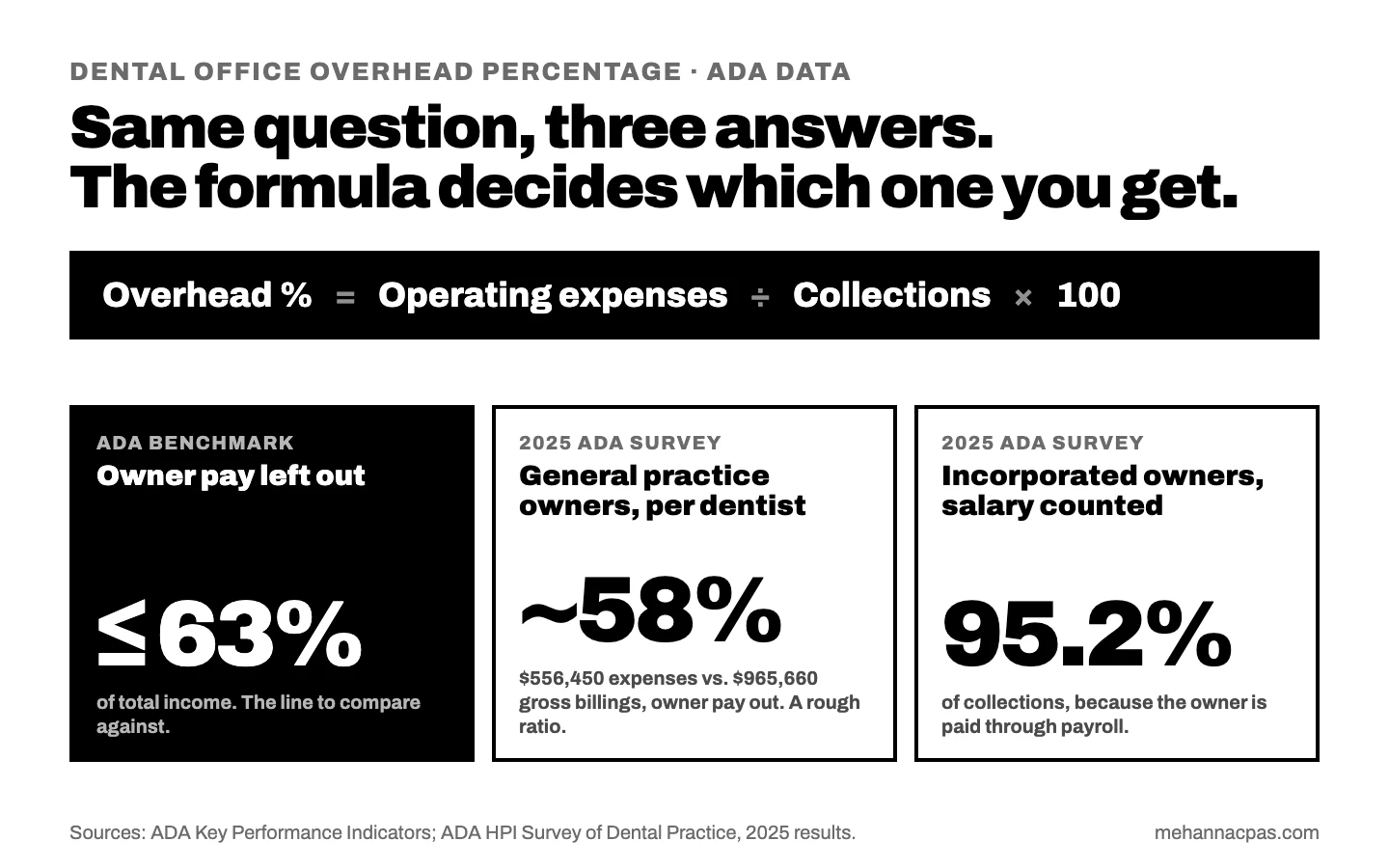
Dental office overhead percentages compare operating expenses to collections. The ADA’s benchmark is overhead at 63% or less of total income, with owner pay left out. In the ADA’s 2025 survey, general practice owners averaged $556,450 in expenses per dentist against $965,660 in gross billings, roughly 58 cents of every billed dollar.
- The ADA’s line is 63% or less of total income. Everything above it comes out of what the owner keeps.
- Owner pay changes the answer more than any cost. Incorporated general dentists who count their own salary as an expense reported expenses at 95.2% of collections on average in 2025.
- Overhead creeps because fees and reimbursement move slower than wages, supplies and rent, not because of one bad decision.
- A practice can be profitable with no cash: loan principal, equipment you already deducted and taxes on profit you left in the business all drain the account without touching the P&L.
- What we see in dental practices: owners who cut supplies first, when the bigger lever is usually the fee schedule or a schedule that doesn’t fill the staff hours already paid for.
Collections were up last year. So was the work. And the account at year end looked about the same as the year before. That is what overhead creep feels like from the chair: no single invoice looks wrong, and the margin still gets thinner every year.
This guide covers the dental office overhead percentages worth comparing against, the 2025 ADA survey numbers behind them, a dental practice overhead breakdown you can build from your own P&L, and why a practice can show a profit and still feel short on cash.
What is dental practice overhead, and what isn’t it?
Dental practice overhead is every cost of running the practice except what the owner takes home: staff, supplies, lab, rent, equipment, insurance, software and professional fees. The overhead percentage is that total divided by collections. The ADA’s version of the question is whether overhead is 63% or less of total income (ADA, Key Performance Indicators).
The trouble is the edges. Several things leave the bank account without being overhead, and one thing (owner pay) is overhead on some P&Ls and not on others:
| Item | Overhead? | Where it shows up | Why it matters |
|---|---|---|---|
| Staff wages, payroll taxes, benefits | Yes | P&L expense | Usually the largest line |
| Supplies, lab, rent, software, insurance | Yes | P&L expense | The lines that creep with prices |
| Owner’s salary (S corporation) | Your choice, but keep it consistent | P&L expense, as W-2 wages | Leaving it in can add 30 or more points |
| Owner’s distributions or draws | No | Equity, not the P&L | Cash out, but not a cost |
| Loan principal | No | Balance sheet | Cash out with no expense line |
| Interest on the practice loan | Usually yes | P&L expense | Decide once and keep it the same |
| Equipment purchase | Through depreciation | Balance sheet, then depreciation | Cash and expense land in different years |
Who should watch overhead percentages, and who can skip them?
Every practice owner should know the number, and it matters most once collections pass $750,000. A few points of drift on a practice that size is real money. It matters most when:
- Collections grew and take-home pay didn’t.
- You converted to an S corporation and the overhead number suddenly jumped.
- You added an associate, a hygienist or a second location in the last two years.
- You are buying a practice, or a buyer or DSO will be reading yours soon.
Associates can skip it for now. Your pay depends on your production and collections, not the practice’s overhead. If you’re planning to own, learn the number before you sign, because it is the first thing that tells you what a practice can afford to pay you.
Why does dental practice overhead matter for profitability?
Because the gap between what practices are paid and what they spend is getting wider every year, and overhead is where it shows. The ADA Health Policy Institute says dental insurance reimbursement is not rising as quickly as prices for equipment, supplies and wages, a “fiscal squeeze” on practices (ADA HPI, State of the U.S. Dental Economy, Q3 2025). In the same report, prices for dental equipment and supplies were up 5% in 2025 by August.
Dentists feel it. Asked about 2026, 41.5% of responding dentists listed increasing expenses and overhead among their top three challenges, behind low insurance reimbursement (55.3%) and staffing (54.2%) (ADA HPI, Economic Outlook, Q4 2025).
Overhead is also the other half of dental practice profitability. Your profit margin is simply 100% minus overhead, measured on the same base. If overhead is 63% of collections, 37 cents of each collected dollar is left for owner pay, debt, retirement and taxes.
What are the benchmarks for dental office overhead percentages?
Use the ADA’s 63% as the line, and the 2025 ADA survey as a reality check. They measure slightly different things, so read them together.
What is the average dental office overhead?
The ADA’s 2025 Survey of Dental Practice puts average practice expenses for general practice owners at $556,450 per dentist, excluding shareholder salaries; the median was $509,720 (ADA HPI, Survey of Dental Practice, 2025 results). Average gross billings for the same group were $965,660 per dentist. Side by side, that is about 58 cents of expense per billed dollar. Treat it as a rough ratio: the two averages come from separate questions, and billings are not collections.
What do dental overhead percentages look like with the owner’s salary included?
Very different. The same survey asked incorporated owners for practice expenses including shareholder salaries as a percentage of gross billings collected. General practitioners averaged 95.2%, with a median of 97.9% (same source). That is not a practice in trouble. It is a practice whose owner is paid through payroll, so nearly everything collected shows up as an expense.
What is a good dental practice profit margin?
If overhead without owner pay sits at the ADA’s 63%, the margin before owner pay is 37%. The ADA’s 2025 survey puts average dental practice profit, measured as general practice owners’ net income, at $228,980, with a median of $199,140 (same source). Net income here includes what an incorporated owner pays themselves, so compare it with your total take: salary plus profit.
Why do dental practice overhead percentages disagree?
Different denominators and different definitions. Some sources divide by production, some by billings, some by collections. Some include the owner’s salary, some include an associate’s pay, some leave out interest and depreciation. A number that looks bad against one benchmark can look fine against another. Pick one definition, write it down and compare against your own last twelve months first.
What goes into a dental practice overhead breakdown?
Group your P&L into five or six categories, divide each one by collections, and watch each line’s trend. Published category ranges vary widely by source and region, so the most useful benchmark for each line is your own history.
| Category | What goes in it | What usually moves it |
|---|---|---|
| Staff | Wages, payroll taxes, benefits, bonuses, temp staff. Not owner or associate dentist pay. | Raises, hard-to-fill hygiene roles, hours paid but not booked |
| Clinical supplies | Dental supplies, small instruments, PPE | Supplier prices, waste, too many vendors |
| Lab | Lab fees, aligner cases | Case mix, remakes |
| Facility | Rent or mortgage interest, utilities, repairs, cleaning | Lease renewals, a second location |
| Equipment and technology | Equipment leases, depreciation, software, IT | New subscriptions, financed equipment |
| Business and administrative | Insurance, merchant fees, marketing, accounting, legal, dues | Card fees as patient payments grow, marketing tests |
What is a normal dental staff cost percentage?
The ADA doesn’t publish a staff-cost benchmark, so calculate yours as total staff cost divided by collections and track it monthly. Wages are moving: the ADA’s 2025 survey puts the average hourly wage at $48.90 for dental hygienists and $25.20 for dental assistants in general practices, up from $47.60 and $24.10 in 2024 (ADA HPI). If staff cost rises while production per staff hour stays flat, the schedule is the problem, not the pay.
What is a normal dental supply costs percentage?
Again, no ADA benchmark. Divide supplies by collections and compare month to month, separately from lab fees so a change in case mix doesn’t hide a supply problem. Prices are rising, so a flat supply percentage while collections grow is a good sign.
When is dental overhead too high, and when is it fine?
Overhead is too high when it is above 63% on the ADA’s definition and still rising, or when it climbs three months in a row while production is flat. Dental overhead that is too high usually shows up first as a thin bank balance, not as a line on a report.
Higher overhead can be fine for a while:
- The first years after a startup or acquisition, while collections ramp up.
- The months right after a new associate or hygienist starts.
- A year with a large equipment purchase deducted in full.
The test is direction. A number that is high and falling is a plan working. A number that is high and rising with no new investment behind it means the dental practice is not profitable enough at its current fees and schedule.
How we review dental practice overhead with practice owners
We read overhead next to collections, cash and the tax projection every month, so creep is caught while it is still small.
- Fix the definition once. Owner pay in or out, interest in or out, collections as the base. Written down, so this year compares to last year.
- Close the books on a fixed date. Overhead from unreconciled books is a guess.
- Break it into categories. Each line as a share of collections, against last month, the same month last year and the rolling twelve months.
- Find the one line that moved. Overhead rarely creeps everywhere at once.
- Carry it into the tax projection. A change in profit changes the next estimated payment and the agenda for the next planning call.
Overhead is one of a handful of numbers worth reading monthly; the rest are in the dental KPIs that tell you if the practice is healthy.
When overhead creeps, the first instinct is to cut supplies or skip a raise. The bigger lever is usually upstream: a fee schedule that hasn’t moved in years, or staff hours that are paid for but not booked. Overhead creeps. The point of a monthly review is that someone calls you about it before the year closes.
Not sure whether your overhead is a cost problem or a fee problem? Bring your last P&L, or don’t. You’ll leave the call knowing where you stand.
How to reduce dental overhead without cutting what makes money
Start with what you collect per hour, then fixed costs, and cut supplies last. Overhead is a ratio, so raising collections lowers it as surely as cutting costs does, and it is usually how to increase dental practice profitability without hurting care.
1. Review fees and payer mix before costs
Private insurance carriers paid half of general practice owners’ gross billings in 2025 (ADA HPI). If a few PPO fee schedules are a large share of the schedule and haven’t moved, every cost line looks worse against them. Look at the fees before you cut people.
2. Match staff hours to the schedule
Staff is usually the largest line, and the waste is in hours paid but not booked. Compare staffed hours to scheduled production by day of week before you cut pay or skip a hire.
3. Fill the hygiene schedule
Open hygiene time is overhead with nothing to show for it. Recare and cancellation numbers predict next quarter’s hygiene production.
4. Clean up supplies and lab
Fewer vendors, a monthly budget and remake tracking. Real savings, smaller than people expect.
5. Treat fixed costs as a growth question
Rent, equipment and software don’t scale down. They get cheaper as a percentage only when collections grow into them. Before you add a lease or a location, know the collections that pay for it.
Profitable but no cash: why the P&L and the bank disagree
A practice can show a healthy profit and still run short of cash, because several big cash outflows never appear as expenses. When owners say the practice is profitable but there is no cash, it is almost always one of these four:
- Loan principal. The practice or building loan payment leaves the account every month, but only the interest is an expense. The principal is invisible on the P&L.
- Equipment deducted in an earlier year. Qualified property acquired after January 19, 2025 can generally be deducted in full in the year it is placed in service (IRS, IR-2026-06). If it was financed, the deduction lands in year one and the payments continue for years, with no expense left to show for them.
- Taxes on profit you didn’t take out. In an S corporation, you generally owe tax on your share of the practice’s income whether or not it was distributed to you (IRS, Shareholder’s Instructions for Schedule K-1 (Form 1120-S)). Profit kept in the business to pay down a loan is still taxed. Set the tax aside before you treat profit as spendable; estimated tax payments for practice owners covers how much.
- Growing receivables. Production that hasn’t been collected is not cash yet.
This is why dental practice cash flow needs its own monthly look next to the P&L. The statements that show it are covered in how to read your dental practice’s financial statements.
Dental office overhead checklist
Run this once a month, after the books close.
| Check | Where it comes from | Good sign | Red flag |
|---|---|---|---|
| Total overhead % | P&L / collections | 63% or less on the ADA definition, stable or falling | Rising three months while production is flat |
| Owner pay treatment | Your written definition | Same every month | Changed when the entity changed |
| Staff % | Payroll reports + P&L | Growing slower than collections | Paid hours not booked |
| Supplies and lab % | P&L, split | Flat as collections grow | Lumped together, so nobody sees which moved |
| Fixed costs | Leases, loans, subscriptions | Covered by current collections | New commitments with no collections plan |
| Cash vs. profit | Cash flow statement | Gap explained by principal and planned purchases | Profit up, cash down, nobody knows why |
| Tax set-aside | Tax projection | Estimates match this year’s profit | Tax on retained profit not reserved |
Mistakes we’d avoid
Most overhead mistakes come from the definition or the order of fixes.
- Comparing an overhead number that includes your salary to a benchmark that doesn’t. You’ll think you are 30 points over when you aren’t.
- Dividing by production instead of collections. PPO write-offs make overhead look better than it is.
- Cutting supplies first. It feels responsible and rarely moves the total much.
- Buying equipment for the deduction. The write-off is real; the payments last longer than the deduction does.
- Spending profit before the tax on it is set aside. That is how a good year turns into a hard April.
What changed for 2026
The ADA Health Policy Institute published its 2025 Survey of Dental Practice in 2026, and the cost side keeps moving.
- General practice owners averaged $556,450 in practice expenses per dentist and $965,660 in gross billings in 2025 (ADA HPI).
- Average hourly wages in general practices rose to $48.90 for hygienists and $25.20 for assistants (same source).
- Rising expenses and overhead were a top-three 2026 challenge for 41.5% of responding dentists (ADA HPI, Q4 2025).
- The permanent 100% first-year depreciation for qualified property acquired after January 19, 2025 got IRS guidance in Notice 2026-11 (IRS, January 14, 2026). Bigger first-year write-offs mean bigger gaps between profit and cash later.
How to tell whether your overhead plan worked
It worked when overhead as a percentage of collections falls or holds steady for two quarters while collections grow, and the cash at year end matches what the P&L said you earned. Check three things each quarter: the total percentage on the same definition, the one category you targeted, and the gap between profit and cash. Monthly financials, overhead reviews and planning calls built on these numbers are part of The Treatment Plan.
Frequently asked questions
What percentage of overhead should a dental practice have?
The ADA’s benchmark is 63% or less of total income, without the owner’s pay. If you count your own salary as an expense, as many S corporation owners do, the number will be much higher: incorporated general dentists reported 95.2% on that basis in 2025. Compare like with like.
Is dental overhead calculated on production or collections?
Use collections. Production includes fees you’ll never collect, such as PPO write-offs, so overhead measured on production looks lower than it really is. Whatever base you choose, use the same one every month.
Does the owner’s salary count as dental practice overhead?
For benchmarking, usually not; the ADA’s 63% leaves it out. On the books of an S corporation, your W-2 salary is a real expense and the IRS expects reasonable compensation (IRS). Setting it is covered in S corp reasonable salary for dentists.
Why is my practice profitable but I have no cash?
Usually loan principal, equipment deducted in an earlier year but still being paid off, taxes on profit you left in the business, or growing receivables. None of these show up as expenses, so the P&L looks better than the bank account.
How often should I check my dental overhead percentage?
Monthly, after the books close, with each category against the same month last year. Check it again before any hire, lease, equipment purchase or fee schedule decision.
Glossary
| Term | Meaning |
|---|---|
| Overhead percentage | Operating expenses divided by collections, with owner pay treated the same way every month. |
| Collections | What the practice actually received from patients and carriers. |
| Gross billings | The total fees charged for care provided, before what goes uncollected. |
| Profit margin | What is left after overhead, as a share of collections: 100% minus overhead. |
| Shareholder salary | The W-2 pay an owner of an incorporated practice takes through payroll. |
| Loan principal | The part of a loan payment that repays the balance. Cash out, but not an expense. |
| First-year depreciation | Deducting the full cost of qualified equipment in the year it is placed in service. |
Sources
- American Dental Association, Key Performance Indicators (Measuring Success): overhead benchmark of 63% or less of total income.
- ADA Health Policy Institute, Dental practice research and its Survey of Dental Practice tables, 2025 results (2026): expenses per dentist, gross billings, expenses including shareholder salaries as a percentage of collections, net income, sources of billings, staff wages.
- ADA Health Policy Institute, State of the U.S. Dental Economy, Q3 2025: reimbursement lagging equipment, supply and wage prices; supply and equipment prices up 5% in 2025 by August.
- ADA Health Policy Institute, Economic Outlook and Emerging Issues in Dentistry, Q4 2025: top challenges for 2026.
- IRS, Shareholder’s Instructions for Schedule K-1 (Form 1120-S): tax on your share of S corporation income whether or not distributed.
- IRS, IR-2026-06, Notice 2026-11 (2026): permanent 100% first-year depreciation for qualified property acquired after January 19, 2025.
- IRS, S corporation compensation and medical insurance issues: reasonable compensation for shareholder-employees.