

Dental KPIs are the few numbers that tell you whether the practice is healthy: collection rate, overhead percentage, production per provider, accounts receivable over 90 days, new patients, hygiene recare, case acceptance and cancellations. The ADA’s benchmarks give a starting point, such as collecting 98% of adjusted production and keeping overhead at 63% or less.
- Eight numbers cover most of it. Four are about money (collections, overhead, production, AR) and four are about the schedule (new patients, recare, case acceptance, cancellations).
- A benchmark only means something when your formula matches the benchmark’s formula. Gross vs. adjusted production and whether owner pay counts as overhead change the answer by several points.
- On the cash basis, a patient balance you never collect is revenue you never had, with no tax deduction to soften it, so AR discipline is worth more than it looks.
- The ADA suggests starting small: pick a few KPIs, pull the last three months, and reassess them at least quarterly.
- What we see most in dental practices: an owner who tracks production daily and overhead never, until the tax bill or the bank balance forces the question.
Your practice software can print forty reports before lunch. Production by provider, aging by carrier, hygiene reappointment, referral sources. Most owners stop opening them after the first month, because forty numbers tell you nothing about which one to worry about. The answer is a short list, read the same way every month, with the formula written down.
This guide covers the dental KPIs that matter, the ADA benchmarks behind them, the definitions that make the benchmarks comparable, and the places where the numbers touch your taxes.
What is a dental KPI, and what isn’t it?
A dental KPI, or key performance indicator, is a measurable value you track over time to judge the practice’s growth and profitability. The ADA defines KPIs as measurable values business owners use to assess growth, profitability and other factors, and recommends starting with a limited number rather than a long list (ADA, Key Performance Indicators).
Dental key performance indicators are not every number your software can produce, and they are not goals by themselves. Each one is a number with three parts: a fixed formula, a cadence, and a level that tells you when to act. People mix up three related things:
| Report or metric | Dental KPI | Benchmark | |
|---|---|---|---|
| What it is | Any number the PMS or the books can produce | One of the few numbers you chose to watch | A reference level from outside the practice |
| Example | Production by procedure code | Collection rate, every month | The ADA’s 98% of adjusted production |
| Who sets it | The software | You, with your accountant and office manager | The ADA, consultants, surveys |
| Question it answers | What happened? | Is this getting better or worse? | How do we compare? |
| Main risk | Too many to read | A formula that changes month to month | A different formula than yours |
Who should track dental KPIs, and who can skip them?
Every practice owner should track a short list, and the payoff grows with size. Tracking matters most when:
- You own a practice collecting $750,000 or more, where a few points of overhead drift is real money.
- You have an associate or a second hygienist, and you need to know whether each provider covers their cost.
- You bought the practice in the last few years and the loan payment depends on collections holding up.
- You are thinking about selling or a DSO offer in the next five years, and a buyer will rebuild your numbers anyway.
Associates can skip the full list. Your own production and collections are the numbers that drive your pay. If you are planning to buy, the same KPIs are how you read a seller’s practice, and they feed straight into what the practice is worth.
Why do dental KPIs matter for your practice?
Because costs are rising faster than what practices get paid, and the gap shows up in KPIs months before it shows up in your income. The ADA Health Policy Institute reports that general dentists’ inflation-adjusted incomes have been falling for 15 years in a “fiscal squeeze,” with revenues up 1.4% while expenses rose 4.9% over a five-year period (ADA HPI, Trends in dentists’ income).
Overhead creep is quiet. A supply order here, a raise there, a PPO fee schedule that didn’t move. No single month looks wrong. Overhead as a percentage, read monthly against last year, is what catches it.
The same numbers decide your taxes. Profit drives your quarterly estimates, and if your practice is an S corporation, you can owe tax on your share of its income whether or not you took the cash out (IRS, Shareholder’s Instructions for Schedule K-1 (Form 1120-S)). A KPI review that ends at “production is up” misses the part that lands in April.
Which dental KPIs actually matter?
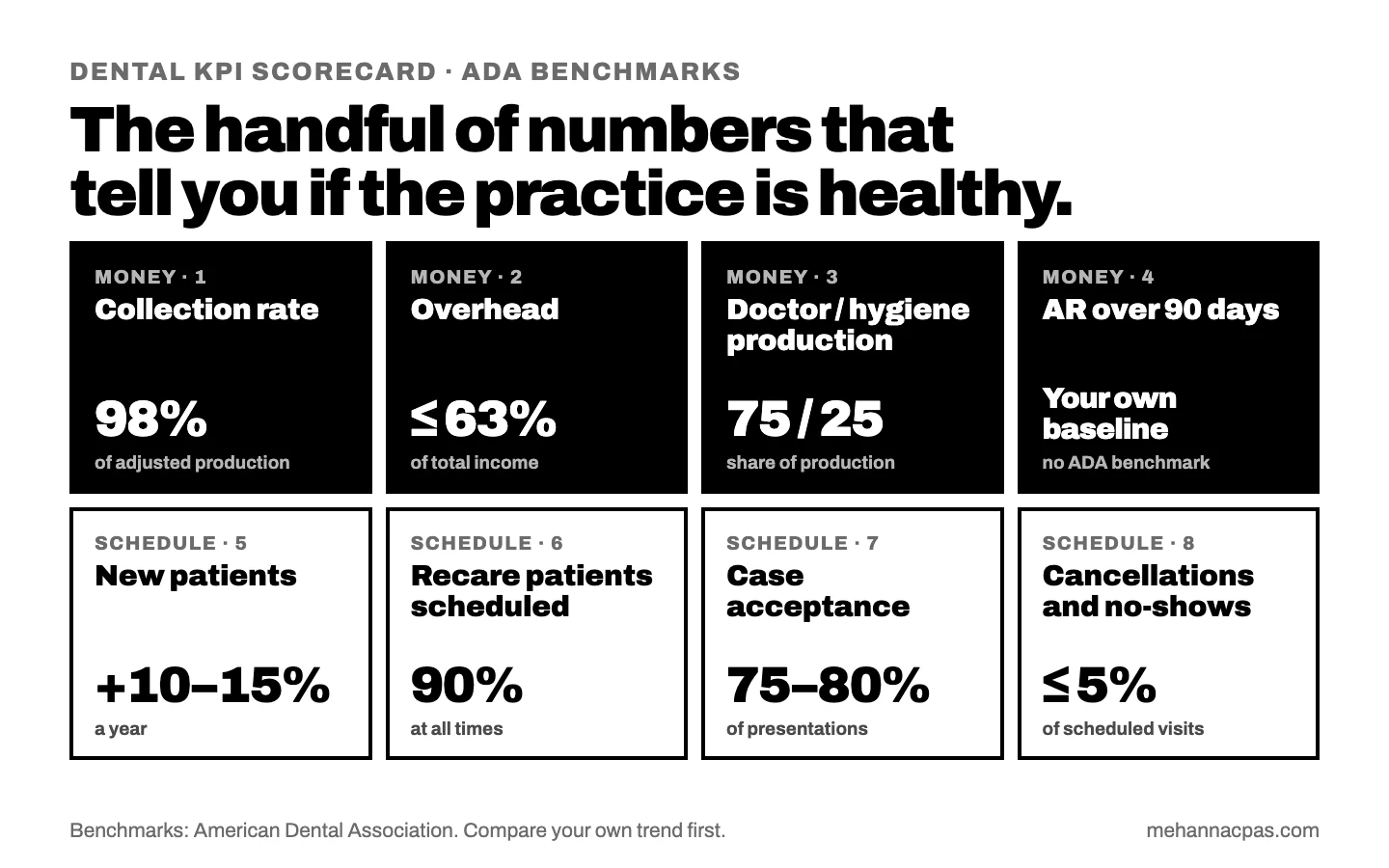
Eight dental practice KPIs cover the money and the schedule. The benchmarks below are the ADA’s; the formulas are the standard way most practices calculate them. Write your own formula down once and keep it.
1. Collection rate
Collections divided by adjusted production. The ADA’s benchmark is collecting 98% of billable, or adjusted, production (ADA). Use adjusted production, after PPO write-offs and other contractual adjustments. Divide by gross production and every in-network practice looks broken.
2. Overhead percentage
Operating expenses divided by total income. The ADA asks whether overhead is 63% or less of total income (ADA). The definition matters more than the target: decide whether owner pay is in or out, and keep it the same every month. In an S corporation, your W-2 salary is an expense on the P&L, and the IRS expects reasonable compensation before distributions (IRS, S corporation compensation). Leave that salary in and your overhead jumps the year you convert, without anything changing in the practice. Setting the salary itself is its own decision, covered in S corp reasonable salary for dentists. The category breakdown and what to do when overhead creeps are in dental office overhead percentages and benchmarks.
3. Production per provider and the doctor/hygiene split
Each provider’s production, daily, weekly and monthly. The ADA’s rule of thumb is the dentist producing at least 75% and hygiene the remaining 25%; a hygiene department under 25% usually lacks a structured recare system (ADA). Before adding an associate, know the break-even production and what you need to collect from that person’s production.
4. Accounts receivable over 90 days
Balances older than 90 days as a share of total AR. There is no ADA benchmark here, so set one from your own baseline and watch the trend. It matters more than it looks for a tax reason. Many dental practices keep their books on the cash basis, so a patient or carrier balance was never counted as income. Under the IRS rules, a cash-method taxpayer generally can’t take a bad debt deduction for unpaid fees (IRS, Topic 453). Money you never collect is simply revenue you never had, with nothing to write off.
5. New patients
New patients per month and per year. The ADA suggests the number should grow 10% to 15% a year (ADA). Track the referral source next to it, so you know which channel is actually sending people.
6. Hygiene recare
The share of recare patients with their next appointment on the books. The ADA’s benchmark is 90% scheduled at all times, with at least 85% of patients active in the recare system (ADA). This is the KPI that predicts next quarter’s hygiene production.
7. Case acceptance
Accepted treatment divided by presented treatment. The ADA asks whether at least 75% to 80% of case presentations are accepted. Pick one way to count it, by case or by dollars, and keep it.
8. Cancellation and no-show rate
Cancellations plus no-shows divided by scheduled appointments. The ADA’s benchmark is 5% or less; above that, the schedule likely has unproductive gaps (ADA).
Which dental KPI benchmarks can you trust?
Trust the trend in your own numbers first, and outside dental practice benchmarks second. Benchmarks disagree mostly because they count different things: gross or adjusted production, overhead with or without owner pay, case acceptance by count or by dollars. A practice that looks several points over on overhead may simply be counting the owner’s salary. Before you compare, check what each number includes.
| KPI | Formula | ADA benchmark | Check it |
|---|---|---|---|
| Collection rate | Collections / adjusted production | 98% | Monthly, glance weekly |
| Overhead | Operating expenses / total income | 63% or less | Monthly |
| Doctor / hygiene split | Each side’s production / total production | At least 75% / 25% | Weekly |
| AR over 90 days | 90+ day balances / total AR | None; use your own baseline | Monthly |
| New patients | Growth vs. same period last year | Up 10% to 15% a year | Monthly |
| Recare scheduled | Recare patients with a next visit / recare patients | 90% | Weekly |
| Case acceptance | Accepted / presented | 75% to 80% | Monthly |
| Cancellations and no-shows | Missed / scheduled appointments | 5% or less | Weekly |
How do you start dental KPI tracking without a dashboard?
Pull the last three months of data on the KPIs you choose, which is the ADA’s rule of thumb for a starting baseline, and reassess at least quarterly. Most practice management systems already run these reports. A one-page spreadsheet with eight rows and twelve monthly columns is enough to see a trend.
Which key performance indicators for dental offices belong to the front desk?
The schedule numbers: recare, cancellations, new patients and case acceptance follow-up. The money numbers, overhead and profit, belong to the owner and the accountant, because they come from the books, not the PMS.
When should you review dental KPIs, and when can you skip a month?
Schedule KPIs weekly, money KPIs monthly after the books close, and the whole list before any big decision. The ADA notes that KPIs tied to production, appointments and overhead deserve more frequent tracking than the rest. The decisions that should never happen without a current read:
- Before hiring an associate or another hygienist.
- Before signing for equipment, a buildout or a second location.
- Before a fee schedule review or a PPO renegotiation.
- Before each estimated tax payment, so the payment matches the year you are actually having.
- Before talking to a buyer or a DSO.
Skipping a month is fine when the books are current and nothing big is pending. KPIs built on books that are three months behind are just history. If that is where you are, start with how to catch up on dental bookkeeping.
How we track dental practice KPIs with practice owners
We read the KPIs next to the books, not instead of them, so every number connects to profit, cash and tax.
- Agree on the formulas once. Adjusted production, overhead with owner pay out, case acceptance by dollars or by count. Written down, so next year compares to this year.
- Close the month on a fixed date. Money KPIs come from reconciled books, not from the bank balance.
- Tie the PMS to the books. Collections in the software should match deposits on the P&L. When they don’t, that gap is the first finding.
- Read the trend, then the benchmark. Each KPI against last month, the same month last year and the rolling twelve months, then against the ADA’s level.
- Carry it into the tax projection. Every close updates the year’s projected tax, which sets the next estimate and the agenda for the next planning call.
The monthly statements behind all this are the subject of how to read your dental practice’s financial statements.
The owner knows yesterday’s production to the dollar and hasn’t looked at overhead as a percentage since the practice was bought. Production is up, the account is thin, and the explanation sits in two lines nobody tracked: a collection rate that slipped a few points and staff costs that grew faster than fees. Overhead creeps. The point of a KPI review is that someone calls you about it before April does.
Not sure which of your numbers to trust? Bring your last P&L and a production report, or don’t. You’ll leave the call knowing where you stand.
Dental KPI checklist
Use this once a month, after the books close. If you can’t fill a row, that is the first thing to fix.
| Check | Where it comes from | Good sign | Red flag |
|---|---|---|---|
| Collection rate | PMS + P&L deposits | Near 98% of adjusted production | Measured against gross production, or dropping three months in a row |
| Overhead % | P&L | Stable or falling, owner pay treated the same every month | Rising while production is flat |
| Doctor / hygiene split | PMS | Around 75 / 25 | Hygiene under 25% with no recare system |
| AR over 90 days | PMS aging report | Flat or shrinking against your baseline | Old balances written off without follow-up |
| New patients | PMS + referral source | Growing year over year, source known | Down three months running, source unknown |
| Recare scheduled | PMS hygiene report | 90% of recare patients booked | Patients leaving without a next visit |
| Case acceptance | PMS treatment plans | 75% to 80% accepted | Diagnosed treatment never scheduled |
| Cancellations and no-shows | PMS schedule | 5% or less | Same-day holes the schedule can’t fill |
Mistakes we’d avoid
Most KPI mistakes come from the definition, not the math.
- Comparing gross production to a benchmark built on adjusted production. Your collection rate will look terrible and nothing will be wrong.
- Changing the overhead formula when the entity changes. An S corp conversion moves your salary onto the P&L. Decide how owner pay is treated and keep it.
- Tracking twenty KPIs. Nobody reads twenty. Start with eight, or fewer.
- Writing off old AR and calling it a deduction. On the cash basis it isn’t one. Collect sooner instead.
- Reading production as profit. Production is the top of the funnel. Overhead, debt and taxes all come out before anything is yours.
What changed for 2026
The ADA Health Policy Institute published its 2025 Survey of Dental Practice results in 2026, and they confirm the squeeze.
- Average net income for general dentists in private practice was $215,320 in 2025, and $346,520 for specialists (ADA HPI, Dental practice research).
- Average gross billings per general dentist in private practice were $965,660 in 2025, and $1,213,040 for specialists (same source).
- General dentists’ inflation-adjusted incomes were unchanged in 2025 and have been decreasing over the past 15 years, with expenses growing faster than reimbursement (ADA HPI).
National averages are not your target. They are a reminder that flat fees and rising costs are the default, which is why overhead percentage deserves a monthly look.
How to tell whether your KPI tracking is working
It works when a KPI changes a decision. Check three things: the numbers arrive by the same date every month, each one uses the same formula as last month, and at least one of them led to an action this quarter, such as a recare push, a collections call list or a fee review. If the report gets read and filed, it is decoration. Monthly financials, projections and planning calls built on these numbers are part of The Treatment Plan.
Frequently asked questions
What are the most important KPIs for a dental practice?
Collection rate and overhead percentage come first, because they decide whether production becomes profit. Then production per provider, AR over 90 days, new patients, hygiene recare, case acceptance and cancellations. The ADA suggests starting with a limited number and reassessing them at least quarterly.
What is a good overhead percentage for a dental practice?
The ADA’s benchmark is 63% or less of total income. Before you compare, confirm whether your overhead number includes owner pay. In an S corporation, your W-2 salary sits on the P&L, so leaving it in can make overhead look several points higher than a benchmark that excludes it.
What collection rate should a dental practice have?
The ADA’s benchmark is 98% of billable, or adjusted, production, meaning production after PPO write-offs and other adjustments. Measured against gross production, the rate will look much lower and won’t tell you whether collections are actually slipping.
How often should I review dental KPIs?
Schedule KPIs, like recare and cancellations, weekly. Money KPIs, like overhead and collections, monthly after the books close. Review the full list before hiring, signing for equipment, making an estimated tax payment or talking to a buyer.
Can I deduct patient balances I never collect?
Generally not, if the practice uses the cash method. The IRS says a cash-method taxpayer generally can’t deduct unpaid fees as a bad debt, because they were never included in income (IRS, Topic 453). Ask your CPA how it applies to your entity.
Glossary
| Term | Meaning |
|---|---|
| KPI | Key performance indicator: a measurable value tracked over time to judge growth and profitability. |
| Adjusted production | Production after PPO write-offs and other adjustments, the amount considered collectible. Also called billable production. |
| Gross production | All dentistry produced at your full fees, regardless of what can be collected. |
| Collection rate | Collections divided by adjusted production. |
| Overhead percentage | Operating expenses divided by total income, with owner pay treated the same way every month. |
| Recare | The system that brings hygiene patients back for their next visit. |
| Accounts receivable (AR) | What patients and insurance carriers still owe the practice. |
| Cash basis | Income counts when received and expenses when paid. The method many dental practices keep their books on. |
Sources
- American Dental Association, Key Performance Indicators (Measuring Success): definition of KPIs, starting with a limited number and three months of data, and the benchmarks for collections (98%), overhead (63% or less), new patients (10% to 15% a year), case acceptance (75% to 80%), doctor/hygiene split (75%/25%), recare (85% active, 90% scheduled) and cancellations (5% or less).
- ADA Health Policy Institute, Dental practice research (2026): 2025 Survey of Dental Practice net income and gross billings.
- ADA Health Policy Institute, Trends in dentists’ income, revenue and hours worked (2026): the “fiscal squeeze,” revenues up 1.4% and expenses up 4.9% over five years.
- IRS, Topic 453, Bad debt deduction: cash-method taxpayers generally can’t deduct unpaid fees never included in income.
- IRS, S corporation compensation and medical insurance issues: reasonable compensation before non-wage distributions.
- IRS, Shareholder’s Instructions for Schedule K-1 (Form 1120-S): tax on your share of S corporation income whether or not distributed.